
A sales representative walks into an operating room for a scheduled demonstration, but when they open the case, the primary device is loose and the housing is visibly scuffed. It’s a scenario that costs more than just a repair bill; it costs professional credibility. You understand that for medical device manufacturers, the demo kit is often the first physical touchpoint a surgeon has with your brand. If the internal packaging looks unprofessional or fails to protect the equipment during flight, it sends the wrong message about the quality of the technology inside.
High-precision custom foam inserts for medical sales demo kits solve this by providing a secure, engineered fit that withstands the rigors of constant travel. In this article, you’ll learn how to select the right materials to protect sensitive electronics and how to design layouts that create a high-impact sales presentation. We’ll also cover how local Southern California manufacturing in cities like Anaheim, Los Angeles, and San Diego allows you to bypass the high costs and long lead times of catalog suppliers. From reducing replacement costs to ensuring next-day delivery for your sales team, we’ll outline the path to a more reliable, professional kit.
Key Takeaways
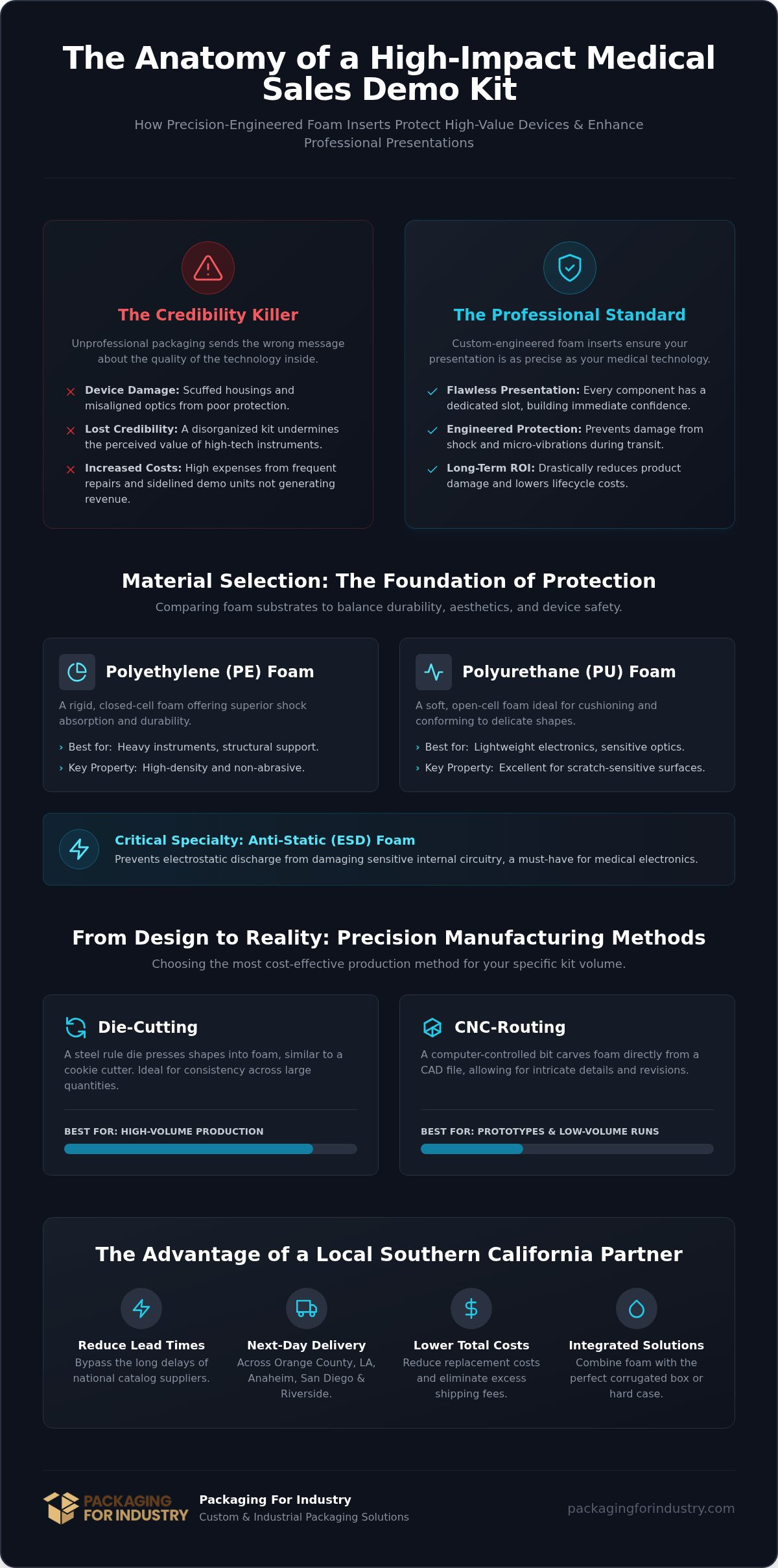
- Learn how to compare Polyethylene and Polyurethane materials to find the ideal balance between durability and aesthetics for your medical instrumentation.
- Discover how CAD/CAM engineering creates high-precision custom foam inserts for medical sales demo kits that prevent shipping damage and scuffing during frequent travel.
- Understand the technical differences between die-cutting and CNC-routing to choose the most cost-effective production method for your specific kit volume.
- Reduce replacement costs and long lead times by transitioning from generic catalog suppliers to a local Southern California partner offering next-day delivery.
- Explore how integrated packaging solutions—combining custom foam with specific corrugated boxes or crates—streamline your logistics and protect high-value devices.
The Critical Role of Custom Foam in Medical Sales Presentations
A medical sales representative’s success often hinges on the first thirty seconds of a presentation. When you open a case in front of a surgeon or hospital procurement team, the organization of that kit speaks volumes about the precision of the device itself. If the equipment is rattling or nested in generic bubble wrap, it undermines the perceived value of the technology. High-quality custom foam inserts for medical sales demo kits ensure that your presentation is as precise as the surgery your tools are designed to perform. This professional approach builds immediate confidence in your product before the demo even begins.
The financial impact of “demo damage” is often underestimated by purchasing departments. Beyond the immediate repair costs for scuffed housings or misaligned optics, there is the hidden cost of a sidelined demo unit. A unit in the repair shop is a unit that isn’t generating revenue. By investing in custom protection, you lower packaging costs over the long term by drastically reducing product damage and the associated shipping fees for returning broken units. Calculating the ROI of custom protection also involves looking at sales rep efficiency; when every piece has a laser-cut slot, reps spend more time selling and less time managing logistics.
Protecting High-Value Medical Instrumentation
Sensitive medical devices, particularly those with calibrated optics or high-end electronics, are vulnerable to the constant vibration of air and ground transit. Standard cushioning often fails to absorb these micro-vibrations, which can lead to internal component failure or loss of calibration. Engineering a kit requires an understanding of different open-cell and closed-cell foams to provide the specific density needed for shock absorption. Using protective foam solutions like polyethylene or polyurethane ensures that every component has a dedicated, secure “home” that prevents parts from colliding during transit. This level of detail is essential for maintaining the integrity of calibrated surgical tools that must function perfectly upon arrival.
Enhancing the Sales Experience
A well-designed kit does more than protect; it assists in the sales narrative. Using multi-layered foam allows sales reps to reveal components in a logical order, effectively telling a product story through the physical layout. An organized kit builds trust with a surgeon, as it reflects the sterility and precision required in a clinical environment. For brands looking to stand out, custom color-coding or branding on the foam surface can reinforce your corporate identity. PFI provides local next-day delivery in Southern California, including Anaheim, Irvine, and Los Angeles, ensuring your sales team has the professional kits they need without the long lead times of catalog suppliers. Our custom design packaging support helps you move beyond generic cushioning to specialized medical-grade inserts that simplify the setup and pack-down process for your busiest reps.
Choosing the Right Foam Material for Medical Instrumentation
Selecting the correct substrate for custom foam inserts for medical sales demo kits is a technical decision that impacts both device safety and regulatory compliance. According to FDA regulations for device packaging, manufacturers must ensure packaging is designed to protect devices from damage during handling and distribution. This requirement is especially critical for sales kits that endure constant cycles of shipping, unpacking, and repacking. Choosing the wrong density or material type can lead to scuffed surfaces or, worse, internal calibration failures.
For kits containing sensitive medical electronics, standard foam isn’t sufficient. You should specify Anti-Static (ESD) foam to prevent electrostatic discharge from damaging internal circuitry during transit. Additionally, polished metal surgical tools or glass optics require non-abrasive surfaces. Materials like cross-linked polyethylene provide a smooth, fine-celled finish that won’t scuff or cloud delicate surfaces over time. Balancing material weight with impact resistance is key; heavier tools require higher density foam to prevent the device from “bottoming out” during a drop.
Polyethylene (PE) Foam for Heavy-Duty Protection
PE is a closed-cell material known for its rigidity and high impact resistance. It’s the industry standard for heavier medical instruments because it maintains its shape under significant weight. Beyond physical protection, PE offers excellent moisture and chemical resistance, which is vital for maintaining a clean, professional appearance in clinical environments. Many manufacturers choose a multi-color approach by using a bright colored bottom layer with a dark top layer. This creates a “shadow board” effect, making it immediately obvious if a tool is missing after a demonstration concludes.
Polyurethane (PU) and Convoluted Foam
While PE provides the structural base, Polyurethane (PU) offers soft-touch protection for lightweight or highly fragile components. PU is an open-cell foam that excels at vibration dampening. Convoluted foam, frequently called “egg crate,” is often used in the lids of demo cases to gently secure irregular shapes without applying excessive pressure. For complex kits, we often recommend a hybrid solution. This utilizes a rigid PE base for heavy components and a soft PU lid to pin everything in place securely. If you’re unsure which material fits your specific device dimensions, you can request a packaging quote to get expert guidance on material density and impact resistance.
Die-Cut vs. CNC-Cut Foam: Precision for Frequent Travel
Deciding between die-cutting and CNC routing depends on your production volume and the specific geometry of your medical instruments. CNC routing serves as the gold standard for deep-cavity custom foam inserts for medical sales demo kits because it allows for multi-level depths without the need for expensive tooling. This process is ideal for low-volume prototypes or specialized surgical sets where precision is paramount. For extreme precision where zero-heat distortion is required, water-jet cutting offers the cleanest edges, particularly for high-density materials that might otherwise fray or melt under traditional friction-based cutting.
In contrast, die-cutting is the most cost-effective solution for bulk production. If you’re outfitting a national sales force with hundreds of identical kits, die-cutting provides high-speed repeatability and lower per-unit costs. As a local Southern California supplier, PFI provides the engineering expertise to help you choose the method that balances your budget with your performance requirements. Whether you’re based in Anaheim, Irvine, or San Diego, our team ensures your manufacturing process aligns with your rollout timeline and logistical needs.
The Demo Kit Lifecycle: Engineering for Repetitive Use
Medical sales reps subject their equipment to constant handling, often traveling by air and car daily. Engineering for this lifecycle requires more than just a snug fit. Shadow boards are essential for preventing lost medical parts; by using a bright, contrasting base layer, a missing probe or specialized screw becomes immediately obvious. We also focus on reinforcing high-stress areas in the foam to prevent tearing after months of repetitive use. Incorporating a finger-pull design ensures reps can remove devices smoothly during a high-stakes demonstration without fumbling. Flexible polyurethane foam (FPF) is frequently used in these applications because it offers the necessary hygiene, support, and versatility for delicate medical components.
Integrated Kitting Services
A complete protection system often requires combining custom foam with other durable layers. For standard field use, we integrate foam inserts with heavy-duty corrugated boxes to provide a lightweight yet resilient outer shell. If your team is heading to international trade shows, we design specialized inserts for custom wooden crates that withstand the rigors of global freight. This integrated approach reduces the overall kit weight, which directly helps to lower packaging costs and sales rep shipping expenses. By managing the box, foam, and assembly in one location, we improve supply reliability and ensure your kits arrive ready for the field.
Designing Your Kit: From CAD Prototypes to Final Assembly
Engineering high-performance custom foam inserts for medical sales demo kits requires more than a simple measurement of the device housing. The process begins with comprehensive CAD/CAM support to map out the specific fragility points of your instrumentation. We analyze the center of gravity and identify components, such as calibrated dials or glass lenses, that are most prone to shock damage. By using digital design files, we ensure that the foam cavity matches the exact geometry of your device, providing the 360-degree support necessary for constant travel.
Once the dimensions are verified, our engineers focus on the internal layout. We prioritize optimal weight distribution to ensure the demo case remains stable and doesn’t tip when opened on a surgical cart. The presentation is equally important; we organize the components to create a logical “reveal” that guides the surgeon through the device’s features. This methodical approach to engineering reduces shipping damage and ensures that your sales force arrives with a kit that functions perfectly every time.
The Role of Free Prototyping
Design errors in medical packaging can be expensive and time-consuming to correct after production begins. PFI provides free prototyping to eliminate this risk, allowing you to verify the fit and the “unboxing” experience before a full production rollout. You can test how easily a sales rep can remove the device and how securely it stays in place during a simulated drop. This phase is the ideal time for your marketing and sales directors to provide feedback on the visual impact of the kit. To begin this process, you can request a custom packaging quote for your initial prototype and see the precision of our engineering firsthand.
Local Southern California Engineering Support
Manufacturers in Anaheim, Irvine, and across Southern California benefit from our local design presence. Proximity allows for in-person design reviews and faster turnaround on revisions, which is critical during a high-stakes medical product launch. Unlike large catalog suppliers that offer one-size-fits-all solutions, we provide hands-on support to ensure your kits meet the specific standards of your quality management system. Our local manufacturing capabilities mean we can move from a finalized CAD drawing to a finished product with the speed your sales team requires, all while maintaining strict oversight of the end-to-end assembly process.
Why PFI is the Preferred Supplier for Medical Demo Packaging
Generic catalog suppliers prioritize high-volume stock items over the precision required for medical instrumentation. If you’re looking for a packaging supplier near me in Southern California, PFI provides the technical expertise that big-box retailers lack. We offer custom sizes available for every project, ensuring your custom foam inserts for medical sales demo kits fit precisely within their outer containers. Whether you need a corrugated box quote for your standard kits or a stretch film quote for securing palletized shipments of demo units, our team integrates every component into a single, cost-effective system.
Our operational strengths are designed to support both local and national medical device manufacturers. We offer fast nationwide shipping for sales teams distributed across the country, alongside local next-day delivery for our partners in Anaheim, Irvine, and Los Angeles. By providing integrated solutions including boxes, foam, and cushioning materials, we eliminate the need to manage multiple vendors. This comprehensive approach simplifies your procurement process and ensures your kitting assembly remains consistent from the first unit to the thousandth.
Cost-Reduction and Supply Reliability
We focus on reducing your total cost of ownership by eliminating the inefficiencies of “off-the-shelf” ordering. Our Vendor Managed Inventory (VMI) programs are specifically designed to prevent packaging shortages during critical product rollouts. By managing your stock levels and providing just-in-time replenishment, we free up valuable warehouse space and capital. This reliability is essential for medical manufacturers who can’t afford delays in their sales cycles or damage-related downtime.
Next Steps: Request a Custom Foam Quote
Starting a project with PFI is a straightforward process focused on your specific engineering needs. Our teams in Orange County, San Diego, and the Inland Empire are ready to review your device specifications and fragility points to create a high-impact presentation. We move quickly from initial CAD design to free prototyping, ensuring your sales force is equipped with a kit that builds trust with surgeons and procurement teams alike. We’ll help you lower packaging costs while maintaining the surgical-grade precision your brand requires.
Contact Packaging For Industry for a custom foam insert quote today
Secure Your Medical Sales Assets and Professional Credibility
It’s a critical investment to engineer high-precision custom foam inserts for medical sales demo kits to protect your brand’s professional image and your bottom line. By selecting the right material densities and utilizing CAD-driven design, you ensure that sensitive surgical instrumentation remains calibrated and undamaged during constant travel. Transitioning from generic catalog options to specialized, integrated packaging solutions reduces replacement costs and eliminates the logistical stress of sidelined demo units.
With local next-day delivery across Orange County, Los Angeles, and San Diego, PFI provides the speed and precision required for competitive medical product launches. Our free prototyping and specialized engineering support allow you to verify every detail of the unboxing experience before full production. You can move forward with the confidence that your sales force is equipped with a durable, high-end kit that reflects the quality of the technology inside.
Frequently Asked Questions
What is the best foam for medical device demo kits?
Polyethylene is typically the standard substrate for custom foam inserts for medical sales demo kits because it maintains its shape under the weight of surgical tools. While we discussed Polyurethane for soft-touch protection earlier, the choice ultimately depends on the G-force sensitivity of your device. We use CAD data to select the exact density required to prevent bottoming out during a drop. This engineering-led approach ensures your instrumentation remains calibrated and ready for use.
How much does a custom foam insert for a sales kit cost?
Costs are determined by the material yield, the complexity of the CAD design, and your total production volume. We help you compare packaging pricing by analyzing the most efficient manufacturing method, whether that is high-speed die-cutting or precision CNC routing. Investing in custom protection reduces shipping damage, which lowers the total cost of ownership for your demo program. We provide bulk packaging pricing for national rollouts to ensure your budget remains optimized across all sales regions.
Can you provide anti-static (ESD) foam for medical electronics?
Yes, we provide anti-static (ESD) and static-dissipative foam for kits containing sensitive medical electronics. These materials prevent the buildup of electrostatic charges that can compromise internal circuitry during transit or handling. We can also provide moisture barrier bags and specialized labels to create a fully compliant ESD protection system. This is a critical requirement for diagnostic equipment and robotic surgical components that must operate flawlessly in the field.
How long does it take to get a custom foam prototype?
Because we are a local Southern California supplier, we can move from your CAD files to a physical prototype very quickly. Our free prototyping service allows you to test the fit and the visual presentation before committing to a full production run. This phase is essential for identifying any necessary design revisions, such as adding finger-pulls for easier device removal. Fast prototyping helps you maintain your product launch timeline without sacrificing the quality of the final kit.
Do you offer local delivery for custom packaging in Orange County?
Yes, we offer local next-day delivery for businesses throughout Orange County, Los Angeles, and the Inland Empire. As a dedicated source of packaging for manufacturers/warehouses/distribution centers, we maintain a local fleet to ensure your production lines never stop due to a shortage. Our service area includes Anaheim, Irvine, and San Diego, providing a more reliable and cost-effective alternative to national catalog suppliers. This local presence allows for better inventory control and reduced lead times.
What information do I need to provide for a custom foam quote?
To provide a custom packaging quote, we require the dimensions and weight of each component, along with any specific fragility concerns. Knowing the expected shipping environment, such as frequent air travel, helps us determine the correct foam density. If you have existing CAD drawings or the physical device, our engineers can use those to create a high-precision layout. This data ensures that every piece has a secure, dedicated home within the demo case.
Is CNC-cut foam better than die-cut foam for medical kits?
CNC routing is generally better for low-volume kits or those requiring complex, multi-depth cavities for various surgical attachments. It eliminates the need for expensive die tooling, making it cost-effective for prototypes and small batches. Die-cutting is the preferred method for bulk packaging pricing when you are outfitting a large sales force with hundreds of identical kits. We evaluate your specific rollout numbers to recommend the manufacturing process that offers the best balance of precision and price.
Can you provide the outer carrying case along with the foam inserts?
We provide integrated solutions that include both the custom foam inserts and the outer carrying cases or corrugated boxes. Whether you need a heavy-duty RSC for standard shipping or a custom-designed case for field sales, we ensure the foam and the outer shell function as a single unit. This eliminates the risk of fitment issues that occur when sourcing components from multiple vendors. Our kitting services ensure your demo kits arrive fully assembled and ready for immediate distribution.