
Most industrial operations are either overpaying for over-engineered boxes that drain their margins or under-specifying their packaging and losing thousands to avoidable shipping damage. Choosing the correct material isn’t just about weight capacity; it’s a precise engineering calculation that balances stacking requirements, transit vibration, and environmental stressors. If you’re wondering how to choose the right corrugated box strength, you’re likely trying to solve a specific pain point like carrier surcharges or high damage rates. You’ve probably felt the frustration of seeing a perfectly manufactured product arrive at a distribution center in a crushed container.
It’s understandable to feel overwhelmed by the technical shift from Mullen Burst tests to Edge Crush Test (ECT) ratings. We’ll help you master these specifications to lower packaging costs and reduce shipping damage across your entire logistics network. This article provides a clear framework for selecting single, double, or triple-wall solutions tailored to your specific supply chain. Whether you need to request a packaging quote for your warehouse in Anaheim or require local packaging delivery in San Diego, understanding these standards ensures your bulk packaging pricing reflects the exact protection your products require. We’ll preview the specific board grades and flute types that provide the peace of mind your operations team needs.
Key Takeaways
- Differentiate between Edge Crush Test (ECT) for stacking strength and Mullen Burst tests for puncture resistance to match your specific logistical environment.
- Master how to choose the right corrugated box strength by calculating gross product weight and evaluating the rigors of LTL versus small parcel handling.
- Identify the specific use cases for single, double, and triple-wall corrugated boxes to optimize protection for everything from lightweight electronics to heavy aerospace components.
- Utilize industrial standards like ASTM D1974 and Box Maker’s Certificates to streamline procurement and ensure consistent packaging integrity across your supply chain.
- Leverage custom engineering and Vendor Managed Inventory (VMI) to lower packaging costs and maintain a reliable supply of high-strength materials without overstocking.
ECT vs. Mullen Test: Which Strength Metric Actually Matters?
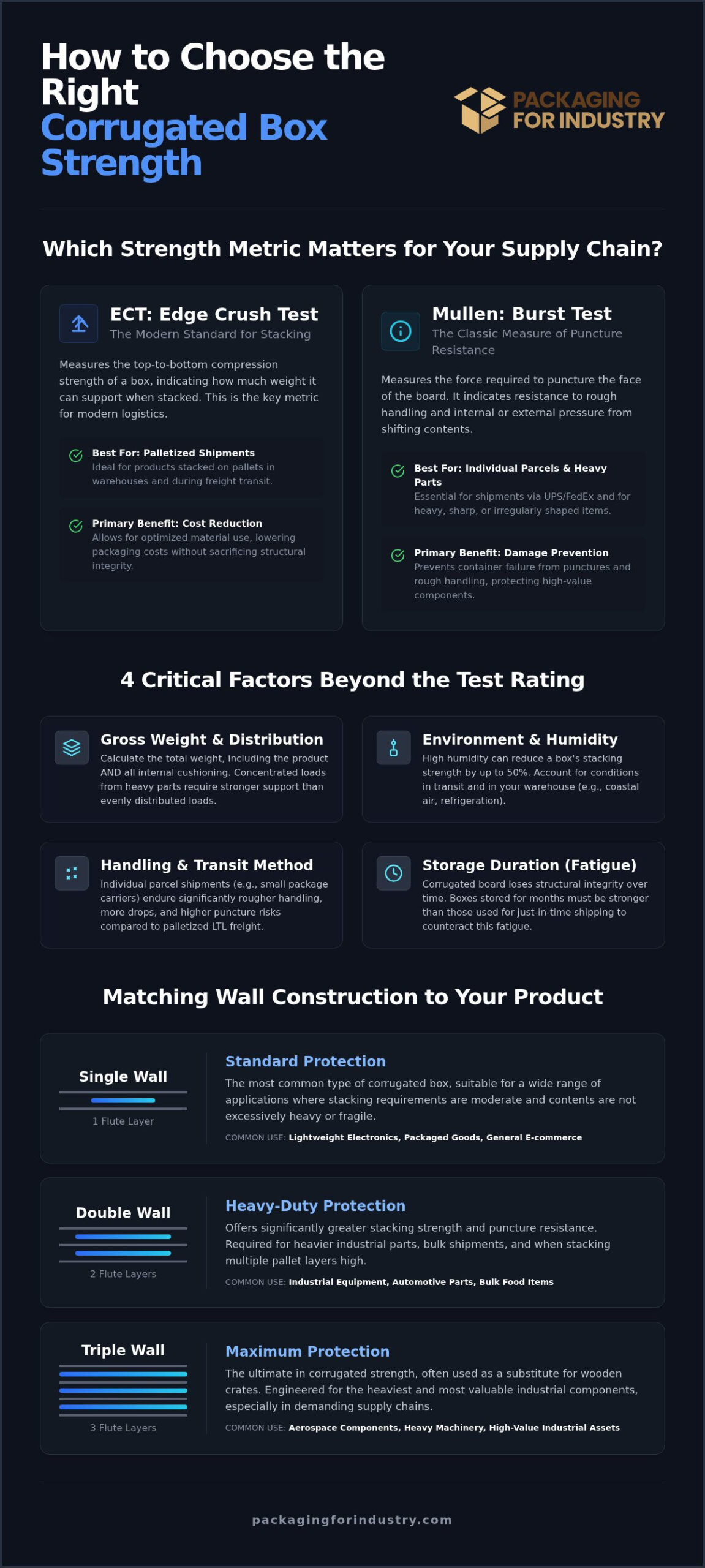
Determining how to choose the right corrugated box strength requires a clear understanding of the two primary industry metrics: Edge Crush Test (ECT) and the Mullen Burst Test. While they both measure board integrity, they evaluate different physical stressors. ECT measures the top-to-bottom compression strength of the board, which tells you how much weight a box can support when stacked on a pallet. In contrast, the Mullen Test measures the force required to puncture the face of the board, indicating its resistance to internal and external pressure. It’s a calculation that directly impacts both your shipping damage rates and your bottom line.
Modern logistics environments often favor ECT. Automated sorting systems and high-density warehouse racking rely on vertical stacking. Because ECT ratings allow engineers to optimize the material used in corrugated boxes, manufacturers can often reduce costs without sacrificing structural integrity. However, industrial manufacturers dealing with heavy, sharp, or irregularly shaped components shouldn’t ignore burst strength. Understanding Corrugated fiberboard properties is essential for selecting the right metric for your specific supply chain.
When to Prioritize Edge Crush Test (ECT)
ECT is the superior choice for palletized loads. Since most industrial freight moves on pallets, vertical stacking strength is the primary concern for warehouse managers. Choosing ECT-rated boxes is a direct way to lower packaging costs because these containers are engineered for compression rather than just raw material weight. This efficiency makes them ideal for a Vendor Managed Inventory (VMI) program, where maximizing warehouse vertical space is a key operational goal. If your products are uniform and safely palletized, ECT provides the most cost-effective protection available.
When Burst Strength (Mullen) is Essential
Burst strength remains the standard for heavy or loose industrial parts that shift during transit. If you ship individual parcels via UPS or FedEx, your boxes face rougher handling and higher puncture risks than palletized freight. Mullen-rated boxes are also non-negotiable for aerospace packaging, where high-value components require maximum resistance against internal pressure. When your product has sharp edges or high density, the puncture resistance of a Mullen-rated box prevents the container from failing during manual handling or mechanical sorting. This decision is a critical step in learning how to choose the right corrugated box strength for high-stakes industrial environments.
Critical Factors Dictating Your Required Box Strength
Weight is the most obvious factor in determining how to choose the right corrugated box strength, but it’s often miscalculated by purchasing teams. You must account for the gross weight, which includes the product and all internal cushioning materials. Beyond raw weight, environmental conditions play a massive role in box performance. For instance, Southern California’s coastal humidity or refrigerated cold storage can compromise fiber integrity. Research indicates that single-wall boxes can lose up to 50% of their stacking strength within just 24 hours in high-humidity environments. If your boxes remain in a warehouse for months, you must also account for the “fatigue factor,” where the board loses structural capacity over time even without additional weight.
Weight Distribution and Internal Support
How your product sits inside the box is as important as its weight. Concentrated loads from heavy industrial parts put localized stress on the bottom flaps, while evenly distributed loads allow the box to utilize its full ECT rating. Integrating custom foam inserts can reinforce box walls from the inside, effectively turning the packaging into a rigid structural unit. For high-value industrial equipment, we typically recommend a higher “Safety Factor” in the strength calculation to account for unforeseen handling errors or poor palletization.
The Transit Environment: Parcel vs. Freight
Your shipping method dictates the type of abuse your box will endure. Small parcel carriers like FedEx or UPS involve frequent drops and mechanical sorting, requiring higher Mullen ratings for puncture resistance. Conversely, palletized LTL freight relies almost entirely on stacking strength. In these environments, using corner and edge protection can supplement your box strength. This allows you to use a lighter board grade without risking a collapsed pallet, helping you lower packaging costs while managing the transit vibration common in long-haul logistics. Understanding these variables is vital when deciding how to choose the right corrugated box strength for high-volume distribution.
Adhering to U.S. standards for fiberboard boxes ensures your shipments meet DOT construction and water resistance requirements. Balancing these variables is complex, but it’s the only way to eliminate shipping damage and optimize your spend. If you’re unsure which grade fits your specific application, you can request a packaging quote for a custom engineering review.
Selecting Between Single, Double, and Triple Wall Corrugated
Selecting the correct wall construction is the most impactful decision you’ll make when determining how to choose the right corrugated box strength. The choice typically comes down to the number of fluted mediums sandwiched between the flat linerboards. Single-wall construction is the industry standard for most lightweight applications, but heavy manufacturing and international logistics often require the reinforced structural integrity of double or triple-wall boards. Understanding the nuances of these materials allows procurement teams to balance protection with fiscal responsibility.
Flute profiles also dictate the performance of these walls. C-flute is the most common profile, accounting for approximately 80% of all corrugated boxes because it provides a reliable balance of stacking strength and cushioning. A-flute offers superior vertical compression, while B-flute provides better puncture resistance and a flatter surface for high-quality printing. By combining different flute heights in double or triple-wall configurations, we can engineer boxes that address multiple logistical stressors simultaneously.
Single-Wall Applications for General Warehousing
Single-wall boxes are the primary solution for e-commerce fulfillment and light manufacturing. A standard 32 ECT single-wall box is typically rated to hold a maximum of 65 pounds, making it a cost-effective choice for high-volume recurring orders. For operations that need a bit more durability without moving to a double-wall, a 44 ECT single-wall board offers a significant boost in stacking capacity. These options provide excellent opportunities to lower packaging costs when your products don’t require heavy-duty puncture resistance.
Heavy-Duty Double and Triple-Wall Solutions
When your loads exceed 80 pounds or involve high-value machinery, double-wall corrugated becomes essential. Double-wall boxes with a 48 to 51 ECT rating generally handle loads between 80 and 120 pounds, offering the superior stacking and puncture resistance required for heavy-duty manufacturing. For the most demanding industrial environments, triple-wall corrugated serves as a lightweight and cost-effective alternative to wooden crates. A triple-wall box with an ECT rating of 90 can withstand over 300 pounds, making it a viable substitute for export wood packaging that is easier to handle and less expensive to ship. Integrating these heavy-duty custom corrugated boxes into your supply chain ensures that even the most sensitive aerospace or industrial equipment remains secure during long-distance transit. Mastering these material tiers is the final step in learning how to choose the right corrugated box strength for your operation.
Industrial Compliance: Performance Testing and Standards
Choosing the right corrugated box strength involves more than just reading a weight limit. Industrial compliance requires adhering to rigorous performance testing and standards that ensure your packaging survives the supply chain. The Box Maker’s Certificate (BMC) is your first line of defense in procurement. This circular stamp on the bottom flap guarantees the board’s burst strength or ECT rating, providing the technical accountability your operations team needs. When you’re assessing how to choose the right corrugated box strength, verifying the BMC ensures you’re getting the material you paid for, not a sub-standard substitute.
Beyond material strength, ASTM D1974 dictates the standard practice for closing, sealing, and reinforcing fiberboard boxes. Even the strongest triple-wall container will fail if the closure method doesn’t match the board grade. For high-value or sensitive shipments, we recommend ISTA (International Safe Transit Association) certified testing. These protocols simulate real-world conditions like vertical compression and transit vibration, allowing you to reduce shipping damage before the first pallet leaves your facility. Adhering to these standards is a critical step for packaging for manufacturers and distribution centers that prioritize reliability.
Meeting Military and Aerospace Specs
Southern California is a primary hub for defense and aviation, making military packaging compliance a daily requirement for many of our clients. Defense contractors must often utilize weather-resistant board grades like V3c or W5c, which maintain structural integrity in extreme environments. These specs go beyond standard commercial grades, requiring specific documentation and labeling to meet government contract obligations. We help manufacturers in Los Angeles and Orange County navigate these complex requirements to ensure their supply reliability stays intact.
In-House Prototyping and Real-World Testing
CAD/CAM prototyping is essential for any custom industrial application. It’s the only way to verify product fit and structural performance before committing to a full production run. PFI offers free prototyping to help Southern California manufacturers in Anaheim, Irvine, and San Diego test their designs under simulated stress. By conducting drop tests and vibration simulations in-house, we can identify potential failure points in sensitive electronics or heavy machinery packaging. This proactive approach helps you lower packaging costs by eliminating over-engineered designs while maintaining total product safety.
Optimize Protection and Costs with PFI Custom Engineering
Choosing how to choose the right corrugated box strength is as much a financial decision as it is a technical one. In many industrial operations, the total cost of ownership is inflated by two hidden factors: over-engineered materials and excessive shipping fees. While a triple-wall box offers maximum protection, using it for a 40-pound component is a waste of capital. Conversely, using a single-wall box that fails during transit leads to costly damage claims and reputation hits. PFI bridges this gap by balancing material engineering with economic optimization, ensuring you pay only for the protection your specific supply chain requires.
We focus on the intersection of durability and logistical flow. By refining your board grade and flute profile, we help you lower packaging costs while improving supply reliability. This approach extends beyond the box itself; it includes how the packaging integrates with your warehouse racks, automated conveyors, and freight carriers. Our goal is to eliminate professional stress by providing a steady, dependable system of protection that supports your bottom line.
Custom Sizing to Combat Carrier Surcharges
One of the most effective ways to reduce freight costs is to eliminate oversized boxes. Many manufacturers rely on stock sizes that require excessive void fill, which increases the dimensional (DIM) weight of the package. Parcel carriers like UPS and FedEx apply heavy surcharges for boxes that take up more space than their actual weight justifies. By designing custom-engineered industrial packaging around your product’s specific dimensions, you can save thousands in annual shipping fees. Custom sizing reduces the footprint of your shipments, allowing for better pallet density and lower freight costs across your entire distribution network.
Reliable Supply and Local Delivery
Operational efficiency depends on having the right materials exactly when you need them. Bulky, heavy-duty corrugated boxes take up significant warehouse space, which is why we offer Vendor Managed Inventory (VMI) programs. We manage your stock levels and provide just-in-time delivery, allowing you to reclaim valuable floor space for production. Our local presence provides a distinct advantage for manufacturers in Southern California. We offer local next-day delivery across the Inland Empire, Orange County, Los Angeles, and Anaheim. This proximity ensures that your production line never stops due to a packaging shortage. If you’re ready to optimize your materials and reduce shipping damage, you can request a packaging quote for a comprehensive audit of your current requirements. We provide the technical expertise and local support needed to streamline your industrial logistics from design to final delivery.
Eliminate Shipping Damage with Engineered Packaging Solutions
Mastering how to choose the right corrugated box strength is the difference between a streamlined supply chain and one plagued by professional stress and financial loss. By aligning your material selection with the specific rigors of your transit environment and environmental stressors, you ensure total product protection while maintaining fiscal responsibility. We’ve explored how precise ECT and Mullen ratings, combined with custom wall configurations, can significantly lower packaging costs and reduce shipping damage across your logistics network. Precision matters.
PFI provides the technical expertise required to navigate these complex industrial specifications. We specialize in heavy-duty double and triple-wall corrugated solutions and offer free CAD/CAM prototyping to verify product fit before your full production rollout. Whether you need local next-day delivery in Anaheim, Los Angeles, or the Inland Empire, or fast nationwide shipping for a distribution center, our team is ready to optimize your industrial logistics. It’s time to replace generic, over-engineered boxes with a system designed for durability.
Take the guesswork out of your procurement process and partner with a steady, dependable supplier dedicated to your operational success and long-term reliability.
Frequently Asked Questions
What is the difference between ECT 32 and 200# burst strength?
ECT 32 focuses on top-to-bottom compression, supporting up to 65 pounds in a single-wall configuration. The 200# Mullen test evaluates the board’s resistance to bursting or puncturing. While ECT is the modern standard for palletized loads in Southern California warehouses, Mullen remains essential for individual parcel shipments where rough handling is common. Choosing between them depends on whether your priority is vertical stacking or protection against sharp internal components.
How much weight can a double-wall corrugated box safely hold?
Double-wall corrugated boxes with a 48 to 51 ECT rating are engineered to safely handle loads between 80 and 120 pounds. These heavy-duty containers provide the superior structural integrity required for manufacturing equipment and industrial parts. By utilizing two layers of fluting, they offer significantly higher stacking strength and puncture resistance than standard single-wall options. This makes them the ideal choice for long-haul freight and extended warehouse storage.
When should I switch from corrugated boxes to wooden crates?
You should consider switching to wooden crates when shipping high-value machinery or items exceeding 300 pounds. However, triple-wall corrugated boxes with an ECT 90 rating often serve as a lightweight, cost-effective alternative for international export. They provide substantial protection while reducing freight costs compared to traditional wood. For aerospace and industrial manufacturers, triple-wall is a viable substitute that simplifies the packing process without compromising the safety of heavy components.
Are custom-sized boxes more expensive than stock sizes for industrial use?
Custom-sized boxes often provide a lower total cost of ownership than stock sizes for industrial applications. While the initial unit price might differ, custom dimensions eliminate the need for excessive void fill and help you avoid expensive dimensional weight surcharges from carriers like FedEx or UPS. Designing your packaging specifically around your product’s dimensions ensures optimal protection and improves pallet density, which directly impacts your bottom line and freight efficiency.
Does humidity affect the stacking strength of my corrugated boxes?
Humidity significantly impacts corrugated fiber integrity, especially in coastal regions like Orange County. Research shows that single-wall boxes can lose up to 50% of their stacking strength within just 24 hours in high-humidity environments. This loss of structural capacity can lead to collapsed pallets and product damage in the warehouse. Understanding these environmental stressors is a vital part of learning how to choose the right corrugated box strength for long-term storage.
What are the requirements for mil-spec corrugated packaging?
Mil-spec corrugated packaging requires adherence to specific Department of Defense standards, such as weather-resistant board grades like V3c or W5c. These materials are designed to maintain structural integrity in extreme climates and often require specialized labeling and documentation. For aerospace suppliers and defense contractors, meeting these requirements is non-negotiable. PFI specializes in these technical specifications, providing the necessary compliance to ensure your shipments meet all government contract obligations.
How can I reduce shipping damage for heavy industrial parts?
Reducing shipping damage for heavy industrial parts requires an integrated approach. You should utilize heavy-duty double or triple-wall boxes paired with custom foam inserts to reinforce the container walls. Additionally, edge protectors and stretch film provide essential stabilization for palletized loads. Mastering how to choose the right corrugated box strength allows you to engineer a solution that accounts for transit vibration and mechanical sorting, ensuring your high-value goods arrive intact.
Do you offer next-day delivery for boxes in Orange County and Los Angeles?
PFI provides local next-day delivery for corrugated boxes and industrial supplies throughout Southern California. Our service area includes Anaheim, Orange County, Los Angeles, San Diego, and the Inland Empire. This proximity allows us to support just-in-time inventory needs and help you reduce the warehouse footprint required for bulky packaging materials. We also offer fast nationwide shipping for manufacturers and distribution centers located outside our primary local delivery zones.