
With the 2026 General Rate Increase effectively hitting up to 12% for many industrial shippers, the standard off-the-shelf box has become a major financial liability. You’re likely struggling with rising UPS and FedEx surcharges, especially with the new cubic volume triggers that penalize any package exceeding 10,368 cubic inches. Savvy managers are now using custom packaging to reduce shipping costs by engineering out the dead air that triggers high dimensional weight charges. It’s frustrating to pay premium rates to ship empty space, but there’s a more efficient path forward for operations that require custom sizes available for bulk industrial orders.
You probably agree that every inch of wasted volume is a direct hit to your bottom line. This guide will teach you exactly how to lower expenses and reduce shipping damage through precision-engineered solutions. We offer local packaging delivery and specialized packaging for manufacturers/warehouses/distribution centers to ensure your high-value components arrive securely. We’ll walk through the technical process of right-sizing your shipments to avoid the 2026 DIM weight divisor of 139 while maintaining total supply reliability across your network.
Key Takeaways
- Understand how the 2026 DIM weight divisor of 139 impacts your billable weight and why shipping air in oversized boxes is a primary driver of logistics waste.
- Discover how to leverage custom packaging to reduce shipping costs by right-sizing corrugated boxes and integrating die-cut foam to eliminate bulky, expensive void fill.
- Learn how ready-to-pack industrial designs reduce labor hours in the warehouse by streamlining the assembly and kitting process for high-value components.
- Identify specific carrier surcharge triggers and learn engineering strategies to keep your shipments below the 2026 cubic volume and length-plus-girth thresholds.
- Explore how free prototyping and local next-day delivery in Southern California ensure your packaging fits perfectly before you commit to a bulk order.
The Economics of Custom Packaging: How Standard Boxes Inflate Shipping Costs
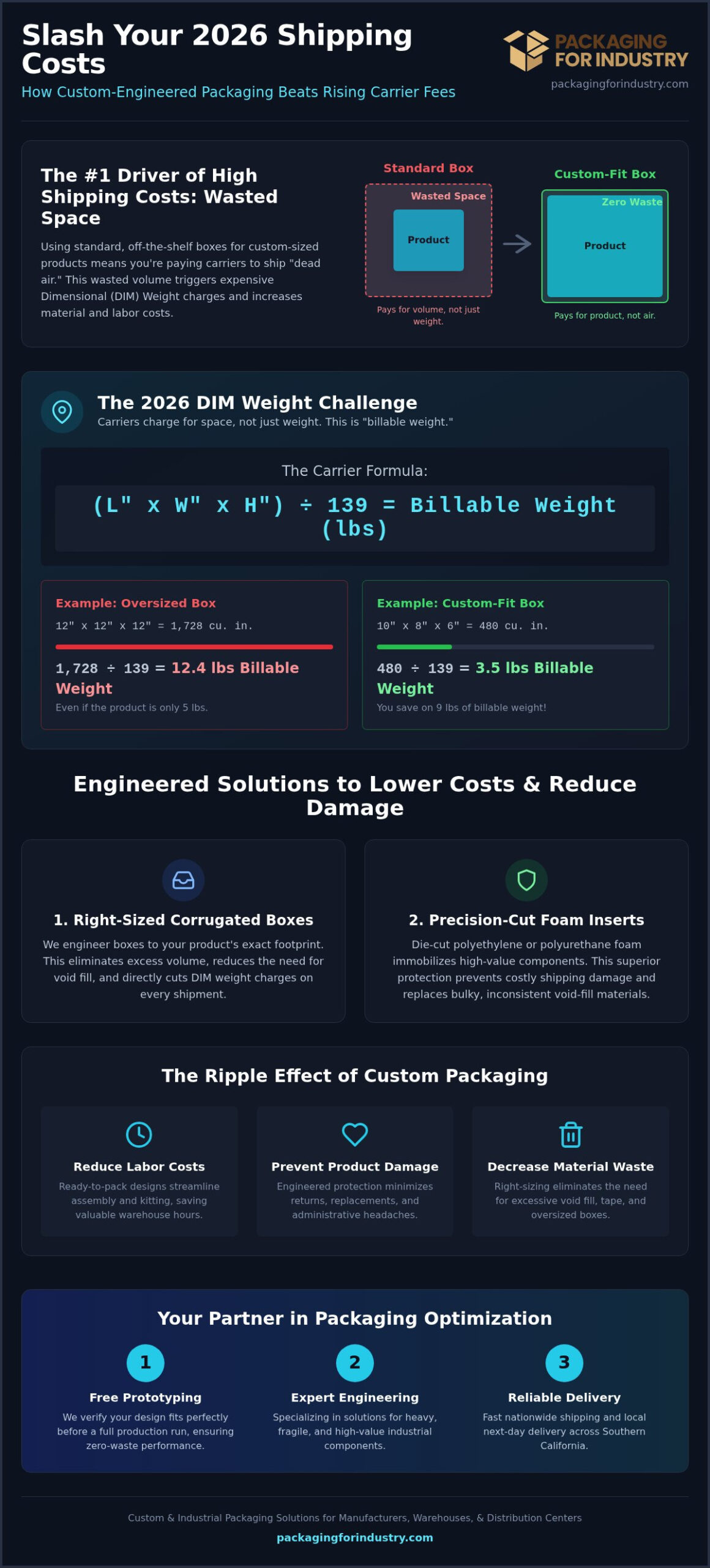
Standard stock boxes are designed for universal convenience, not for logistics optimization. When you use a generic 12x12x12 box for a component that only measures 10x8x6, you’re essentially paying your carrier to transport empty space. This inefficiency is a textbook example of overpackaging, which drives up freight expenses and forces your warehouse team to consume excessive amounts of void fill just to keep the product stable. Shifting to custom corrugated boxes allows you to right-size your shipments from the start, addressing the root cause of high shipping bills.
Using custom packaging to reduce shipping costs requires a shift in how you view procurement. It’s not just about the per-unit price of a box; it’s about the total landed cost. While a stock box might appear cheaper on a purchase order, the cumulative cost of extra tape, bubble wrap, and labor hours spent on complex kitting quickly erodes those initial savings. Most industrial operations find the breaking point for custom sizing occurs when the reduction in carrier surcharges and material waste offsets the engineering and production costs of a tailored solution.
Understanding Dimensional Weight (DIM) in 2026
Carriers like UPS and FedEx utilize a dimensional weight divisor of 139 for all domestic shipments in 2026. The formula is straightforward: (Length x Width x Height) / 139 equals the billable weight in pounds. If your actual package weight is 5 pounds but the DIM weight calculates to 12 pounds, you’re billed for 12. Reducing a single dimension by just one inch can often drop your billable weight by several pounds, resulting in immediate savings on every shipment leaving your dock. DIM weight is the carrier’s way of charging for space rather than actual weight.
The Hidden Cost of Shipping Damage
Standard boxes rarely provide the structural integrity required for high-value industrial components or sensitive electronics. When a part shifts inside an oversized container, impact damage is almost inevitable. Beyond the cost of the destroyed component, you have to account for the administrative burden of processing returns and the operational delays of sending replacements. Integrating custom foam packaging ensures your product is immobilized and protected against the shocks of transit. This level of precision engineering eliminates the “hidden tax” of shipping damage that often goes unmeasured in traditional supply chain audits.
Engineering Precision: Using Custom Corrugated and Foam to Lower Freight Expenses
Engineering is the practical bridge between logistics costs and product safety. By utilizing custom corrugated boxes, manufacturers can eliminate the excess volume that triggers DIM weight penalties. Unlike stock boxes that require layers of tape and wrap to secure a loose item, a precision-engineered box fits the product footprint exactly. This eliminates the need for oversized containers and ensures that every square inch of the shipment is utilized effectively.
Moving away from loose-fill materials like peanuts or bubble wrap is a critical step for modern distribution centers. These materials are bulky, inconsistent, and difficult to manage on a high-speed production line. Die-cut foam inserts provide a repeatable, secure fit that protects high-value components while minimizing the outer container’s dimensions. This approach is particularly effective for aerospace and medical electronics where precision is non-negotiable and space is at a premium.
PFI engineers specialize in designing solutions for heavy, fragile, or high-value industrial components that standard suppliers often overlook. We provide free prototyping to ensure your design is optimized for zero-waste before you commit to a full production run. This iterative process allows you to verify that your custom packaging to reduce shipping costs actually performs under real-world transit conditions. If you’re ready to see how a tailored fit can impact your bottom line, you can request a custom packaging quote today.
Optimizing Material Strength vs. Weight
You don’t always need the thickest material; you need the right material for the load. Double-wall corrugated often provides sufficient burst strength for heavy industrial parts without the added weight of triple-wall, which can save on freight costs over long hauls. Similarly, selecting polyethylene foam for its high load-bearing capacity can reduce the overall thickness required compared to softer polyurethane. For 2026 international shipments, specifying weather-resistant materials prevents moisture absorption, which can unexpectedly increase package weight and freight fees during ocean transit.
Integrated Material Solutions
Combining different materials creates a more resilient and compact system. Utilizing corner and edge protection inside the box often allows for a lighter outer corrugated grade, as the internal supports handle the vertical stacking strength. This integrated design reduces the total part count of your packaging, making it faster for warehouse teams to assemble and pack. For heavy machinery, a custom wooden crate with integrated foam linings provides a significantly smaller shipping footprint than a standard palletized box setup.
Optimizing Packaging Design to Reduce Labor and Handling Costs
While engineering the box size handles the freight aspect, the human element of your operation represents a separate, often larger, cost center. Complex packaging assemblies that require multiple steps of folding, taping, and wrapping slow down production lines and increase the total labor hours per shipment. When you utilize custom packaging to reduce shipping costs, you should also look for “ready-to-pack” designs that simplify the workflow. Eliminating unnecessary manual steps allows your warehouse team to move more units through the facility without increasing headcount.
Utilizing specialized packaging kitting services is a practical strategy for high-volume fulfillment centers. By receiving pre-assembled packaging sets that include the outer box, internal foam, and required labels, your staff can focus entirely on product throughput. This shift from manual assembly to streamlined packing reduces the physical strain on workers and minimizes the potential for packing errors that lead to costly returns.
Reducing Assembly Time with Custom Inserts
Manual wrapping with bubble wrap or packing peanuts is an inconsistent and time-consuming process. Custom-cut foam inserts replace this tedious task with a simple drop-in motion, ensuring every part is protected identically every time. Implementing “pop-up” or auto-bottom box designs further accelerates the process by removing the need for bottom-taping. In a high-volume operation, saving just 30 seconds per box translates to over eight hours of recovered labor for every 1,000 units shipped. These small incremental gains at the packing station have a massive impact on your monthly operational budget.
Vendor Managed Inventory (VMI) and Labor
The labor associated with packaging isn’t limited to the warehouse floor; it also impacts your procurement and administrative teams. Traditional ordering processes require constant inventory counts and manual purchase orders, which consume valuable office hours. Our VMI programs automate this cycle, ensuring you never run out of critical supplies while removing the burden of inventory management from your staff. By leveraging “just-in-time” delivery, you keep your warehouse floors clear of excess material and reduce the labor spent on internal material handling. For businesses in Orange County, Los Angeles, and San Diego, our local next-day delivery ensures a consistent operational flow that supports lean manufacturing principles.
Navigating DIM Weight and Carrier Surcharges with Custom Sizing
In 2026, the base freight rate is only part of the fiscal equation. Carriers have increasingly relied on accessorial fees to drive revenue, making it critical to understand the specific triggers that lead to Additional Handling or Large Package surcharges. These fees are often triggered by dimensions alone, regardless of the actual weight. Using custom packaging to reduce shipping costs involves designing your containers to sit just below these costly thresholds. For instance, an Additional Handling surcharge now applies to packages with a cubic volume greater than 10,368 cubic inches, while a Large Package Surcharge triggers at 17,280 cubic inches.
Your warehouse team must also consider the physical presentation of the shipment. Automated carrier scanners are sensitive to irregular shapes or bulging sides. Implementing stretch film optimization ensures that palletized loads remain tight and uniform. This prevents the bulging effect that can lead to manual handling fees or a re-classification of your freight into a more expensive tier. Review your current inventory against this 2026 carrier checklist:
- Is the total length plus girth (2x width + 2x height) under 108 inches?
- Does the package volume stay below the 10,368 cubic inch threshold?
- Are long, narrow items protected by specialized containers to avoid irregular shape fees?
- Is the billable weight calculated using the 139 DIM divisor accurately reflected in your budget?
The 108-Inch Rule and Industrial Shipping
The 108-inch length plus girth rule is a common trap for industrial shippers. A stock box that is only an inch too large in one dimension can move a shipment from standard pricing into the Large Package category, which carries a minimum billable weight of 90 pounds. Custom-sized corrugated boxes allow you to maximize internal volume while staying safely at 107 inches. For long, slender components, using custom mailing tubes prevents the irregular package fees associated with taped-together boxes. Consolidating multiple smaller shipments into a single, custom-sized master carton also reduces the number of individual tracking numbers and residential surcharges you incur.
Palletization and Freight Class Optimization
For LTL and heavy freight, your packaging density directly influences your National Motor Freight Classification (NMFC). Custom wooden pallets and crates are engineered to fit the exact footprint of your machinery or bulk components. By reducing the overall footprint and increasing the density of the load, you can often qualify for a lower freight class and more favorable rates. Custom skids are particularly effective for heavy machinery, as they remove the wasted pallet space that carriers charge for when your shipment occupies more floor space than necessary.
Custom Industrial Packaging Quotes: Why Manufacturers Choose PFI
Manufacturers of high-value components can’t afford a trial-and-error approach to logistics. PFI’s expertise in aerospace packaging and military-spec compliance means we understand the rigorous protection requirements of critical industries. We don’t just sell containers; we provide an engineering-first strategy that integrates custom packaging to reduce shipping costs. Before committing to a full production run, you can request a corrugated box quote that includes free prototyping to ensure your components are secured without the bloat of excess material.
If you’re ready to move beyond the limitations of standard stock inventory, you can request a custom packaging quote for bulk pricing. Our team focuses on the intersection of engineering and economics, identifying exactly where your current design is leaking money through surcharges or wasted labor.
Local Service, Nationwide Reach
For businesses operating in Anaheim, Irvine, or Los Angeles, finding a reliable packaging supplier near me is a strategic asset. As a dedicated Anaheim packaging supplier, we offer rapid design changes and local next-day delivery across Orange County, San Diego, and the Inland Empire. This proximity allows for a tighter feedback loop between your production line and our design team, which is essential for just-in-time manufacturing environments. While we provide specialized local support, our nationwide shipping partners ensure that customers with multiple US locations receive the same precision-engineered solutions with consistent reliability across their entire network.
Integrated Supply and VMI Programs
Efficiency isn’t just about the box; it’s about the entire supply chain footprint. Our VMI programs allow you to combine boxes, protective foam, and film into a single recurring supply cycle. When you request a stretch film quote as part of an integrated program, you improve cash flow by only stocking what you need for current production runs, rather than tying up capital in massive quantities of stock boxes. This is a proven way to lower packaging costs while eliminating the administrative burden of managing multiple vendors. Compare our bulk packaging pricing and compare packaging pricing against your current catalog supplier to see how much you can save on your total landed costs in 2026.
Engineering Your Logistics Strategy for 2026
Optimizing your distribution requires an engineering-minded approach to the container itself. By implementing custom packaging to reduce shipping costs, you address the root causes of supply chain waste: excessive DIM weight, manual labor hours, and transit damage. Precision-engineered corrugated boxes and foam inserts transform your packaging from a simple expense into a strategic tool for fiscal responsibility.
PFI provides the technical expertise needed for aerospace and military-spec compliance, backed by free prototyping and CAD support to ensure a perfect fit. For manufacturers in Orange County, Los Angeles, and San Diego, our local next-day delivery keeps your operations lean and responsive. We focus on the intersection of engineering and economics to provide a system of protection that supports your long-term growth.
Start protecting your profit margins by eliminating the hidden costs of air and inefficiency. We’re ready to help you streamline your distribution and improve your bottom line today.
Frequently Asked Questions
How does custom packaging reduce my overall shipping costs?
Custom packaging to reduce shipping costs works by eliminating the empty space that triggers higher dimensional weight charges. When you right-size your corrugated boxes to fit the product footprint exactly, you stop paying carriers to transport air. This strategy also lowers your spend on secondary materials like bubble wrap or packing peanuts. By engineering a precise fit, you reduce both the billable weight of the package and the volume of protective materials required for every shipment.
What is dimensional weight (DIM) and how can I avoid it?
Dimensional weight is a pricing technique used by carriers like UPS and FedEx to bill based on a package’s volume rather than its actual weight. In 2026, the standard divisor for domestic shipments is 139. You can avoid these inflated costs by using custom-sized boxes that minimize external dimensions. Even a one-inch reduction in length or width can drop a shipment into a lower weight tier, protecting your margins from the carrier’s cost of air penalties.
Can custom packaging design really lower my labor costs in the warehouse?
Yes, optimized designs significantly reduce the labor hours required at the packing station. Ready-to-pack custom boxes and drop-in foam inserts eliminate the time-consuming tasks of manual wrapping and complex box assembly. By streamlining these repetitive motions, your warehouse team can achieve higher throughput without increasing headcount. Saving just 30 seconds per unit can recover hundreds of labor hours annually in high-volume fulfillment centers or manufacturing plants.
Does PFI offer custom foam inserts for fragile electronics or aerospace parts?
PFI specializes in designing die-cut foam inserts for sensitive electronics and high-value aerospace components. We utilize a range of materials, including polyethylene, polyurethane, and ESD-safe foam, to provide density-based protection tailored to your product’s fragility. Our engineering team provides CAD support and free prototyping to ensure your custom foam assembly meets mil-spec or aerospace standards while maintaining the smallest possible shipping footprint to control freight expenses.
What is the minimum order quantity for custom corrugated boxes?
We specialize in high-volume, recurring orders for industrial and manufacturing clients. While minimums depend on the specific box style and material grade, our programs are designed for businesses that require consistent, bulk packaging supplies. We focus on supporting production lines and distribution centers rather than one-time retail purchases. For recurring needs, we often integrate these items into a Vendor Managed Inventory (VMI) program to ensure a reliable supply without stockouts.
How long does it take to get a custom packaging prototype from PFI?
We provide rapid prototyping to help you verify fit and protection before committing to a full production run. Our design team uses CAD technology to develop samples quickly, often within a few business days depending on the complexity of the foam or corrugated assembly. This iterative process ensures your custom packaging to reduce shipping costs is fully optimized for your specific components and transit conditions before you place a bulk order.
Do you offer local delivery in Southern California for bulk orders?
We provide local next-day delivery for bulk orders across Southern California, including Anaheim, Orange County, Los Angeles, and San Diego. Our fleet supports the Inland Empire and Riverside areas to ensure your production line never stops due to a packaging shortage. This local proximity allows us to offer Vendor Managed Inventory (VMI) services where we monitor your stock levels and replenish supplies automatically, keeping your warehouse floor clear and organized.
Can custom packaging help me avoid UPS and FedEx oversized surcharges?
Custom packaging is the most effective way to stay below the 2026 carrier surcharge thresholds. By engineering boxes to remain just under the 108-inch length-plus-girth limit or the 10,368 cubic inch Additional Handling trigger, you can avoid hundreds of dollars in fees per shipment. We analyze your product dimensions to create a container that maximizes protection while strictly adhering to carrier rate cards, protecting you from unexpected Large Package penalties.