
Is your returnable packaging system actually protecting your bottom line, or is it just masking a cycle of hidden costs? Many manufacturers invest heavily in durable plastic trays, yet they continue to face frequent product damage during internal transit because they overlooked the critical role of the interior dunnage. If your custom foam inserts for reusable dunnage trays don’t fit perfectly or utilize the wrong material density, you aren’t just risking part quality; you’re likely overspending on frequent foam replacements and labor.
We agree that inconsistent fitment and premature foam failure create unnecessary professional stress for operations and purchasing managers. This guide provides a pragmatic roadmap to help you specify, engineer, and procure foam solutions that maximize the lifespan of your systems. You’ll learn how to select between polyethylene and polyurethane, the benefits of precision CAD prototyping, and how partnering with an industrial packaging supplier can streamline your inventory. By focusing on the intersection of engineering and economics, you can finally achieve the reduced shipping damage and lower long-term costs your operation requires.
Key Takeaways
- Identify the optimal foam material and density to prevent part-on-part contact and eliminate product damage during internal transit.
- Discover how CAD-engineered custom foam inserts for reusable dunnage trays ensure a precise fit and maximize the lifespan of your returnable systems.
- Learn how optimized dunnage engineering can lower packaging costs by reducing dimensional weight surcharges from major carriers.
- Understand the role of Vendor Managed Inventory (VMI) in streamlining supply reliability for high-volume industrial operations.
- Benefit from free prototyping and local next-day delivery across Southern California to accelerate your production timelines.
What are Custom Foam Inserts for Reusable Dunnage Trays?
Custom foam inserts for reusable dunnage trays are precision-engineered interior components designed to secure high-value parts within a returnable shipping system. Unlike generic cushioning, these inserts are fabricated to the exact geometry of your components and the specific dimensions of their outer transport container. Dunnage systems serve as a protective barrier, effectively eliminating part-on-part contact and absorbing the mechanical shocks common in industrial transit. For manufacturers in the aerospace, medical device, and electronics sectors, these inserts aren’t just accessories; they’re critical tools for maintaining tight quality tolerances.
While generic void fill might seem cost-effective for one-way shipments, it fails in recurring logistics. Custom-cut foam packaging provides a repeatable, durable solution that withstands multiple transit cycles without degrading. This durability is vital for aerospace components that require delicate handling or medical instruments that must remain scratch-free. By using a tailored approach, you ensure that every part arrives in the same condition it left the production floor, which directly protects your bottom line from the costs of rework and rejected shipments.
The Components of a High-Performance Dunnage System
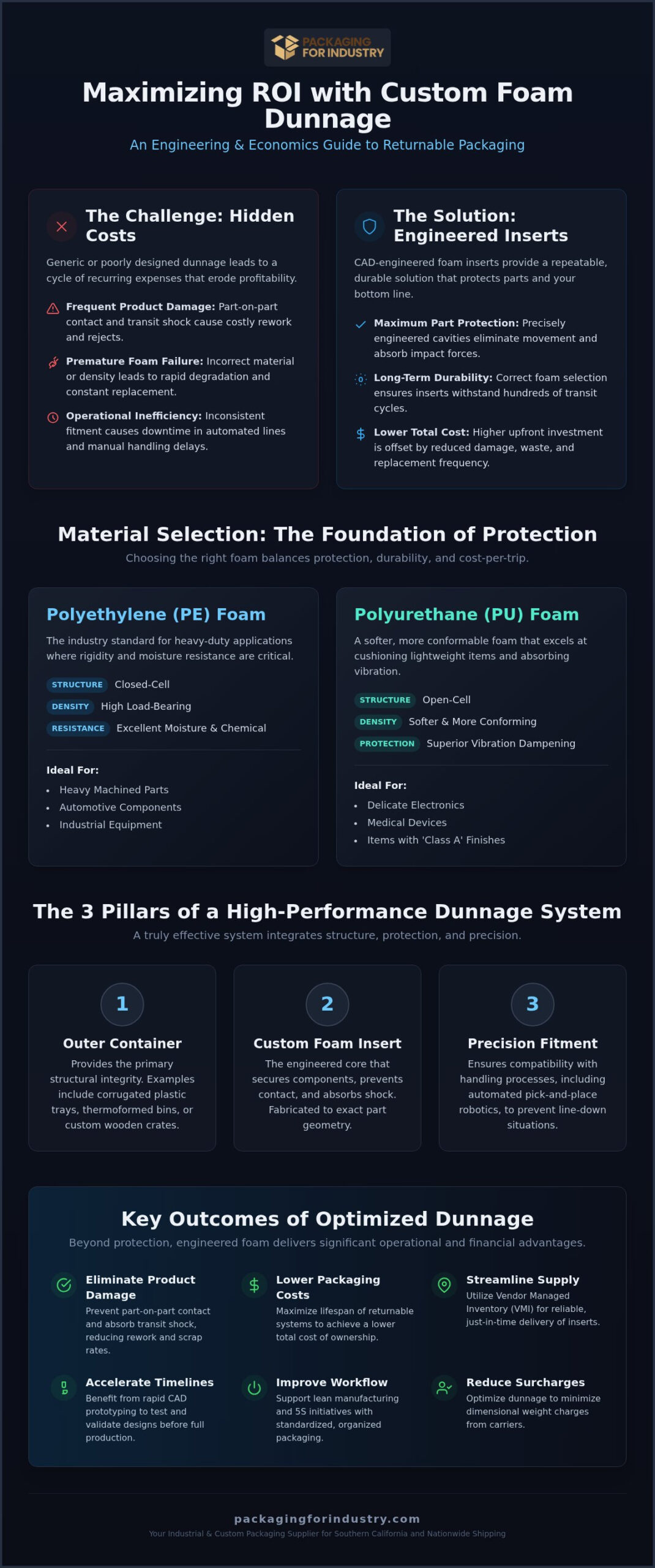
A truly effective system integrates three distinct elements. First, the outer container, typically corrugated plastic trays, thermoformed bins, or wooden crates, provides structural integrity. Second, the custom foam inserts for reusable dunnage trays provide the specialized nesting needed for the parts. Finally, the assembly must account for precision fitment. In modern manufacturing environments, dunnage must be compatible with automated pick-and-place robots. If an insert shifts by even a few millimeters, it can cause expensive downtime on a production line. We focus on CAD-driven designs to ensure these systems function flawlessly with your existing automation.
Returnable vs. Expendable Packaging: Making the Business Case
Switching to reusable foam inserts often requires a higher upfront investment, yet the long-term ROI is substantial. We help businesses calculate the lifecycle cost by comparing the price of a single reusable insert against the recurring expense of hundreds of one-way boxes and rolls of bubble wrap. Beyond direct cost savings, these systems support lean manufacturing and 5S initiatives by creating a standardized, organized workflow. Reducing packaging waste also aligns with corporate sustainability goals, as returnable dunnage can often stay in service for years before needing replacement. This shift moves packaging from a consumable expense to a long-term operational asset.
Material Selection: Choosing the Right Foam for Your Inserts
Selecting the correct material for your custom foam inserts for reusable dunnage trays is a decision that balances upfront procurement costs with long-term durability. In a returnable system, the foam must survive hundreds of cycles while maintaining its structural integrity and protective properties. If the material degrades too quickly, the cost-per-trip skyrockets, negating the financial benefits of a reusable system. Our engineering team evaluates part weight, fragility, and the environmental conditions of your facility to recommend a material that optimizes both protection and ROI.
Polyethylene (PE) vs. Polyurethane (PU) Foam
Polyethylene (PE) is the standard for heavy industrial applications. As a closed-cell foam, it offers superior moisture resistance and high load-bearing capacity. It’s ideal for heavy machined parts or automotive components that might carry residual oils. On the other hand, Flexible polyurethane foam (PU) provides a softer, open-cell structure. This material excels at absorbing high-frequency vibrations and protecting lightweight, delicate items. For components with sensitive ‘Class A’ finishes, such as painted aerospace panels or polished medical housings, we often recommend cross-linked polyethylene (XLPE). Its smooth surface prevents the micro-abrasions that standard foams can cause over repeated transit cycles.
Density is the primary indicator of how many cycles an insert can withstand. Standard PE foam typically ranges from 1.7 to 2.2 pounds per cubic foot. While lower densities save on material costs, higher density foams (4.0 lbs and above) are necessary for heavy industrial components to prevent ‘bottoming out’ during impact. A well-specified high-density insert can often last three to five years in a closed-loop system. If you’re unsure which density fits your part weight, you can request a packaging quote to have our engineers evaluate your specific requirements.
Specialty Foams for Sensitive Industrial Goods
Specific industrial environments demand specialized material properties. For semiconductor and electronics manufacturing, anti-static or ESD-safe foam is mandatory to prevent electrostatic discharge from damaging sensitive circuits. These foams are typically pink or black to signify their conductive or dissipative properties. In aerospace and defense, we provide mil-spec foams that meet rigorous flame-retardancy and outgassing standards. Additionally, for automotive assembly lines where parts are frequently coated in lubricants, we utilize chemically inert foams that won’t swell or soften when exposed to industrial fluids. This targeted material selection ensures your custom foam inserts for reusable dunnage trays remain a reliable asset throughout their entire service life.
Engineering and Prototyping: Ensuring a Perfect Fit
Precision is the cornerstone of effective industrial logistics. While some suppliers claim that standard trays fit most parts, we know that high-value components require CAD-level accuracy to prevent movement. Our process for creating custom foam inserts for reusable dunnage trays starts with technical specifications, not guesswork. This engineering-first approach ensures that your parts are nested securely, which is the most reliable way to lower packaging costs and reduce shipping damage over the long term. By integrating CAD/CAM technology, we eliminate the fitment issues that often plague generic packaging solutions.
The Custom Design Journey
Our custom design packaging workflow begins with a comprehensive assessment of your part’s geometry and fragility. We utilize CAD modeling to optimize the layout within the tray, ensuring you maximize part density without compromising protection. This spatial efficiency directly impacts your bottom line by reducing the total number of shipments required. Once the digital model is finalized, we provide free prototyping. This step is essential because it allows your team to conduct real-world transit testing before you commit to a bulk order. It’s a pragmatic way to identify fitment issues or ergonomic challenges early, saving you from expensive mistakes during full-scale production.
Precision Manufacturing Techniques
We employ different fabrication methods based on your volume and design complexity. Die-cut foam inserts are the standard for high-volume orders where cost-effectiveness is the priority. This method is fast and provides consistent results for large runs. For parts with complex three-dimensional geometries or when using thick foam planks, we utilize CNC routing. This technology allows for extreme precision and can handle intricate shapes that die-cutting cannot achieve. This flexibility ensures that whether you need simple partitions or complex nested cavities, the final product meets your exact tolerances.
Beyond the cut itself, we focus on operational efficiency. We design inserts with ergonomics in mind, including features like finger pull holes or lead-in chamfers that allow operators to insert and remove parts quickly. This focus on the end-user reduces labor time and prevents repetitive strain in high-speed assembly environments. To further streamline your operations, we offer packaging kitting services. We deliver your custom foam inserts for reusable dunnage trays fully assembled and ready for the production line. If you’re ready to improve your logistics flow and supply reliability, you can request a packaging quote to start the engineering process.
Lowering Costs with Optimized Dunnage Management
Lowering costs in industrial logistics requires a focus on both material expenses and operational overhead. While catalog suppliers offer convenience, they often lack the engineering support needed to optimize your shipping footprint. We help manufacturers move beyond standard options by providing bulk packaging pricing tailored to recurring needs. This approach ensures you aren’t paying for “air” or oversized containers that trigger expensive carrier penalties. By choosing custom foam inserts for reusable dunnage trays that are engineered for specific part densities, you minimize the overall footprint of your shipping units and maximize your ROI.
Vendor Managed Inventory (VMI) for Packaging
One of the most effective ways to streamline your supply chain is through Vendor Managed Inventory (VMI). Managing custom foam inserts for reusable dunnage trays can be complex, especially when dealing with multiple part numbers and high production volumes. We eliminate the risk of stockouts by conducting scheduled inventory reviews and implementing planned replenishment cycles. This system allows you to stock only what you need, significantly reducing your warehouse footprint and freeing up capital that would otherwise be tied up in excess inventory. Shifting the management burden to us provides supply reliability and the peace of mind that your production lines won’t stall due to missing packaging.
Reducing Transit Damage and Freight Costs
Freight expenses are often inflated by dimensional (DIM) weight surcharges from carriers like UPS and FedEx. When your dunnage isn’t optimized, you’re forced to use larger outer containers, which increases your shipping costs regardless of the actual weight. Precision-engineered inserts allow for the tightest possible nesting of parts, enabling you to use smaller, more efficient containers. This optimization is a core component of achieving meaningful Packaging Cost Savings.
The most direct way to lower costs is by reducing the damage rate. Engineered shock absorption ensures that high-value components survive the rigors of transit without the need for additional, bulky void fill. A lower damage rate means fewer returns, less rework, and a stronger reputation with your customers. We focus on the total cost of ownership, ensuring that every dollar spent on custom foam inserts for reusable dunnage trays generates a return through improved logistical flow and reduced shipping damage.
Why PFI is Your Southern California Packaging Partner
National catalog retailers often provide a one-size-fits-all approach that fails to address the unique logistical pressures of Southern California’s manufacturing hubs. PFI stands apart as a seasoned industrial packaging supplier with deep roots in Anaheim, Irvine, and Long Beach. We understand that supply reliability is just as important as the quality of the materials themselves. By positioning ourselves as a steady and dependable partner, we help you eliminate professional stress through proactive problem-solving and technical expertise. Our team focuses on the intersection of engineering and economics, ensuring that every packaging asset you procure contributes to your bottom line.
Local Service, National Support
For manufacturers in Anaheim and Irvine, PFI offers a level of personalized support that distant suppliers simply cannot match. Our local presence allows for on-site packaging reviews where our engineers evaluate your specific production line needs and part handling challenges firsthand. This proximity enables us to provide local next-day delivery across Orange County, Los Angeles, and the Inland Empire, which is essential for supporting Just-In-Time (JIT) manufacturing schedules. While we’re a leading Southern California packaging supplier, we also offer fast nationwide shipping. This ensures that multi-location operations receive the same precision-engineered custom foam inserts for reusable dunnage trays regardless of where their facilities are located.
Comprehensive Industrial Solutions
PFI operates as a comprehensive one-stop shop, simplifying your procurement process by integrating custom foam packaging with heavy-duty corrugated boxes, pallets, and custom crates. Sourcing your entire dunnage system from a single industrial packaging supplier eliminates the risk of fitment discrepancies between the inner foam and the outer container. We’ve developed deep expertise in the aerospace and medical industries, where we account for stringent cleanliness and durability standards. By managing the end-to-end experience from initial design to final delivery, PFI provides total accountability and logistical optimization. We don’t just sell supplies; we deliver a complete system of protection designed to lower your long-term packaging costs.
We’re ready to help you lower packaging costs and build a more reliable, efficient supply chain today.
Frequently Asked Questions
What is the best foam material for reusable dunnage trays?
Polyethylene (PE) is the most effective material for custom foam inserts for reusable dunnage trays because its closed-cell structure provides superior durability and moisture resistance. It withstands the rigors of high-cycle returnable systems without losing its protective shape. For lighter components requiring softer cushioning, polyurethane (PU) foam is a viable alternative. We also offer cross-linked polyethylene (XLPE) for “Class A” surfaces that require non-abrasive protection to prevent micro-scratches during transit.
How much can I save by switching to returnable dunnage with custom inserts?
Savings are achieved by eliminating the recurring expense of expendable materials like one-way corrugated boxes and plastic void fill. While the initial investment in returnable dunnage is higher, the cost-per-trip is drastically lower over the system’s lifespan. Additionally, precision inserts reduce shipping damage rates and labor costs associated with packing. Many Southern California manufacturers see a full return on investment within the first few months of a closed-loop shipping cycle.
Do you provide free prototypes for custom foam inserts?
Yes, PFI provides free prototyping and samples as part of our custom design process. We believe that physical testing is the only way to guarantee a perfect fit and ensure your components are adequately protected. Our Anaheim based engineering team uses CAD/CAM technology to create these prototypes quickly. This allows your operations team to verify ergonomics and fitment on the production line before you move forward with a bulk packaging quote.
Can custom foam inserts be made with ESD or anti-static properties?
We specialize in supplying anti-static and ESD foam packaging for the electronics and semiconductor industries. These custom foam inserts for reusable dunnage trays are treated with antistatic agents to prevent the buildup of static electricity, which can destroy sensitive circuits. This protection is essential for high-value electronic assemblies and medical devices. We offer these specialized materials in various densities to match the specific weight and fragility of your industrial components.
What is the typical lead time for custom-cut foam in Southern California?
For businesses in Southern California, we offer local next-day delivery for recurring orders through our stocking programs. The initial lead time for a new custom-cut foam project typically includes a few days for design and prototyping, followed by production. Because we operate locally in Anaheim, we can bypass the long shipping delays associated with national catalog distributors. Our goal is to keep your production moving with reliable, fast turnarounds.
How do custom foam inserts help reduce UPS or FedEx shipping surcharges?
Custom foam inserts reduce shipping surcharges by optimizing the internal layout of your parts to fit the smallest possible outer container. Carrier fees from UPS and FedEx are often based on dimensional (DIM) weight rather than actual weight. By eliminating excess “air” and oversized boxes, you lower your freight costs significantly. Our engineering team focuses on maximizing part density within each tray, ensuring you get the most value out of every shipment.
Do you offer Vendor Managed Inventory for custom packaging items?
Yes, we offer comprehensive Vendor Managed Inventory (VMI) programs for all custom packaging items, including foam, crates, and corrugated boxes. We perform regular on-site inventory reviews at your facility to monitor usage and manage replenishment. This prevents production stops caused by packaging shortages and frees up valuable warehouse space. Our VMI service ensures you always have the right amount of custom protection on hand without tying up excessive capital.
What industries benefit most from custom foam dunnage?
Aerospace, medical device manufacturing, and electronics benefit most from custom dunnage because their products are often high-value, fragile, and oddly shaped. These industries require the precision and reliability that only engineered foam can provide. Additionally, automotive and industrial equipment manufacturers use these systems to move heavy machined parts safely between facilities. Any business with a recurring, closed-loop shipping route can achieve significant cost savings and damage reduction with these systems.