
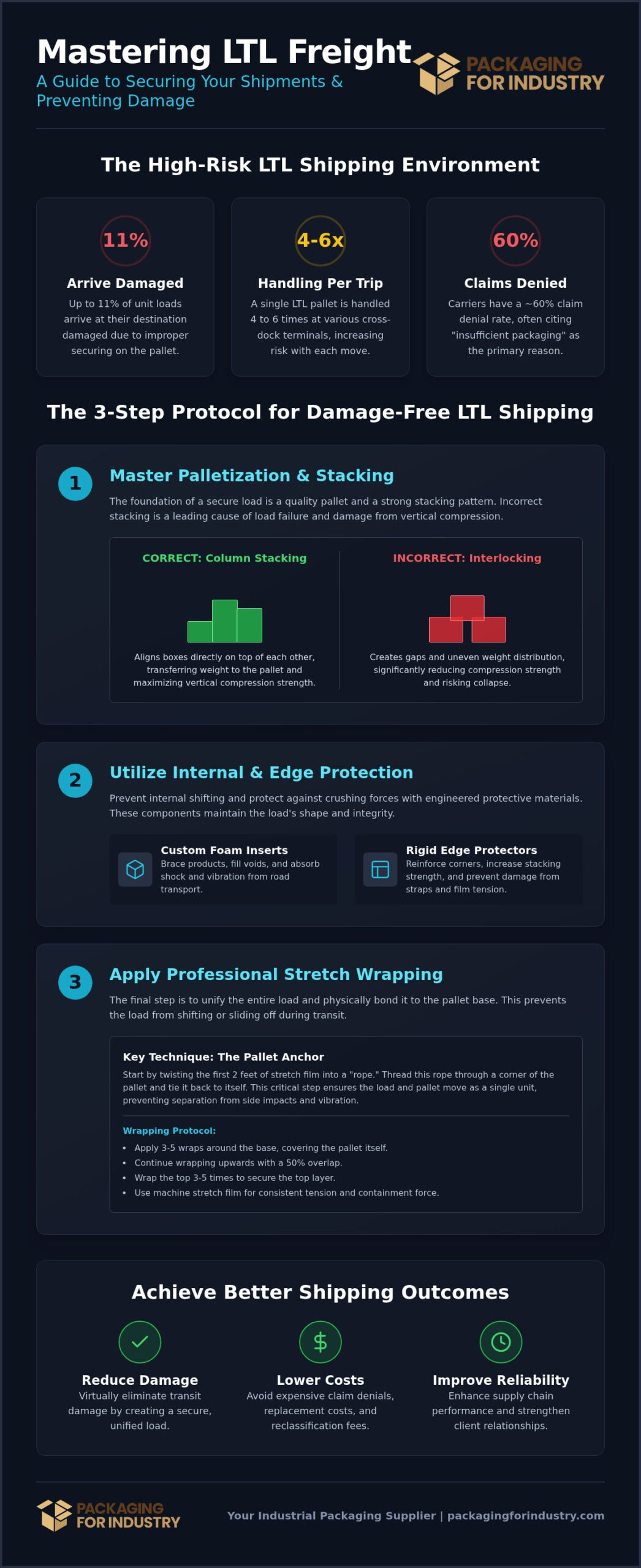
Did you know that up to 11% of unit loads arrive damaged simply because the freight wasn’t correctly secured to its pallet? In the high-touch environment of less-than-truckload transit, where a single shipment may be handled six times before reaching its destination, understanding how to properly secure loads for LTL shipping is your primary defense against an industry-wide 60% insurance claim denial rate. You likely already know the professional stress of seeing a high-value shipment rejected at the receiving dock due to “insufficient packaging.” It’s a costly operational failure that drains your margins and strains critical client relationships.
This guide will help you master the technical requirements of load stabilization to virtually eliminate transit damage and lower your total freight costs. We’ll provide a repeatable, durable palletizing protocol designed for industrial manufacturers and distribution centers. By optimizing your use of machine stretch film, custom foam inserts, and heavy duty corrugated boxes, you can create a secure system of protection that survives the rigors of the national LTL network while significantly improving your material efficiency and supply reliability.
Key Takeaways
- Understand why the high-touch nature of LTL transit demands specialized packaging protocols to survive multiple cross-dock terminal transfers.
- Master how to properly secure loads for LTL shipping by utilizing column-stacking methods that maintain significantly more vertical compression strength than interlocking patterns.
- Use custom foam inserts and rigid edge protectors to provide internal stabilization and protect against the crushing forces common in multi-stop freight environments.
- Apply professional stretch wrapping techniques like the pallet anchor to ensure your load remains physically bonded to the pallet base throughout the entire journey.
- Reduce long-term operational expenses by leveraging custom-engineered packaging and VMI programs to optimize your shipping footprint and material usage.
Understanding the LTL Freight Environment: Why Load Securing is Critical
LTL shipping isn’t just a transport method; it’s a high-impact gauntlet for your cargo. Unlike Full Truckload (FTL) shipping, where a trailer is loaded once and driven directly to its destination, Less-Than-Truckload freight moves through a complex hub-and-spoke network. Your pallets will likely be handled four to six times at various cross-dock terminals before reaching the final receiver. Each time a forklift operator moves your freight, the risk of structural failure increases. Mastering how to properly secure loads for LTL shipping is your only reliable defense against an industry-wide damage rate of approximately 1.24%.
Cargo in this environment faces constant physical stress from three main directions. Road vibration can loosen poorly applied stretch film, vertical compression from stacked freight can crush bottom layers, and side-impacts during trailer consolidation can shift the entire load off its base. If your packaging fails to withstand these forces, the financial consequences are immediate. LTL carriers maintain the highest claim denial rate in the logistics industry, often between 50% and 60%. Most denials cite “insufficient packaging,” which leaves your business responsible for the total loss of revenue and the cost of replacement goods. Adhering to established load securing principles protects both your physical product and your legal right to a successful insurance payout.
The Difference Between FTL and LTL Handling
In an FTL scenario, your load remains stationary from origin to destination. In LTL, your pallet is frequently shifted to maximize trailer density. This creates a significant risk of “top-loading,” where carriers place lighter pallets on top of yours to fill vertical space. If you don’t utilize heavy duty corrugated boxes or double-wall structures, your shipment will likely collapse under this unexpected weight. The LTL environment is a high-vibration, multi-point transit system that punishes any shortcut in packaging quality.
Standard Freight Class and Load Stabilization
Pallet stability directly influences your freight class and total shipping costs. Carriers are rapidly shifting toward density-based pricing models, which means poorly optimized pallets that overhang the wooden shipping pallets often trigger expensive reclassification fees. Using professional industrial packaging solutions ensures your load remains within its designated footprint. Standardizing these pallet footprints allows your purchasing department to acquire supplies in bulk, which lowers your unit costs and simplifies warehouse operations across multiple facilities.
Step 1: Mastering Palletization and Base Stabilization
The physical foundation of any LTL shipment is the pallet. If the base is compromised or poorly chosen, even the most advanced stretch wrapping won’t prevent transit damage. Learning how to properly secure loads for LTL shipping begins with structural integrity at the floor level. You must ensure that your pallet is rated for the total weight of the cargo and remains free from broken stringers or cracked deck boards that could fail during forklift maneuvers. Properly securing loads for LTL shipping is a science of alignment and weight distribution that starts before the first box is even placed.
Choosing Your Pallet Base
For most standard industrial applications, high-quality wooden shipping pallets provide the necessary durability. However, if you’re shipping internationally, you must use heat-treated pallets to comply with ISPM-15 export regulations. For irregular, high-value, or sensitive industrial equipment, custom crates offer a superior level of enclosure and protection compared to open pallets. When building your load, the bottom layer is the most critical for stability. We recommend using heavy-duty corrugated boxes for these base layers to prevent the “accordion effect” when pallets are stacked during transit at cross-dock terminals.
Optimal Stacking Patterns for Manufacturers
The way you arrange boxes on the pallet determines the stack’s ultimate vertical strength. While many warehouse teams use interlocking patterns to “tie” the load together, this actually reduces vertical compression strength by up to 50% because the box corners are not aligned. Instead, use the column-stacking method. Aligning box corners vertically maximizes the structural capacity of the corrugated material, allowing the boxes to support the weight of top-loaded freight. Every inch of overhang reduces box strength by approximately 30%.
This strength loss occurs because the edges of the boxes are no longer supported by the pallet deck, leaving them vulnerable to crushing. Conversely, significant underhang creates gaps in the trailer that allow the load to shift during transit. Always place your heaviest items at the base to lower the center of gravity and use slip sheets between layers to reduce internal friction. Compliance with FMCSA cargo securement rules starts here, by ensuring the unit load is physically sound before it ever touches a trailer. If you’re unsure which pallet size or box grade fits your specific application, you can request a packaging quote for a customized analysis of your shipping needs.
Step 2: Internal Protection and Edge Guarding Strategies
External stretch wrap only secures the perimeter of your load; it does nothing to prevent movement within the individual containers. Mastering how to properly secure loads for LTL shipping requires a focus on internal stabilization to neutralize the constant vibration and sudden shifts inherent in multi-stop transit. When products move inside their boxes, they create dynamic loads that can burst corrugated seams or cause the entire pallet stack to lean. Internal protection is not just about padding; it is about creating a zero-movement environment through engineered materials.
Engineered Foam vs. Generic Cushioning
Generic void fill like air pillows or paper dunnage often collapses under the heavy compression of industrial freight. For high-value aerospace or medical components, protective foam packaging is the professional standard for reliable shock absorption. You must select the correct density based on the fragility and weight of your specific item. Polyethylene foam provides rigid, multi-impact protection for heavier industrial parts, while Polyurethane foam offers softer, open-cell cushioning for lighter, vibration-sensitive electronics. PFI’s design team provides free prototyping for custom foam inserts, ensuring a precision fit that eliminates the need for excessive secondary wrap and lowers your total packaging costs.
Edge and Corner Protection for Palletized Loads
Once the internal contents are stabilized, you must reinforce the exterior corners of the pallet stack. Using cardboard edge protectors serves two critical functions: it unitizes the load into a single structural block and prevents “strap crush.” When high-tension strapping or tight stretch film is applied, it can bite into the corners of your corrugated boxes, compromising their vertical integrity. Vertical angle boards distribute this pressure across the entire height of the stack, effectively turning your boxes into a rigid column. This reinforcement is especially vital for loads that may be double-stacked in a carrier’s terminal.
To fill irregular gaps between non-uniform items, use specialized cushioning materials rather than leaving empty spaces. Voids are the primary cause of load collapse during the side-to-side swaying of a trailer. By combining rigid corner boards with internal foam stabilization, you create a durable unit that resists transit forces. This comprehensive approach ensures you are following the best practices for how to properly secure loads for LTL shipping, protecting your bottom line from the high costs of rejected damage claims.
Step 3: Professional Stretch Wrapping and Labeling Techniques
Applying stretch film is more than just circling a pallet with plastic. It’s the final mechanical bond that holds your entire unit together against the centripetal forces of a turning truck. Learning how to properly secure loads for LTL shipping involves more than just covering the product; it’s about creating a unified structural block through high containment tension. This process ensures that the pressure the film exerts on the load is consistent enough to prevent boxes from shifting even an inch during transit.
For maximum reliability, we recommend the 3-3-3 wrapping rule. Your operators should start by applying three full wraps at the base, ensuring they catch the pallet itself. The “Pallet Anchor” is the critical junction where film grips the wood to prevent the load from sliding off during sudden stops. Without this anchor, your entire shipment can slide off the base as a single unit. After the base, overlap each layer by 50% as you move up the stack, applying three wraps in the middle and three at the top to secure the upper corners. This standardized method is a pillar of how to properly secure loads for LTL shipping that reduces the risk of load failure.
Selecting Industrial Stretch Film
Choosing the correct material is vital for both safety and cost-efficiency. Blown film is significantly tougher and offers higher puncture resistance, making it ideal for loads with sharp corners or irregular shapes. Cast film is quieter and more transparent, which helps with barcode readability. If your facility handles high volumes, switching to machine stretch film can significantly lower your material costs through consistent pre-stretch levels. For manual warehouses, using heavy-duty hand stretch film ensures your team has the durability needed for high-tension applications. You might also consider opaque or colored pallet wrap to conceal high-value goods and prevent pilferage during multi-stop LTL routes.
Labeling and Documentation for LTL Success
Proper labeling is the final step in securing your freight. If a carrier can’t read your documentation, your pallet is more likely to be mishandled or delayed. Place your PRO labels and shipping documents on the side of the pallet, never on the top where they can be obscured by other freight. Ensure that barcodes are flat and readable through the wrap; avoid wrapping over labels multiple times, as the resulting glare can prevent scanner success. If your load is fragile, use “Do Not Stack” cones on the top of the pallet to provide a physical deterrent against top-loading. These small tactical additions, combined with professional packaging tape and clear labeling, ensure your shipment remains intact and identifiable throughout the LTL network.
Optimizing LTL Logistics with PFI Custom Packaging Solutions
Mastering how to properly secure loads for LTL shipping is a technical challenge, but it’s also an economic one. While the previous steps focused on the mechanics of stabilization, PFI helps you integrate these protocols into a broader strategy of logistical optimization. We specialize in custom-engineered packaging that reduces your overall shipping footprint. This is a critical advantage as LTL carriers move toward density-based pricing models. A smaller, more stable pallet doesn’t just reduce damage; it lowers your freight class and total transportation spending. You can request a packaging quote to see how a professional review of your current materials can drive immediate savings.
Custom Design and Prototyping in Anaheim
As a premier Anaheim packaging supplier, PFI provides rapid prototyping to solve specific shipping issues before they become insurance claims. We help manufacturers and distribution centers avoid costly carrier surcharges through better dimensional weight management and optimized box sizing that fits the exact needs of your freight. Our team acts as a logistical fixer, designing integrated solutions that combine heavy-duty corrugated boxes, custom foam inserts, and wooden crates for the ultimate protection of high-value industrial equipment. This expertise is why aerospace suppliers trust PFI for military packaging that meets rigorous durability standards. If you need custom boxes in Los Angeles or specialized crates in the Inland Empire, our engineering-first approach ensures your freight survives the most demanding routes.
Streamlining Your Supply Chain with PFI
For manufacturers across Southern California, supply chain reliability is just as important as protection. PFI offers Vendor Managed Inventory (VMI) to ensure you always have the stretch film, pallets, and edge protectors you need without the stress of constant reordering. This program eliminates stockouts and frees up valuable warehouse floor space by shifting the inventory burden to our facility. Being an industrial packaging supplier near Orange County allows us to provide local next-day delivery to Anaheim, San Diego, and Riverside. We act as a single-source distributor for your tapes, labels, pallets, and film, allowing you to compare packaging pricing and simplify your procurement process. If you’ve been searching for an industrial packaging supplier near me in Southern California, PFI is the steady partner you need. Contact PFI for a packaging cost-savings analysis today to identify hidden inefficiencies in your current LTL protocol. Understanding how to properly secure loads for LTL shipping is essential, but having a dependable partner for your bulk packaging supplies is what truly secures your bottom line.
Secure Your Freight for the Long Haul
Mastering how to properly secure loads for LTL shipping is a critical investment in your operational efficiency. It isn’t just about adding more material; it’s about applying engineering principles to the high-touch logistics environment. By transitioning to a system of column stacking, internal foam stabilization, and professional anchor wrapping, you’ll protect both your product and your revenue. These technical adjustments neutralize the unique risks of the LTL network while lowering your total freight costs through density optimization.
PFI has served as a B2B industrial specialist since our inception, providing the reliable expertise required to solve complex logistics challenges. Whether you need free packaging design and prototyping or local next-day delivery across Southern California, our team acts as your steady partner in damage reduction. We’ll help you move past the stress of rejected claims and into a more predictable, cost-effective supply chain that supports your long-term growth.
Take control of your shipping outcomes today and experience the peace of mind that comes with professional-grade protection.
Frequently Asked Questions
What is the most common mistake made when securing LTL loads?
The most common mistake is failing to anchor the load to the wooden base, which allows the entire stack to slide off during transit. Research indicates that 11% of unit loads arrive damaged because they weren’t correctly secured to the pallet. Shippers also mistakenly use interlocking stacking patterns instead of column stacking, which reduces vertical compression strength by up to 50%. Mastering how to properly secure loads for LTL shipping requires prioritizing the Pallet Anchor technique.
How many layers of stretch wrap are needed for a standard LTL pallet?
For a standard industrial pallet, we recommend the 3-3-3 rule: three full wraps at the base, three in the middle, and three at the top. This ensures consistent containment tension throughout the stack. Using high-quality machine stretch film or heavy-duty hand film is essential to maintain this tension. In the multi-stop LTL environment, these nine total layers provide the necessary structural integrity to prevent load shifting during the frequent handling at cross-dock terminals.
What is the difference between blown and cast stretch film for industrial use?
Blown stretch film is manufactured to be significantly tougher with higher puncture resistance, making it the preferred choice for heavy or sharp-edged industrial loads. Cast film is produced to be transparent and quiet during application, which is beneficial for reading barcodes through the wrap. While cast film is often more cost-effective for uniform loads, blown film provides the superior cling and durability needed to secure irregular freight in the high-vibration LTL transit system.
When should I use a custom wood crate instead of a corrugated box for LTL?
You should transition from corrugated boxes to custom wood crates when shipping high-value, heavy, or irregularly shaped industrial equipment that requires total enclosure. Crates offer superior structural protection against the side-impacts and top-loading forces common in LTL trailers. PFI specializes in designing foam-lined crates for aerospace and medical device manufacturers, ensuring that sensitive components remain stationary and protected even when the pallet is handled multiple times across terminal hubs.
How do I prevent my pallet from being crushed by top-loading?
To prevent crushing from top-loading, you must use heavy-duty double-wall or triple-wall corrugated boxes combined with vertical edge protectors. These materials significantly increase the vertical stacking strength of your pallet. Additionally, placing Do Not Stack cones on top of the load provides a physical deterrent for forklift operators. This strategy is a vital part of how to properly secure loads for LTL shipping, as it protects your freight from the weight of secondary pallets.
What are the benefits of using edge protectors for palletized freight?
Edge protectors serve as structural reinforcements that unitize your boxes into a single, rigid block. They prevent strap crush by distributing the tension from strapping or stretch film across the entire corner of the load. In the LTL environment, vertical angle boards also protect the edges of your boxes from being punctured by other freight during trailer consolidation. This simple addition can drastically reduce the 1.24% industry-wide damage rate for your specific shipments.
Does PFI offer local delivery for packaging supplies in Southern California?
Yes, Packaging For Industry (PFI) provides local next-day delivery across Southern California from our headquarters in Anaheim. Our fleet serves Los Angeles, Orange County, San Diego, and the Inland Empire, ensuring you have a reliable supply of pallets, stretch film, and custom boxes. This local focus helps manufacturers and warehouses maintain leaner inventory levels through our VMI programs while eliminating the long lead times associated with national catalog suppliers.
Can custom foam packaging help lower my LTL insurance premiums?
While custom foam packaging doesn’t directly dictate insurance premiums, it significantly reduces your damage claim frequency, which improves your overall risk profile with carriers. With LTL claim denial rates consistently between 50% and 60%, using engineered foam inserts demonstrates that you’ve taken the necessary steps to prevent internal shifting. This documentation is crucial when negotiating rates or disputing claims, as it proves your packaging meets the highest standards for industrial protection.