
The softest foam isn’t always the safest choice for your high-value industrial equipment. Using an overly compliant material can often lead to “bottoming out” during transit, which results in the very impact damage you were trying to prevent. Choosing between polyethylene vs polyurethane foam for cushioning is a critical decision that impacts both your product integrity and your bottom line. Most operations managers face the constant pressure of reducing shipping damage claims while trying to lower packaging costs. It’s a difficult balance to maintain when the technical differences between open-cell and closed-cell performance remain unclear.
This guide provides the technical clarity you need to select the optimal protective material for your high-value industrial shipments. You’ll discover how to match material density to specific product weights to avoid over-engineered, expensive packaging. We’ll examine the load-bearing strength of polyethylene alongside the vibration-dampening qualities of polyurethane. By the end of this selection guide, you’ll have a clear framework for evaluating your needs and selecting a reliable industrial packaging supplier. Whether you’re shipping aerospace components or medical devices, understanding these material properties ensures your logistics chain remains reliable and cost-effective.
Key Takeaways
- Polyethylene foam provides high load-bearing capacity and moisture resistance, making it ideal for securing heavy industrial equipment and machinery during long-distance transit.
- Polyurethane foam offers superior vibration dampening and flexibility, effectively cradling fragile items like sensitive electronics or laboratory optics to prevent impact damage.
- Analyzing the technical trade-offs of polyethylene vs polyurethane foam for cushioning helps operations managers avoid over-engineered packaging and lower packaging costs.
- Material density must be matched to product weight to prevent “bottoming out,” a common cause of damage that occurs when cushioning is too soft for the load.
- Custom-engineered foam inserts and professional prototyping ensure a precise fit for complex components, improving supply reliability and reducing the risk of shipping claims.
Polyethylene vs Polyurethane: Understanding the Core Foam Structures
Polyethylene (PE) and Polyurethane (PU) serve distinct roles in protective foam packaging. Polyethylene is a closed-cell foam characterized by its high density and structural rigidity. Because each cell is a sealed unit, PE doesn’t compress easily under heavy loads. This makes it a primary choice for structural support in industrial shipping, where maintaining the position of heavy machinery is vital. Conversely, Polyurethane (PU) foam features an open-cell structure where the cells are interconnected. This allows air to pass through the material, creating a soft, flexible cushion that excels at protecting delicate items by dissipating energy through air displacement.
Selecting the wrong material often leads to “bottoming out.” This occurs when the weight of a product exceeds the compression strength of the foam, causing the material to flatten completely during an impact. When you compare polyethylene vs polyurethane foam for cushioning, you’re essentially balancing load-bearing capacity against energy dissipation. PE resists compression to keep heavy items stationary, while PU uses its flexibility to absorb shocks for lighter, more fragile goods. Failing to account for this physics-based difference is a leading cause of shipping damage in manufacturing supply chains.
Closed-Cell vs. Open-Cell: The Functional Difference
The sealed nature of closed-cell PE foam provides excellent buoyancy and moisture resistance. It doesn’t absorb liquids, which is essential for manufacturers using custom crates for overseas export. Open-cell PU foam offers superior breathability and a non-abrasive surface. While PU is more prone to moisture absorption, its ability to recover its original shape after multiple light impacts makes it a reliable choice for recurring shipping cycles. Understanding these structural differences when comparing polyethylene vs polyurethane foam for cushioning helps operations managers lower packaging costs by selecting the right material density for the specific application.
Common Industrial Applications in Southern California
In the Anaheim and Los Angeles industrial hubs, material selection is often dictated by industry standards. Aerospace components often require rigid PE foam inserts to prevent heavy metal parts from shifting within a container. Medical device manufacturers frequently utilize PU foam for its soft, protective qualities that won’t scratch sensitive finishes. For the electronics sector, both materials are available in specialized ESD (Electrostatic Discharge) variants to protect sensitive circuitry from static shock during transit. This regional expertise allows a local industrial packaging supplier to provide just-in-time solutions that meet these specific technical requirements.
Polyethylene Foam: The Heavy-Duty Choice for High-Value Protection
Polyethylene (PE) foam stands as the industry standard for high-density, structural protection. Its closed-cell architecture allows it to withstand significant weight without collapsing under pressure. This high load-bearing capacity is vital for manufacturers shipping heavy industrial equipment or precision machinery. Unlike softer materials, PE provides a rigid framework that prevents heavy items from shifting during transit. When you evaluate polyethylene vs polyurethane foam for cushioning, it’s clear that PE is the superior choice for its chemical resistance and moisture-wicking properties. These characteristics are essential for export crates where humidity, salt spray, or chemical exposure can compromise packaging integrity during long-distance shipping.
For the electronics and aerospace sectors, specialized variants provide even more targeted protection. ESD foam packaging prevents electrostatic discharge from damaging sensitive circuit boards or flight control systems. This is a critical requirement for high-value components where a single static spark can lead to catastrophic product failure. By utilizing custom foam inserts, companies can ensure their components remain static-free and physically secure throughout the entire supply chain.
PE Foam End Caps and Bracing
Precision-engineered PE end caps are a highly effective way to suspend products within heavy duty corrugated boxes. By creating a clear buffer between the product and the outer box wall, these custom inserts absorb external shocks before they ever reach the item. This bracing strategy is especially useful for heavy automotive parts or industrial motors that would otherwise crush standard cushioning. Precision-cut PE planks ensure a tight, zero-movement fit, which eliminates internal rattling and significantly reduces shipping damage claims for manufacturers and distributors.
Durability and Reusability in VMI Programs
The physical durability of PE makes it the preferred material for long-term storage and returnable packaging programs. It doesn’t degrade over time or lose its structural memory after repeated use. Many businesses integrate these durable inserts into their Vendor Managed Inventory (VMI) programs to streamline their supply chain operations. This approach allows for material recovery and reuse, which lowers packaging costs over time compared to single-use cushioning. For companies in Southern California, utilizing a local packaging supplier for these programs can dramatically reduce lead times. If you’re looking to optimize your logistics flow and reduce waste through material optimization, you can request a packaging quote to see how custom PE solutions fit your operational budget.
Polyurethane Foam: Superior Cushioning for Fragile Goods
Polyurethane (PU) foam is the industry’s primary solution for protecting lightweight and highly sensitive products. Its open-cell structure creates a soft, flexible matrix that effectively “cradles” items, distributing pressure evenly across the surface area. This is a fundamental distinction in the polyethylene vs polyurethane foam for cushioning debate. While PE is rigid and load-bearing, PU is compliant and resilient. It’s the ideal choice for vibration dampening in sensitive optics and laboratory instrumentation. The material’s ability to absorb low-energy impacts prevents delicate components from experiencing the G-force spikes that occur during conveyor belt transitions or rough handling.
Another critical advantage of PU is its non-abrasive surface. Finished plastics, medical-grade polymers, and polished metals are susceptible to micro-scratching when secured with coarser materials. Polyurethane provides a gentle interface that maintains the aesthetic and functional integrity of high-value goods. This softness doesn’t sacrifice performance; rather, it allows for a high degree of energy dissipation through air movement within the foam’s interconnected cells. For manufacturers, this means fewer returns due to surface damage and a significant reduction in shipping damage claims.
Cushioning for Electronics and Medical Devices
Precision is paramount in aerospace packaging, particularly when transporting delicate sensors or flight-control modules. PU foam is the standard here because it can be engineered into ESD-safe (Electrostatic Discharge) variants. These specialized foams protect semiconductors and microchips from static buildup while providing physical security. In the medical sector, custom PU die-cut inserts are frequently used for surgical kits and diagnostic tools. This ensures that every component remains immobile and protected from impact until it reaches the end user.
Convoluted Foam vs. Die-Cut PU Inserts
Selecting between convoluted foam and die-cut inserts is a key step in material optimization. Convoluted PU, often called egg-crate foam, is a cost-effective choice for general void fill. Its nested peaks and valleys accommodate various product shapes without requiring unique tooling. However, for complex geometries or higher protection requirements, custom design packaging offers a more precise solution. Understanding the trade-offs of polyethylene vs polyurethane foam for cushioning allows engineers to fine-tune the material’s density. By adjusting the density, typically measured in pounds per cubic foot, we can match the shock absorption properties to the specific fragility of the shipment. This level of customization is essential for businesses looking to lower packaging costs by using only the necessary amount of material to ensure safe delivery.
Head-to-Head: Durability, Cost, and Performance Metrics
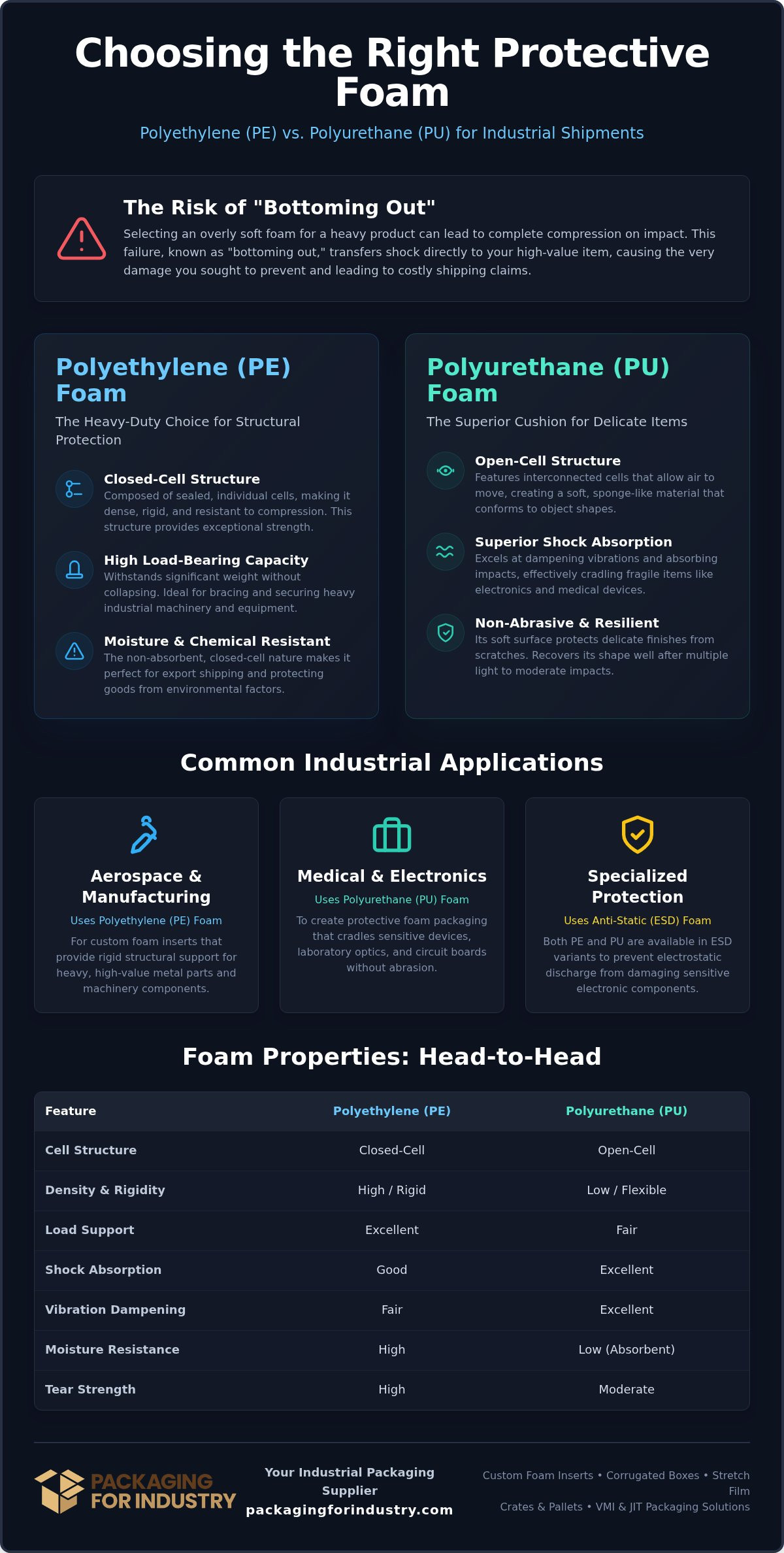
Selecting the right protective material requires a direct comparison of physical properties against operational costs. When you evaluate polyethylene vs polyurethane foam for cushioning, the decision often centers on the weight-to-fragility ratio of your product. Polyethylene (PE) is a high-performance, closed-cell material that offers exceptional structural integrity. Polyurethane (PU) is a flexible, open-cell material designed for delicate energy absorption. The following table outlines the primary metrics that industrial purchasers must consider.
| Metric | Polyethylene (PE) Foam | Polyurethane (PU) Foam |
|---|---|---|
| Cell Structure | Closed-cell (Rigid) | Open-cell (Flexible) |
| Load Capacity | High (Supports heavy loads) | Low (Best for light items) |
| Moisture Resistance | Excellent (Non-absorbent) | Poor (Can act like a sponge) |
| Abrasiveness | Low to Moderate | Extremely Low (Softest) |
| Primary Use Case | Bracing and heavy blocking | Cushioning and vibration dampening |
Analyzing the cost per cubic inch reveals that PU is generally less expensive upfront. However, performance value is found in material efficiency. Because PE is much stronger, you can often use smaller die-cut pieces or end caps to secure a heavy item, whereas PU might require a full block to prevent the item from shifting. From an environmental perspective, PE is easier to recycle in standard industrial streams (LDPE), while PU is more difficult to process. Ultimately, the foam that saves you the most on shipping damage is the one that prevents your specific product from hitting the “bottom out” point during a drop.
The Fragility Factor: Matching Foam to G-Force Limits
Every industrial product has a G-factor, which is the maximum deceleration it can survive without breaking. Heavy items will bottom out PU foam instantly. This sends the full force of an impact directly into the product. Conversely, lightweight items often bounce on high-density PE foam because the material is too stiff to compress. This “trampoline effect” can be just as damaging as a hard strike. You must match the foam’s resistance to the product’s weight to ensure the material actually absorbs the energy instead of reflecting it.
Southern California Logistics: Sourcing and Lead Times
For manufacturers in Anaheim and the surrounding Inland Empire, sourcing custom foam packaging from a local industrial packaging supplier is a strategic advantage. Long-distance shipping for bulk foam is expensive because you’re essentially paying to transport air. Local delivery reduces the total cost of ownership by eliminating high freight surcharges and reducing lead times to just a few days. This proximity allows for faster design iterations and ensures your production line never stalls due to a lack of protective supplies.
Custom Engineering: Finding the Right Foam Solution with PFI
At Packaging For Industry (PFI), we understand that raw material data is only the first step. The real value lies in how that material is engineered to fit your specific logistics environment. Our in-house design team utilizes CAD/CAM technology to create precision-cut foam inserts that eliminate guesswork. When choosing between polyethylene vs polyurethane foam for cushioning, our engineers analyze the weight, fragility, and dimensions of your product to determine the most cost-effective density. We don’t just sell foam; we provide a comprehensive system of protection that often integrates these custom inserts with custom corrugated boxes for a total industrial solution.
We offer free prototyping for custom foam assemblies to ensure a perfect fit before you commit to a bulk order. This phase is critical for identifying potential failure points and optimizing the amount of material used. From our headquarters in Anaheim, we serve manufacturers across Southern California with local next-day delivery. For businesses operating nationwide, our fast shipping capabilities ensure your distribution centers remain stocked with reliable packaging supplies regardless of your location.
From Prototype to Production
The PFI process begins with a thorough assessment of your current shipping damage rates and packaging expenses. Once we’ve identified the technical requirements, we move into CAD design and rapid prototyping. This methodical approach allows us to address common shipping issues like UPS and FedEx dimensional weight (DIM) surcharges. By optimizing the internal cushioning, we can often reduce the size of the outer box. This strategy directly lowers your freight costs and improves your bottom line without compromising the safety of your high-value equipment.
Vendor Managed Inventory for Foam Packaging
Warehouse space is a valuable asset in the Southern California industrial market. PFI helps you reduce clutter through Just-In-Time (JIT) and Vendor Managed Inventory (VMI) programs. We track your usage rates and maintain stock levels at our facility, delivering only what you need for your immediate production schedule. Our VMI programs take the complexity out of the polyethylene vs polyurethane foam for cushioning debate by ensuring the right material is always on hand for your specific SKU requirements. This ensures a consistent supply for high-volume lines in Orange County and Los Angeles. You can contact our team today for a packaging cost-reduction analysis to see how an integrated supply strategy can improve your operational efficiency.
Optimize Your Protective Packaging Performance
Selecting the correct protective material is a fundamental step in reducing product damage and lowering overall logistics expenses. When you evaluate polyethylene vs polyurethane foam for cushioning, you’re choosing between structural rigidity and flexible energy absorption. PFI bridges the gap between material science and economic efficiency by offering free CAD prototyping for custom foam inserts. This ensures your specific product weight is perfectly supported without the waste of over-engineered packaging.
Our local next-day delivery throughout Southern California and specialized knowledge in aerospace and mil-spec standards make us a dependable partner for your most critical shipments. By choosing a local industrial packaging supplier, you gain the advantage of faster lead times and reduced freight surcharges for bulk foam orders. We provide the technical support needed to transition from generic supplies to precision-engineered protection that safeguards your bottom line.
Take the first step toward a more secure and efficient supply chain by speaking with our engineering team today.
Frequently Asked Questions
Is polyethylene foam better than polyurethane for heavy items?
Polyethylene foam is the superior choice for heavy items due to its high load-bearing capacity and rigid, closed-cell structure. While polyurethane is effective for lightweight goods, it often collapses under the weight of heavy machinery or automotive parts. This failure, known as bottoming out, leaves your product vulnerable to impact damage. PE provides the structural support necessary to keep heavy components stationary and protected during the rigors of industrial transit.
Can I use anti-static foam for both PE and PU materials?
Anti-static and ESD variants are available for both polyethylene and polyurethane materials. These specialized foams are treated to prevent the buildup of static electricity, which is vital for protecting sensitive semiconductors and aerospace components. When you compare polyethylene vs polyurethane foam for cushioning electronic goods, the choice depends on the product’s weight. Both materials can be engineered with pink anti-static properties to ensure comprehensive physical and electrical protection.
Which foam is more cost-effective for high-volume shipping?
Polyurethane is typically less expensive per cubic inch, but the most cost-effective choice depends on material optimization. Because polyethylene is stronger, you can often use smaller die-cut end caps or bracing planks to achieve the same protection as a larger block of polyurethane. PFI provides packaging cost-reduction analysis to help you determine which material minimizes waste and reduces shipping dimensions. This approach helps lower your total cost of ownership by balancing material prices with freight efficiency.
How do I know if my product needs a custom foam insert?
If your products are sustaining damage during transit or you’re facing high shipping costs due to oversized boxes, a custom foam insert is likely necessary. Off-the-shelf cushioning often fails to secure complex industrial components, leading to shifting and breakage. Custom designs ensure a precision fit that maximizes protection while minimizing the outer box dimensions. PFI offers free prototyping and CAD design to demonstrate how a tailored solution can improve your shipping reliability and reduce claims.
Does PFI provide local delivery for foam packaging in Los Angeles?
PFI provides local next-day delivery for foam packaging and other supplies across Los Angeles County. From our Anaheim headquarters, we serve industrial hubs in Torrance, Carson, Santa Fe Springs, and San Pedro. This local focus allows us to support just-in-time production schedules and reduce the lead times associated with long-distance shipping. Whether you need custom inserts or bulk planks, our regional distribution network ensures your warehouse remains stocked without requiring excessive on-site storage.
What is the difference between open-cell and closed-cell foam for shipping?
The primary difference lies in the cell structure and how it handles air. Open-cell foam, like polyurethane, has interconnected pores that allow air to move through, creating a soft, breathable cushion for fragile items. Closed-cell foam, such as polyethylene, consists of sealed units that trap air. This makes the material rigid, buoyant, and resistant to moisture. Understanding these structural traits is essential when evaluating polyethylene vs polyurethane foam for cushioning to ensure your material matches your product’s fragility.
Can I combine foam inserts with custom wood crates for international transit?
Combining custom foam inserts with wood crates is a highly effective strategy for international transit. PFI specializes in integrated solutions where rigid polyethylene foam provides the structural bracing needed inside a heavy-duty export crate. This combination protects high-value equipment from both physical impact and the moisture common in ocean freight. Our team designs these assemblies to meet international shipping standards, ensuring your goods arrive at their destination without damage or delays caused by improper packaging.
How does foam density affect the protection of my product?
Foam density, measured in pounds per cubic foot, determines the material’s ability to support weight and absorb energy. Higher density foam provides greater resistance to compression, making it suitable for heavy industrial parts that require rigid bracing. Lower density foam is softer and better at dampening vibrations for lightweight, fragile items. If the density isn’t correctly matched to your product’s weight, the foam will either be too stiff to cushion or too soft to prevent bottoming out.