
High-value components arriving damaged despite being encased in foam isn’t just a shipping error; it’s a material failure. When protective inserts lose their ability to rebound, your products are essentially vibrating against a hard surface, leading to costly returns and professional stress. Understanding what is the best foam for absorbing repeated impacts is the first step toward eliminating these transit damage rates and protecting your bottom line.
Most operations teams agree that one-time-use packaging is a drain on resources, yet finding a material that survives multiple shipments is a common industrial challenge. You need a solution that balances technical resilience with fiscal responsibility. This guide explores the engineering principles and material properties that define the best multi-impact foams for industrial and aerospace applications. We’ll examine why specific polyethylene and polyurethane blends outperform the rest, helping you identify a reliable local packaging supplier to secure your supply chain and reduce recurring costs.
Key Takeaways
- Learn the technical distinction between material resilience and simple cushioning to ensure your packaging maintains its protective shape throughout the shipping cycle.
- Discover what is the best foam for absorbing repeated impacts by comparing the high-rebound properties of polyurethane with the durable, closed-cell structure of polyethylene.
- Understand how to calculate static loading and select the correct foam density to prevent your products from bottoming out during heavy-duty industrial transit.
- Explore how custom-engineered inserts for aerospace and medical devices provide superior shock absorption compared to off-the-shelf cushioning materials.
- See how free prototyping and professional die-cut foam solutions help lower packaging costs by reducing damage rates and eliminating one-time-use waste.
Understanding the Physics of Repeated Impact Absorption
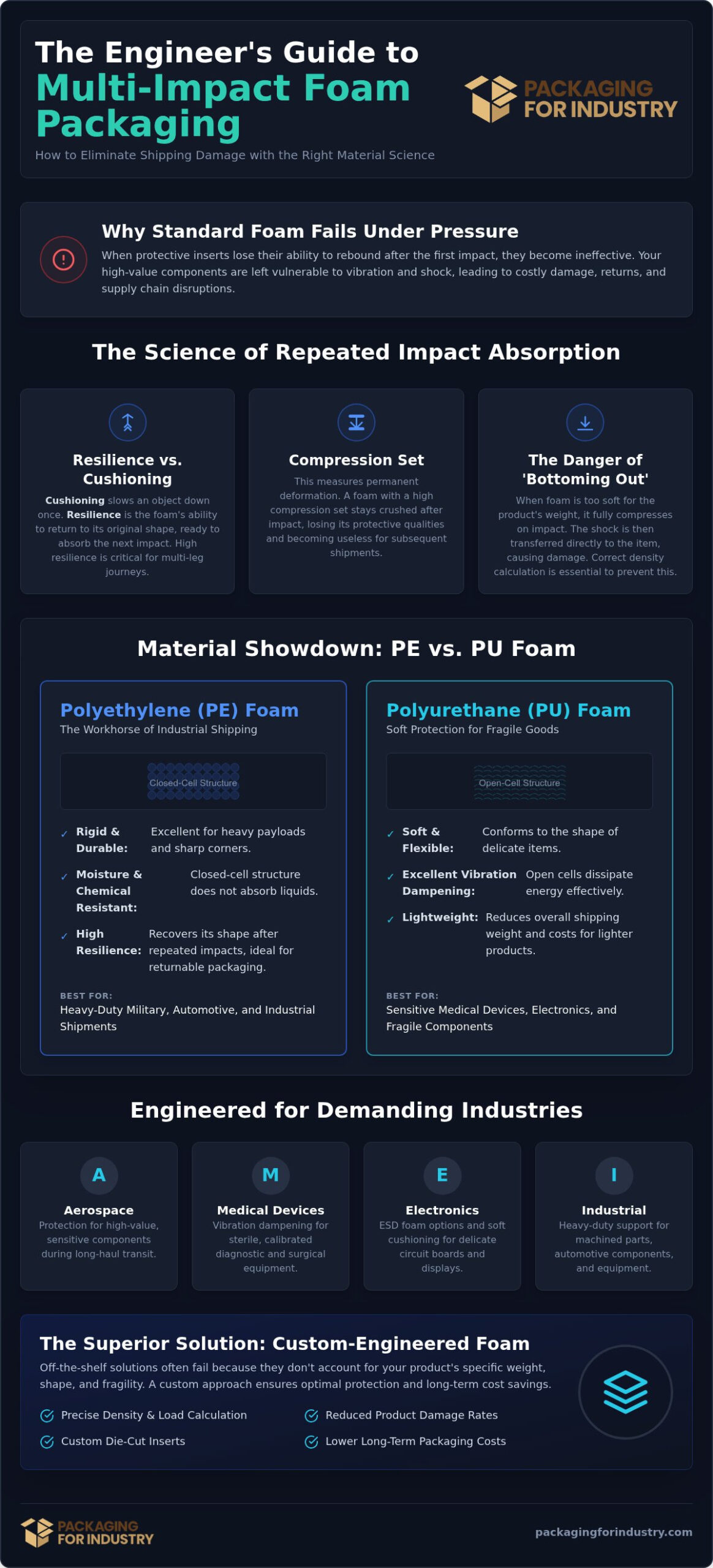
Impact absorption is the technical capacity of a material to dissipate kinetic energy so it doesn’t reach the product. In industrial logistics, this isn’t a one-time event. A shipment might face dozens of drops, vibrations, and shifts during a single transit cycle. If you’re asking what is the best foam for absorbing repeated impacts, you have to look beyond initial softness. You need a material with high resilience. While “cushioning” refers to the foam’s ability to slow down an object, “resilience” is its ability to return to its original shape after that compression. This recovery is what keeps your products safe during the fifth or tenth bump in the road.
A critical metric for any operations manager is the “compression set.” This refers to the permanent deformation a foam suffers after a load is applied. If a foam has a high compression set, it stays crushed and loses its protective qualities. This is why Expanded Polystyrene (EPS), commonly known as Styrofoam, is unsuitable for multi-impact cycles. EPS is a “one-hit” foam; its cells break upon impact to absorb energy. Once those cells are compromised, they offer zero protection for the next impact. For recurring shipments or returnable packaging, you must use materials that maintain their mechanical properties of foams over time.
Energy Dissipation vs. Energy Return
The way a foam manages air determines its effectiveness in high-vibration environments. Open-cell structures, like certain polyurethane foams, allow air to flow through the material, dissipating energy through pneumatic resistance. Closed-cell structures, such as polyethylene foam, trap air in individual cells, acting like thousands of tiny springs. High-rebound materials are essential for returnable packaging systems because they recover their shape almost instantly. This elasticity ensures the second impact is handled with the same precision as the first, which is vital for long-haul aerospace or medical logistics where damage isn’t an option.
The Danger of ‘Bottoming Out’
Selecting a foam that’s too soft for a product’s weight leads to a failure known as bottoming out. When the static load is too high, the foam compresses too far during a drop. As the material loses its effective thickness, the “G-factor” protection drops significantly, transferring the shock directly to the item. Bottoming out is the point where foam is fully compressed and no longer absorbs energy. To avoid this, PFI engineers calculate the specific gravity and weight distribution of your product to ensure the foam density matches the expected impact force, keeping your products suspended and safe.
Top Materials for Repeated Impact: PE vs. PU Foam
Deciding what is the best foam for absorbing repeated impacts often comes down to a choice between Polyethylene (PE) and Polyurethane (PU). These two polymers represent the industry standard; however, they serve very different logistical purposes. PE foam is characterized by its closed-cell structure, providing a rigid and durable barrier for heavy payloads. PU foam utilizes an open-cell architecture, offering the soft, spring-like flexibility needed for delicate items. Choosing the wrong material leads to either “bottoming out” or unnecessary bulk, both of which increase shipping costs and risk product damage.
While standard PE and PU cover most needs, high-end aerospace and medical applications often require Cross-linked Polyethylene (XLPE). This material offers a finer cell structure and superior aesthetic finish, making it ideal for clean-room environments or high-value instrument kits. Every industrial application has a specific “sweet spot” where material density meets product weight to ensure maximum energy dissipation over multiple transit legs.
Polyethylene (PE) Foam: The Workhorse of Industrial Shipping
PE is the standard for industrial environments because it resists moisture, chemicals, and repeated compression without losing its structural integrity. It’s the ideal material for custom foam inserts used in heavy-duty military and automotive shipments. Because the cells are sealed, PE doesn’t absorb liquids. This makes it a reliable choice for warehouses or distribution centers where environmental exposure is a constant factor. Its durability allows it to be used in returnable packaging programs, significantly lowering long-term packaging costs for recurring shipments.
Polyurethane (PU) Foam: Soft Protection for Fragile Goods
PU foam excels at vibration dampening, making it essential for sensitive medical devices and lightweight electronic components. In aerospace packaging, PU is often the preferred choice for delicate instruments that require a high degree of flexibility to prevent internal component shift. The material acts as a high-rebound cushion that recovers its shape almost instantly after a drop, ensuring the product remains suspended in the center of the box.
Most industrial PU foams are categorized as either ether-based or ester-based. Ether foams are typically better for humid environments as they resist breakdown from moisture; meanwhile, ester foams provide superior chemical resistance and higher tensile strength. If your product is lightweight but fragile, PU’s open-cell structure allows for controlled air movement, which acts as a consistent shock absorber during multiple impacts. To find the most cost-effective material for your specific application, you can request a packaging quote and compare technical specifications tailored to your product’s weight and fragility.
Key Technical Specifications: Density and Cell Structure
Technical performance in packaging is determined by density, which is measured in pounds per cubic foot. This metric serves as the primary indicator of a foam’s load-bearing capacity and durability. When you evaluate what is the best foam for absorbing repeated impacts, the answer depends entirely on the “Static Loading” of your product. To calculate this, divide the weight of the item by the surface area that contacts the foam. If the loading is too high for the chosen density, the material will fail to rebound, leaving your product vulnerable to subsequent shocks.
Cell structure also plays a decisive role in long-term reliability. Closed-cell foams, like polyethylene, feature sealed walls that trap air, providing a consistent energy-absorption curve over multiple shipping cycles. Open-cell foams, while softer, rely on air movement through the material. While open-cell is excellent for lightweight items, closed-cell structures generally handle repeated heavy compression better because the cell walls are more resistant to permanent deformation. Proper engineering must also account for drop height. A greater potential fall requires thicker foam, but the density must remain calibrated to the product’s weight to ensure the material actually compresses rather than acting like a solid brick.
Matching Density to Product Weight
For most industrial equipment, 1.7lb to 2.2lb polyethylene foam provides the optimal balance of protection and cost-effectiveness. It is a common mistake to assume that higher density always equals better protection. Over-specifying density can make the packaging too rigid, which increases the “G-force” transferred to the product upon impact. This rigidity prevents the foam from absorbing energy, potentially leading to internal component failure. Higher density directly increases the longevity of custom foam packaging by resisting the “crush” that occurs over dozens of transit legs.
Anti-Static and ESD Foam Considerations
Sensitive electronics require more than just physical shock protection; they need a controlled electrical environment. Utilizing ESD foam packaging is essential for components that face repeated impacts during assembly or shipping. These foams are typically treated with chemical additives, often identified by a pink color, that prevent the buildup of static electricity. This is a critical requirement for semiconductor and medical device manufacturers who must maintain strict compliance standards. PFI provides both PE and PU ESD options, ensuring that your protective inserts prevent both mechanical damage and electrostatic discharge without compromising material resilience.
Industrial Applications: From Aerospace to Medical Devices
Aerospace parts often travel through multiple distribution centers and transit legs before reaching their final assembly point. During this process, they face constant vibration and potential drops. Determining what is the best foam for absorbing repeated impacts for these heavy components requires a material that won’t bottom out over long transit legs. Polyethylene inserts are the standard here; they provide the necessary rebound for engines and airframe components that must arrive in pristine condition.
Medical devices require high-performance shock absorption while maintaining strict cleanliness standards. We often integrate specialized foam inserts into custom crates to protect sensitive surgical robots or diagnostic equipment. This combination ensures that the device remains calibrated and secure despite rough handling in the warehouse or during international shipping.
Automotive logistics and e-commerce fulfillment also benefit from engineered protection. Operations managers often ask what is the best foam for absorbing repeated impacts when designing returnable dunnage for automotive assembly lines. Using durable foam protects painted parts from scratches and repeated mechanical shifts during transport. Meanwhile, fulfillment centers use advanced cushioning materials to reduce return rates, which directly improves profit margins and customer satisfaction.
Aerospace and Military Packaging Standards
Defense contractors face strict military packaging specifications that leave no room for error. These standards require materials that survive extreme environmental shifts and repeated rough handling. For these high-stakes shipments, PFI designs custom foam lined crates that pass rigorous drop tests. Manufacturers across Southern California rely on PFI’s expertise to ensure mil-spec compliance and avoid the financial penalties associated with damaged government property. Our proximity to major hubs like Anaheim and Los Angeles allows for rapid prototyping and local next-day delivery, ensuring that your aerospace projects stay on schedule.
High-Volume Manufacturing and VMI
Maintaining a consistent supply of foam is just as important as the foam’s quality itself. Our Vendor Managed Inventory (VMI) programs ensure that production lines never stop due to a lack of inserts. By streamlining packaging for manufacturers, we help businesses lower operational overhead and focus on their core competencies. Consistent foam quality across every shipment reduces long-term costs by providing a predictable level of protection for every unit that leaves the facility. This proactive approach to supply reliability eliminates the stress of stockouts and protects your bottom line.
Why Custom Foam Engineering from PFI is the Best Solution
Packaging For Industry (PFI) bridges the gap between engineering and economics by designing inserts that maximize protection while minimizing material waste. While technical data helps determine what is the best foam for absorbing repeated impacts, the physical execution requires a partner capable of translating those specs into a functional, cost-effective product. We provide custom sizes available for any payload, from small medical sensors to massive aerospace assemblies. By integrating these inserts with custom corrugated boxes, PFI acts as a single-source industrial packaging supplier that simplifies your procurement process and ensures total accountability for the arrival condition of your goods.
Our goal is to help you lower packaging costs by right-sizing your protection. We don’t believe in the one-size-fits-all approach found in large catalogs. Instead, we look at the specific transit challenges your product faces and engineer a solution that targets those exact stress points. This proactive approach to design is what differentiates PFI as a custom packaging supplier that values long-term reliability over high-volume catalog sales.
The PFI Design and Prototyping Process
Our design methodology centers on a comprehensive packaging review to identify where your current system is failing. We use CAD/CAM support to create die-cut foam inserts that provide an exact fit, eliminating the internal movement that often leads to shipping damage. We invite manufacturing teams to compare packaging pricing against their current damage rates; often, a small investment in custom engineering leads to massive long-term savings. Our free prototyping service allows you to test custom foam inserts in real-world conditions, providing peace of mind before you finalize a custom packaging quote for high-volume production. This ensures that the final packaging for manufacturers is validated and optimized for the specific rigors of your distribution cycle.
Next-Day Delivery and Local Support in SoCal
Reliability in the supply chain is often a matter of geography. As a local packaging supplier based in Anaheim, PFI offers next-day delivery across Orange County, Los Angeles, and the Inland Empire. This proximity allows us to provide aggressive bulk packaging pricing by eliminating the excessive freight costs associated with shipping foam from out-of-state. Whether you need a San Diego packaging supplier or a partner for packaging delivery in Los Angeles, our local presence means we can provide on-site support and rapid design iterations. Choosing PFI as your industrial packaging supplier near me ensures that your warehouse stays stocked and your production lines remain moving without the risk of lead-time surprises.
Secure Your Shipments with Precision-Engineered Foam
Identifying what is the best foam for absorbing repeated impacts is a technical decision that directly influences your operational efficiency and bottom line. By selecting high-resilience materials like polyethylene or polyurethane and matching them to your product’s specific static load, you can virtually eliminate bottoming out failures during transit. This strategic approach to packaging design not only reduces shipping damage but also lowers the high costs associated with replacing one-time-use materials.
PFI provides the specialized engineering expertise needed to secure your high-value aerospace and medical device shipments. It’s our priority to offer free prototyping for all custom designs to ensure a perfect fit before mass production begins. With local next-day delivery across Southern California, we help you maintain supply reliability and minimize the professional stress of transit failures. We are ready to help you optimize your industrial logistics and achieve tangible cost savings through precision-engineered solutions.
We look forward to partnering with you to solve your most complex packaging challenges and improve your supply chain durability.
Frequently Asked Questions
What is the best foam for repeated impacts in shipping?
Polyethylene (PE) foam is the industry standard for high-durability requirements due to its closed-cell structure. As a leading bulk packaging supplier, PFI recommends PE for heavy-duty aerospace and automotive parts that require high rebound. By matching the foam density to your product’s static load, we help you lower packaging costs and reduce shipping damage over multiple transit cycles, ensuring your high-value goods remain protected.
How do I request a foam packaging quote for custom inserts?
You can request a foam packaging quote by submitting your product specifications and drop-test requirements through our online portal. Our engineering team provides free prototyping to ensure your custom inserts fit perfectly before mass production begins. PFI focuses on high-volume industrial needs, offering bulk packaging pricing that is significantly more competitive than large national catalog suppliers, especially for recurring manufacturing and distribution orders.
Why should I look for an industrial packaging supplier near me in Southern California?
Partnering with an industrial packaging supplier near me like PFI in Anaheim provides significant logistical advantages, including local next-day delivery and on-site packaging reviews. We serve Orange County, Los Angeles, and the Inland Empire with a full range of supplies from custom corrugated boxes to protective foam. This local proximity reduces lead times and freight expenses, helping Southern California businesses improve their supply chain reliability and overall operational flow.
Are custom sizes available for bulk foam orders?
Yes, we have custom sizes available for all protective inserts, and we encourage customers to compare packaging pricing based on material efficiency. Instead of using oversized stock boxes, our engineered solutions use the exact amount of foam required for your product’s weight. This approach minimizes dimensional weight surcharges from carriers like FedEx and UPS, directly contributing to a more cost-effective and sustainable shipping strategy for your warehouse.
Is anti-static foam necessary for bulk electronic shipments?
Anti-static (ESD) foam is mandatory for electronic components to prevent damage from electrostatic discharge during handling and transit. As a specialized packaging distributor, PFI stocks pink anti-static polyethylene and polyurethane foams that comply with semiconductor and medical device standards. These materials provide the same high-rebound impact protection as standard foams while ensuring your sensitive internal circuits remain functional and safe from invisible electrical damage throughout the distribution cycle.
Does PFI offer local packaging delivery for urgent orders?
PFI provides local packaging delivery across Southern California, including Irvine, Santa Ana, and Huntington Beach. Our Vendor Managed Inventory (VMI) programs are designed to eliminate stockouts for high-volume manufacturers by monitoring your usage and replenishing supplies automatically. This proactive service ensures you always have a reliable supply of wholesale packaging supplies on hand, allowing your production team to focus on manufacturing rather than managing inventory levels.
What information is needed for an industrial packaging supplier near me to start a design?
To receive an accurate industrial packaging supplier near me quote, you should provide the product’s weight, dimensions, and known fragility (G-factor). This technical data allows our designers to select the appropriate foam density and thickness to prevent bottoming out. By leveraging PFI’s local engineering support, you can quickly iterate on designs and move from a prototype to a final, high-performance protective solution that meets your specific transit requirements.
Can I use EPS for products that face multiple impacts?
EPS is a one-time-use material that breaks upon impact and is not suitable for repeated impact cycles. For recurring shipments or returnable dunnage, you should contact a bulk packaging supplier for resilient alternatives like polyethylene. These materials are engineered for longevity, allowing them to be reused across multiple shipping legs without losing their protective properties. This durability makes them a much more sustainable and fiscally responsible choice for modern industrial logistics.