
Is the lowest unit price on a corrugated box actually the most expensive choice for your bottom line? Many manufacturers and warehouse managers discover too late that cheap materials lead to rising freight costs and frequent product damage during transit. If you’re tired of unpredictable lead times causing production delays, it’s time to quantify your supply chain’s efficiency. Learning how to create a supplier scorecard for your packaging vendor allows you to move beyond basic price comparisons and focus on industrial performance.
You likely agree that a reliable partner is worth more than a discount catalog, yet without a standardized system, it’s difficult to hold suppliers accountable. This guide provides a clear roadmap to building a data-driven scorecard that reduces shipping damage and ensures your packaging supplier meets rigorous standards. We’ll explore the essential KPIs for measuring transit integrity, the financial impact of VMI and JIT programs, and how to manage upcoming regulatory shifts like the ISO 9001:2026 update and California’s SB 343 labeling laws.
Key Takeaways
- Shift your focus from price-per-unit to the total cost of ownership. This ensures you account for hidden expenses like transit damage and freight inefficiencies.
- Learn exactly how to create a supplier scorecard for your packaging vendor by weighting critical KPIs like defect rates and on-time delivery.
- Establish clear benchmarks for material compliance, such as Edge Crush Test (ECT) and burst strength, to prevent product damage during shipping.
- Identify where Vendor Managed Inventory (VMI) or Just-In-Time (JIT) programs can eliminate stockouts and production stops.
- Use scorecard data during Quarterly Business Reviews to negotiate better terms and drive continuous performance improvements from your industrial packaging supplier.
Why a Packaging Supplier Scorecard is Essential for Operational Efficiency
A packaging supplier scorecard is more than a simple performance review; it’s a strategic framework designed to align your vendor’s output with your operational goals. For manufacturers and distribution centers, supplier evaluation ensures that every dollar spent on materials contributes to supply chain stability. Understanding how to create a supplier scorecard for your packaging vendor allows you to move past the surface level of invoicing and analyze how packaging impacts your entire facility. This is a strategic tool. It’s particularly critical in high-stakes sectors like aerospace and medical device manufacturing, where a single defective box or a missed delivery can halt production or jeopardize high-value components.
By shifting the focus from price-per-unit to the Total Cost of Ownership (TCO), you begin to see packaging as a component of engineering rather than just a commodity. A scorecard acts as a risk mitigation tool, highlighting where an industrial packaging supplier might be underperforming in areas that aren’t immediately visible on a balance sheet. It provides the data you need to hold partners accountable.
Identifying Hidden Costs in Your Packaging Supply Chain
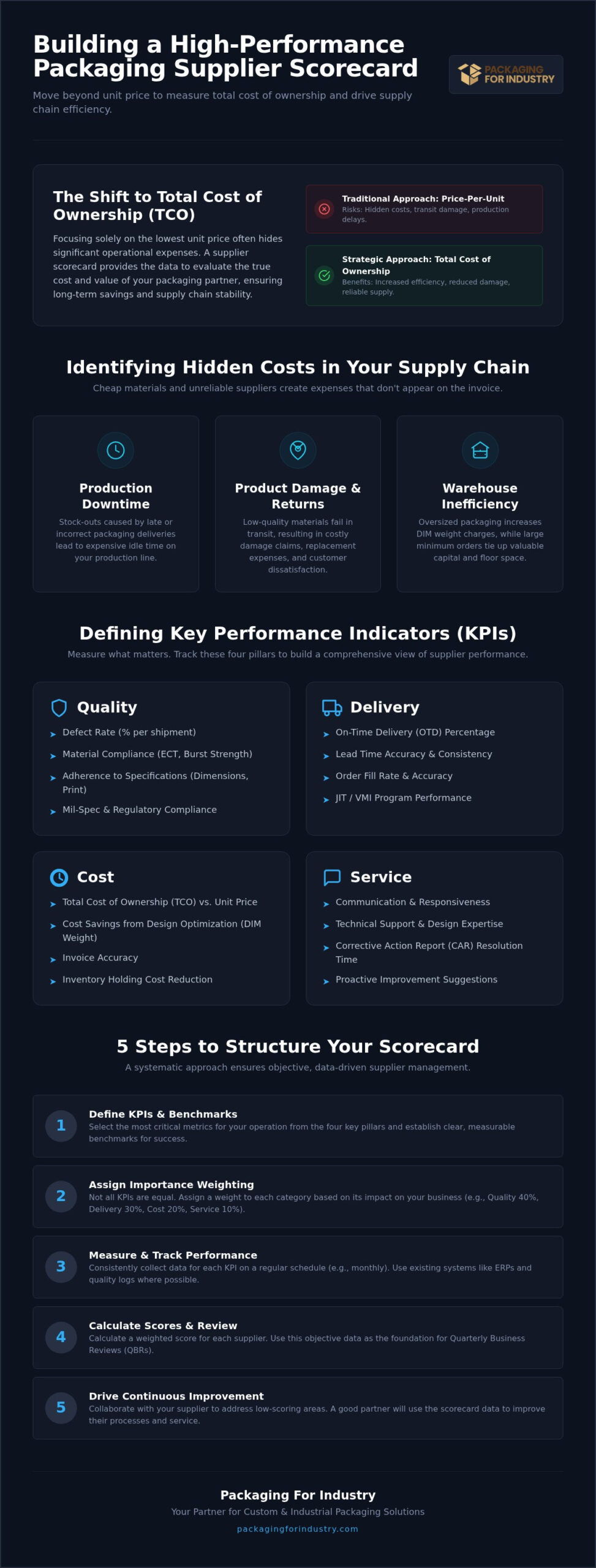
Hidden costs often lurk in the gaps between procurement and shipping. One of the most common drains on a budget is oversized packaging. When boxes aren’t optimized for the product, you pay for “shipping air” through excessive dimensional weight (DIM) charges. A scorecard tracks these inefficiencies, forcing a focus on packaging cost savings through better design. Consider these common operational leaks:
- Production Downtime: If a custom corrugated box isn’t available when the line is running, the resulting “stock-out” creates expensive idle time.
- Damage Claims: Cheap materials might save pennies on the quote, but they often lead to thousands in transit damage and replacement costs.
- Warehouse Inefficiency: Vendors who require massive bulk orders to hit a price point effectively use your floor space as their warehouse, tying up your capital.
Moving Beyond Price-Per-Unit Benchmarking
The lowest quote often hides the highest total cost. When you learn how to create a supplier scorecard for your packaging vendor, you gain the data needed to justify a higher-quality partner over a budget catalog. Lead times and responsiveness are critical metrics. A vendor who delivers in 24 hours is significantly more valuable than one who takes two weeks, even if their unit price is slightly higher. You should also measure the value of custom design packaging and free prototyping, as these services prevent costly trial-and-error in the field.
Defining Key Performance Indicators (KPIs) for Packaging Vendors
Packaging isn’t just a commodity; it’s an engineered protective system. To ensure your products arrive intact, your scorecard must track specific material performance rather than generic satisfaction ratings. Learning how to create a supplier scorecard for your packaging vendor requires a deep dive into technical data that impacts your bottom line. You need to measure four primary pillars: quality, delivery, cost, and service. When these metrics are clearly defined, you can hold your industrial packaging supplier to a higher standard of accountability.
Quality Metrics: Beyond Visual Inspection
Visual checks aren’t enough to guarantee transit integrity. Your scorecard should track material compliance through specific tests like the Edge Crush Test (ECT) and Burst Strength (Mullen test). These metrics determine if a corrugated box will collapse under pallet pressure or puncture during handling. For high-value electronics or medical devices, you must measure material consistency for custom foam inserts, ensuring density and ESD properties meet your exact specifications. If your business operates in defense, adherence to military packaging standards is a non-negotiable quality KPI. Tracking the defect rate per shipment helps identify if a vendor’s quality control is slipping before it results in a major damage claim.
Logistics and Reliability: Meeting Just-In-Time Requirements
Reliability is measured by a vendor’s ability to support just-in-time inventory management. If your production line stops because a custom box isn’t available, the cost of that downtime far outweighs any minor material savings. Track On-Time Delivery (OTD) rates meticulously. You should also monitor lead-time accuracy and the frequency of emergency orders or rush shipping fees. A late shipment of stretch film or pallets can cause a bottleneck in your warehouse that ripples through your entire distribution network. Accuracy in documentation also matters; frequent errors on packing slips or invoices create administrative friction that slows down your operations.
Price stability is a critical cost KPI, but you should also measure a vendor’s proactive cost-reduction initiatives. Does your supplier suggest material alternatives that maintain protection while lowering shipping weight? This type of engineering support is a hallmark of a true partner. If you’re looking to benchmark your current vendor’s performance against industry standards, you can request a packaging quote to see how a data-driven approach impacts your total cost of ownership. Understanding how to create a supplier scorecard for your packaging vendor ensures you aren’t just buying supplies, but investing in a reliable supply chain.
A Step-by-Step Guide to Structuring Your Scorecard
Building a functional scorecard requires more than just a list of numbers; it needs a hierarchy that reflects your specific operational risks. When you determine how to create a supplier scorecard for your packaging vendor, you must first decide which performance areas carry the most weight. A one-size-fits-all approach doesn’t work for complex industrial supply chains. You need a tool that identifies where a packaging supplier is adding value and where they are creating bottlenecks. By assigning specific weights and benchmarks, you turn raw data into actionable business intelligence.
Weighting Your Metrics Based on Industrial Priorities
Not all metrics are created equal. Your weighting should mirror the impact a failure has on your bottom line. For instance, quality should be weighted significantly higher for high-value aerospace packaging, where a material failure could jeopardize multi-million dollar components. In contrast, a fulfillment center might weigh delivery speed and stock availability more heavily to prevent shipping delays. A common, balanced weighting strategy for an industrial packaging supplier involves:
- Quality (40%): Defect rates, material compliance, and transit integrity.
- Delivery (30%): On-time delivery rates and lead-time accuracy.
- Cost (20%): Price stability and total cost of ownership (TCO) initiatives.
- Service and Innovation (10%): Engineering support and responsiveness to custom requests.
Establishing a Rating Scale for Objective Evaluation
To keep evaluations objective, you must establish a standardized rating scale. Quantitative metrics, such as OTD and defect rates, are easy to track with percentages. However, qualitative metrics like “Engineering Support” require a 1-5 scale to remain consistent. For example, a “5” might represent a vendor that provides free prototyping and suggests packaging cost savings through material optimization. A “1” would indicate a vendor that only offers stock sizes and fails to respond to technical inquiries.
Benchmarks are only effective if they have consequences. You must create “Red Flag” thresholds that trigger a mandatory Corrective Action Plan. If a vendor’s OTD score falls below 95% for two consecutive months, the scorecard should automatically prompt a formal review. This ensures that issues are addressed before they cause a production stop. Consistency is the final requirement. Decide on a data collection period, such as monthly or quarterly, and assign ownership to a specific lead within your procurement or operations team. This person is responsible for aggregating data from receiving, quality control, and accounting to ensure the scorecard remains a reliable source of truth. Following this structured approach ensures that when you learn how to create a supplier scorecard for your packaging vendor, you are building a system that actively lowers costs and improves supply reliability.
Analyzing Results and Driving Supplier Performance Improvements
Data collection is only the first stage of the process. The real value of a scorecard lies in how you use that data to drive operational change. When you understand how to create a supplier scorecard for your packaging vendor, you gain the leverage needed to negotiate better terms and stocking programs. These results shouldn’t just sit in a spreadsheet; they should be the centerpiece of your Quarterly Business Reviews (QBRs). Use these meetings to move beyond transactional purchasing and hold your industrial packaging supplier accountable for the physical reality of your warehouse floor.
The Feedback Loop: Turning Data into Action
Transparency is essential for any successful partnership. Share the scorecard results with your vendor to encourage a culture of continuous improvement. If the data shows a high rate of transit damage, set collaborative goals for reduction. For instance, you might challenge your vendor to lower damage claims by 10% through better material engineering. High-performing vendors should be rewarded. If a supplier consistently hits their KPIs, consider rewarding them with larger contract volumes or moving them into a preferred status. This incentive structure ensures your most reliable partners are the ones growing with you.
Scorecard data is also a powerful tool for identifying packaging cost savings. If you notice rising freight costs, it’s often a sign that your current box sizing is inefficient. Use the scorecard to demand engineering support. A proactive partner will suggest custom corrugated boxes that reduce dimensional weight while maintaining protection. This is often the point where manufacturers realize they’ve outgrown a basic “catalog” supplier and need a dedicated custom solutions provider who understands industrial logistics.
When to Seek a New Custom Packaging Partner
Sometimes, the data reveals chronic failure patterns that no amount of collaboration can fix. If your vendor repeatedly misses delivery windows or provides inconsistent material quality, they are a direct threat to your production timeline. Evaluate whether your current partner can scale with your manufacturing needs as your volume increases. Staying with a failing vendor in a high-demand market is a risk that leads to stock-outs and lost revenue. When you know how to create a supplier scorecard for your packaging vendor, you have the objective evidence required to justify a switch to a more reliable, local packaging supplier who prioritizes your supply chain stability.
Optimizing Your Supply Chain with PFI’s Managed Packaging Solutions
If you’ve followed the steps on how to create a supplier scorecard for your packaging vendor, you now have the data to distinguish between a simple vendor and a strategic partner. PFI doesn’t just supply materials; we engineer systems that ensure you never fail your own internal metrics. We focus on the intersection of engineering and economics to deliver high-performance results that look as good on a scorecard as they do on your bottom line. We understand that for manufacturers and distributors, reliability is the only metric that truly matters when production is on the line.
Leveraging VMI to Eliminate Stock-Outs
One of the most common red flags on a scorecard is the “stock-out.” When a production line stops because a custom box isn’t available, the cost of downtime is catastrophic. PFI’s Vendor Managed Inventory (VMI) program automates high performance in this category. We manage your corrugated boxes inventory levels on-site, ensuring you always have what you need without the risk of running dry. This approach frees up valuable warehouse floor space in Anaheim and Los Angeles, allowing you to use that square footage for production instead of storage. It also improves your cash flow. You only pay for the materials you actually use, effectively shifting the burden of inventory management and capital tie-up to us.
Why Local Proximity Matters for Scorecard Success
Distance is often the enemy of a high delivery score. Long shipping lanes lead to unpredictable lead times and higher freight costs that eat into your margins. PFI provides local next-day delivery across Orange County and Southern California, which drastically reduces your lead-time variables and ensures supply continuity. Proximity also allows for more collaborative engineering. We perform on-site packaging reviews to identify where material adjustments can eliminate transit damage before it reaches your customer. If you have a complex industrial project, our team provides rapid prototyping and custom-engineered solutions using materials like high-density foam or heavy-duty corrugated. This proactive service model ensures that when you assess how to create a supplier scorecard for your packaging vendor, PFI consistently meets or exceeds your performance thresholds.
Don’t settle for a vendor that merely “checks the box.” Use your new scorecard data to request a packaging quote and benchmark your current supplier against PFI’s industrial standards. We provide the reliability, precision, and local support required to optimize your entire supply chain and lower your total cost of ownership.
Secure Your Supply Chain with Data-Driven Oversight
Implementing a rigorous evaluation system is the only way to stop hidden costs from eroding your operational margins. By mastering how to create a supplier scorecard for your packaging vendor, you transition from reactive purchasing to proactive supply chain management. This process ensures your materials meet the high performance standards required for aerospace and industrial applications while identifying specific opportunities to reduce shipping damage.
PFI supports your scorecard goals through specialized custom engineering and local next-day delivery across Southern California. Our VMI and JIT programs are designed to eliminate the stock-outs and production stops that frequently plague generic catalog suppliers. We provide the technical expertise and logistical reliability needed to lower your total cost of ownership and improve your warehouse efficiency. You don’t have to manage these complexities alone when you have a partner focused on your long-term success.
Let’s build a more efficient and dependable packaging system for your business today.
Frequently Asked Questions
What are the most important KPIs for a packaging vendor?
The most critical KPIs focus on quality, delivery reliability, and total cost of ownership. You should track defect rates and material compliance, such as Edge Crush Test (ECT) results, to ensure transit integrity. On-time delivery (OTD) rates are equally vital to prevent production stops. By monitoring these metrics, you can hold your industrial packaging supplier accountable for the physical performance of their materials rather than just the unit price on the invoice.
How often should I review my packaging supplier’s scorecard?
Strategic reviews should happen quarterly, but data collection must be a monthly habit. Frequent data gathering allows you to identify performance trends before they cause significant shipping damage or production delays. For businesses in Southern California, local proximity enables more frequent on-site reviews. This regular cadence ensures that any issues with custom corrugated boxes or stretch film are addressed quickly, maintaining a stable and efficient supply chain.
Can a scorecard really help me lower my packaging costs?
A scorecard lowers costs by exposing hidden expenses that a simple invoice doesn’t show. When you learn how to create a supplier scorecard for your packaging vendor, you can track costs related to oversized boxes, freight surcharges, and transit damage. Reducing these inefficiencies often results in higher savings than a minor discount on materials. It shifts your focus toward total cost of ownership, which is essential for long-term fiscal responsibility.
What is the difference between a catalog supplier and a custom packaging distributor?
Catalog suppliers sell stock items with no engineering support or inventory management. In contrast, a custom packaging distributor like PFI provides engineered solutions and managed programs. We design protection specifically for your products, such as custom foam inserts or heavy duty corrugated boxes. While catalog sellers focus on one-time transactions, a custom partner focuses on optimizing your entire operation through services like VMI and next-day local delivery across Orange County.
How do I measure ‘Quality’ for industrial corrugated boxes?
Quality for corrugated boxes is measured through technical performance standards rather than visual checks. You should track the Edge Crush Test (ECT) rating to ensure stacking strength and the Mullen burst test to measure puncture resistance. Consistent dimensions and material density are also critical for automated packing lines. PFI ensures all custom corrugated boxes meet these industrial specs to prevent product damage and ensure reliable performance in demanding shipping environments.
What should I do if my packaging supplier fails their scorecard review?
Start by issuing a formal Corrective Action Plan (CAP) that outlines the specific failures and required improvements. A professional vendor will use this feedback to adjust their processes or engineering. However, if chronic issues like late deliveries or material defects persist, it’s time to evaluate new partners. Transitioning to a reliable industrial packaging supplier near Los Angeles can protect your production schedule and prevent the professional stress of recurring supply shortages.
Is it worth creating a scorecard for a small-volume packaging account?
It is absolutely worth it if those materials are critical to your production line. Even a small volume of custom foam or specialized crates can halt your operations if they arrive late or defective. The complexity of the item often matters more than the volume. Using a scorecard for critical, low-volume components ensures that your vendor prioritizes your account and maintains the high standards required for aerospace or medical device protection.
How does Vendor Managed Inventory (VMI) affect supplier scoring?
Vendor Managed Inventory (VMI) significantly improves scores for delivery and stock availability. Because the supplier monitors your inventory on-site, the risk of stock-outs is virtually eliminated. This proactive management automates high performance on your scorecard. PFI’s VMI programs in Southern California ensure that your corrugated boxes and stretch film are always ready for use, which simplifies your purchasing process and ensures your production line never stops due to a shortage.