
A single puncture doesn’t just damage a box; it compromises the safety of your entire supply chain and triggers costly shipping surcharges. When you’re shipping industrial components like machined parts or metal brackets, standard off-the-shelf containers often fail under the pressure of a sharp point. Investing in custom packaging design for products with sharp edges isn’t just about protection; it’s a strategic move to eliminate worker injury claims and stop the bleed of additional handling fees. You’ve likely seen how quickly a jagged edge can slice through double-wall corrugated, leading to rejected shipments and frustrated customers.
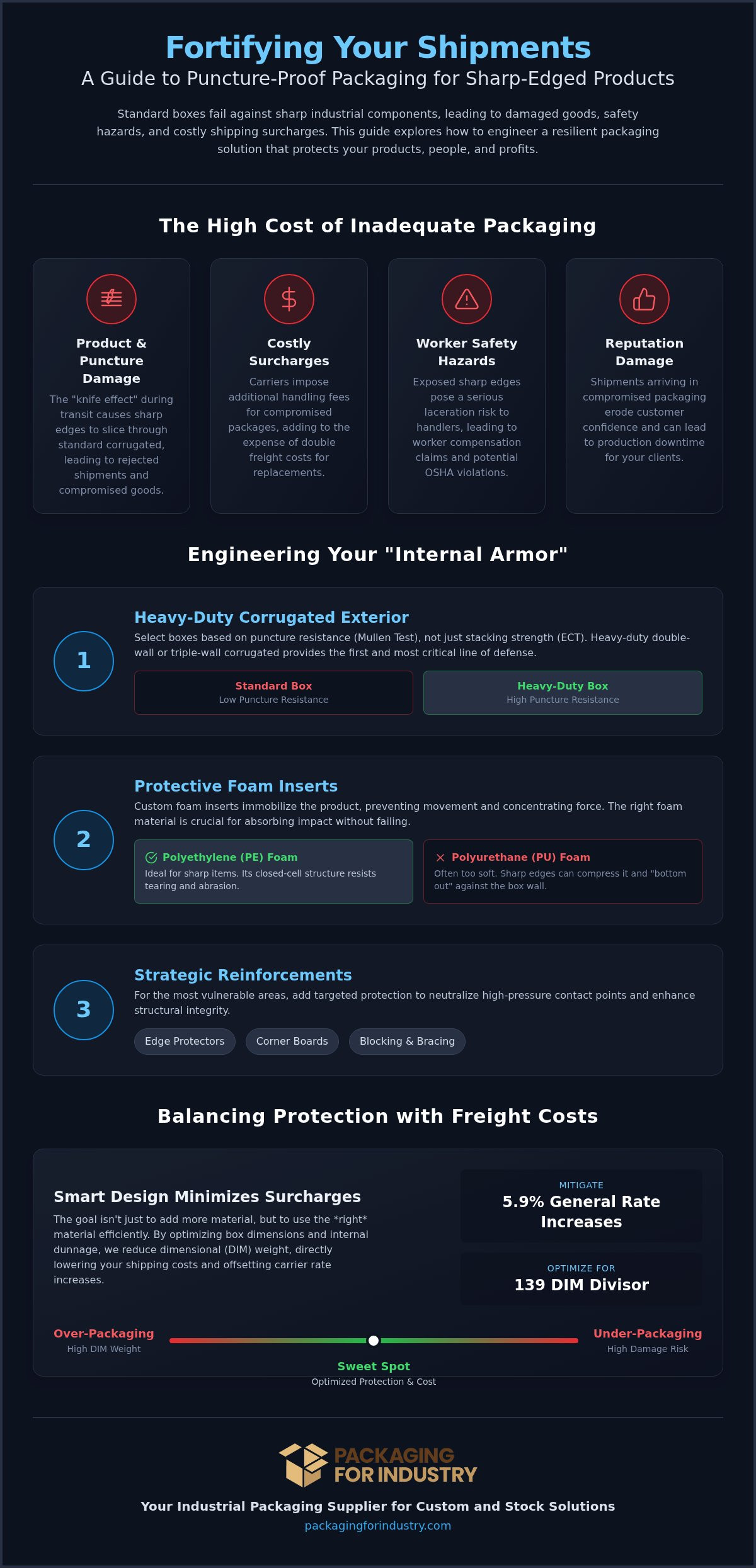
We understand that your goal is to achieve zero damage while keeping freight costs manageable in a 2026 market where carriers have implemented a 5.9% general rate increase. This guide will show you how to engineer high-performance packaging that neutralizes puncture points and optimizes dimensional weight. We’ll explore how to use heavy-duty corrugated, custom foam inserts, and edge protection to create a reliable “Internal Armor” for your most difficult items. From meeting the updated ISTA 3E-2026 testing standards to navigating the current 139 DIM divisor, you’ll learn exactly how to build a more resilient and cost-effective shipping operation.
Key Takeaways
- Identify when to specify heavy-duty double-wall or triple-wall corrugated materials to prevent industrial components from puncturing their containers.
- Discover how custom packaging design for products with sharp edges uses blocking, bracing, and edge protectors to neutralize high-pressure contact points.
- Learn to select between polyethylene and polyurethane foam to create a protective internal environment that ensures worker safety during unboxing.
- Minimize freight expenses by balancing protective material thickness with optimized box dimensions to reduce dimensional weight surcharges.
- Utilize free prototyping services to validate fit and performance, ensuring your custom solution meets rigorous industrial shipping standards.
Understanding the Risks of Shipping Products with Sharp Edges
Standard RSC boxes are designed for uniform weight distribution, not concentrated pressure points. When an industrial component with a jagged profile or sharp corner is placed inside a standard container, the vibrations inherent in truckload shipping create a constant sawing motion. This “knife effect” eventually breaches the corrugated wall. Once the exterior is compromised, the product is exposed to moisture, debris, and potential theft. Effective custom packaging design for products with sharp edges must account for these dynamics to prevent structural failure before the shipment reaches its destination.
The technical challenge lies in puncture resistance. While many distributors focus on the Edge Crush Test (ECT) to ensure boxes don’t collapse when stacked, ECT doesn’t measure how well a material resists piercing. For sharp-edged items, the Mullen Test (bursting strength) is often a more accurate metric. It measures the force required to rupture the liner board. Our team at PFI initiates every project with a comprehensive design audit. We analyze your current failure points to see where the internal pressure is most prominent. This allows us to suggest targeted improvements rather than simply over-packaging the entire unit.
Failing to address these risks leads to hidden costs that impact your bottom line:
- Rejected shipments and double freight costs for replacements
- Production line downtime for your customers waiting on intact parts
- Administrative labor spent filing and tracking freight claims
- Brand reputation damage from shipments that arrive looking compromised
Structural Failure and Internal Puncture Damage
Industrial components often shift during transit if the internal dunnage is insufficient. When a heavy metal part with a sharp edge slides, its kinetic energy is focused on a tiny surface area, resulting in an outward puncture. With 2026 general rate increases averaging 5.9%, you can’t afford the added expense of shipping replacement parts because of a preventable packaging failure. Utilizing heavy duty corrugated boxes with higher bursting strengths provides the necessary barrier to keep products contained and protected.
Safety Liability and Handler Protection
Protecting the product is only half the battle; safety is a primary concern for warehouse managers. A sharp edge that has breached its box is a hidden hazard that can cause severe lacerations during unboxing or manual handling. These incidents lead to high worker compensation claims and potential OSHA violations. By implementing custom packaging design for products with sharp edges through custom design packaging, you proactively reduce your liability. Engineered solutions like multi-wall corrugated and reinforced corners ensure that sharp points remain contained, protecting every person who touches the shipment from the factory floor to the end-user.
Selecting High-Performance Materials for Puncture Resistance
Selecting the correct substrate is the first defense against transit damage. In custom packaging design for products with sharp edges, the goal is to create a barrier that can withstand concentrated pressure. While standard single-wall containers are sufficient for lightweight consumer goods, industrial components require heavy-duty corrugated materials. Double-wall boxes offer two layers of fluting for added rigidity, but triple-wall solutions are often necessary for heavy, jagged parts. These materials don’t just provide stacking strength; they offer the high bursting strength required to keep sharp points from piercing the exterior liner.
Beyond the box, internal cushioning plays a vital role. High-density protective foam packaging is essential for immobilizing the product. Polyethylene (PE) foam is the industry standard for sharp items because its closed-cell structure resists tearing and abrasion better than softer alternatives. In contrast, polyurethane (PU) foam is often too compliant; a sharp edge can easily compress it until it “bottoms out” against the cardboard. For maximum protection, you can also utilize custom poly bags as a secondary layer to prevent surface scratches and contain any small fragments.
Heavy-Duty Corrugated: Triple-Wall Solutions
Triple-wall corrugated is engineered for the most demanding industrial applications. It consists of three fluted layers and four liner boards, providing a thickness that is nearly impossible to puncture under normal shipping conditions. This material is a cost-effective alternative to wood crates for many aerospace and manufacturing components. It also offers superior weather resistance when treated with specialized coatings, making it ideal for international transit where humidity can weaken standard cardboard. If you’re unsure which grade fits your application, you can compare packaging pricing for different material weights to find the most economical balance of safety and cost.
Custom Foam Inserts for Product Immobilization
Engineering the internal environment requires more than just loose fill. Custom die-cut foam inserts are designed to encapsulate sharp points, effectively neutralizing them. By using custom foam inserts, you can create a “floating” environment where the product never touches the outer box walls. This design philosophy aligns with USPS packaging requirements for sharp-edged instruments, which mandate strong containers and sufficient cushioning. For sensitive electronics with sharp heat sinks or connectors, anti-static (ESD) foam provides both physical protection and defense against electrostatic discharge.
Engineering the Internal Packaging Environment
Engineering a secure internal environment is the critical next step after selecting your base materials. In custom packaging design for products with sharp edges, the primary objective is total immobilization. If an industrial component shifts even slightly during transit, its sharp points act as levers against the container walls. We utilize CAD/CAM technology to design internal structures that match the exact geometry of your product. This precision ensures that high-pressure points are held away from the corrugated liners, effectively neutralizing the risk of “strike zone” punctures before they occur.
For items with extreme weight or aggressive sharpness, we often recommend custom wood crates. These provide a level of puncture resistance that even heavy-duty triple-wall corrugated cannot match. By combining these rigid exteriors with precise internal blocking, we ensure that even the most irregularly shaped parts remain stationary. This methodical approach to engineering reduces the need for excessive “fluff” materials, which helps lower your overall packaging costs while simultaneously improving protection.
Internal Corner and Edge Protection Strategies
Standard boxes often fail when sharp edges slice through the corners from the inside out. By applying corner and edge protection internally, you reinforce the most vulnerable areas of the carton. Angle board is particularly effective in these applications; it distributes the load across the entire height of the container rather than allowing force to concentrate on a single point. For long, thin components with sharp ends, such as industrial spindles or blades, we often integrate custom-length mailing tubes as internal structural supports. These tubes provide a circular barrier that is naturally resistant to outward piercing and keeps the product centered.
Custom Blocking and Bracing Techniques
Heavy machinery with sharp protrusions requires a robust anchoring system to prevent lateral movement. We utilize heavy-duty skids and custom pallets to bolt or strap these items securely. An essential part of our design process involves determining the “G-factor,” which is the maximum deceleration a part can handle without sustaining damage. To secure a sharp-edged part effectively, we follow a specific sequence using custom foam packaging. We first identify the center of gravity to ensure the load is balanced on the pallet. We then apply blocking foam to the flat, non-sharp surfaces to arrest movement. Finally, we brace the sharp edges with high-density foam inserts that provide a mandatory clearance gap between the sharp point and the outer box wall.
Balancing Protection with Dimensional Weight and Freight Costs
Industrial logistics in 2026 requires a strict focus on dimensional weight. With the standard DIM divisor now uniform at 139 across UPS, FedEx, and USPS, oversized containers are a liability. Carriers are increasingly using automated scanning technology to capture dimensions, leading to a higher frequency of billing corrections for inaccurate declarations. When implementing custom packaging design for products with sharp edges, the objective is to minimize external volume without compromising the internal safety buffer. Over-packaging often happens when using stock boxes that don’t fit the product, forcing teams to use excessive void fill to stop movement. This increases the billable weight of the package, often by 10% to 30% depending on your negotiated carrier rates.
We focus on the total landed cost of your shipment rather than just the price of the materials. While a heavy-duty triple-wall box has a higher unit price than a standard RSC, it often allows for a smaller overall footprint. By eliminating the need for three inches of “safety” bubble wrap on every side, you can fit more units on a single pallet. This optimization is critical for meeting ISTA 3E-2026 standards for unitized loads while keeping freight expenses under control. Implementing Vendor Managed Inventory (VMI) further enhances these savings by ensuring you always have the right custom sizes on hand without tying up warehouse capital.
Right-Sizing to Avoid Freight Surcharges
Finding the “sweet spot” between protection and size is a precise engineering challenge. Our design team uses CAD software to ensure custom corrugated boxes provide exactly the clearance needed for sharp points to remain safe. This precision eliminates the waste associated with generic packaging. When you reduce the box size by even two inches in one dimension, you can often drop into a lower freight tier. This helps you avoid the aggressive surcharges that carriers now use to boost revenue on oversized or poorly handled packages.
Bulk Ordering Strategies and Warehouse Efficiency
Efficiency extends beyond the shipping dock and into your storage facility. Manufacturers can achieve wholesale packaging pricing by consolidating their recurring orders into a single supply chain. We help you reduce your physical footprint through just-in-time inventory management, delivering custom solutions to your Southern California facility exactly when needed. Whether you’re in Anaheim, Los Angeles, or Orange County, our local next-day delivery ensures your production line never stops. This approach eliminates the clutter of bulk stock while maintaining total supply reliability.
Custom Packaging Design and Prototyping at PFI
PFI provides more than just materials; we deliver an integrated engineering partnership. Our approach to custom packaging design for products with sharp edges begins in our design lab, where we translate your product’s physical specifications into a digital CAD model. This allows us to simulate stress points and identify exactly where a sharp edge might strike the container wall. By integrating heavy-duty corrugated boxes with custom foam inserts and internal edge protection into a single design, we eliminate the guesswork often associated with industrial shipping. You get a cohesive system designed to neutralize puncture risks while maintaining fiscal responsibility.
We offer free prototyping services because we believe a “perfect fit” is the only way to guarantee zero damage. You don’t have to rely on generic catalog sizes that leave your components vulnerable to shifting. Instead, you receive a physical sample engineered specifically for your part’s geometry. This hands-on validation ensures that your team can pack quickly and securely while maintaining total compliance with the shipping standards discussed in previous sections. It’s about providing peace of mind through tangible, real-world testing before you commit to a bulk production run.
CAD/CAM Support and Engineering Expertise
Our engineering team specializes in solving the complex logistics challenges found in the aerospace and medical industries. We understand that a sharp-edged surgical instrument or a machined aviation component requires more than just a standard box. Through packaging kitting, we provide pre-assembled sets of boxes, foam, and labels that arrive ready for immediate use. This process improves production line efficiency and reduces the labor costs associated with manual assembly. We move from initial prototype to full-scale production in days, not weeks, helping you maintain a lean and responsive supply chain.
Local Southern California Delivery and National Shipping
Proximity matters when you’re managing recurring industrial orders. As a leading Southern California packaging supplier, we offer local next-day delivery across Anaheim, Orange County, Los Angeles, and San Diego. This local presence allows us to respond quickly to design changes and urgent inventory needs. While we provide specialized support for the SoCal region, we also maintain nationwide shipping capabilities for multi-location manufacturers who require consistent packaging quality across all their facilities. If you’re ready to lower your shipping damage and optimize your logistics spend, it’s time to partner with a consultant who understands the intersection of engineering and economics.
Optimize Your Industrial Logistics Performance
Effective protection for jagged industrial components requires moving beyond off-the-shelf boxes. By integrating heavy-duty materials with custom foam inserts, you can eliminate punctures and ensure worker safety during the unboxing process. High-performance custom packaging design for products with sharp edges doesn’t just stop damage; it actively reduces your freight spend by optimizing dimensional weight and avoiding carrier surcharges. This strategic approach ensures your shipments meet the latest 2026 industry standards while protecting your bottom line from unnecessary losses.
PFI has supported the aerospace and medical sectors for decades with precise, engineering-minded solutions that solve complex logistics challenges. We offer free prototyping for all custom designs to validate fit and performance before you commit to a full production run. With our local next-day delivery across Anaheim, Los Angeles, and Orange County, you can maintain a lean inventory while ensuring total supply reliability. Our team is ready to help you transition from standard packaging to a high-performance system that works for your operations.
Take the first step toward reducing your shipping damage and lowering your total landed costs today. Our consultants are here to engineer a solution that fits your specific industrial needs.
Frequently Asked Questions
What is the best material for protecting sharp edges inside a shipping box?
High-density polyethylene (PE) foam is the most effective material for neutralizing sharp points. Its closed-cell structure provides superior tear resistance compared to polyurethane foam, which can bottom out under concentrated pressure. In a custom packaging design for products with sharp edges, we often use die-cut PE inserts to encapsulate the product. This creates a mandatory clearance gap between the sharp edge and the outer corrugated wall, ensuring the container remains intact throughout the transit cycle.
How do I prevent heavy metal parts from puncturing through the bottom of a box?
Preventing bottom punctures requires a combination of high-burst-strength corrugated and internal blocking. For heavy machinery or metal components, we recommend utilizing triple-wall corrugated boxes or custom wood crates. These rigid exteriors should be paired with heavy-duty skids or custom pallets to anchor the part securely. By bolting or strapping the product to a solid base, you eliminate the shifting that leads to high-velocity impact punctures during rough handling or forklift maneuvers.
Should I use double-wall or triple-wall corrugated for sharp industrial products?
Choosing between double-wall and triple-wall corrugated depends on the product’s weight and the intensity of the sharp edges. Double-wall boxes are typically sufficient for medium-weight industrial parts, providing two layers of fluting for puncture resistance. However, for heavy aerospace components or items with aggressive jagged profiles, triple-wall is the standard. It offers four liner boards and three fluted layers, creating a structural barrier that is nearly impossible for sharp points to pierce from the inside out.
Can custom foam inserts really save me money on shipping costs?
Custom foam inserts save money by significantly reducing product damage and lowering total landed costs. While the initial material cost is higher than loose fill, engineered inserts allow for smaller box dimensions. This reduces your dimensional weight (DIM), which is calculated using the 139 divisor for 2026 shipments. By minimizing the box footprint and eliminating the need for oversized containers, you save on freight charges while simultaneously removing the administrative expense of processing returns and replacements.
How does right-sizing packaging help with UPS and FedEx surcharges?
Right-sizing is the most effective way to avoid aggressive UPS and FedEx surcharges. Carriers now use automated scanning to identify packages that exceed specific size thresholds, often adding fees for Additional Handling or Large Packages. Precision engineering ensures your container is only as large as necessary to provide a safety buffer. This helps you stay within standard shipping tiers, protecting your margins from the 5.9% average rate increases implemented across major carriers in January 2026.
What are the safety requirements for shipping sharp-edged items internationally?
International shipping requires compliance with ISTA 3E-2026 standards for unitized loads and ISPM 15 regulations for wood packaging. Sharp-edged industrial products must be secured to prevent any breach of the outer container, as exposed edges pose a safety risk to customs inspectors and logistics personnel. We utilize heat-treated export crates and heavy-duty corrugated materials to meet these global requirements. This ensures your shipments pass through international ports without delays, fines, or safety-related rejections.
Do you offer local delivery for custom packaging in Orange County?
We provide local next-day delivery for all custom packaging orders throughout Orange County and the surrounding Southern California region. Our Anaheim headquarters is positioned to serve manufacturers in Irvine, Santa Ana, Huntington Beach, and Brea with rapid replenishment. This local presence is a core component of our Vendor Managed Inventory (VMI) programs. It allows businesses to maintain lean warehouse operations by receiving custom boxes and foam inserts exactly when they’re needed for the production line.
How long does the prototyping process take for a custom foam design?
The prototyping process for a custom foam design typically moves from a CAD drawing to a physical sample in just a few days. Our engineering team uses CAD/CAM technology to create precise fit prototypes that match your product’s specific geometry. We offer this service for free to ensure the design performs as expected before you commit to a full production run. This rapid turnaround helps your team meet tight project deadlines without sacrificing the quality of your product protection.