
By January 1, 2027, your operations must achieve a 10% reduction in plastic packaging weight to comply with California SB 54 regulations. For many industrial manufacturers, the transition to eco-friendly void fill alternatives feels like a high-stakes choice between regulatory compliance and product safety. You’ve likely seen the damage reports that pile up when inferior “green” materials fail to secure heavy components during transit. It’s frustrating to balance stakeholder pressure for sustainability with the hard reality of your bottom line and shipping reliability.
You don’t have to sacrifice protection for the sake of the environment. This guide explores the most effective sustainable solutions available in 2026 that actually withstand the rigors of industrial logistics. We’ll examine how precision-engineered paper systems, sustainable foam inserts, and innovative cushioning materials can lower your total landed cost while meeting the strict labeling requirements of SB 343. From aerospace parts to bulk electronics, you’ll discover how to optimize your packaging strategy for both fiscal efficiency and environmental responsibility.
Key Takeaways
- Understand how 2026 regulations like California SB 54 and SB 343 impact your material choices and labeling requirements to avoid significant non-compliance penalties.
- Identify high-performance eco-friendly void fill alternatives like honeycomb paper and starch-based peanuts that maintain industrial-grade protection for high-value goods.
- Learn how to analyze shock absorption and material weight to lower total landed costs and avoid expensive carrier surcharges.
- Discover how to meet specialized standards for aerospace, electronics, and military shipping using sustainable cushioning materials and custom-engineered designs.
- Optimize warehouse efficiency and supply reliability through Vendor Managed Inventory (VMI) and local next-day delivery in Southern California.
The Industrial Shift Toward Eco-Friendly Void Fill Alternatives
Void fill serves as the critical barrier between your product and the kinetic energy of transit. It occupies the empty space within a container to prevent shifting, bracing the contents against impact and vibration. For decades, the industrial sector relied on expanded polystyrene (EPS) and plastic air pillows because they were perceived as the cheapest options. However, 2026 represents a regulatory tipping point. With the permanent regulations of California SB 54 now in effect and the upcoming SB 343 labeling requirements, the financial burden of plastic has shifted. Procurement teams are now forced to look at eco-friendly void fill alternatives to mitigate the risk of daily penalties and rising disposal fees.
Transitioning from traditional materials to sustainable packaging isn’t just about environmental stewardship; it’s about logistical optimization. Modern eco-friendly void fill alternatives offer superior compression strength compared to traditional plastics. Traditional loose fill like foam peanuts creates a storage bottleneck in the warehouse. In contrast, modern engineered solutions often arrive in compact rolls or flat sheets, expanding only when needed. This shift from “loose fill” to “engineered protection” allows manufacturers to maintain high throughput while reducing the footprint of their packaging inventory.
Why Sustainability Matters for Industrial Procurement
Tier 1 suppliers face increasing pressure to align with corporate ESG (Environmental, Social, and Governance) mandates. Procurement officers aren’t just looking for the lowest unit price. They’re looking for partners who help them meet carbon reduction targets. Adopting sustainable materials also reduces the “unboxing burden” for your B2B clients, who often have to pay for industrial waste removal. In sectors like aerospace or electronics, using high-performance, sustainable materials reinforces a brand’s reputation for precision and forward-thinking engineering. This is especially true when meeting military packaging standards, where durability and environmental compliance must coexist.
The Problem with Traditional Plastic and Foam
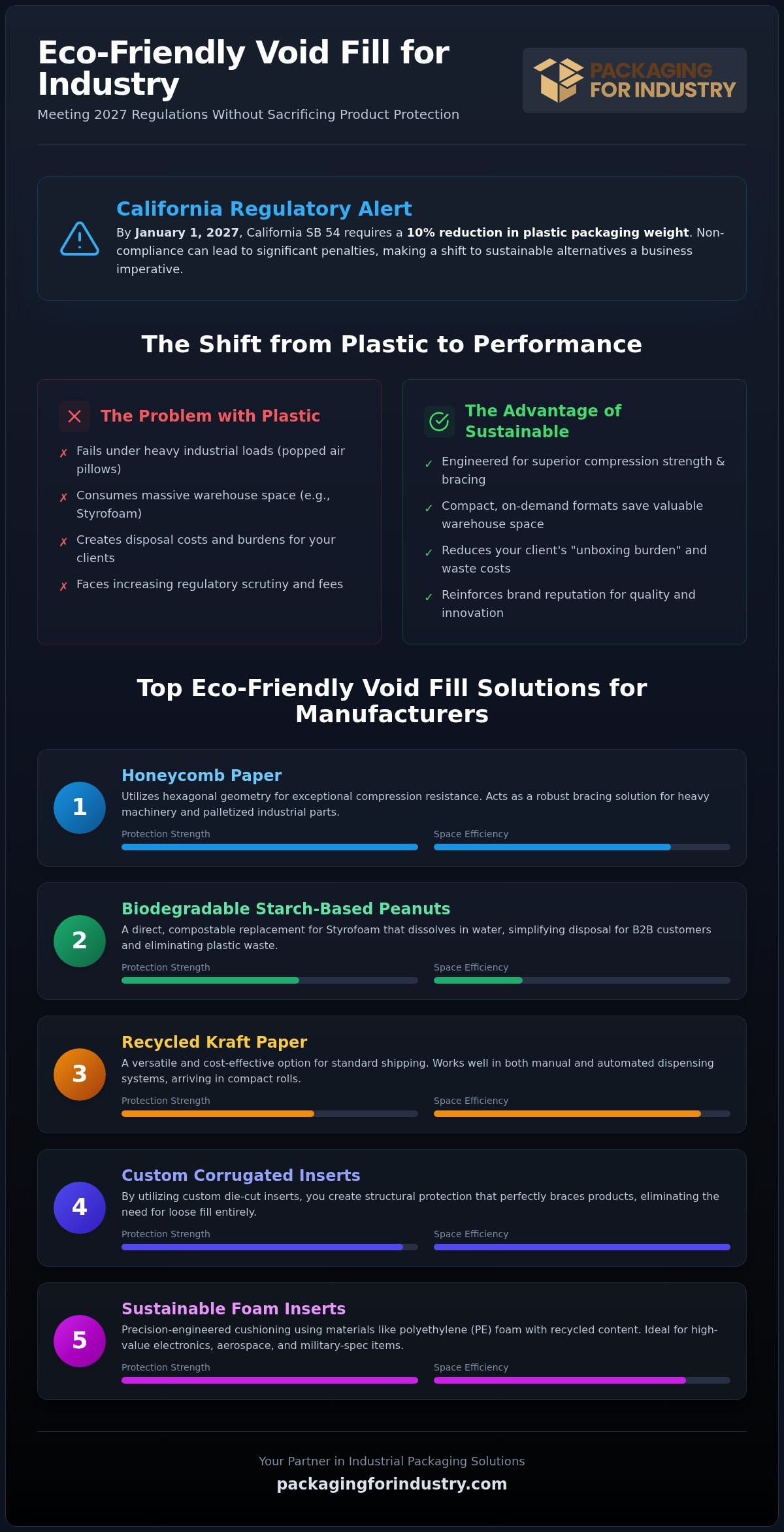
Styrofoam peanuts are a logistical nightmare. They take up massive amounts of warehouse space and are difficult to manage on a high-speed packing line. While plastic air pillows are popular for lightweight e-commerce, they often fail under the weight of heavy industrial components. When an air pillow pops, the void is no longer filled, leading to catastrophic shipping damage. In industrial shipping, a circular economy refers to a system where packaging materials are designed for reuse, recycling, or composting to eliminate waste and continuously circulate resources. Replacing fragile plastics with robust cushioning materials or specialized protective foam packaging ensures that your high-value goods remain secure throughout the entire supply chain. Space is money. Efficiency is peace of mind.
Top 5 Sustainable Void Fill Materials for Manufacturers
Selecting eco-friendly void fill alternatives involves balancing material characteristics with the physical demands of your industrial load. The right choice depends on whether you need high-strength bracing, light cushioning, or structural stabilization. Here are the top five materials currently leading the shift away from plastic in industrial logistics:
- Honeycomb Paper: This material utilizes a hexagonal geometry to provide exceptional compression resistance. It acts as a robust bracing solution for heavy machinery and palletized industrial parts.
- Biodegradable Starch-Based Peanuts: These are a direct, compostable replacement for Styrofoam. They dissolve in water, which simplifies disposal for your B2B customers and eliminates plastic waste.
- Recycled Kraft Paper: A versatile and cost-effective option for standard shipping. It is readily available and works well in both manual and automated dispensing systems.
- Corrugated Inserts: By utilizing custom corrugated boxes with integrated die-cut inserts, you can create structural protection that eliminates the need for loose fill entirely.
- Mushroom and Plant-Fiber Cushioning: This bio-engineered frontier involves growing packaging to fit specific product dimensions. It offers custom-molded protection for sensitive electronics without the environmental footprint of expanded foam.
Honeycomb Paper and Load Stabilization
The geometric design of honeycomb paper creates vertical strength that rivals wood or heavy plastics. This makes it perfect for stabilizing heavy loads that might otherwise crush lighter materials during transit. When you integrate honeycomb panels with specialized corner and edge protection, you ensure that high-value goods remain centered and secure. Manufacturers often use these systems for furniture and large industrial components where maintaining edge integrity is a non-negotiable requirement for quality control.
Bio-Based Loose Fill vs. Recycled Paper
Starch-based peanuts provide excellent shock absorption, but they require careful management in high-humidity environments where they can become tacky. Kraft paper rolls offer a more stable alternative for long-term storage and diverse climate conditions. From a logistical standpoint, a single roll of Kraft paper occupies significantly less warehouse space than bags of loose fill or pre-inflated air pillows. This efficiency reduces your storage footprint while maintaining the throughput needed for high-volume warehouses. If you’re looking to optimize your material usage, you can compare packaging pricing for these different sustainable options to determine which provides the best long-term ROI for your specific application.
Comparing Protection: Sustainable Options vs. Traditional Plastic
Engineering a sustainable shipping strategy requires more than swapping materials. It demands a technical comparison of how these materials perform under real-world stress. Many operations managers worry that paper-based eco-friendly void fill alternatives lack the dampening properties of traditional protective foam packaging. While plastic excels in multi-drop vibration protection, modern paper systems are designed with high-initial-stiffness profiles that absorb significant shock during a primary impact. For international transit and ocean freight, durability hinges on moisture resistance and structural integrity. Paper alternatives often require higher gsm (grams per square meter) ratings to withstand the humidity of a sea container, yet they offer a distinct advantage in disposal simplicity upon arrival at a B2B facility.
Material Performance Under Stress
When you evaluate material performance, you must consider the compression set. This is the permanent deformation of a material after a load is removed. High-value gear often requires a material that recovers its shape to provide ongoing protection through multiple handling points. In these scenarios, custom foam inserts manufactured with high percentages of recycled content provide a pragmatic middle ground between performance and sustainability. To ensure reliability, we recommend testing protocols that align with ISTA (International Safe Transit Association) standards. Rigorous drop tests and vibration table simulations reveal exactly how much energy reaches your product. This data allows you to engineer a solution that uses the minimum amount of material necessary for total safety, rather than over-packing with inefficient loose fill.
Freight and Dimensional Weight Optimization
The economic impact of switching materials often appears in your freight bill rather than the unit price of the material. Dimensional (DIM) weight pricing means that the volume of your box often matters more than its physical weight. If your eco-friendly void fill alternatives are too bulky, they force you into larger containers, triggering UPS or FedEx surcharges. True sustainability is achieved by reducing the box size through custom engineering, which minimizes the need for void fill entirely. This approach is one of the most effective ways to achieve lower packaging costs while improving your environmental footprint. By designing the box around the product’s specific dimensions, you reduce material waste and ensure a tighter, more secure fit that prevents internal shifting during transit. Efficiency in design translates directly to peace of mind in operations.
Selecting the Right Eco-Friendly Fill for Your Industry
Industrial applications demand a more rigorous selection process than standard retail shipping. When you evaluate eco-friendly void fill alternatives, the primary variable is the vulnerability of the specific cargo. Aerospace and Defense sectors, for instance, must adhere to stringent military packaging standards that prioritize total immobility and moisture control. In these environments, sustainable materials aren’t just a compliance checkbox; they’re a technical requirement for mission-critical reliability. Choosing the wrong fill can lead to catastrophic failure of high-precision components during high-G transit events.
Electronics manufacturers face a unique challenge with electrostatic discharge (ESD). While traditional pink anti-static foam was the industry standard, modern ESD-safe sustainable cushioning provides the same surface resistance without the plastic waste. For medical device companies, cleanroom compatibility is the deciding factor. You need eco-friendly void fill alternatives that don’t shed fibers or particulates, ensuring that recyclability doesn’t compromise the sterility of the environment. These specialized materials allow medical suppliers to meet sustainability goals while maintaining the highest hygiene standards.
Heavy machinery and construction equipment require structural bracing rather than soft cushioning. In these cases, the primary void fill often consists of wood crates and heavy-duty corrugated inserts. These materials provide the rigid stabilization necessary to prevent massive parts from shifting. By using custom-cut corrugated blocks, you eliminate the need for hundreds of cubic feet of loose fill, which significantly lowers your total material consumption and disposal costs for the end receiver.
Aerospace and High-Value Component Protection
High-precision parts often feature odd shapes and delicate finishes that are susceptible to abrasion. Custom-engineered solutions for aerospace packaging focus on non-abrasive sustainable surfaces that protect finished metal components. By integrating custom-designed inserts directly into the shipping container, we create a secure “nest” for the part. This precision design reduces the reliance on external void fill and ensures that the component remains untouched by the outer walls of the box, even if the container is dropped or overturned.
E-commerce and Fulfillment Center Efficiency
Operational speed is the lifeblood of warehouse and distribution centers. Automated paper dispensing systems win in high-volume environments because they’re faster and more reliable than manual plastic pillow inflation. Beyond speed, there’s a psychological impact on your B2B buyers. When a procurement manager unboxes a shipment filled with high-quality, recyclable paper instead of plastic waste, it reinforces your company’s reputation as a modern, responsible partner. Managing bulk supplies through a local partner ensures you have the inventory needed to maintain these standards without overstocking your floor space.
Optimizing Your Sustainable Supply Chain with PFI
Implementing eco-friendly void fill alternatives is a strategic decision that extends beyond material selection into the core of your warehouse operations. Storage space is a premium asset in industrial facilities. Our Vendor Managed Inventory (VMI) programs solve the logistical burden of bulky sustainable supplies by ensuring you only stock what you need for current production cycles. This approach prevents stockouts while eliminating the waste associated with over-ordering materials that may degrade or occupy valuable floor space. We specialize in combining custom corrugated boxes with precision-engineered cushioning to create a total protection system. This integrated design often reduces the total amount of void fill required, which is the most effective way to lower packaging costs and improve supply reliability.
Local Support for Southern California Manufacturers
Manufacturers in Southern California require a partner that understands the speed of local logistics. PFI provides local next-day delivery across Anaheim, Irvine, and Los Angeles; this allows you to maintain a lean inventory without risking production delays. Sourcing from a local industrial packaging supplier also reduces the “shipping miles” of your packaging, further lowering the carbon footprint of your entire operation. If you’ve been searching for a reliable industrial packaging supplier near me, our facility offers the fast response times needed to keep your warehouse running. During an on-site packaging review, we can evaluate your current eco-friendly void fill alternatives to identify specific cost-reduction opportunities.
Custom Engineering for Complex Logistics
Complex industrial parts require more than off-the-shelf solutions. Our team utilizes CAD-designed protection to ensure every component is braced against the specific stresses of your shipping lane. Whether you need to combine wood, foam, and corrugated for military-grade sustainability or require free prototyping for a new product launch, PFI acts as a technical extension of your engineering team. This level of precision ensures you maintain product integrity while achieving bulk packaging pricing. It’s a pragmatic way to solve protection challenges without excessive material waste. You’ll get the protection you need without paying for material you don’t.
To see how our sustainable solutions can improve your bottom line, request a custom packaging quote tailored to your specific industrial lead times today. You can also compare packaging pricing for our full range of stock and custom supplies to find the best fit for your 2026 sustainability goals.
Future-Proofing Your Industrial Logistics Strategy
Navigating the transition to sustainable materials is no longer optional; it’s a requirement for operational stability in 2026. By adopting eco-friendly void fill alternatives that match the technical demands of your cargo, you protect your products while avoiding the financial risks of regulatory non-compliance. High-performance paper systems and bio-based cushioning offer the durability needed for heavy machinery and aerospace parts without the environmental footprint of traditional plastics.
PFI specializes in custom sizes and bulk orders for industrial manufacturers, providing free prototyping to ensure a perfect product fit before you commit to a full rollout. We support your production schedule with fast nationwide shipping and local next-day delivery across Southern California. Our engineering-first approach helps you maintain supply reliability and lower total landed costs through better material efficiency.
We’re ready to help you build a more resilient and efficient supply chain starting today.
Frequently Asked Questions
What is the most cost-effective eco-friendly void fill for bulk shipping?
Recycled Kraft paper is the most cost-effective solution for bulk industrial needs. It provides a low unit price and occupies minimal warehouse space compared to pre-inflated materials. By using an automated dispenser, your team can quickly create protective cushioning on demand. This efficiency reduces labor costs and material waste. Manufacturers often choose Kraft paper for its versatility across various box sizes and product weights in high-volume environments.
Can paper-based void fill protect heavy industrial parts as well as foam?
High-strength honeycomb paper and heavy-duty corrugated inserts are excellent eco-friendly void fill alternatives for heavy industrial parts. These materials offer superior compression resistance and vertical strength that rivals traditional foam. While foam provides better multi-drop vibration dampening, engineered paper solutions excel at bracing heavy loads and preventing internal shifting. We recommend using custom-engineered inserts to ensure maximum stability for high-precision components during transit.
Are biodegradable packing peanuts safe for all types of electronic components?
Biodegradable starch-based peanuts are safe for most electronics, but you must consider humidity and static. These peanuts dissolve in water, so they shouldn’t be used in high-moisture environments. For sensitive components, we suggest using anti-static (ESD) sustainable cushioning or ESD-safe paper systems. These alternatives prevent electrostatic discharge while meeting your sustainability goals. Always verify that your void fill doesn’t shed particulates if you’re shipping to a cleanroom environment.
How does switching to sustainable void fill affect my freight costs?
Switching to sustainable materials impacts freight costs primarily through dimensional (DIM) weight. While paper is heavier than plastic air pillows, it often allows you to use smaller corrugated boxes. Reducing the outer dimensions of your shipment is the most effective way to lower packaging costs and avoid carrier surcharges. PFI provides packaging reviews to help you optimize the balance between material weight and box size for maximum freight efficiency.
What is the difference between recyclable, biodegradable, and compostable void fill?
Recyclable materials can be processed into new products through municipal or industrial systems. Biodegradable void fill breaks down naturally over time through biological processes. Compostable materials are a subset of biodegradable goods that break down into nutrient-rich organic matter under specific conditions. Understanding these distinctions is critical for compliance with 2026 labeling laws like California SB 343. We help you select materials that align with both your ESG goals and regional disposal requirements.
Do I need special equipment to use paper-based automated void fill systems?
Automated paper systems require specific converter machines that transform flat rolls into high-volume cushioning. These systems are significantly faster than manual packing and provide consistent protection levels. PFI offers equipment integration as part of our industrial packaging solutions. These machines have a small footprint and can be integrated directly into your existing pack stations. This automation reduces worker fatigue and increases the overall throughput of your fulfillment operation.
How can a VMI program help manage my sustainable packaging inventory?
A Vendor Managed Inventory (VMI) program ensures you always have eco-friendly void fill alternatives available without overstocking your warehouse. We monitor your usage levels and replenish supplies on a scheduled basis. This eliminates the need for emergency rush orders and prevents stockouts of critical materials. By managing your inventory locally, we free up your warehouse floor space and capital for other core manufacturing operations.
Where can I find a local Southern California supplier for eco-friendly void fill?
Packaging For Industry (PFI) is a leading Southern California packaging supplier based in Anaheim. We provide local next-day delivery to Los Angeles, Orange County, the Inland Empire, and San Diego. Our team specializes in custom sizes and bulk quantities for industrial manufacturers and distribution centers. We offer free prototyping and CAD design services to help you transition to sustainable packaging systems with total confidence in your product protection.