
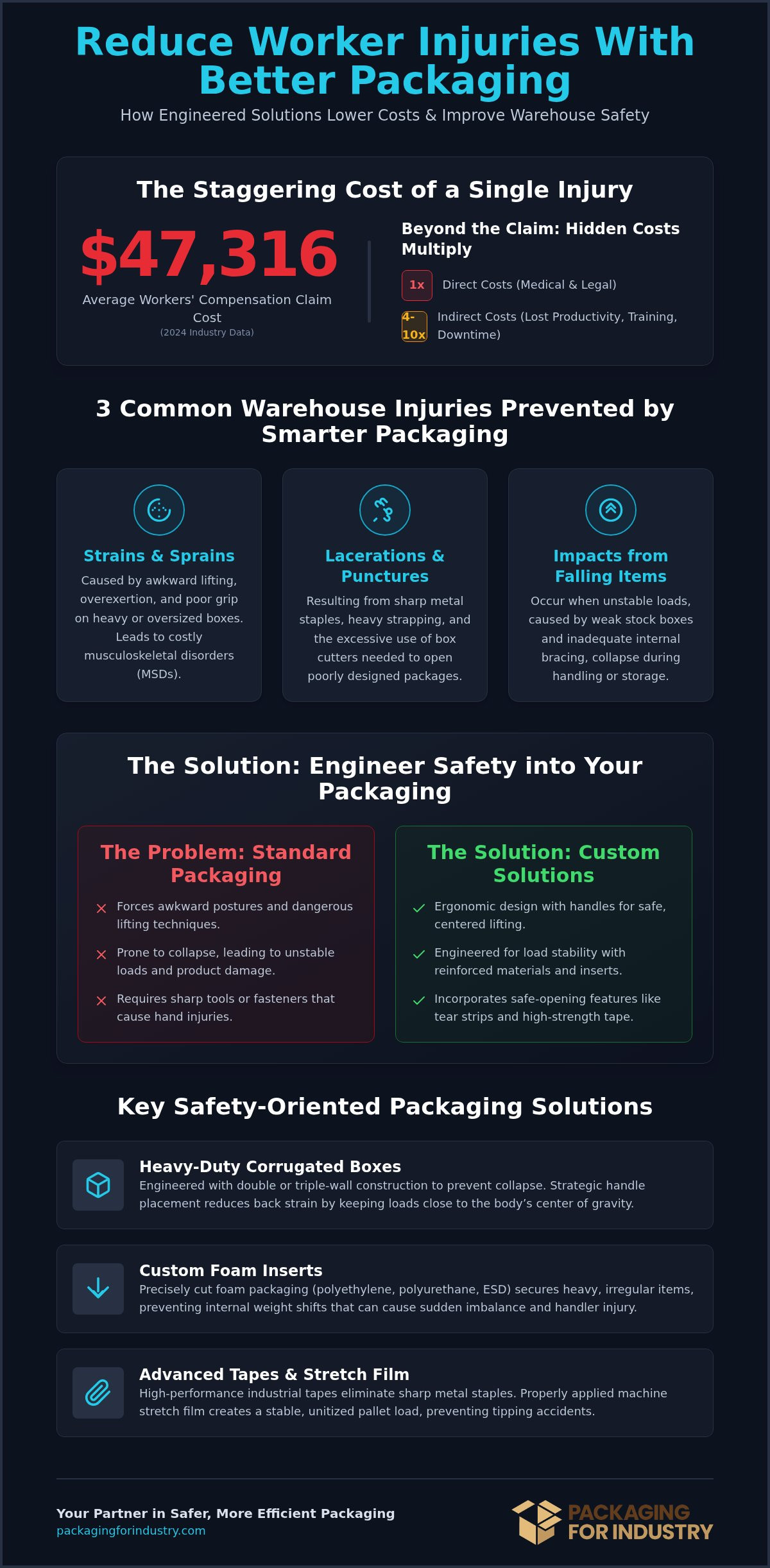
Did you know that the average workers’ compensation claim now costs approximately $47,316? In an industrial environment where every second of warehouse uptime matters, the financial and operational toll of musculoskeletal disorders can be devastating. Many facilities view boxes and tape as simple commodities, but forward-thinking operations are reducing worker injuries with better packaging design. We understand that managing a high-volume shipping floor is difficult when repetitive strain injuries and poor load stability lead to constant downtime and rising insurance premiums.
This guide will show you how custom packaging engineering reduces ergonomic strain, prevents accidents, and lowers your overall operational costs. We’ll examine how to streamline the packing process for safety, improve load stability with heavy duty corrugated boxes, and justify the ROI of custom solutions through safety metrics. By treating your materials as engineered safety tools rather than just overhead, you can protect your team from repetitive strain while simultaneously protecting your bottom line.
Key Takeaways
- Discover how reducing worker injuries with better packaging design directly lowers annual workers’ compensation costs and improves warehouse uptime.
- Learn how custom foam inserts and heavy duty corrugated boxes stabilize loads to prevent musculoskeletal disorders caused by awkward lifting.
- Identify high-risk “awkward reach” zones on your packing line by auditing current shipping materials against manual material handling limits.
- Justify the ROI of custom packaging by calculating the long-term savings gained from streamlined safety processes and reduced shipping damage.
- Leverage PFI’s CAD/CAM engineering support and local Southern California delivery to implement just-in-time safety upgrades for your facility.
The Hidden Impact of Packaging Design on Workplace Safety
Ergonomic packaging design is design that prioritizes the physical capabilities of the handler. In an industrial context, this means engineering containers to minimize overexertion and repetitive strain. While many purchasing departments treat packaging as a simple commodity, operations managers understand its role as a vital safety tool. Reducing worker injuries with better packaging design is a strategic move that addresses the human element of logistics. Standard catalog boxes frequently fail to meet the safety requirements of heavy goods because they don’t account for specific weight distribution or grip requirements. This mismatch often creates ergonomic hazards that lead to chronic physical strain for warehouse teams.
The Economics of Injury Prevention
The financial impact of workplace accidents is significant and often overlooked until a claim is filed. According to 2024 industry data, the average workers’ compensation claim costs approximately $47,316. These direct costs are just the surface. Indirect costs, such as the expense of training replacement staff and the loss of operational momentum, can be four to ten times higher than the medical claim itself. In competitive Southern California logistics hubs like Los Angeles and Orange County, employee retention is closely tied to workplace safety. If a facility has a reputation for high injury rates, turnover increases, leading to a cycle of constant hiring and reduced productivity. By implementing smarter packaging design, companies can streamline packing motions, effectively reducing the repetitive fatigue that leads to long-term disability claims.
Beyond the Box: A Holistic Safety View
Safety goes beyond the exterior dimensions of a carton. Load stability is paramount for preventing catastrophic tipping accidents during transit or storage. Standard packaging often lacks the structural integrity needed for heavy industrial goods, which can lead to box collapse and subsequent injury. This is where custom corrugated boxes become essential. Unlike stock options, custom-engineered boxes can be reinforced with double or triple-wall construction and designed to accommodate specific internal bracing. For manufacturers of aerospace or medical equipment, a “standard” box isn’t safe. These high-value, heavy items require precise weight distribution and secure grip points to ensure that handlers aren’t forced into compromised positions. Investing in tailored industrial packaging solutions ensures that the container supports the worker, rather than adding to their physical burden.
3 Common Warehouse Injuries Prevented by Smarter Packaging
Industrial environments prioritize speed, but speed without safety leads to high turnover and insurance costs. Reducing worker injuries with better packaging design involves identifying specific mechanical risks before they manifest as medical claims. By engineering the package to fit the worker’s physical limits, you eliminate the most common points of failure in the shipping and receiving process. Addressing these hazards requires moving beyond stock supplies toward components that prioritize the handler’s safety.
Strains and Sprains: The Ergonomic Challenge
Musculoskeletal disorders (MSDs) account for a significant portion of warehouse-related injuries. When workers handle heavy boxes without defined grip points, they’re forced into awkward postures that strain the spine. Strategic handle placement on heavy-duty boxes reduces lower back torque by allowing the load to stay closer to the body’s center of gravity. Additionally, box dimensions that are too deep or wide can shift the weight unexpectedly, leading to overexertion. For long or irregularly shaped items, using custom mailing tubes makes the load more manageable and significantly easier to carry. Following OSHA packaging guidelines helps ensure that your facility stays within safe manual material handling limits.
Lacerations and Hand Injuries
Lacerations are frequent in facilities that rely on metal staples or heavy plastic strapping for closure. These fasteners often leave sharp edges during the unboxing process, posing a constant risk to hands and forearms. Transitioning to high-performance industrial adhesive tapes eliminates the need for sharp fasteners entirely while maintaining superior seal strength. Safe-opening designs, such as integrated tear strips, also reduce the reliance on box cutters. By minimizing the need for blades on the warehouse floor, you remove one of the most common sources of preventable hand injuries.
Crush injuries are another major concern, often occurring when loads shift or boxes collapse during manual stacking. custom foam packaging minimizes the need for awkward lifting by ensuring the internal contents are perfectly balanced and secure. This internal stability prevents sudden weight shifts that cause workers to lose their footing or drop heavy items. If you’re looking to upgrade your safety standards, you can request a packaging quote to see how custom-engineered solutions can protect your team.
Engineering Safety: Custom Foam and Corrugated Solutions
Effective safety management requires moving beyond the exterior dimensions to the internal architecture of the package. Reducing worker injuries with better packaging design starts with precision engineering that accounts for both the product’s weight and the handler’s physical limits. The OSHA guide on packaging ergonomics highlights that the weight distribution of a container is just as critical as its total mass. When a load shifts unexpectedly, the worker’s muscles must compensate instantly, which is a primary cause of acute back strain. Engineering solutions that lock components in place provide a predictable, balanced lifting experience every time.
Material Density and Weight Distribution
Custom foam inserts are vital for redistributing weight and ensuring the center of gravity remains constant. Choosing the right material density is a technical decision that impacts safety. Polyethylene foam is ideal for heavy industrial parts due to its high density and structural memory. It maintains its shape even under significant pressure. Polyurethane foam is better suited for lighter, delicate items that require softer cushioning. Precision-cut foam cavities prevent shifting loads, which eliminates the risk of sudden weight transfers during manual handling.
In addition to internal bracing, the outer shell must provide reliable structural integrity. Utilizing heavy-duty corrugated boxes with double or triple-wall construction is essential for Southern California manufacturing safety. These reinforced materials prevent box collapse during stacking. A collapsed box doesn’t just damage the product; it creates an unstable pile that can lead to falling inventory and crush injuries. Custom engineering also allows us to design packaging that “tells” the worker how to lift by providing intuitive handholds and visual cues for proper orientation.
Load Stabilization with Stretch Film
Pallet stability is the final line of defense against warehouse accidents. While hand-wrapping pallets is a common practice, it often results in uneven tension and significant physical fatigue for the operator. Transitioning to machine stretch film creates a safer, more uniform pallet than manual methods. Automating the wrapping process eliminates the repetitive circular walking and bending that lead to worker dizziness and musculoskeletal strain.
A properly wrapped load is much less likely to fail during transit or unloading. When combined with corner and edge protection, the pallet becomes a rigid, secure unit. This prevents “dumped loads,” where items slide off the pallet during forklift maneuvers or manual breakdown. By stabilizing the entire unit, you protect the team members responsible for receiving and destuffing containers at the end of the supply chain.
How to Audit Your Packaging for Ergonomic Risks
Integrating safety into your logistics strategy requires a systematic review of how materials are handled on the floor. Reducing worker injuries with better packaging design isn’t just about changing materials; it’s about evaluating the human-machine interface. A comprehensive audit identifies hidden risks before they become OSHA recordables. If you haven’t reviewed your packing line in the last twelve months, you may be overlooking simple engineering changes that could prevent the next musculoskeletal claim.
Follow these five steps to conduct a thorough ergonomic audit:
- Step 1: Observe the packing line for “awkward reach” zones. If employees must twist their torsos or overextend their arms to reach corrugated boxes or tape dispensers, they’re at risk for repetitive strain.
- Step 2: Weigh your most common shipments against manual handling limits. If your standard packs exceed 35 to 40 pounds without mechanical assistance, the design needs to be re-evaluated for better weight distribution.
- Step 3: Evaluate the “grip-ability” of your current corrugated designs. Many stock boxes lack handholds, forcing workers to use pinch grips that strain finger tendons and increase the likelihood of drops.
- Step 4: Check for over-packing that leads to excessive box weight. Excessive void fill or unnecessarily large boxes move the center of gravity away from the worker’s body, increasing lower back torque.
- Step 5: Consult with a custom packaging supplier for a professional review. An outside expert can identify engineering gaps in your current setup that internal teams might miss.
Identifying Red Flags in the Warehouse
Recognizing signs of worker fatigue is the first step in identifying a failing packaging system. If your team consistently slows down in the final two hours of a shift, the physical toll of your current packaging may be to blame. There’s often a direct overlap between high transit damage rates and worker injury incidents. A box that’s difficult for a carrier to handle is usually just as difficult for your internal team to pack. Additionally, analyze the unboxing experience. If your customers must use aggressive cutting tools to bypass staples or excessive tape, you’re exporting safety risks to their facility and increasing the chance of product damage.
The Role of Prototyping in Safety
PFI provides CAD/CAM support and free prototyping to ensure every safety feature performs as intended before a full rollout. We recommend testing new custom designs directly with your warehouse staff. Their feedback on handle placement or box depth is invaluable for iterating designs that find the perfect balance of protection and portability. By using these real-world insights, you can refine the engineering to reduce repetitive motion fatigue. This collaborative approach ensures that the final product isn’t just a container, but a functional tool that supports your team’s physical health.
Partnering with PFI for Custom Safety-Oriented Packaging
Choosing an industrial packaging supplier that understands the intersection of engineering and human safety is critical for long-term operational stability. At PFI, we specialize in reducing worker injuries with better packaging design by utilizing advanced CAD/CAM support to prototype ergonomic features before they reach your warehouse floor. Our design process focuses on more than just material protection; it prioritizes the physical interaction between your staff and the product. By engineering specific grip points and balanced weight distribution into every custom box or insert, we help you eliminate the physical stressors that lead to chronic absenteeism.
For businesses across Southern California, our local presence in Orange County and Los Angeles allows for on-site safety assessments and next-day delivery of critical supplies. We integrate these safety-first designs into Vendor Managed Inventory (VMI) and just-in-time packaging programs. This ensures your team never resorts to using improper, unsafe materials because the correct custom solutions are always in stock. High-volume facilities benefit from this consistent supply, as it removes the temptation for workers to over-pack boxes or reuse damaged corrugated materials that lack structural integrity.
Custom Solutions for High-Risk Industries
Different sectors face unique ergonomic challenges that standard supplies cannot address. In the aerospace and defense industries, handling oversized, high-value components safely requires precision-engineered supports that prevent shifting during manual maneuvers. For heavy industrial manufacturing, custom crates are essential for protecting line workers from the risks associated with heavy lifting and awkward postures. In the medical and electronics sectors, we provide specialized ESD foam packaging that protects sensitive components while ensuring the handler can safely manage the load without repetitive strain. These tailored responses ensure that reducing worker injuries with better packaging design becomes a standard part of your safety protocol.
Next Steps for Your Safety Program
Improving your safety metrics begins with a professional review of your current packaging workflow. Our team can help you identify where shipping damage and worker injuries overlap, allowing for targeted engineering upgrades that solve both problems simultaneously. While we provide local next-day delivery in Southern California, we also offer fast nationwide shipping to maintain consistent safety standards across all your North American facilities. You can lower packaging costs and protect your workforce by making safety a core component of your procurement strategy.
Optimizing Your Safety Culture Through Engineered Packaging
Workplace safety is a continuous process of refinement rather than a static goal. The container your product travels in acts as a critical engineering control that directly affects the physical health of your warehouse team. By auditing your current packing line for ergonomic hazards and transitioning to custom-engineered solutions, you can significantly lower the risk of musculoskeletal disorders and costly workers’ compensation claims. Reducing worker injuries with better packaging design is a high-ROI strategy that protects both your employees and your bottom line.
PFI provides the technical expertise needed to transform your logistics from a liability into a safety asset. With our custom CAD/CAM design support and specialized experience in aerospace and industrial manufacturing, we engineer packaging that prioritizes the handler. Our local Southern California presence ensures you receive on-site assessments and next-day delivery to keep your operations running safely and efficiently. It’s time to move beyond standard catalog supplies and invest in materials that support your team’s physical capabilities.
Taking the first step toward a safer facility starts with a professional redesign. We look forward to helping you build a more reliable and ergonomic supply chain that supports your long-term growth.
Frequently Asked Questions
How does packaging design specifically reduce the risk of back injuries?
Packaging design reduces back injuries by ensuring the load’s center of gravity remains close to the handler’s body. When a custom packaging supplier engineers internal foam inserts or specific box dimensions, they prevent the weight from shifting unexpectedly. This stability eliminates the sudden torque on the lower spine that occurs when a worker compensates for an unbalanced product during manual lifting or stacking maneuvers.
Can custom packaging actually lower my insurance premiums?
Custom packaging can lower insurance premiums by reducing the frequency and severity of workers’ compensation claims. Insurance carriers often consider safety improvements and documented injury reduction when calculating experience modification rates. By reducing worker injuries with better packaging design, you demonstrate a proactive approach to risk management, which can lead to lower premiums and significantly reduced long-term operational costs for your facility.
What are the OSHA requirements for industrial packaging weight?
OSHA doesn’t enforce a single weight limit but uses the General Duty Clause to regulate ergonomic hazards. Industry guidelines generally recommend keeping manual lifts under 40 pounds to minimize musculoskeletal strain. If your shipments exceed these limits, OSHA suggests using engineering controls like custom handles or mechanical aids. We help you stay compliant by designing packaging that fits these manual material handling safety protocols.
How do handles on corrugated boxes improve warehouse safety?
Integrated handles on corrugated boxes improve safety by providing secure grip points that reduce reliance on dangerous pinch grips. Pinching the edges of a box strains the small tendons in the fingers and hands, increasing the likelihood of drops. Handholds allow workers to use their larger muscle groups and maintain a neutral wrist position, which is essential for preventing long-term strain during high-volume packing.
Is machine stretch film safer than hand-wrapping pallets?
Machine stretch film is significantly safer than hand-wrapping because it eliminates the repetitive bending and circular walking that cause worker dizziness and back strain. Hand-wrapping often results in inconsistent load tension, which leads to pallet failure during transit. Automation ensures a uniform, stable load while removing the physical burden from your warehouse team, effectively streamlining the safety and reliability of your shipping department.
What materials are best for stabilizing heavy industrial loads?
Stabilizing heavy industrial loads requires high-density materials like polyethylene foam and triple-wall corrugated boxes. Polyethylene foam provides the structural memory needed to lock heavy parts in place, while triple-wall corrugated prevents the outer shell from collapsing under pressure. Adding edge protectors and machine-applied stretch film further secures the unit, preventing catastrophic load shifts that could cause crush injuries during the unloading process.
How can PFI help me redesign my current packaging for better ergonomics?
PFI helps you redesign packaging through our specialized CAD/CAM support and free prototyping services. Our team conducts a thorough packaging review to identify ergonomic risks like awkward reach zones or improper weight distribution. As a local Southern California packaging supplier, we provide on-site assessments in areas like Orange County and Los Angeles to ensure your new designs perfectly match your facility’s specific operational needs and safety goals.