
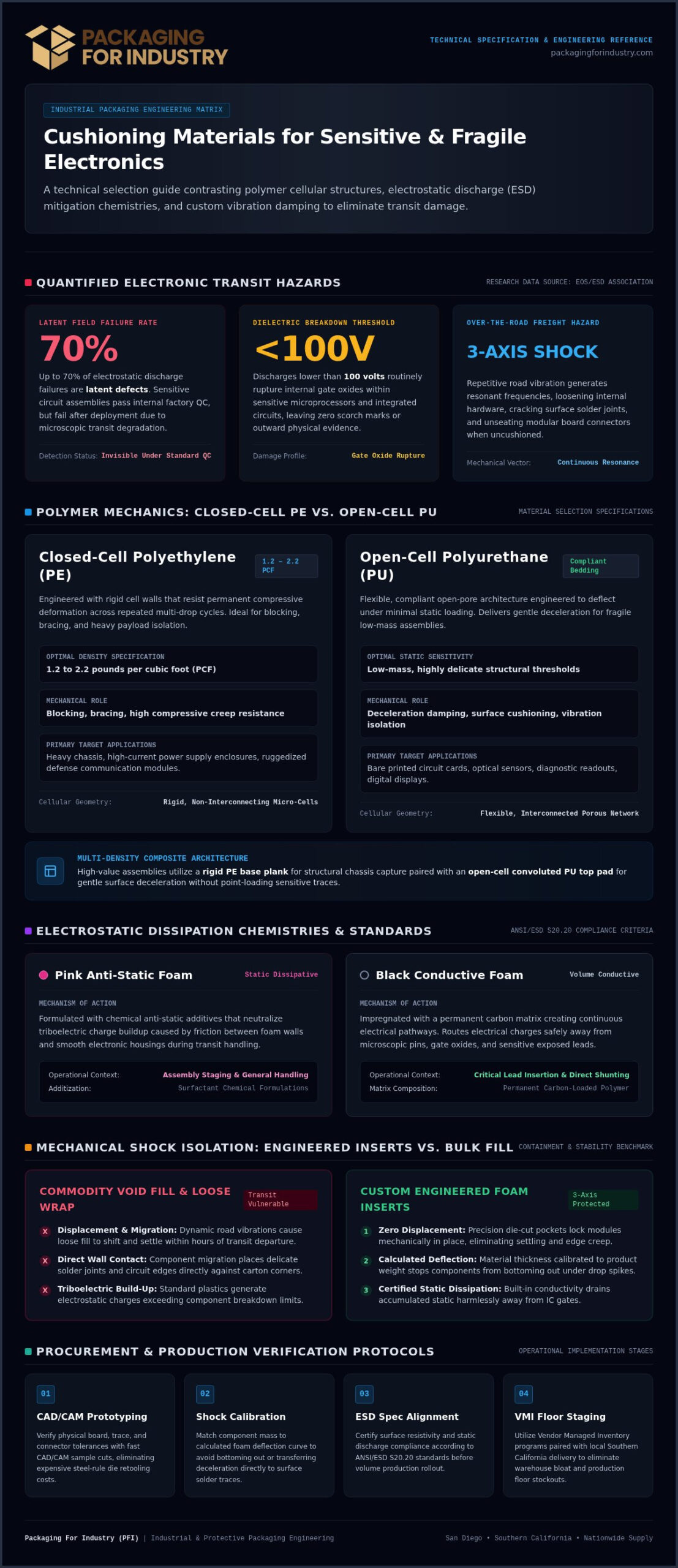
According to EOS/ESD Association research, up to 70% of electrostatic discharge failures are latent defects; sensitive assemblies easily pass internal quality control, only to break down in the field after sustaining microscopic damage during transit. If you’re sourcing cushioning material for fragile electronics San Diego technology and defense contractors rely on, generic bubble wrap and loose void fill won’t protect your margins.
You already know how frustrating it is to battle unexplained field returns, sudden parcel dimensional weight surcharges, and unpredictable supplier lead times that stall your production floor. That’s why this guide shows you how to specify, select, and source high-performance industrial cushioning materials to protect sensitive electronics across San Diego supply chains. We’ll examine the technical differences between static-dissipative polyethylene and conductive polyurethane, evaluate shock-absorption metrics, and explain how regional inventory programs guarantee reliable packaging supply for your facility.
Key Takeaways
- Identify the critical performance differences between closed-cell polyethylene and open-cell polyurethane to stop delicate circuit assemblies from bottoming out under transit shock.
- Discover why custom die-cut inserts outperform generic void fill as the premier cushioning material for fragile electronics San Diego facilities ship nationwide.
- Learn how to align your packaging specs with rigorous industry standards like ANSI/ESD S20.20 to prevent invisible, latent electrostatic component failure.
- Eliminate tooling risks and verify physical component fit before production rollout by utilizing fast CAD/CAM prototyping.
- Protect your manufacturing floor from stockouts and cut warehouse footprint using vendor-managed inventory programs paired with local Southern California delivery.
Why Fragile Electronics Require Specialized Cushioning Materials
Shipping complex electronics requires far more protection than commodity packaging can deliver. When sourcing the right cushioning material for fragile electronics San Diego manufacturers quickly find that off-the-shelf bubble wraps and loose void fill fail under real-world freight stresses. Dynamic transit movement causes standard loose fill to shift and settle within hours. Once that displacement occurs, sensitive circuit boards migrate straight toward carton edges, exposing fragile solder points and components to direct impact.
Specifying high-performance cushioning materials prevents this migration. By isolating components across all three axes, engineered packaging neutralizes physical drop forces and protects against invisible transit hazards that cause unexpected field failures.
The Threat of Shock and Resonant Road Vibration
Freight movement subjects cargo to continuous mechanical abuse. Over-the-road freight transfers repetitive road shock directly through trailer beds, creating resonant frequencies that rattle internal chassis hardware. Uncushioned inertial forces cause hairline micro-fractures along surface-mount solder traces, crack ceramic capacitors, and unseat modular board connectors.
A package dropped during parcel distribution experiences severe deceleration spikes. Without calculated cushion deflection, that kinetic energy transfers entirely into delicate assemblies. Engineered packaging absorbs and dissipates that shock wave, keeping deceleration forces well within safe component limits.
Electrostatic Discharge (ESD) Hazards in Transit
While impact shock leaves visible dents, electrostatic discharge creates invisible destruction. Triboelectric charging happens when standard, untreated plastics rub against component housings during transit. In low-humidity freight environments, such as dry cargo holds or cross-country trailers, uncontrolled static charges build up rapidly.
Discharges below 100 volts can rupture gate oxides inside sensitive microprocessors and integrated circuits. These events leave zero scorch marks or outward physical signs, making them impossible to detect without specialized bench diagnostics. Mitigating this risk requires strict packaging surface resistivity:
- Pink anti-static foam: Formulated with chemical additives to prevent static generation during general handling and clean assembly staging.
- Black conductive foam: Impregnated with permanent carbon matrixes to safely route electrical currents away from sensitive leads and pins.
Investing in the correct ESD-safe cushioning material for fragile electronics San Diego aerospace and tech operations produce ensures delicate circuit assemblies reach end users in working order, eliminating costly warranty repairs.
Comparing Cushioning Materials for Electronics Packaging
Selecting the right cushioning material for fragile electronics San Diego engineers design requires matching polymer chemistry directly to product mass and structural sensitivity. Generic packaging strategies often treat all padding equally. However, under-specifying foam density causes material to bottom out during heavy handling, while over-specifying creates an overly rigid bed that transmits destructive deceleration shock directly into delicate boards. High-value systems frequently rely on multi-density protective foam packaging that balances compressive creep resistance with dynamic shock absorption.
Polyethylene (PE) vs. Polyurethane (PU) Foam
Cellular structure determines how foam behaves over repeated drop cycles:
- Closed-Cell Polyethylene (PE): Ranging from 1.2 to 2.2 pounds per cubic foot, PE foam features rigid cell walls that resist permanent deformation under repeated mechanical impacts. It excels at blocking and bracing heavy chassis, power supplies, and ruggedized communication units.
- Open-Cell Polyurethane (PU): Softer and more compliant, PU foam deflects under lighter static loads. It provides gentle deceleration for low-mass, high-sensitivity items like sensors, bare circuit cards, and digital displays.
Integrating a rigid PE bottom plank with an open-cell convoluted PU top pad allows you to lock a heavy chassis in place while gently cushioning exposed surface components.
Anti-Static Pink vs. Conductive Black Cushioning
Material chemistry also dictates electrostatic control:
- Pink Anti-Static Foam: Treats polyurethane or polyethylene with topical surfactants that draw atmospheric moisture to dissipate triboelectric charges. It’s cost-effective for general sub-assembly staging and low-risk electronic enclosures.
- Black Conductive Foam: Uses permanently embedded carbon black to achieve surface resistance below 1.0 x 10^4 ohms. It creates an active grounding path, making it the preferred standard for lead insertion and high-value semiconductors.
- Cross-Linked Polyethylene (XLPE): Cleanroom and aerospace facilities rely on high-purity XLPE foams. Unlike standard blown foams, XLPE won’t shed particulate or outgas chemical plasticizers onto sensitive optical lenses or sensor arrays.
If your operations require calibrated, compliant cushioning material for fragile electronics San Diego defense and commercial facilities can rely on, you can request a packaging quote to evaluate custom material pairings.
Custom Engineered Foam Inserts vs. Bulk Void Fill
Relying on loose-fill packaging to protect high-value assemblies creates unnecessary operational risk and inflates shipping expenses. While commodity fillers appear inexpensive initially, bulk materials shift under continuous transit vibration, allowing heavy components to migrate directly against carton walls. Investing in custom packaging design replaces loose packing with fabricated inserts that lock hardware firmly in pre-engineered orientations. Beyond stopping physical impact, tailored inserts minimize outer box volume, which helps packaging for manufacturers avoid oversized dimensional weight surcharges from parcel carriers.
The Limitations of Air Pillows and Packing Peanuts
Inflatable air cushions and expanded polystyrene peanuts present serious vulnerabilities for delicate circuit assemblies. Air pillows can puncture easily on pointed chassis corners or lose pressure under cargo hold altitude changes, resulting in a total loss of cushioning support. Loose peanuts generate dangerous triboelectric static and break down into fine particulate that contaminates optical sensors, connectors, and fan bearings. They also introduce human error; inconsistent filling by warehouse packers leads to unpredictable transit protection across production runs.
Benefits of Precision Die-Cut Foam End Caps
Precision die-cut end caps provide consistent structural protection by holding assemblies suspended in the geometric center of the master carton. This guarantees a uniform crush zone on every face, edge, and corner drop. End caps offer distinct operational advantages for busy shipping departments:
- Accelerated pack-out speed: Standardized drop-in foam sets eliminate guessing games, cutting packing labor and streamlining warehouse fulfillment.
- Integrated component kitting: Custom cavities hold accompanying power supplies, cabling, and delicate sub-assemblies securely in a single pack.
- Repeatable drop resistance: Engineered foam profiles absorb repeated shocks without compressing permanently or losing geometric shape.
Switching to fabricated end caps delivers the ideal cushioning material for fragile electronics San Diego suppliers and OEMs need to reduce shipping damage and lower packaging costs across their distribution networks.
Procurement Checklist for San Diego Electronics Manufacturers
Procurement teams across Southern California balance tight production deadlines against strict quality tolerances. Sourcing cushioning material for fragile electronics San Diego OEMs and defense contractors produce requires a structured qualification process. Rather than treating packaging as a commodity afterthought, operations managers need to audit prospective materials against physical transit shock, static dissipation, and supply chain continuity. Partnering with a responsive local packaging supplier eliminates delivery bottlenecks, facilitates fast physical prototyping, and keeps assembly lines running on schedule.
Mil-Spec and Cleanroom Compliance Standards
Contract manufacturers supplying defense installations around Naval Base San Diego must confirm full compliance with MIL-STD-2073 military packaging requirements. This standard governs preservation methods, drop tolerances, and mechanical cushioning for sensitive defense avionics and tactical communication systems. At the same time, life science and medical technology operations in Sorrento Valley require cleanroom-compatible packaging materials, such as cross-linked polyethylene, that won’t slough particulate or contaminate optical lenses.
Every packaging evaluation should demand written certifications showing that dissipative or conductive foams comply with ANSI/ESD S20.20 standards. Without documented surface resistivity controls, sensitive microelectronics face invisible electrostatic threats during transit.
Auditing Regional Delivery and Production Lead Times
Relying on out-of-state distributors introduces substantial lead times whenever production demand spikes unexpectedly. You need a packaging distributor capable of providing local next-day delivery across Carlsbad, Otay Mesa, Kearny Mesa, and Poway. Partnering with a supplier offering Vendor Managed Inventory (VMI) stages critical cushioning supplies nearby. This guarantees your warehouse maintains a steady supply of custom foam packaging, preventing costly line halts without tying up floor space.
Before authorizing volume production, always require pre-production sample prototypes to validate component fit and ease of assembly. For heavy chassis or overseas shipments departing through the Port of San Diego, pair custom foam cushioning with engineered custom crates to guarantee structural integrity across demanding freight networks.
Packaging For Industry: San Diego Electronics Partner
When selecting high-performance cushioning material for fragile electronics San Diego defense and commercial facilities can count on, Packaging For Industry (PFI) provides end-to-end protective packaging solutions. Rigid catalog distributors often force fragile electronic devices into generic box dimensions lined with loose fill. In contrast, PFI integrates heavy-duty corrugated cartons, precision die-cut foam inserts, and anti-static materials engineered around your product’s exact geometry. This unified systems approach reduces product damage, streamlines procurement, and provides bulk packaging pricing that helps operations lower packaging costs.
Turnkey Design, Prototyping, and Assembly
Our packaging specialists evaluate component weight distribution, chassis geometry, and fragility ratings to specify optimal foam densities. Before you commit capital to volume production tooling, PFI provides rapid CAD/CAM prototyping. Your engineering team receives physical samples quickly, allowing you to test physical fit and conduct drop testing without financial risk.
To accelerate throughput on the packaging line, we also provide packaging kitting services. Our team pre-assembles die-cut foam sets directly into outer corrugated containers alongside required static-shielding bags and corner board. Packaging for warehouses becomes seamless when pack-out crews receive a single, drop-in unit ready for immediate loading, cutting assembly labor and preventing floor bottlenecks.
Vendor Managed Inventory for High-Volume Production
High-volume assembly leaves no margin for stockouts or crowded warehouse aisles. Implementing a vendor managed inventory (VMI) program with PFI maintains optimal safety stock based directly on your production forecasts. We monitor run rates, maintain local buffer inventories, and coordinate reliable local packaging delivery directly to your facility in Carlsbad, Kearny Mesa, Poway, or Otay Mesa.
Staging inventory regionally protects your operations from unpredictable raw material shortages and extended transit delays. Sourcing custom cushioning material for fragile electronics San Diego manufacturers export gives your team total peace of mind and dependable supply reliability.
Ready to protect sensitive assemblies and eliminate field returns? Request a packaging quote from our technical packaging specialists today to review your project specifications.
Upgrade Your Electronics Cushioning Strategy in San Diego
Protecting complex printed circuits and aerospace sub-assemblies requires engineered material science rather than off-the-shelf guesswork. Transitioning away from settling void fill gives you total control over multi-axis shock and rising dimensional freight charges. Partnering with an experienced industrial packaging team ensures your shipping sets remain fully compliant with ANSI/ESD S20.20 static control packaging requirements.
Packaging For Industry simplifies this transition by providing complimentary custom CAD prototyping to guarantee precise physical component fit before tooling rollout. Backed by a dependable regional delivery network serving San Diego County and Southern California, our inventory programs keep your assembly floor supplied with the exact cushioning material for fragile electronics San Diego facilities need to eliminate shipping damage.
Take control of your transit performance and safeguard your sensitive shipments from the very first drop.
Frequently Asked Questions
What is the most effective cushioning material for shipping fragile electronics?
Precision-fabricated closed-cell polyethylene (PE) and open-cell polyurethane (PU) foams offer the highest protection levels for delicate circuits. Unlike loose-fill materials, engineered foam inserts absorb shock without permanently deforming or allowing items to shift during transit. When specifying cushioning material for fragile electronics San Diego manufacturers frequently use a dual-material configuration, pairing a firm PE base for structural support with a soft, non-abrasive PU top pad to cradle sensitive components.
How does anti-static foam differ from standard packaging foam for electronics?
Anti-static foam contains specialized chemical additives or conductive carbon to control electrostatic generation, whereas standard packaging foam acts as an electrical insulator. Insulative plastics easily accumulate static charges through friction, discharging thousands of volts directly into unprotected microchips. Anti-static pink foam prevents charge buildup, while conductive black foam provides an active path to ground electrical charges safely away from sensitive semiconductor leads during transit and handling.
Can custom foam inserts lower overall freight and parcel shipping expenses?
Yes, custom foam inserts directly reduce parcel shipping expenses by eliminating excess box volume that triggers carrier dimensional weight penalties. Parcel carriers calculate shipping rates based on container dimensions rather than actual product weight alone. By engineering a custom die-cut foam insert that tightly contours to your component, you minimize master carton dimensions, lower packaging costs, and eliminate the need for costly secondary void fillers.
Does Packaging For Industry provide local delivery to San Diego electronics facilities?
Packaging For Industry maintains a dedicated regional delivery network providing local next-day delivery across San Diego County and Southern California. Our fleet delivers directly to manufacturing hubs in Carlsbad, Sorrento Valley, Kearny Mesa, Poway, and Otay Mesa. We also offer vendor-managed inventory programs that stage packaging supplies locally, ensuring your assembly lines never halt due to unexpected packaging stockouts or extended freight carrier transit delays.
What packaging standards apply to defense and aerospace electronics shipments?
Aerospace and defense assemblies must comply with MIL-STD-2073, which specifies preservation methods, packaging materials, and physical cushioning requirements for military supply chains. Electrostatic protection must satisfy ANSI/ESD S20.20 standards, which govern surface resistivity and static discharge mitigation. Cleanroom-bound medical and aerospace components also demand non-outgassing, cross-linked polyethylene materials that won’t shed particulates or contaminate sensitive optical arrays and electronic sensors during storage or transit.
How quickly can custom foam prototypes be manufactured for component testing?
Packaging For Industry uses in-house CAD/CAM cutting tables to produce physical packaging prototypes rapidly for component verification and drop testing. Our technical design team can take your component CAD files or physical samples and generate functional prototypes in just a few days. This free prototyping service ensures an exact physical fit and validates transit cushioning performance before you commit capital to volume production tooling.
Why should electronics manufacturers avoid using standard packing peanuts or loose fill?
Electronics manufacturers should avoid packing peanuts because transit vibration causes loose fill to settle, allowing heavy circuit boards to migrate straight against box walls where impacts occur. In addition, expanded polystyrene peanuts generate high levels of triboelectric static and crumble into abrasive dust that fouls cooling fans, connectors, and optical sensors. Engineered foam remains the superior cushioning material for fragile electronics San Diego facilities use to guarantee repeatable transit survival.