
Aerospace GSE survival depends on load-engineered crating architectures, not oversized commodity boxes. When precision ground power units, hydraulic test carts, or towbars face severe road vibration and ocean freight racking, standard catalog containers quickly fail. Shifting centers of gravity and harsh dynamic loads don’t just crack standard lumber; they destroy critical calibrations and cause severe equipment damage before your gear ever reaches the tarmac. Procuring heavy-duty custom crates for aerospace ground support equipment (GSE) is the only reliable way to eliminate transit damage and keep operational turnaround on schedule.
You shouldn’t have to risk mission-readiness or bottleneck maintenance cycles waiting on unproven packaging. In this industrial buying guide, you’ll discover how to build rigorous crate specifications covering payload capacities, dynamic shock mitigation, and ISPM-15 export compliance. We’ll also examine how partnering with an experienced industrial packaging supplier for custom CAD design, physical prototyping, and reusable construction helps your team slash packaging costs while ensuring flawless transit.
Key Takeaways
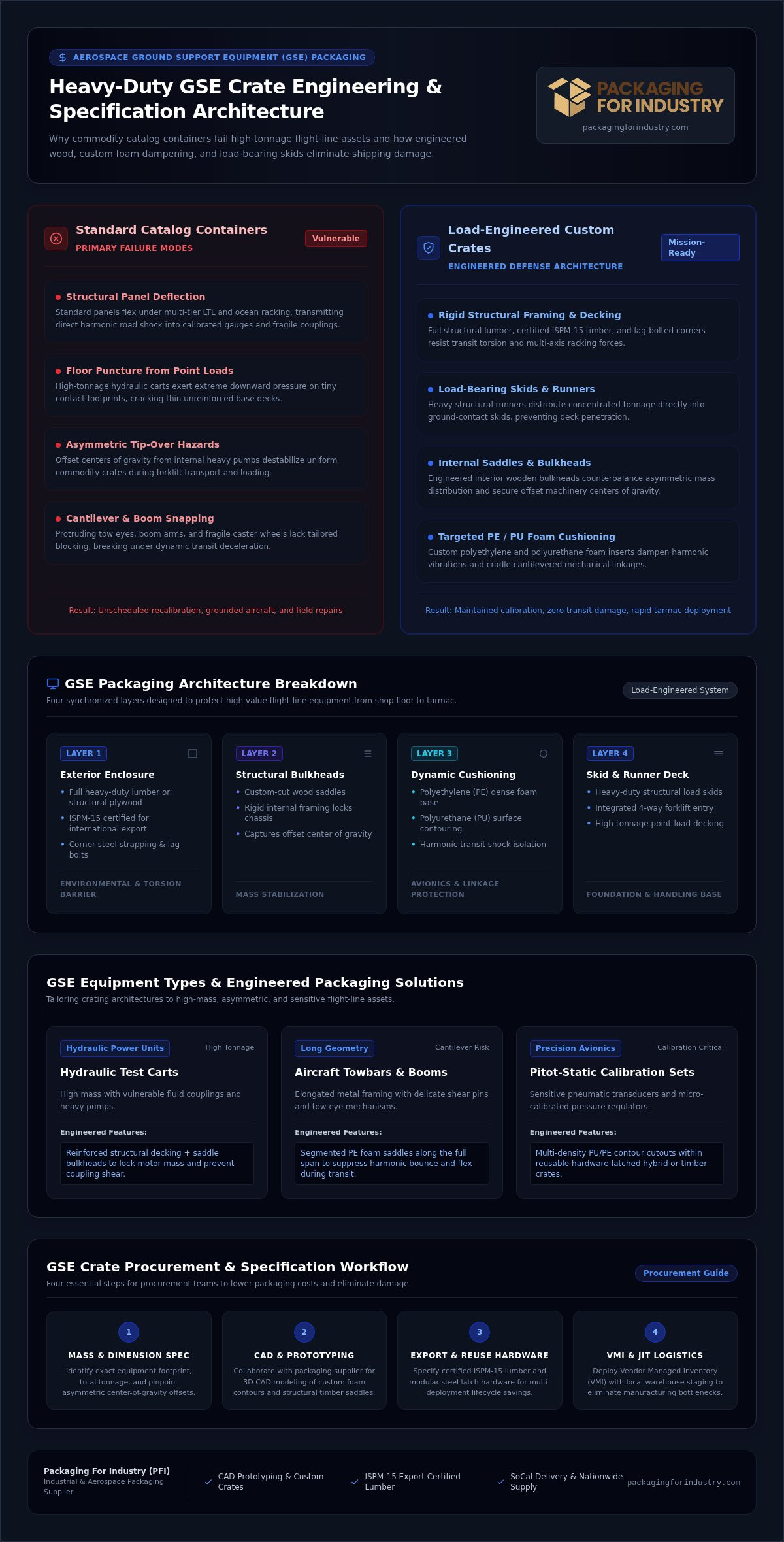
- Standard shipping containers fail when subjected to asymmetric centers of gravity and severe road vibrations, risking costly calibration loss on sensitive GSE.
- Load-engineered custom crates for aerospace ground support equipment (GSE) utilize heavy-duty structural skids, certified ISPM-15 lumber, and robust fastening systems to secure high-tonnage payloads.
- Combining internal wood saddles with custom polyethylene or polyurethane foam dampens harmonic transit shock to protect fragile mechanical linkages and avionics.
- Specifying exact equipment dimensions and utilizing modular, reusable crate hardware helps procurement teams reduce shipping damage and lower packaging costs over time.
- Working directly with an industrial packaging partner offering CAD prototyping, vendor-managed inventory, and local Southern California delivery prevents deployment bottlenecks.
Why Standard Containers Fail: Critical Requirements for Aerospace Ground Support Equipment Crates
Aerospace ground support equipment (GSE) encompasses diverse, mission-critical assets including maintenance stands, towbars, pitot-static calibration test sets, and mobile hydraulic power units. Unlike uniform freight, these units combine massive mechanical tonnage with fragile instrumentation and hydraulic fittings. Relying on commodity catalog boxes creates unacceptable vulnerability. Standard packaging simply lacks the engineered structural integrity required to contain concentrated heavy equipment under severe transit loads.
Off-the-shelf catalog containers are designed for evenly distributed pallet freight. When subjected to the harsh dynamic forces of multi-tier less-than-truckload (LTL) trucking or ocean swell racking, stock wood panels flex. This structural deflection transfers dynamic road shocks directly into sensitive internal components, leading to broken fluid couplings, misaligned linkages, and ruined calibration. Specifying engineered custom crates for aerospace ground support equipment (GSE) solves this failure mode by eliminating structural deflection, dampening dynamic impact, and sealing out exterior environmental contaminants.
The True Cost of Shipping Damage on Critical Flight Line GSE
Flight-line equipment damage triggers consequences far beyond a typical transit claim. Equipment downtime halts scheduled aircraft turnarounds and grounds commercial or military operations. When an uncalibrated hydraulic cart or damaged towbar arrives on site, the delay ripples across flight schedules. Emergency field repairs and unscheduled recalibrations cause severe budgetary overruns. Working with an experienced aerospace packaging supplier to implement robust, load-bearing wood packaging drastically reduces shipping damage, protecting tight operational schedules and avoiding project delays.
Addressing Irregular Geometry, High Mass, and Offset Centers of Gravity
Most aerospace ground support units are not uniform cubes. They present challenging geometries that catalog boxes cannot safely support:
- Cantilevered Components: Protruding booms, tow eyes, and fragile caster wheels snap off under unmitigated dynamic loads.
- Offset Centers of Gravity: Heavy internal pumps and power heads generate asymmetrical weight distributions, creating serious tip-over hazards during forklift handling.
- Concentrated Point Loads: High-tonnage machinery pushes downward on small contact areas, easily puncturing generic container floors.
Deploying heavy-duty custom crates for aerospace ground support equipment (GSE) neutralizes these mechanical hazards. Purpose-built crating incorporates custom load-bearing skids and interior structural bulkheads. These engineered elements distribute asymmetric mass and transfer payload forces directly into ground-contact structural runners, ensuring absolute stability through every stage of transport.
Essential Technical Specifications: Engineering Wood Packaging for Extreme Payloads
Protecting multi-ton flight-line hardware requires uncompromising raw materials and load calculations. Industrial packaging suppliers cannot rely on basic framing methods when building wooden crates for concentrated machinery. Crating teams must balance high load capacities against overall tare weight. While hybrid designs incorporating heavy-duty double-wall or triple-wall corrugated sleeves around a timber base work well for lighter auxiliary gear, full heavy-duty lumber and structural plywood enclosures remain non-negotiable for high-tonnage GSE. Fastener patterns, heavy lag bolts, and corner steel strapping reinforce every load-bearing junction against transit torsion.
Lumber Selection, Skid Engineering, and Heavy-Duty Decking
Everything starts with the base. Fabricating dependable custom crates for aerospace ground support equipment (GSE) begins with selecting certified structural softwoods or dense hardwoods for the runners. Engineered base skids allow smooth four-way entry for forklifts and provide rated pick points for crane slings. Decking must feature thick, structural-grade plywood to spread concentrated point loads evenly across underlying stringers. Integrated rub strips shield the primary runners from direct abrasion during repeated towing and repositioning across abrasive tarmac surfaces.
ISPM-15 Heat Treatment and Global Export Certification
Cross-border deployments trigger strict phytosanitary regulations. Solid timber packaging thicker than 6 mm must comply with the international ISPM-15 standard. That requires heat treating lumber until the core reaches a minimum of 56°C (132.8°F) for at least 30 consecutive minutes, followed by applying an official IPPC stamp on opposing faces. Skipping this step risks customs quarantines, container rejections, or forced cargo destruction at international commercial and military terminals. Plywood sheathing remains exempt under ISPM-15, but structural base framing requires strict certification stamps.
Military and Industrial Packaging Compliance Standards
Aerospace packaging must conform to proven structural baselines. Specifying ASTM D6039 for open and covered crates or ASTM D6256 for skidded, load-bearing bases ensures your containers survive multi-tier freight compression and drop impacts. For defense contracts requiring military-grade durability, containers must satisfy MIL-STD-2073-1E preservation requirements. These measures protect bare hydraulic couplings, actuators, and wiring harnesses from corrosion during extended outdoor staging. When specifying project dimensions, operational teams should partner with an experienced provider to review payload dynamics and request a packaging quote tailored to specific handling environments.
Internal Load Securing: Custom Foam Cushioning, Bracing, and Hardware Integration
Locking heavy machinery inside an outer shell requires total immobilization. Standard wheel brakes fail under dynamic freight loads, allowing rolling equipment to ram interior walls during emergency braking. Engineering reliable custom crates for aerospace ground support equipment (GSE) demands integrated internal bracing. Custom-milled wood saddles contour directly to structural tubular frames, while recessed heavy-duty steel D-rings, ratchet tie-downs, and dedicated axle chocks capture rolling casters. Desiccant packs, heat-sealed barrier bags, and vapor corrosion inhibitors isolate sensitive electrical terminals, preventing atmospheric oxidation across open depot staging.
Engineering Custom Foam Cushioning for Calibrated Instrumentation
Vibration mitigation demands targeted material densities. Deploying specialized foam packaging protects delicate instrumentation from harmonic transit frequencies. Rather than relying on generic cushioning, aerospace GSE packaging utilizes dual-density foam architectures:
- High-Density Polyethylene Foam: Rigid, closed-cell polyethylene foam blocks support heavy frame contact points, providing structural spacing without bottoming out under static weight.
- Flexible Polyurethane Foam: Softer open-cell polyurethane cushions delicate digital sensors, pressure gauges, and optical test tools against high-frequency road chop.
- Anti-Static ESD Foam: Electrostatic dissipative foam surrounds electronic consoles and circuit modules, neutralizing static discharge that can scramble field computers.
Hardware Integration for Reusable Flight Line Deployments
Airfield operations move quickly, making single-use nailed crates obsolete. High-value GSE shuttles continuously between air bases, depots, and line-maintenance stations. Specifying reusable hardware transforms heavy wood containers into sustainable operational assets. Klimp fasteners, link-locks, and threaded steel lag inserts allow maintenance crews to uncrate machinery rapidly without pry bars. Hinged access panels and integrated drop-down wood loading ramps permit a single technician to roll heavy carts in and out safely. Heavy-duty exterior lifting rings and hoist shackles streamline crane handling, keeping tarmac staging efficient and injury-free.
By engineering internal saddles, shock-absorbing foam, and modular hardware directly into custom crates for aerospace ground support equipment (GSE), operations teams eliminate field damage while drastically lowering packaging lifecycle costs.
GSE Crate Procurement Guide: How to Spec Custom Sizes and Lower Packaging Costs
Procuring engineered industrial packaging requires a balanced approach to structural survivability and total freight expense. Guessing on dimensions inflates transportation bills and risks expensive transit failures. Operations teams can systematically specify custom crates for aerospace ground support equipment (GSE) by auditing physical equipment geometry and evaluating container lifecycle economics. Deciding between a single-trip expendable crate and a multi-trip modular system often makes the difference between continuous replacement costs and long-term capital savings.
Step-by-Step Crate Specification and Design Process
Following a methodical engineering workflow guarantees your crating fits the asset perfectly on the first pass:
- Step 1: Document Physical Parameters: Measure total payload mass, overall external dimensions, ground clearance heights, and wheel track widths. Identify off-center weight concentrations.
- Step 2: Map Vulnerability Zones: Pinpoint precision mechanical linkages, hydraulic fittings, display consoles, and surface finishes that require custom foam blocking.
- Step 3: Define the Transport Environment: Establish whether the container moves via closed dry van, flatbed trailer, intermodal ocean freight, or military air transport cargo holds.
- Step 4: Review CAD Models and Physical Prototypes: Work with an industrial packaging supplier that develops precise CAD drawings and delivers rapid physical prototypes to test fitment before full-scale manufacturing.
Strategies to Lower Packaging Costs and Eliminate Surcharges
Controlling procurement spend goes beyond unit prices; it involves optimizing total shipping efficiency. Designing custom sizes around standard truck-bed and sea container widths eliminates dead space, carrier overhang fees, and dimensional weight penalties. Consolidating repeat crate orders into recurring build batches allows your purchasing team to secure volume bulk packaging pricing.
Sourcing your outer wood enclosures alongside ancillary supplies like stretch wrap, heavy-duty banding, desiccant pouches, and barrier bags simplifies administrative overhead. Standardizing exterior dimensions across product families also enables uniform warehouse stacking, maximizing vertical space in distribution centers.
Why Defense Chooses Packaging For Industry for GSE Crates
Aerospace prime contractors and defense manufacturing teams require more than a catalog distributor; they need an engineering partner with manufacturing capabilities. Packaging For Industry (PFI) operates as a full-service custom packaging supplier, delivering high-performance packaging solutions built specifically for demanding aerospace environments. Rather than supplying generic wooden boxes, we design and manufacture bespoke wood crates, integrated foam cushioning assemblies, and heavy-duty skids tailored to complex equipment geometries. Our in-house CAD design capabilities and physical prototyping allow engineering teams to verify exact tolerances, load balance, and access clearances before full production runs begin.
Southern California Manufacturing Hub and Local Delivery Network
Headquartered in Anaheim, California, PFI sits at the center of the Southern California aerospace corridor. We provide reliable local packaging delivery across Orange County, Los Angeles, and the Inland Empire. Dedicated fleet routes provide local next-day delivery to aerospace facilities, flight test centers, and manufacturing plants in Irvine, Santa Ana, Long Beach, and surrounding defense manufacturing clusters. For contractors operating across multiple states, our fast nationwide shipping network reliably routes heavy-duty timber enclosures and bulk packaging supplies directly to your facilities without transit delays.
Vendor Managed Inventory (VMI) and Dedicated Stocking Programs
Floor space on an active flight-line assembly or depot floor comes at a high premium. Staging bulky, empty timber crates creates unnecessary warehouse congestion and safety hazards. PFI solves floor bottlenecks through comprehensive vendor-managed inventory (VMI) and just-in-time replenishment programs. We fabricate and warehouse your recurring crate designs at our distribution facilities, releasing them in scheduled batches as finished equipment comes off your production line.
This integrated supply model prevents costly assembly line shutdowns and helps procurement teams lower packaging costs through volume scheduling. Explore our specialized engineering services for aerospace packaging to streamline your container supply chain. When you are ready to upgrade your flight-line transport containers and eliminate transit damage, contact our engineering team to request a packaging quote on certified custom crates for aerospace ground support equipment (GSE).
Secure Your Fleet with Load-Engineered GSE Packaging
Protecting multi-ton aerospace assets against transit damage requires engineered precision, not standard catalog timber. Specifying custom crates for aerospace ground support equipment (GSE) gives your operation the structural bulkheads, tailored cushioning, and certified ISPM-15 heat-treated lumber needed to survive severe global handling. By integrating custom foam dampening and reusable hardware systems, your procurement team actively protects critical calibrations while lowering packaging costs over the lifecycle of your hardware.
Packaging For Industry delivers complete packaging accountability from our Anaheim manufacturing center. We provide free CAD design and rapid physical prototyping to confirm exact equipment fit before fabrication. Our facilities support active flight lines with scheduled vendor-managed inventory, local next-day delivery across Southern California, and fast nationwide shipping networks.
Partnering with an experienced industrial packaging supplier keeps your ground support equipment flight-ready and protected across every domestic highway and international sea lane.
Frequently Asked Questions
What makes a custom crate suitable for aerospace ground support equipment (GSE)?
A crate is suitable for GSE when it incorporates load-bearing base skids, structural framing for asymmetric centers of gravity, and tailored vibration dampening. Standard catalog boxes collapse under dynamic transit loads. Purpose-built custom crates for aerospace ground support equipment (GSE) utilize heavy-duty plywood, structural timber runners, and internal saddles to isolate fragile hydraulic couplings, linkages, and digital sensors from highway vibration and ocean racking.
How do ISPM-15 regulations affect international shipping crates for aviation equipment?
ISPM-15 mandates that all solid wood packaging materials exceeding 6 mm in thickness must undergo certified heat treatment before crossing international borders. The wood core must reach at least 56°C for 30 consecutive minutes and carry visible, traceable IPPC stamps on opposing faces. Non-compliant timber results in immediate customs quarantine, costly re-exportation fees, or shipment destruction at commercial airports and military entry ports worldwide.
Can custom GSE crates be designed for multi-trip reusable flight line operations?
Yes, custom GSE crates can feature modular hardware such as Link-Locks, Klimp fasteners, and threaded lag inserts for repeated tool-free field access. Instead of destroying crates with pry bars, maintenance technicians can quickly unlatch panels, access equipment, and reseal containers. Adding integrated drop-down loading ramps, heavy-duty caster channels, and reinforced exterior lifting eyes allows single-operator loading while maximizing crate service life across multiple deployments.
What types of protective foam are best suited for heavy aerospace ground equipment?
High-density closed-cell polyethylene foam and open-cell flexible polyurethane foam deliver the most effective shock isolation for ground equipment. Rigid polyethylene planks support heavy contact points without crushing under extreme static weight, maintaining essential clearances. Softer polyurethane buffers delicate electronic displays, hydraulic valves, and optical calibration tools against continuous transit vibration. For sensitive avionics, anti-static ESD foam variants prevent damaging electrostatic discharge during transit.
How do I calculate the weight capacity and skid dimensions needed for my GSE crate?
Calculate capacity by summing total equipment mass, dynamic transit multipliers, and internal blocking weight, then sizing base runners to distribute that load evenly. For asymmetrical machinery, locate the exact center of gravity so structural runners support the heavier zone. Skid lengths should match trailer bed or freight container widths to eliminate shifting. In-house CAD design ensures base stringers prevent decking deflection under concentrated point loads.
What information is required to receive an accurate custom packaging quote for GSE crates?
To generate an accurate quote, supply overall external dimensions, total payload weight, center-of-gravity details, and target transit modes. Specify whether the shipment requires ISPM-15 export certification, mil-spec preservation standards, or custom foam inserts. Providing CAD files, photos, or equipment drawings helps engineers evaluate point-load distribution and hardware needs. Sourcing custom crates for aerospace ground support equipment (GSE) alongside bulk packaging supplies allows our team to maximize your volume discounts.
How quickly can Packaging For Industry deliver custom aerospace crates to our facility?
Packaging For Industry provides local next-day delivery across Southern California once custom production or prototyping runs are complete. Operating from our Anaheim headquarters, our dedicated truck fleet serves manufacturing plants and defense facilities throughout Orange County, Los Angeles, and the Inland Empire. For clients with recurring crating requirements, our vendor-managed inventory (VMI) programs maintain pre-built stock for immediate release, while our nationwide shipping network reliably supports aerospace facilities across America.