
A single uncertified barrier film or missing barcode label can instantly halt a mission-critical DoD shipment at the loading dock, freezing invoice disbursements and triggering expensive repackaging penalties. Juggling disconnected catalog vendors for corrugated boxes, precision die-cut foam, and heat-treated crates only magnifies that operational risk. When delivery deadlines aren’t negotiable, securing engineered mil-spec packaging solutions for defense contractors San Diego operations can trust is essential to pass DCMA inspection without delays.
You already know the frustration of managing erratic supplier lead times and sacrificing valuable production floor space to store bulky packaging supplies. Discover how San Diego defense contractors ensure rigorous military compliance, eliminate shipping damage, and streamline procurement with engineered mil-spec packaging. Below, we examine the governing preservation standards under MIL-STD-2073, multi-material kitting strategies, and responsive local stocking programs that keep your shipments protected and audit-ready.
Key Takeaways
- Understand the precise preservation methods, marking codes, and barrier specifications required to pass DCMA audits without facing shipment rejections.
- Discover how engineered multi-material kits combining double-wall boxes, custom foam inserts, and wood skids eliminate transit damage for sensitive defense hardware.
- Learn to use a structured materials matrix to evaluate watervaporproof foils, ESD shielding films, and heavy-duty corrugated board against your contract packaging codes.
- See how sourcing mil-spec packaging solutions for defense contractors San Diego facilities rely on can streamline procurement and lower packaging costs.
- Find out how local Vendor Managed Inventory (VMI) stocking programs and next-day delivery protect your production lines from costly packaging stockouts.
Navigating Mil-Spec Packaging Standards for San Diego Defense Contracts
Military packaging isn’t standard commercial boxing. It operates as an engineered system built to survive severe logistics cycles, from high-humidity maritime holds to desert staging areas. Local aerospace and defense manufacturers must satisfy strict Defense Contract Management Agency (DCMA) oversight on every delivery order. Sourcing proven mil-spec packaging solutions for defense contractors San Diego facilities depend on eliminates the operational friction of juggling multiple disconnected vendors. Instead of managing separate purchase orders for cartons, barrier bags, and custom skids, contractors gain operational certainty through integrated assemblies aligned with codified military defense standards.
MIL-STD-2073 is the official Department of Defense standard for military packaging requirements.
Demystifying MIL-STD-2073 and Preservation Methods
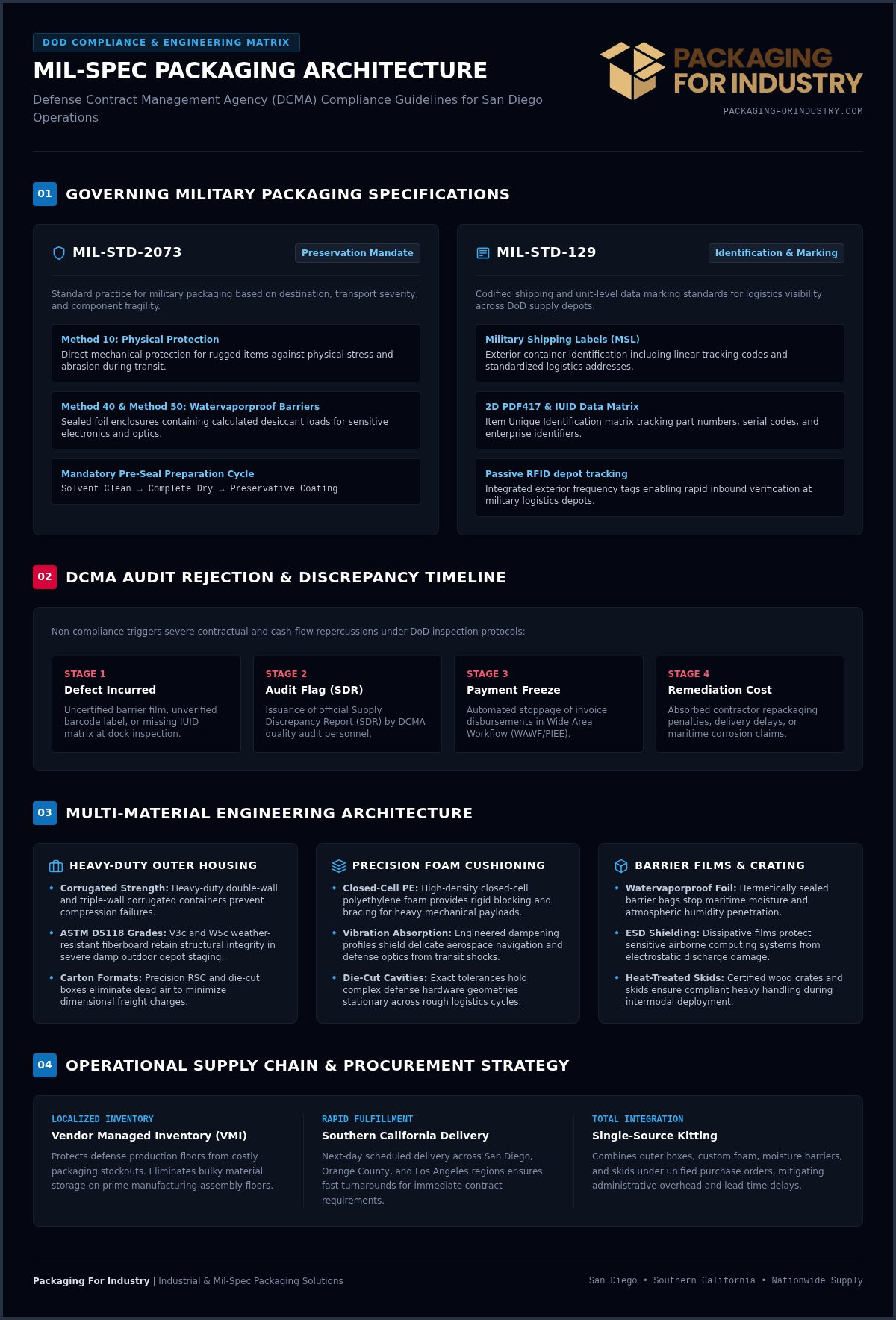
MIL-STD-2073 establishes exact military preservation methods dictated by an item’s fragility and deployment destination. Basic mechanical protection falls under Method 10, while sensitive maritime and airborne electronics demand watervaporproof barrier enclosures with desiccant under Method 40 or Method 50. Before sealing parts into certified barrier film, technicians must execute thorough solvent cleaning, complete drying, and approved preservative applications. These disciplined steps neutralize surface contaminants so corrosion can’t degrade hardware during long-term depot storage or harsh Pacific transit.
Barcoding and Labeling Requirements Under MIL-STD-129
Exterior container compliance hinges on flawless data marking. MIL-STD-129 dictates strict protocols for Military Shipping Labels (MSLs), linear barcodes, and PDF417 2D symbols. Mission-critical assemblies also require machine-readable Item Unique Identification (IUID) 2D Data Matrix codes tracking part numbers, serial numbers, and commercial identifiers. Shipments moving into defense logistics distribution depots often mandate passive RFID tags. Clear, scannable markings ensure immediate verification and eliminate delays during incoming quality audits.
The Costly Consequences of DCMA Packaging Non-Compliance
A missing barcode or uncertified foil barrier bag isn’t a minor administrative clerical issue; it triggers an immediate Supply Discrepancy Report (SDR). This audit finding halts invoice processing in Wide Area Workflow (WAWF/PIEE) and forces vendors to absorb costly corrective repackaging charges. More critically, compromised barrier protection allows corrosive moisture to damage mission-critical components deployed aboard naval vessels. Partnering with an experienced military packaging supplier mitigates contractor audit risks, safeguards cash flow, and keeps delivery schedules firmly on track.
Essential Mil-Spec Packaging Solutions for Mission-Critical Defense Hardware
Defense hardware demands customized packaging architectures engineered to match precise weight, fragility, and transit profiles. Sensitive defense optics, navigation electronics, and aviation assemblies will fail in the field if transit shock or vibration exceeds critical thresholds. Off-the-shelf catalog cartons rarely provide the exact tolerances required for specialized military gear. Sourcing comprehensive mil-spec packaging solutions for defense contractors San Diego teams rely on means uniting exterior durability with engineered internal protection into a single, cohesive unit.
Heavy-Duty Corrugated and Weather-Resistant Containers
Standard shipping boxes collapse under the physical demands of military distribution. To prevent compression failures during overseas transport and depot stacking, contractors utilize heavy-duty double-wall and triple-wall corrugated containers. When outdoor depot staging is specified, weather-resistant fiberboard grades such as ASTM D5118 V3c or W5c maintain compressive strength under severe moisture exposure. Having custom sizes available for regular slotted containers (RSC) and die-cut boxes eliminates dead air, which lowers packaging costs and avoids costly dimensional weight freight penalties.
Precision Custom Foam Packaging and Cushioning
Internal cushioning must absorb dynamic energy and hold complex assemblies firmly in place. High-density closed-cell polyethylene foam provides rigid structural blocking and bracing for heavy mechanical components. In contrast, open-cell polyurethane foam absorbs shock across fragile defense optics and instrumentation. For radar assemblies and circuit cards sensitive to static discharge, engineers integrate anti-static and conductive custom foam packaging to neutralize electrostatic risks throughout transit and handling.
Mil-Spec Wood Crates and Export Pallets
Oversized naval machinery, aircraft subassemblies, and heavy munitions require structural timber containers built to withstand forklift handling and sea transit. All solid wood packaging materials must meet ISPM 15 standards, requiring heat-treated lumber stamped with the official IPPC mark to clear international military ports without customs quarantines. Aligning heavy timber skids, custom internal blocking, and weather-resistant barriers ensures compliance with published Defense Logistics Agency packaging requirements.
Integrating these elements into a single assembly eliminates the hassle of coordinating between separate box plants, foam converters, and crating shops. If you want to benchmark your current packaging spend against integrated manufacturing, request a packaging quote to compare packaging pricing for your upcoming contract deliverables.
Evaluating Mil-Spec Packaging Materials: Technical Comparison Framework
Selecting compliant materials requires balancing structural strength, electrostatic shielding, and long-term chemical preservation. A contract packaging code dictates performance parameters, but choosing the right substrates determines whether your shipment survives the logistics chain. Engineering your containers prevents over-packaging expenses while ensuring full compliance with FAR 47.305-10 packing and marking instructions. Sourcing tailored mil-spec packaging solutions for defense contractors San Diego buyers depend on helps lower packaging costs while eliminating transit damage.
Barrier Bags, Desiccants, and Humidity Controls
Water-vaporproof protection relies on heavy-duty barrier laminates certified under MIL-PRF-131. Class 1 materials offer foil flexibility and puncture resistance for machinery, while Class 3 scrim-backed materials provide exceptional tear strength. Inside the sealed barrier, desiccant quantity must follow MIL-STD-2073 formulas based on interior surface area and dunnage factor. Depot inspectors rely on color-changing humidity indicator cards placed behind inspection windows to verify that internal moisture remains safely below critical thresholds without cutting the package open.
Static Shielding and Cleanroom Packaging Standards
Sensitive avionics, guidance systems, and microelectronics demand specialized electrostatic discharge protection. MIL-PRF-81705 Type I films supply comprehensive EMI/RFI attenuation, electrostatic shielding, and moisture-vapor barriers in a single opaque structure. Type III transparent films provide static dissipation when visual part identification is required. Unlike temporary topical sprays that degrade over time, permanently conductive and dissipative ESD cushioning ensures mission-critical circuit assemblies remain shielded across extended depot storage cycles.
Material Selection Matrix for Defense Logistics
This technical matrix outlines standard materials mapped to military specifications and transit environments:
| Preservation Type | Material Substrate | Governing Spec | Primary Application |
|---|---|---|---|
| Physical Cushioning | Closed-Cell Polyethylene Plank | A-A-59136 / Commercial Equivalent | Heavy mechanical assemblies, machined gears, edge protection |
| Shock Absorption | Open-Cell Polyurethane Foam | MIL-PRF-26514 | Fragile navigation optics, delicate avionics instrumentation |
| Moisture Barrier | Foil Laminate Film (Class 1 or 3) | MIL-PRF-131L | Long-term naval depot storage, corrosion-prone steel components |
| Electrostatic Shielding | Type I Barrier Film & ESD Foam | MIL-PRF-81705F | Radar electronics, guidance computers, semiconductor assemblies |
| Exterior Shipping | Weather-Resistant Triple-Wall | ASTM D5118 (V3c / W5c) | High-stacking depot loads, rugged overseas deployment crates |
Balancing these materials controls overall tare weight, cutting air freight logistics expenses while keeping your contract deliverables completely secure.
Streamlining Defense Supply Chains in San Diego with Local VMI Programs
Defense production contracts run on rigid milestones where packaging stockouts can stop an entire assembly line cold. Sourcing from national catalog distributors introduces transit vulnerabilities, inconsistent lead times, and inflated emergency freight fees. When schedules are tight, deploying responsive mil-spec packaging solutions for defense contractors San Diego operations require ensures that certified boxes, crates, and cushioning arrive right on schedule.
Overcoming Defense Manufacturing Bottlenecks in San Diego
Industrial facilities across Kearny Mesa, Sorrento Valley, Poway, and Otay Mesa face high commercial floor space costs. Storing bulky triple-wall corrugated cartons, rolls of barrier film, and pre-fabricated wood crates on active manufacturing floors ties up high-value square footage. Partnering with a regional packaging supplier solves this constraint. Local next-day delivery throughout San Diego County provides a dependable buffer, eliminating supply disruptions without cluttering your operational floor.
Vendor Managed Inventory (VMI) for Recurring Defense Contracts
Recurring defense manufacturing calls for disciplined material flow. Implementing a customized program for vendor managed inventory transfers the burden of tracking stock levels to packaging specialists. Through regular inventory audits and automated replenishment pegged to agreed minimum-maximum thresholds, your team avoids stockouts of custom foam assemblies and military containers. This systematic control eliminates emergency order expedites, lowers packaging costs, and guarantees that DCMA-ready materials are always staging dockside.
Packaging Kitting and Just-in-Time Assembly Support
Packaging line bottlenecks often stem from staging individual components from fragmented purchase orders. Packaging kitting combines custom die-cut foam inserts, MIL-PRF barrier bags, desiccant packs, and heavy-duty cartons into unified, ready-to-pack units tied to a single part number. Packers receive pre-collated kits at their packing stations, speeding up pack-out times and reducing assembly errors. Combined with just-in-time delivery scheduling, kitting streamlines dock-to-stock workflows and frees up production staff to focus entirely on contract manufacturing.
San Diego Defense Packaging with Packaging For Industry
Packaging For Industry delivers practical, consultative packaging engineering built for mission-critical manufacturing. Rather than treating containers as an afterthought, we evaluate how each physical component interacts with regulatory codes and shipping realities. Sourcing certified mil-spec packaging solutions for defense contractors San Diego facilities require doesn’t need to involve disparate vendors or endless coordination meetings. PFI bridges technical packaging engineering with local manufacturing agility, helping operations teams reduce shipping damage while maintaining flawless military compliance.
Engineering Collaboration and Free Prototyping
Precision manufacturing demands custom-fit cushioning. PFI uses CAD/CAM modeling to translate complex equipment drawings into tailored polyethylene and polyurethane foam assemblies. We offer free prototyping to validate part nesting, hand clearance, and center-of-gravity balance before launching volume fabrication. This engineering validation prevents material over-specification, trims exterior cube dimensions, and avoids costly packaging redesigns after components reach the assembly stage.
Single-Source Sourcing Across Corrugated, Foam, and Crates
Splitting procurement across separate suppliers creates friction and administrative waste. PFI eliminates this burden by manufacturing and supplying the complete packaging assembly from one regional point of contact:
- Engineered Crating: Heavy-duty, ISPM 15 heat-treated export skids and custom wooden crates.
- Outer Cartons: Heavy-duty double-wall and weather-resistant triple-wall corrugated boxes.
- Internal Protection: Precision die-cut and CNC-routed protective foam packaging.
- Preservation Barriers: Certified MIL-PRF barrier bags, desiccant packs, and humidity indicators.
Consolidating these materials under a single purchase order lowers administrative overhead, simplifies purchasing paperwork during DCMA audits, and provides reliable wholesale pricing that catalog distributors can’t match.
How San Diego Contractors Can Request a Mil-Spec Packaging Review
Transitioning away from inflexible national suppliers starts with a straightforward drawing and contract review. Send our engineering team your contract packaging codes, delivery schedules, and part dimensions. We evaluate your specifications against current defense preservation criteria to deliver competitive, bulk packaging pricing and customized VMI stocking schedules tailored directly to your production cycle.
Take the next step to optimize your packaging workflow, safeguard critical defense assets, and streamline dockside sign-offs. Contact our regional engineering specialists today to request a packaging quote.
Secure Compliance and Accelerate Defense Deliveries in San Diego
Passing DCMA source inspections and avoiding costly shipment rejections requires an engineered packaging strategy. Relying on disconnected catalog vendors for uncertified boxes and generic cushioning introduces severe operational risk. Securing compliant mil-spec packaging solutions for defense contractors San Diego manufacturers rely on gives your facility complete contract certainty and protects critical hardware in transit.
With multi-material manufacturing spanning heavy-duty corrugated cartons, precision die-cut foam, and heat-treated export crates, Packaging For Industry eliminates supply chain friction. Our engineering team provides free CAD/CAM design and physical prototyping to validate part nesting before full production. Paired with reliable next-day delivery across San Diego County and responsive VMI stocking programs, we keep your production schedules running smoothly without packaging stockouts.
Take control of your packaging procurement today and ensure your mission-critical deliverables arrive safely, on schedule, and fully audit-ready.
Frequently Asked Questions
What specific military packaging standards do San Diego defense contractors need to comply with?
Contractors primarily follow MIL-STD-2073-1 for preservation methods and MIL-STD-129 for marking and labeling. Specialized contracts frequently invoke MIL-PRF-131 for greaseproof and watervaporproof barrier materials, MIL-PRF-81705 for electrostatic discharge shielding films, and ASTM D5118 for weather-resistant fiberboard containers. Solid wood crates and pallets must comply with ISPM 15 heat-treatment mandates. Always verify exact part packaging codes directly with your administrative contracting officer.
Can Packaging For Industry provide custom foam inserts engineered for fragile military electronics?
Yes, PFI designs and fabricates custom foam inserts tailored specifically for delicate defense electronics, avionics, and optical targeting devices. Using CAD/CAM modeling, our team routes and die-cuts open-cell polyurethane, rigid polyethylene planks, and permanently dissipative ESD foam. We also provide free prototyping to confirm snug component fit, correct load distribution, and proper drop protection before volume manufacturing begins.
How quickly can mil-spec packaging materials be delivered to facilities in San Diego County?
PFI provides dependable local next-day delivery throughout Southern California, including San Diego County industrial hubs like Kearny Mesa, Poway, Sorrento Valley, and Otay Mesa. For contractors enrolled in a custom stocking or Vendor Managed Inventory program, scheduled replenishments arrive on demand to align with strict manufacturing cycles. Fast nationwide shipping is also available through partner distribution networks for multi-facility operations.
What is the difference between commercial packaging and certified mil-spec packaging?
Standard commercial packaging follows guidelines like ASTM D3951 to withstand routine distribution channels using off-the-shelf corrugated boxes and generic void fill. In contrast, certified military packaging must satisfy rigid MIL-STD-2073 requirements designed for worldwide deployment and years of depot storage. Delivering compliant mil-spec packaging solutions for defense contractors San Diego facilities require involves certified barrier films, calculated desiccant loads, and strict barcode traceability.
How does a Vendor Managed Inventory program benefit a defense contractor’s operations?
A Vendor Managed Inventory program eliminates the threat of production line shutdowns caused by sudden packaging shortages. PFI monitors your stock levels and manages scheduled replenishment based on agreed minimum and maximum inventory thresholds. This system frees up valuable floor space in high-cost San Diego manufacturing facilities, eliminates expensive emergency order freight surcharges, and ensures DCMA-compliant packaging is always staged dockside for inspection.
Can you design packaging that combines custom wood crates, corrugated boxes, and foam inserts together?
Yes, PFI specializes in complete multi-material packaging integration under a single purchase order. Instead of coordinating with separate box makers, crating shops, and foam fabricators, we engineer an integrated unit combining heavy-duty triple-wall corrugated cartons, ISPM 15 export crates, precision-molded foam cushions, and certified barrier bags. This single-source approach lowers packaging costs, cuts administrative overhead, and guarantees that all internal components fit together seamlessly.
What documentation or labeling is required on exterior mil-spec containers under MIL-STD-129?
MIL-STD-129 mandates comprehensive Military Shipping Labels featuring both human-readable text and machine-readable barcodes. Exterior containers require linear barcodes, PDF417 2D symbols, contract numbers, National Stock Numbers (NSNs), and Transportation Control Numbers. Mission-critical serialized assets also demand machine-readable Item Unique Identification Data Matrix codes. Meeting these marking protocols prevents incoming inspection discrepancies at military supply depots and speeds up payment disbursements through WAWF.