
The easiest way to order packaging is often the most expensive way to ship it. For growing manufacturing and warehouse teams, ordering off-the-shelf cartons from a massive national catalog seems convenient until unpredictable freight markups and carrier dimensional fees appear on the invoice. That exact operational friction explains why our company left Uline for a local SoCal supplier to protect our bottom line.
You already know the frustration of paying catalog prices for stock sizes that leave empty space, require excessive void fill, and push your cartons past carrier surcharge thresholds. Switching from a distant catalog distributor doesn’t mean sacrificing supply reliability; it gives you direct access to tailored packaging that fits your exact product footprint. You’ll discover how partnering with a regional industrial packaging supplier lowers packaging costs, eliminates transit delays, and delivers custom corrugated boxes and protective foam packaging right when your floor needs them.
Below, we break down the hidden expenses of catalog ordering, examine the financial impact of carrier cubic surcharges, and demonstrate how local next-day delivery across Southern California streamlines your entire packaging operation.
Key Takeaways
- Uncover how catalog carton pricing conceals steep freight line items, fuel surcharges, and accessorial fees that inflate your landed costs.
- Learn why standard box sizes lead to excessive void fill and carrier dimensional penalties, and how custom corrugated engineering protects your profit margins.
- Understand why our company left Uline for a local SoCal supplier to secure reliable local next-day delivery across Los Angeles, Orange County, and the Inland Empire.
- Discover how tailored Vendor Managed Inventory (VMI) programs recover expensive Southern California warehouse floor space while eliminating stockouts.
- Follow a step-by-step framework to audit your current packaging spend, compare true landed costs, and transition smoothly to a dedicated regional partner.
The Hidden Costs of Buying Packaging from National Catalog Distributors
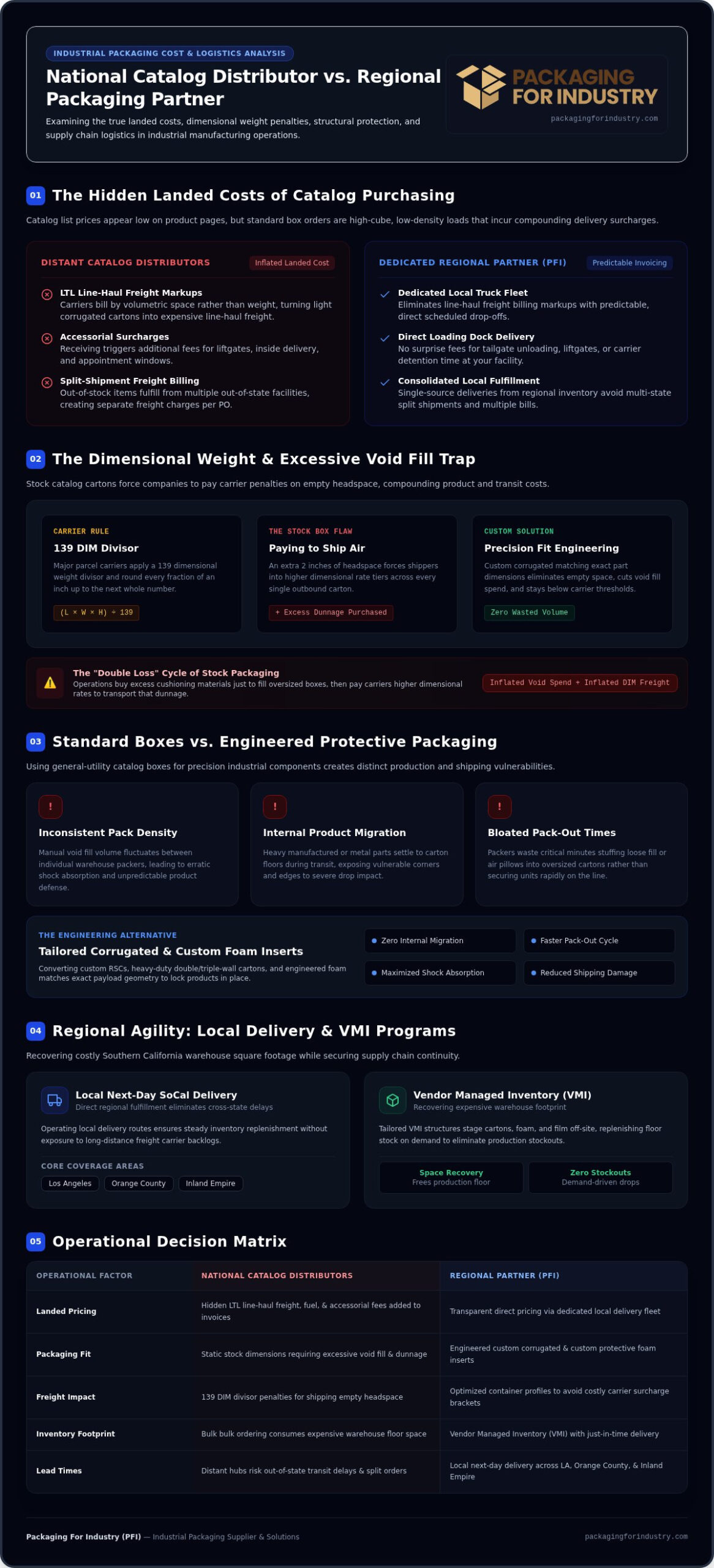
Catalog list prices look straightforward on a product page. You see a low per-carton rate for stock corrugated boxes, add them to your cart, and expect predictable spend. The reality surfaces when the actual invoice clears accounts payable. Bulky corrugated packaging is light but takes up immense volume, meaning national distributors rarely absorb line-haul shipping expenses. This exact discrepancy in landed cost is a core operational reason why our company left Uline for a local SoCal supplier.
When you rely on distant mega-distributors, hidden shipping lines routinely inflate the final price of routine packaging supplies. Common invoice additions that drain your procurement budget include:
- LTL line-haul freight markups: Shippers calculate freight by dimensional volume rather than actual weight, turning cheap boxes into expensive cargo.
- Accessorial delivery surcharges: Dock requirements trigger fees for liftgates, inside delivery, and limited access appointments.
- Split-shipment billing: Out-of-stock items fulfill from secondary facilities across state lines, creating separate freight charges for a single purchase order.
Deconstructing Freight Markups and Accessorial Fees
National third-party freight carriers treat corrugated pallets as high-cube, low-density loads. Catalog distributors pass those carrier freight charges directly to you. In contrast, working with a regional packaging distributor that operates its own local delivery truck fleet removes unpredictable line-haul freight billing. You receive scheduled drop-offs at your loading dock without surprise line-item fees for tailgate unloading or detention time.
The True Expense of Dimensional Weight Penalties
Settling for stock catalog box dimensions creates compounding expenses downstream. Major parcel carriers enforce a 139 dimensional weight divisor, rounding every fraction of an inch up to the next whole number. If a stock carton has two extra inches of empty headspace, you pay carrier freight on unused air across every outbound shipment.
Packaging operations often mask this issue by purchasing extra bubble, paper dunnage, or loose fill. That strategy doubles your losses. You buy excess cushioning materials just to fill space inside an oversized box, and then pay parcel carriers higher dimensional rates to transport that void fill. Unlocking measurable packaging cost savings requires matching the outer container to your part profile. Custom corrugated boxes eliminate dead volume, reduce shipping damage, and keep outbound shipments below costly carrier surcharge brackets. That fundamental shift in efficiency reflects why our company left Uline for a local SoCal supplier that engineers packaging around our products.
Catalog Limitations vs. Custom Industrial Packaging Engineering
Massive catalog distributors operate on volume standardization. They stock thousands of static box dimensions designed for general utility, not precision manufacturing. When your plant ships irregular sheet metal, sensitive avionics, or sterile medical devices, standard cardboard dimensions fail to provide adequate structural defense. That technical gap is a major reason why our company left Uline for a local SoCal supplier with true engineering capabilities.
High-volume operations often try to bridge the gap between stock cartons and delicate products by stuffing packages with loose fill, air pillows, or kraft paper. Relying on packing materials to compensate for incorrect carton sizes creates several production hazards:
- Inconsistent pack density: Manual void fill application varies between warehouse packers, causing erratic shock absorption during transit.
- Internal product migration: Heavy metal components settle to the bottom of the carton, leaving corners vulnerable to drop damage.
- Bloated pack-out times: Warehouse associates spend extra minutes stuffing dunnage into every carton instead of securing units quickly.
Precision Protection with Custom Corrugated and Foam
True protection demands containers tailored to your exact payload. An industrial converter manufactures custom corrugated boxes ranging from standard RSCs to heavy-duty double wall and triple wall containers built for structural stacking strength. Integrating these outer boxes with precision die-cut polyethylene, polyurethane, or anti-static ESD foam inserts locks sensitive assemblies firmly in place.
Rather than managing three different vendors for boxes, foam lining, and heavy shipping crates, a regional packaging manufacturer builds unified packaging kits. Your receiving dock handles a single SKU that combines outer corrugated protection, precision internal foam, and required wooden pallets or crates.
The Role of CAD Prototyping and Drop-Testing
Catalog distributors cannot engineer a container around your physical CAD files. In contrast, working directly with a dedicated packaging company gives you access to full in-house CAD/CAM prototyping. Design teams evaluate product tolerances, test compression strength, and run sample drop tests before you purchase full production runs.
Prototyping uncovers stress points early, ensuring packaging performs reliably under real-world freight vibrations. Validating physical samples with your quality assurance department eliminates packaging failures before products ship out to customers. If your facility is dealing with chronic transit damage or awkward box sizes, you can submit your part dimensions to request a packaging quote for custom prototypes that resolve those packaging bottlenecks immediately.
Why Local SoCal Logistics Beat Massive Centralized Warehouses
Centralized distribution centers operate efficiently on paper, yet they struggle when navigating complex regional freight corridors. When your production lines run at full capacity across Southern California, waiting on long-haul freight carriers introduces unnecessary risk. Freight hubs get backlogged, missed delivery windows halt outbound staging, and regional customer service teams lack visibility once orders enter common carrier networks. This operational vulnerability highlights why our company left Uline for a local SoCal supplier with dedicated regional routes.
Relying on a local packaging supplier changes how your loading dock operates day-to-day. Rather than competing for attention with thousands of parcel drops, you gain immediate advantages tailored to regional logistics:
- Direct route deliveries: Orders travel on dedicated company trucks, avoiding sorting hubs, missed connections, and common carrier damages.
- Dock-level familiarity: Drivers understand your facility access rules, designated unloading zones, and receiving hours.
- Agile dispatching: Emergency replenishment requests get routed directly from nearby facilities without waiting for multi-state line-haul transfers.
Hyper-Local Delivery Across Southern California Corridors
Southern California manufacturers operate under strict production schedules. Whether your facilities sit in Irvine, Santa Ana, Long Beach, or across Riverside, standard LTL transit windows can disrupt critical fulfillment targets. Partnering with an Anaheim packaging supplier provides fast local next-day delivery across Orange County, Los Angeles County, and the Inland Empire. When an unexpected surge in orders depletes your carton inventory, a nearby distribution partner can stage and dispatch critical stock without carrier handoff delays.
Dedicated Account Representatives vs. Anonymous Call Centers
National mega-distributors route inquiries through centralized call centers where representatives have never seen your facility. Solving complex packaging challenges requires direct, eyes-on evaluation. A regional packaging partner assigns dedicated specialists who physically visit your warehouse floor to review staging constraints, analyze line packing speed, and inspect pallet wrap stability.
These hands-on consultations eliminate the guesswork of digital ordering portals. When you need immediate answers regarding carton burst strength, moisture barriers, or foam density, you speak with a packaging consultant who understands your operational requirements. Having an accessible partner who resolves dock challenges in real time reinforces why our company left Uline for a local SoCal supplier committed to ongoing operational collaboration.
Solving Warehouse Space Crises with Vendor Managed Inventory (VMI)
Southern California industrial real estate commands a massive premium. Warehouse square footage in Orange County and Los Angeles represents some of the most expensive industrial space in the country. Storing thirty pallets of empty, bundled boxes on your production floor ties up revenue-generating space. Buying in massive bulk just to earn catalog discount tiers drains working capital and crowds your facility aisles. That severe space crunch clarifies why our company left Uline for a local SoCal supplier with agile stocking programs.
Transitioning from reactive ordering to structured vendor replenishment delivers several direct operational advantages:
- Reclaimed footprint: Bulky packaging supplies move off your production floor until active pack stations actually require them.
- Optimized working capital: Capital stays allocated to raw manufacturing materials rather than pallets of idle packaging.
- Zero production stoppages: Buffer stocks managed by a nearby partner prevent line shutdowns caused by sudden spikes in outbound shipping.
Reclaiming High-Cost Warehouse Floor Space
Every pallet position dedicated to empty boxes carries an ongoing monthly holding cost. If your facility stores forty pallets of standard catalog cartons, you are effectively paying high industrial lease rates simply to store empty air. A local packaging distributor acts as your auxiliary warehouse, holding customized stock off-site and delivering replenishment drops directly to your packing lines.
How Structured Packaging Replenishment Works
Structured replenishment relies on real operational metrics rather than educated guesses. Your team establishes agreed-upon minimum and maximum inventory thresholds based on current production runs. A dedicated packaging specialist conducts scheduled weekly, biweekly, or monthly stocking reviews to audit usage, check stock levels, and place replenishment triggers before inventory dips below your safety buffer.
This hands-on coordination lifts inventory management completely off your purchasing team’s desk. Implementing a structured program for vendor managed inventory guarantees that high-volume operations stay supplied without cluttering warehouse racks. Knowing our packaging supplies are replenished automatically on a local schedule reinforces why our company left Uline for a local SoCal supplier that operates as a true logistics partner.
Switching to a Regional Packaging Partner
Switching packaging suppliers shouldn’t disrupt active production lines. Operations managers often stay with massive catalog vendors simply because transitioning dozens of carton sizes feels overwhelming. A methodical migration actually prevents downtime while cutting waste across your supply chain. Executing a structured, multi-tier procurement transition illustrates why our company left Uline for a local SoCal supplier without missing a single dispatch window.
A reliable changeover relies on a phased rollout that balances active stock with new supplier onboarding:
- Run-out legacy stock: Deplete existing inventory on non-critical SKUs while establishing custom sizing benchmarks.
- Pilot critical production lines: Test new custom corrugated boxes and foam assemblies on high-volume product runs first.
- Transition bulk commodities: Shift high-turn consumables like stretch film, edge board, and strapping once outer packaging designs are locked.
Conducting a Thorough Packaging Spend and SKU Audit
The transition begins by pulling accounts payable records for your top twenty packaging items over the trailing twelve months. Categorize those line items by actual unit costs, third-party freight charges, accessorial add-ons, and documented damage write-offs. This baseline highlights where catalog ordering created structural losses.
Auditing the physical packing floor alongside shipping invoices often reveals quick operational wins. Packaging specialists spot opportunities to down-gauge stretch film, replace hand-taped corners with rigid edge protectors, or replace three oversized box sizes with a single engineered carton. This detailed analysis forms the economic core of why our company left Uline for a local SoCal supplier focused on total landed cost reduction.
Consolidating Materials to Maximize Purchasing Power
Fragmented procurement erodes purchasing leverage. Buying boxes from one distributor, machine stretch film from another, and cushioning dunnage from a third creates unnecessary freight bills and administrative overhead. Consolidating all industrial packaging supplies under a single regional supplier combines your operational volume into unified tiered pricing.
Consolidation also streamlines receiving operations. Your dock receives bundled deliveries containing custom boxes, protective foam, strapping, and pallet wrap on a single truck. Cross-category consolidation lowers packaging costs, cuts administrative processing time, and aligns production requirements under one accountable regional partner. Plant managers and procurement directors ready to benchmark current supply costs can request a packaging quote to evaluate custom sizes, compare landed container pricing, and establish a dependable local supply line.
Upgrade Your Southern California Packaging Operations
Transitioning to a regional partner transforms industrial packaging from an unpredictable overhead expense into an operational asset. Eliminating third-party line-haul freight fees, avoiding carrier dimensional penalties with right-sized cartons, and recovering high-cost warehouse floor space through structured inventory replenishment represent the exact reasons why our company left Uline for a local SoCal supplier.
Packaging For Industry delivers the regional responsiveness modern distribution centers and manufacturing plants require. With a dedicated local truck fleet providing next-day delivery across Orange County, Los Angeles, and the Inland Empire, alongside in-house CAD/CAM prototyping for custom corrugated boxes and protective foam packaging, your lines stay fully protected and continuously supplied.
Take control of your packaging supply chain, eliminate hidden freight markups, and give your operations team the dependable local support they need to succeed.
Frequently Asked Questions
Will switching from a national catalog supplier slow down my delivery timelines?
No, switching to a regional supplier usually improves replenishment speed for operations across Southern California. National catalog distributors rely on third-party freight carriers and out-of-state distribution hubs that face transit delays and missed delivery windows. A local supplier operates dedicated route trucks that provide dependable next-day delivery throughout Anaheim, Los Angeles County, Orange County, and the Inland Empire, ensuring your packaging materials arrive on a predictable schedule.
Can a local Southern California supplier handle custom engineered boxes and foam inserts?
Yes, regional packaging manufacturers provide full in-house CAD/CAM design and physical sampling for complex industrial applications. Unlike catalog companies that only sell fixed stock dimensions, a specialized supplier engineers custom corrugated boxes, heavy-duty double-wall containers, and precision-cut polyethylene or ESD foam inserts. Prototyping allows manufacturers to validate physical product fit, eliminate shipping damage, and avoid paying for excess carton space.
How does Vendor Managed Inventory (VMI) prevent packaging stockouts on production lines?
Vendor Managed Inventory prevents shortages by establishing fixed minimum and maximum inventory levels based on your facility’s actual production run rates. A dedicated packaging specialist conducts scheduled weekly, biweekly, or monthly on-site reviews to audit inventory, track burn rates, and trigger replenishments before stock dips into safety reserves. This hands-on oversight was a central reason why our company left Uline for a local SoCal supplier.
What volume do I need to order to get competitive wholesale packaging pricing?
Competitive wholesale pricing does not require ordering full truckloads of a single stock SKU. Regional suppliers offer tiered volume pricing across consolidated packaging programs that group custom cartons, machine stretch film, edge protectors, and wooden pallets on the same account. This cross-material purchasing structure gives mid-sized manufacturing plants and warehouses wholesale rate tiers without forcing them to store excess packaging inventory on-site.
How does a local supplier help reduce our carrier shipping and freight surcharges?
A regional packaging partner right-sizes outer shipping boxes to match your exact manufactured components, directly eliminating unnecessary cubic volume. Major parcel carriers bill on dimensional weight and assess steep handling surcharges on oversized packages. By engineering custom corrugated boxes that stay below carrier cubic volume thresholds, you avoid dimensional penalties and eliminate the expense of purchasing secondary void fill materials.
What happens if our manufacturing plant needs emergency packaging replenishments?
Having local supplier facilities in Anaheim and regional distribution staging prevents production stops when unexpected order surges occur. National suppliers fulfill rush orders via expensive priority freight from distant hubs, which often arrives too late. A dedicated Southern California partner can dispatch critical stock or pull from local safety buffers to keep your shipping operations active without crippling freight fees, demonstrating why our company left Uline for a local SoCal supplier.