
With the average package carrying over 50% empty space, shipping out of the West Coast has quietly turned into an expensive exercise in moving air. If your warehouse ships across the country, steep rate jumps for Zone 7 and Zone 8 parcels originating in the state can quickly erode your margins, especially with major carriers enforcing the 139 DIM divisor and rounding up package dimensions. You already know oversized stock cartons drive up carrier invoices, yet arbitrarily cutting box sizes risks severe transit damage. Finding proven packaging solutions to reduce DIM weight costs from California requires a smarter approach that balances cubic volume reduction with industrial-grade product defense.
In this 2026 guide, you’ll discover how custom industrial packaging engineering helps California shippers slash dimensional weight surcharges and freight costs across major carrier networks without sacrificing protection. We’ll examine how right-sized corrugated designs, engineered protective foam inserts, and localized Southern California supply pipelines eliminate wasted space, safeguard high-value goods, and permanently lower outbound shipping expenses.
Key Takeaways
- Understand how the universal 139 dimensional divisor and whole-inch rounding rules impact Zone 7 and Zone 8 parcel costs originating from West Coast facilities.
- Compare catalog cartons with custom corrugated boxes and dense die-cut foam inserts to eliminate billable cubic volume without sacrificing product protection.
- Implement high-performance closed-cell polyethylene foam cushioning to reduce required wall thicknesses and keep cartons under costly handling thresholds.
- Execute a two-step SKU audit that quantifies interior air space to identify targeted packaging solutions to reduce DIM weight costs from California.
- Leverage local next-day packaging delivery and Vendor Managed Inventory (VMI) from an Anaheim industrial supplier to streamline supply lines and lower freight expenses.
Understanding DIM Weight Impact on Outbound California Shipments
Major carriers no longer calculate shipping invoices strictly on scale weight. Instead, freight networks bill based on the space a carton occupies inside delivery vehicles. Under standard parcel carrier guidelines, dimensional weight serves as a calculated minimum billable weight determined by exterior cubic volume. When shipping low-density, bulky industrial assemblies, your actual physical scale weight becomes practically irrelevant. If a 12-pound fabricated aluminum housing ships in a poorly fitted 20x20x16 carton, carriers bill that shipment at volumetric rates rather than actual mass, charging you directly for dead air.
The Mathematical Formula: How Carriers Bill for Dead Air
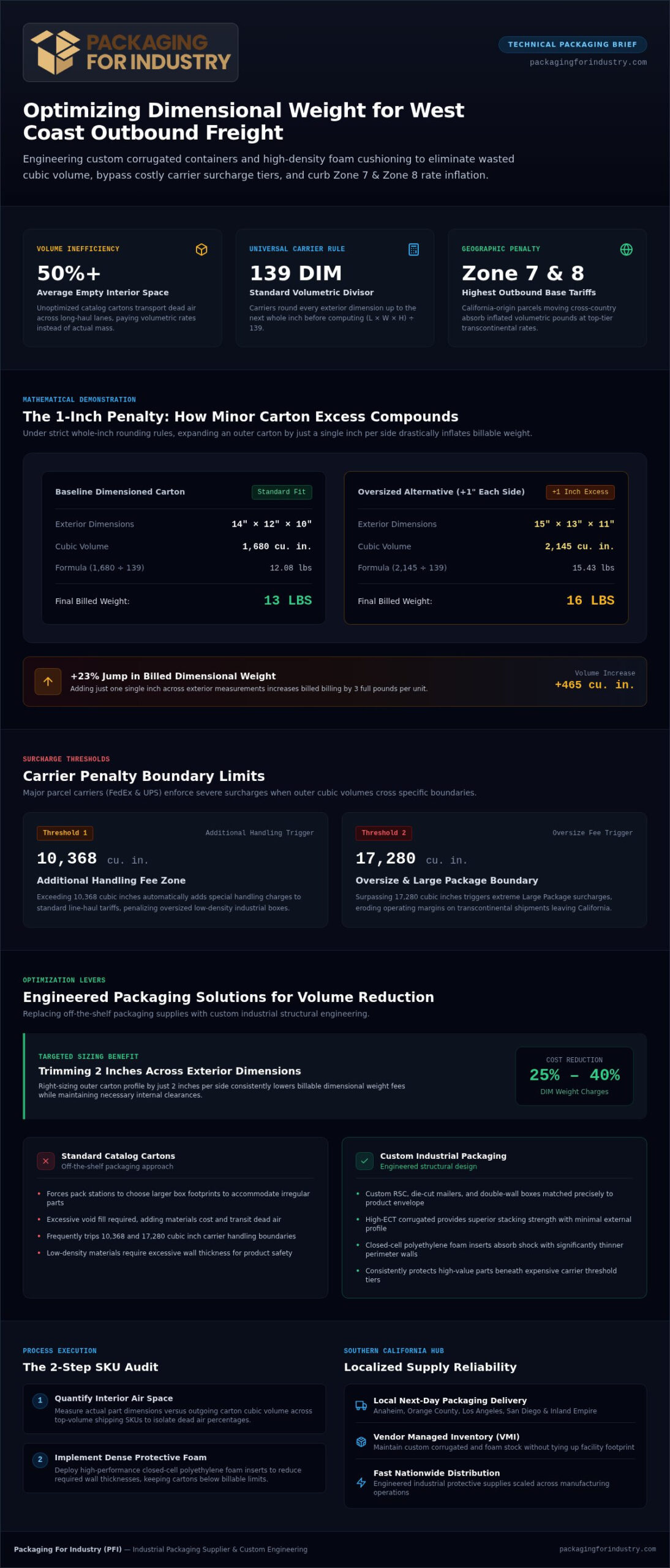
Domestic carriers determine volumetric weight by calculating length times width times height divided by the standard 139 dimensional divisor. Under current carrier audit practices, each exterior measurement is rounded up to the next whole inch before multiplication. Consider the financial penalty of modest packaging excess:
- Baseline Carton (14x12x10 inches): Generates 1,680 cubic inches, billing at 13 pounds (12.08 rounded up).
- Oversized Alternative (15x13x11 inches): Adding just one inch to each dimension yields 2,145 cubic inches, billing at 16 pounds (15.43 rounded up).
That single extra inch in each dimension forces a 23% jump in billed weight. For warehouses packing lightweight electronics, assembled medical devices, or aerospace tubing into generic containers, these inflated volumetric calculations compound daily across every outgoing pallet.
The Geographical Cost Penalty for West Coast Manufacturers
Geography amplifies dimensional weight penalties for West Coast operations. Shipments originating in California moving east encounter Zone 7 and Zone 8 line-haul rates, where base per-pound tariffs sit at their highest tier. When a cross-country carton triggers carrier dimensional rules, you absorb those inflated volumetric pounds at top-tier transcontinental rates rather than regional short-haul pricing.
West Coast operations also face strict volume surcharge boundaries. Both FedEx and UPS enforce Additional Handling fees once a parcel exceeds 10,368 cubic inches, while Oversize and Large Package charges hit at 17,280 cubic inches. Reaching those thresholds on long-haul routes turns single shipments into major margin drains. Deploying engineered custom design packaging prevents these arbitrary threshold violations by matching exterior carton geometry exactly to internal part clearance, keeping packages safely beneath costly carrier trigger points.
Implementing targeted packaging solutions to reduce DIM weight costs from California delivers an immediate impact on these high-mileage lanes. Right-sizing exterior carton dimensions by just two inches across all sides can lower dimensional weight charges by 25% to 40%, safeguarding your operating margins against aggressive transcontinental rate structures.
Comparing Packaging Solutions to Reduce Dimensional Weight
Warehouses relying on generic catalog boxes invariably pay to ship trapped air. Selecting effective packaging solutions to reduce DIM weight costs from California requires a direct comparison between off-the-shelf packaging supplies and custom-engineered protective configurations that minimize cubic footprint.
Stock Boxes vs. Custom-Sized Corrugated Containers
Stock catalog cartons force pack stations into compromises. When a manufactured component does not fit standard carton sizes, packers jump to the next larger footprint, filling the empty perimeter with dunnage. This practice creates two direct expenses: the cost of purchasing excessive void fill and carrier surcharges for transporting dead space across long-haul lanes.
Precision custom corrugated boxes eliminate that wasted volume. Tailoring regular slotted cartons (RSC), custom die-cut mailers, or heavy-duty double-wall boxes to the exact profile of your payload strips unneeded inches from every dimension. Rather than relying on oversized overpack containers to protect sensitive goods, utilizing high-ECT (Edge Crush Test) double-wall or triple-wall corrugated board maintains superior stacking strength within a significantly tighter outer profile. This precise sizing is how industrial operations consistently lower packaging costs across volume shipping lines.
Loose Void Fill vs. Precision Cushioning Materials
Loose packaging materials create hidden dimensional liabilities. Kraft paper, bubble wrap, and loose fill settle and migrate during transit vibration. To counteract that shifting, packaging guidelines often mandate two to four inches of loose fill around an entire assembly, artificially inflating the carton’s exterior dimensions.
Engineered protective foam packaging changes the geometry of package protection:
- Targeted shock isolation: Precision custom foam inserts and corner caps secure load-bearing points directly, eliminating the need to cushion empty interior air.
- Thinner protective profiles: Resilient closed-cell polyethylene foam absorbs high impact energy within a fraction of the wall thickness required by loose paper or bubble film.
- Reduced outer dimensions: Stabilizing the payload internally lets you downsize the exterior shipping container by multiple inches on every side.
Implementing engineered packaging solutions to reduce DIM weight costs from California protects delicate assemblies against transit drops while eliminating billable bulk. If your facility is managing high parcel volumes, you can request a packaging quote to benchmark your current carton dimensions against custom-designed corrugated and foam packaging.
Engineered Protective Foam and Structural Design Strategies
Arbitrarily downsizing a box without evaluating internal dynamics leads directly to damaged components and expensive return freight. Packaging engineers eliminate dead space by selecting cushion densities that deliver maximum deceleration across minimal thickness. Rather than surrounding a product with generic, low-density void fill that requires broad buffer zones, precision-fabricated foam materials allow you to shrink the outer container geometry while maintaining complete drop protection.
Material Selection: Polyethylene vs. Polyurethane Density
Matching dynamic loading requirements to the correct polymer structure is essential for volume reduction. High-density, closed-cell polyethylene foam provides exceptional compressive strength, absorbing severe shock loads with substantially thinner walls than standard dunnage. This compact profile makes it ideal for dense metal fabrications, heavy tooling, and aerospace hardware. Conversely, open-cell polyurethane foam delivers gentle, conforming deceleration for low-mass, shock-sensitive instruments that cannot tolerate stiff resistance.
For sensitive electronics, medical assemblies, and circuit boards, static-dissipative and conductive ESD foam packaging prevents electrostatic discharge while maintaining tight spatial boundaries. Selecting engineered foam packaging tailored to exact product fragility curves allows shippers to strip multiple exterior inches from their carton builds, providing reliable packaging solutions to reduce DIM weight costs from California outbound distribution lines.
CAD/CAM Prototyping and Drop-Test Validation
Modern packaging design relies on computer-aided modeling rather than trial and error on the pack line. Using digital drawings of your physical hardware, engineers construct tailored cavity inserts that secure fragile edges while leaving non-critical clearances hollow. This approach concentrates protective material exclusively where mechanical stress occurs:
- Precision CNC routing: Cuts complex contours that anchor heavy components, preventing payload shift without wrapping the entire unit in bulk cushioning.
- Integrated structural end caps: Suspends assemblies in the center of the carton, eliminating contact with exterior walls while cutting total cubic volume.
- Rapid physical sampling: Validates dimensional tolerances and assembly speed before committing to volume manufacturing runs.
Drop testing under strict industrial transit protocols proves that a tighter exterior container performs reliably through abusive hub sorting environments. Leveraging professional custom design packaging ensures that every reduction in cubic dimension is backed by repeatable drop-performance data, preventing costly transit damage across long-haul freight corridors.
How Southern California Facilities Can Audit and Optimize Packaging
Plant managers often view dimensional penalties as unavoidable carrier rate adjustments. In reality, these charges stem directly from uncalibrated packing processes on the plant floor. Systematically auditing your outbound shipping lines uncovers immediately actionable opportunities to eliminate empty volume. Southern California fulfillment and manufacturing hubs can systematically overhaul their pack stations through a structured, four-step assessment:
- Step 1: Audit high-frequency SKUs. Pull freight invoices to isolate your top twenty outbound part numbers that routinely trigger dimensional adjustments on Zone 7 and 8 deliveries.
- Step 2: Quantify wasted air space. Record the physical dimensions of each component, then compare those against the exterior measurements of the shipping carton to calculate the cubic volume gap.
- Step 3: Convert loose fill to custom inserts. Replace manual paper wrapping or bubble bags with dense, precision-cut internal bracing to collapse outer perimeter dimensions.
- Step 4: Standardize carton sizes. Replace broad catalog inventories with targeted custom box sizes engineered to group similar component profiles safely.
Conducting an In-Plant Packaging Dimensional Audit
Start your audit by reviewing carrier billing line items rather than standard rate sheets. Compare actual scale weights against billed dimensional weights across all outbound parcel files. When you find significant variances, inspect your packing benches. Line workers under speed pressure naturally grab oversized stock boxes and fill the extra space with paper or air pillows. Identifying these patterns reveals which product families are actively inflating your freight spend, establishing the baseline needed to implement packaging solutions to reduce DIM weight costs from California distribution centers.
Managing Lead Times and Floor Space with Stocking Programs
Plant managers frequently hesitate to order custom boxes because they fear consuming valuable floor space with numerous specialized cartons. Dedicated stocking agreements resolve this operational friction. By partnering with a local supplier that offers Vendor Managed Inventory, facilities maintain just-in-time supplies of custom corrugated cartons, precision foam inserts, and protective materials without tying up staging aisles.
Local industrial inventory management ensures manufacturing plants across Anaheim, Orange County, and Los Angeles pull exact pallet quantities on demand. Having pre-staged packaging solutions to reduce DIM weight costs from California delivered directly to packing lines keeps operations lean, prevents stockouts, and eliminates unnecessary catalog freight markups.
Packaging For Industry: Regional Supply Reliability
Controlling outbound parcel expenses requires a manufacturing partner that combines technical packaging design with responsive regional supply channels. Operating directly out of Anaheim, California, Packaging For Industry (PFI) delivers complete industrial packaging solutions to reduce DIM weight costs from California manufacturing plants and fulfillment centers. We eliminate middleman distributor markups, providing direct engineering oversight from initial CAD prototyping straight through to scheduled plant-floor replenishment.
Local Delivery Across Southern California Industrial Corridors
Supply chain reliability depends on fast, predictable turnaround times. PFI operates dedicated regional delivery routes providing local next-day delivery across Orange County hubs including Anaheim, Irvine, Santa Ana, and Huntington Beach. Our local fleet also services major industrial corridors throughout Los Angeles County, the Inland Empire, and San Diego County.
For operations distributing goods beyond the West Coast, we maintain nationwide shipping capabilities through trusted domestic freight channels. Whether your facility requires daily truckload drops or scheduled weekly replenishments, our localized logistics network prevents packaging bottlenecks while protecting warehouse operational flow.
Complete Turnkey Industrial Protection Under One Roof
Sourcing corrugated boxes from one vendor, protective foam from a second, and wood crates from a third complicates procurement and leads to dimensionally mismatched packs. PFI functions as a single-source custom packaging supplier, manufacturing fully integrated protective assemblies under a unified specification:
- Matched Corrugated and Cushioning: We manufacture heavy-duty custom corrugated boxes designed specifically around high-density foam inserts, ensuring flush internal tolerances that leave zero excess billable volume.
- Industrial and Mil-Spec Compliance: Our engineering team supports demanding aerospace, electronics, medical device, and defense contractors requiring rigorous mil-spec compliance and strict transit validation.
- Cash Flow and Inventory Management: Structured Vendor Managed Inventory (VMI) and just-in-time stocking programs allow your facility to draw down pre-engineered packaging runs without absorbing high storage costs or carrying excess overhead on balance sheets.
Eliminating carrier dimensional penalties begins by auditing your high-volume shipping footprints. Talk with our packaging specialists today to request a quote and explore tailored packaging solutions to reduce DIM weight costs from California facilities while safeguarding critical industrial assemblies.
Streamline Your Shipping Footprint and Protect Profit Margins
Unchecked cubic volume will continue to drain outbound shipping budgets as parcel carriers enforce strict dimensional divisor rules. Transitioning from generic catalog cartons to engineered corrugated containers paired with dense, precision-cut foam inserts allows West Coast facilities to systematically eliminate billed dead air. Implementing specialized packaging solutions to reduce DIM weight costs from California transforms outbound parcel logistics from a recurring financial penalty into a reliable competitive advantage.
Packaging For Industry delivers this optimization directly from our Anaheim, CA manufacturing headquarters. We provide complete end-to-end integration of custom corrugated boxes, precision die-cut foam, and industrial crates under a single roof. With in-house CAD/CAM prototyping, our team validates physical fit, material density, and transit protection before full-scale manufacturing, supported by responsive next-day local delivery across Southern California.
Take control of your freight expenses today and ensure every outgoing carton delivers maximum protection at the lowest billable weight.
Frequently Asked Questions
What is dimensional weight and how do carriers calculate it on California shipments?
Dimensional weight reflects cubic package volume rather than physical scale weight. Parcel carriers multiply the rounded-up length, width, and height in inches and divide that total by the standard 139 divisor. If the resulting dimensional weight exceeds actual scale weight, carriers bill at the higher volumetric number. Utilizing engineered packaging solutions to reduce DIM weight costs from California eliminates this costly dead space on outbound carrier manifests.
Why do outbound packages from Southern California face higher dimensional weight surcharges?
Shipments originating on the West Coast traveling across the country incur Zone 7 and Zone 8 line-haul rates, which carry the highest baseline tariffs. When oversized cartons trigger dimensional weight calculations or cubic volume thresholds, those volumetric penalties compound against maximum long-haul mileage rates. California shippers moving goods eastward absorb a far harsher financial impact from empty box space than regional shippers operating within lower zones.
How much carton space can custom corrugated boxes save compared to stock boxes?
Custom corrugated boxes eliminate the significant empty space commonly found inside standard catalog cartons. Because catalog sizes force packaging lines to round up to the next available carton dimension, shippers frequently add multiple inches of unneeded perimeter volume. Custom boxes engineered to exact product dimensions remove redundant dunnage, drop total exterior cubic inches, and routinely lower billable dimensional weight by 25% to 40%.
Can custom-engineered foam inserts protect heavy equipment while reducing outer box dimensions?
Yes, high-density closed-cell polyethylene foam provides superior shock absorption within a significantly thinner protective profile. Unlike loose void fill or bubble wrap that shifts and requires thick interior buffers, engineered foam end caps isolate critical impact points directly. This focused structural dampening absorbs heavy drop energy efficiently, allowing packaging engineers to reduce exterior carton dimensions without risking equipment damage during transit.
How do Vendor Managed Inventory (VMI) programs help manage custom packaging inventory?
VMI programs eliminate the warehouse floor space concerns typically associated with ordering custom box sizes in bulk. Your packaging partner monitors plant inventory levels and replenishes custom corrugated cartons and die-cut foam inserts on scheduled recurring intervals. This structure prevents line stockouts, eliminates expensive rush orders, and ensures facilities keep effective packaging solutions to reduce DIM weight costs from California stocked at packing benches.
What production industries benefit most from packaging dimensional weight reduction?
Manufacturers producing lightweight, bulky, or fragile industrial assemblies realize the greatest immediate savings from dimensional optimization. Primary sectors include aerospace and defense contractors, electronics and semiconductor fabricators, medical device manufacturers, and precision instrumentation companies. These operations frequently pack lightweight, delicate units into oversized boxes filled with dunnage, routinely triggering carrier volumetric billing penalties and expensive oversize handling surcharges across nationwide distribution networks.
How fast can Southern California businesses receive custom packaging prototypes and deliveries?
Facilities across Southern California receive rapid CAD/CAM physical prototypes within days and benefit from next-day local delivery on volume production runs. Operating from an Anaheim manufacturing headquarters, PFI maintains a dedicated fleet serving Orange County, Los Angeles County, the Inland Empire, and San Diego County. This regional proximity enables fast sampling to validate drop performance before running production, followed by dependable next-day dock delivery.