
The airtight seal you rely on to stabilize pallet loads might actually be destroying them from the inside out. When warm goods enter cold distribution environments, trapped heat creates severe pallet sweat that weakens corrugated boxes, breeds mold, and triggers dangerous load shifts in transit. You shouldn’t have to sacrifice containment force just to let your inventory breathe. Integrating breathable logistics wrap into your warehouse operation eliminates internal moisture buildup, allowing temperature-sensitive freight to off-gas and cool down without compromising unit load rigidity.
You already know that keeping shipping damage low requires rock-solid pallet integrity, but constant moisture-related carton failures erode operating margins and disrupt delivery schedules. This industrial guide covers how vented stretch film stabilizes challenging freight, shortens cold storage dwell times, and protects secondary packaging across demanding supply chains. Here is what your operations team needs to know to evaluate venting performance, select the right film specifications, and secure reliable bulk packaging supplies that protect your bottom line.
Key Takeaways
- Understand how breathable logistics wrap eliminates transit condensation, stops corrugated box collapse, and maintains proper holding force for industrial loads.
- Identify how continuous pallet airflow accelerates cooling for hot-fill processing and reduces dwell times inside cold storage blast freezers.
- Compare reinforced die-cut film styles to balance required airflow percentages against critical unit containment strength.
- Discover application best practices, including wrapper tension calibration and pairing vented wrap with corner board to stop load shifting.
- Learn how to evaluate bulk packaging pricing, request specialized quotes, and utilize vendor managed inventory (VMI) to stabilize packaging supply.
What Is Breathable Logistics Wrap and Why Does Standard Film Fail?
Every warehouse manager recognizes the security of a tightly wrapped pallet. Applying traditional stretch film provides structural rigidity, but wrapping temperature-sensitive or warm inventory with solid plastic creates a closed microclimate. As ambient conditions shift during transit, this trapped environment produces catastrophic packaging failures.
Breathable logistics wrap solves this vulnerability. Engineered from linear low-density polyethylene (LLDPE) featuring continuous die-cut perforations, it allows uninterrupted airflow across the unit load. This airflow lets warm gases escape and cold air enter freely while maintaining high tensile containment forces. Where impermeable films seal in problems, vented wrap balances structural load stability with constant product respiration.
When shipping containerized freight across changing climates, dew point shifts pose a major risk. The air inside an enclosed truck trailer or ocean container rapidly cools during transit. If the internal pallet environment remains warm and humid, the air temperature drops below its dew point, forcing vapor into liquid. Pallets wrapped in solid plastic lack ventilation, transforming this condensation into trapped moisture that pools directly against your goods.
The Mechanics of Pallet Sweat and Condensation Damage
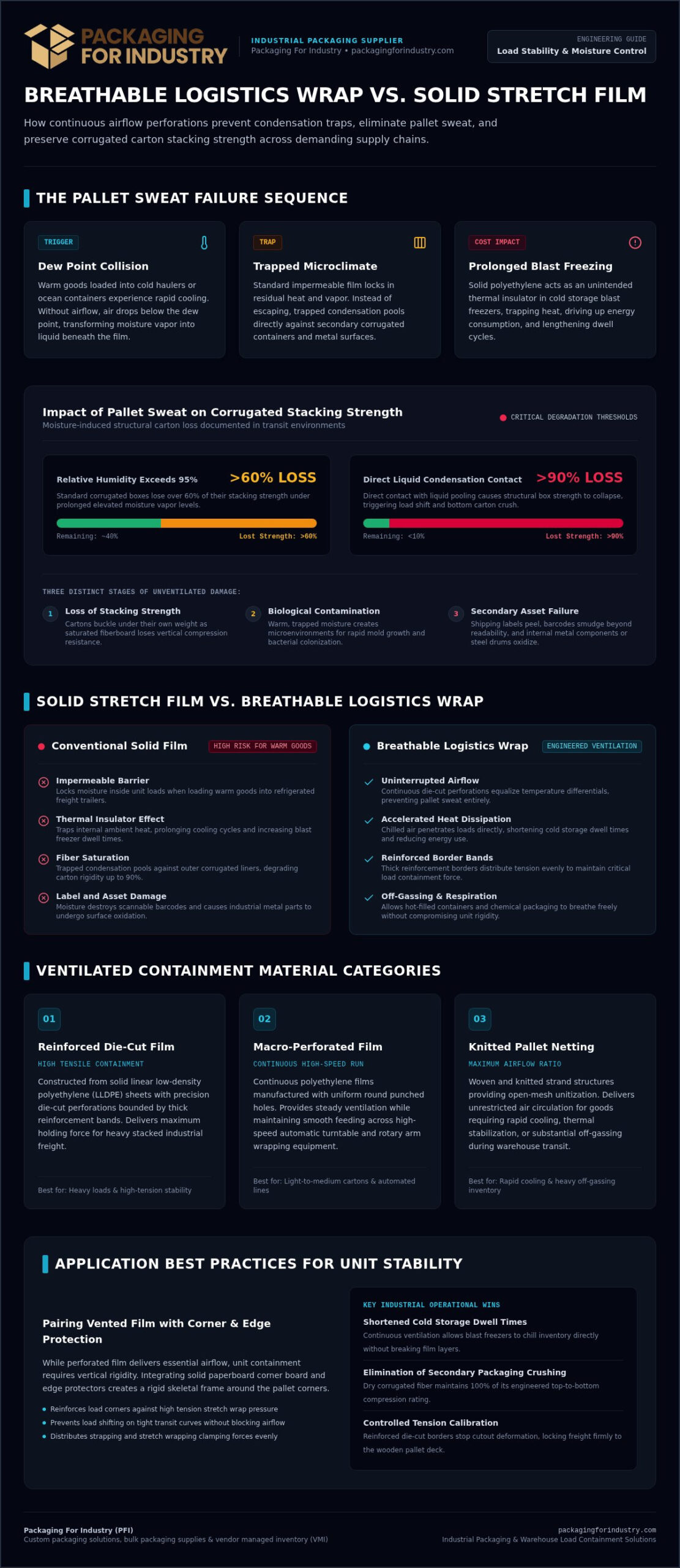
Pallet sweat occurs whenever temperature differentials collide with impermeable surfaces. Warm industrial goods loaded directly into refrigerated haulers generate immediate condensation beneath internal film layers. Without ventilation, this moisture destroys packaging integrity across three distinct stages:
- Loss of stacking strength: When relative humidity exceeds 95%, standard corrugated boxes lose over 60% of their stacking strength. Direct liquid contact drops structural strength by more than 90%, causing stacked cartons to buckle under their own weight.
- Biological contamination: Warm, trapped moisture creates the exact conditions required for mold growth and bacterial colonization on food and chemical packaging.
- Secondary asset failure: Saturated cardboard causes barcodes to smudge, shipping labels to peel, and internal steel drums or metal parts to oxidize.
Using corner and edge protection alongside breathable stretch wrap reinforces load corners while allowing total air circulation to equalize internal pallet temperatures with ambient air.
Solid Stretch Film vs. Vented Logistics Film
Conventional wrapping relies on solid layers of standard stretch film to unitize freight. In blast-freezer operations, solid polyethylene acts as an unwanted thermal insulator. It locks in residual heat, which prolongs cooling cycles and drives up facility energy consumption. Conversely, breathable logistics wrap lets chilled air circulate directly across individual cartons, drastically cutting dwell times.
The engineering advantage centers on elastic memory. Quality vented film features reinforced borders around each cutout. These bands distribute tension evenly, delivering the necessary holding force to stop load shifting during transit without choking the cargo.
Types of Breathable Pallet Wraps: Comparing Materials and Reinforcements
Selecting the right breathable logistics wrap requires balancing product weight, required airflow volume, and machinery capabilities. Not all ventilated films behave the same way under tension. Choosing the incorrect style risks load shifting on tight transit curves or choking goods that demand heavy continuous air exchange. Evaluating specialized stretch film products based on load profiles helps purchasing teams secure freight stability while managing film consumption effectively.
Breathable containment materials fall into three distinct structural categories:
- Reinforced die-cut films: Solid linear low-density polyethylene sheets with precision cutouts bordered by thick reinforcement bands. They deliver maximum holding force for heavy stacked freight.
- Macro-perforated films: Continuous films featuring round punched holes. These provide steady ventilation for light-to-medium cartons while running smoothly on standard high-speed equipment.
- Knitted pallet netting: Open-mesh polyolefin structures offering near-total exposure for maximum post-harvest respiration and rapid moisture evaporation.
Reinforced Die-Cut Film Architecture
Die-cut films solve the challenge of securing heavy industrial freight without causing tears. Continuous lateral ribs distribute wrapping tension across each layer. Hemmed edges prevent tears from propagating across perforations during automated pallet turn cycles. This architecture delivers containment force comparable to standard 80-gauge solid film, making it suitable for stacked cartons, heavy beverage cans, and chemical pails.
Macro-Perforated and Knitted Logistics Netting
Knitted netting and macro-perforated wraps prioritize maximum cubic airflow over rigid tensioning. Knitted mesh stretches cleanly across irregular profiles, including bagged grains, peat moss, firewood, and fresh agricultural harvests. Open mesh structures also simplify sanitation washdowns and let fumigation gases penetrate deep into pallet centers without unwrapping.
Automated rotary arms and turntable wrappers apply perforated films differently than standard wrap. Following safe pallet wrapping procedures ensures line operators maintain safe tension thresholds and prevent film snapbacks. If you need help identifying whether reinforced die-cut film or elastic netting fits your automated turntables, request a packaging quote to evaluate your current freight specifications.
Critical Industrial Applications Requiring Breathable Logistics Wrap
Operations leaders often assume vented stretch film only applies to freshly harvested orchard produce. While agriculture represents substantial film volume, several high-value industrial manufacturing and processing sectors depend on continuous airflow to prevent catastrophic product degradation. Breathable logistics wrap provides an engineered pathway for heat dissipation, chemical vapor dispersal, and moisture control across diverse supply networks.
Facilities handling thermal-shift goods face immediate quality risks if pallet contents cannot vent freely. The food and beverage sector accounts for 38% of vented stretch film demand, largely because sealed containers require active thermal stabilization right off packaging lines. Industrial manufacturing lines face similar pressures with off-gassing polymers and moisture-sensitive chemicals.
Food Processing, Beverage, and Cold Storage Logistics
Hot-fill operations, such as bottling facilities for sauces, juices, and canned vegetables, package goods at elevated temperatures to ensure commercial sterility. When production teams palletize these containers immediately, residual heat radiates into the unit load. Standard film locks that energy inside. Breathable logistics wrap allows this heat to radiate away rapidly, slashing dwell time in cooling staging zones before staging freight into reefers.
This rapid heat transfer protects secondary packaging assets:
- Eliminates surface rust on tinplate can seams and steel drum rings caused by trapped steam
- Prevents water-based adhesives from softening, keeping shipping labels secure and legible
- Accelerates freezing cycle times in blast-freezer warehouses, cutting distribution center compressor runtimes
- Stops condensation from pooling inside corrugated trays, preventing secondary carton failure
Industrial Manufacturing and Chemical Outgassing
Beyond the food cold chain, continuous pallet ventilation is vital for chemical manufacturing and construction supplies. Freshly molded polymers, rubber compounds, specialty adhesives, and industrial paints release volatile organic compounds and thermal moisture as they cure. Palletizing these goods in solid plastic creates trapped pressure zones that distort container walls and trigger blister defects on finished parts.
Damp construction products like bagged cement mixes, refractory bricks, and concrete masonry blocks must cure without trapping trapped atmospheric water. Applying breathable logistics wrap allows excess moisture to evaporate naturally during warehouse transit. Industrial operations should pair vented wrapping with heavy-duty corner and edge protection to stabilize rigid building products without crushing vulnerable carton perimeters or restricting vital horizontal airflow channels.
How to Apply Breathable Logistics Wrap for Maximum Load Stability
Applying perforated stretch film demands precise tension management. Unlike solid films that tolerate erratic turntable speeds, breathable logistics wrap relies on intact lateral bands to maintain structural integrity. Running vented rolls with improper carriage settings tears the perforations, destabilizing the pallet before it reaches the loading dock.
Operations teams achieve optimal load containment by implementing a five-step wrapping framework:
- Step 1: Audit cargo parameters. Calculate gross pallet weight, evaluate dew point risks across transit routes, and verify carton compression thresholds under dynamic tension.
- Step 2: Calibrate machine pre-stretch. Match carriage pre-stretch ratios to film gauge so die-cut holes open fully without shearing the load-bearing bands.
- Step 3: Secure the pallet base. Anchor the film tail with three complete revolutions wrapping the lower cartons directly into the wooden pallet deck.
- Step 4: Maintain consistent overlap. Advance up the pallet column using a consistent 50% overlap to build uninterrupted vertical holding strength.
- Step 5: Measure containment force. Test outgoing pallets using calibrated pull gauges against ASTM standards before staging trailers.
Machine Wrapper Calibration and Pre-Stretch Settings
Automated turntables and rotary arms require mechanical adjustments when transitioning from solid film. Calibrate pre-stretch rollers between 150% and 250% depending on film specifications. Exceeding recommended pre-stretch limits splits lateral reinforcement bands. Adjust corner compensation dampening so the wrapper eases tension when rounding sharp box edges, eliminating localized puncture tears.
Hand Application Protocols for Distribution Centers
Manual wrapping stations present significant consistency challenges. Warehouse selectors pulling standard hand film often rely on erratic physical tension, leading to inconsistent holding force. Equip packing teams with specialized manual dispensers featuring mechanical braking. Ensure workers apply three solid rotations around the pallet base runners before ascending the load.
Procuring Breathable Logistics Wrap: Custom Sourcing and Inventory Reliability
Purchasing teams often view stretch film through a narrow lens: cost per roll. When evaluating specialty materials like breathable logistics wrap, that single metric distorts real operational costs. Factoring in load failures, freight rejections, and spoiled inventory proves that perforated film pays for itself by eliminating transit moisture damage. Sourcing through an established industrial packaging supplier provides steady access to both standard rolls and custom configurations without exposure to import lead times.
Working with an offshore distributor leaves operations vulnerable to port congestion and sudden stockouts. When specialized film supplies dry up, warehouse teams revert to impermeable wrap, immediately reigniting condensation problems on the shipping dock. Partnering with a reliable domestic distributor protects your workflow with dependable stock access and scheduled local deliveries.
Lowering Overall Packaging Costs Beyond Unit Price
Evaluating packaging spend requires analyzing total cost of ownership. A rejected reefer load or collapsed pallet column costs significantly more than the price difference between commodity wrap and engineered vented film. Sourcing heavy-duty corrugated shipping cartons alongside your wrap creates a unified containment strategy that stands up to demanding transport cycles.
Facilities running high-volume lines can streamline replenishment through vendor-managed inventory services. Implementing a VMI program prevents unexpected runouts, stabilizes bulk packaging pricing, and frees warehouse floor space from excess safety stock. Your purchasing department maintains steady inventory thresholds while eliminating emergency rush-freight charges.
Partnering with Packaging For Industry (PFI)
Packaging For Industry delivers complete packaging support, helping facilities balance material engineering with strict operating budgets. Rather than pushing generic catalog items, we audit your pallet configurations, machinery, and temperature profiles to match the right gauge and vent geometry to your freight.
Industrial operations across Southern California gain a distinct logistical edge. We provide reliable local next-day delivery across Orange County, Los Angeles, Anaheim, and the Inland Empire, supported by nationwide fulfillment capabilities for multi-site operations. Whether you require truckload stock corrugated boxes, custom edge protectors, or machine-grade perforated film, our specialists help you stabilize pallet loads and reduce shipping damage. Contact our technical team today to request a packaging quote and evaluate your facility’s containment strategy.
Protect Cargo Integrity with Engineered Pallet Ventilation
Moisture-related transit losses and crushed cartons don’t have to be accepted operational costs. Breathable logistics wrap delivers continuous airflow to eliminate pallet sweat while maintaining the critical containment force your freight requires. Pairing vented film with heavy-duty corrugated cartons and edge protection keeps unit loads stable across demanding distribution routes.
Packaging For Industry helps you optimize pallet protection with complete stock and custom stretch film supplies, corrugated boxes, and protective foam packaging. Facilities across Southern California benefit from local next-day delivery, while our Vendor Managed Inventory (VMI) programs eliminate production stockouts and stabilize your packaging spend.
Take control of your moisture risks today. With the right film engineering and dependable packaging supply, your operations can eliminate shipping damage and protect the bottom line.
Frequently Asked Questions
What is the difference between breathable logistics wrap and standard pallet stretch film?
Breathable logistics wrap features engineered perforations or die-cut apertures that permit continuous airflow throughout palletized inventory. Standard stretch film creates an impermeable, airtight seal around freight. While solid wrap locks in residual heat and condensation, ventilated film allows temperature-sensitive goods to equalize with ambient air without losing the elastic memory required to stabilize heavy industrial loads.
Does breathable logistics wrap compromise pallet load containment and stability?
No, properly engineered breathable wrap does not sacrifice load containment. High-performance vented films incorporate reinforced lateral bands along the perforation margins. These bands absorb dynamic transit shock and distribute tension evenly across tiers. When applied with correct carriage pre-stretch ratios, vented wrap delivers containment strength comparable to conventional 80-gauge stretch film while preventing moisture-induced carton failure.
Can breathable stretch film run on existing automatic pallet wrapping machinery?
Yes, machine-grade vented stretch wrap runs efficiently on standard turntable, rotary tower, and orbital wrapping machines. Operators only need to adjust tension and corner-compensation settings to prevent edge shearing. Packaging For Industry works with warehouse teams across Southern California to calibrate pre-stretch rollers, ensuring smooth transitions without requiring costly equipment retrofits or specialized carriage investments.
How does breathable logistics wrap prevent corrugated boxes from collapsing during transit?
Corrugated containers lose over 60% of their stacking strength when relative humidity climbs above 95%, and direct moisture contact destroys over 90% of carton compression integrity. Breathable logistics wrap continuously vents evaporated moisture before it converts to liquid sweat. Keeping corrugated packaging dry preserves the vertical box fluting, stopping bottom cartons from buckling under overhead pallet weight during transit.
Which industries benefit most from using breathable pallet wrap?
Food and beverage processors benefit heavily, particularly operations shipping hot-fill bottles, fresh produce, dairy, or frozen inventory. Chemical manufacturers, industrial paint producers, and composite molders rely on ventilated wrap to dissipate outgassing fumes safely. Additionally, building material suppliers use it to allow damp masonry and bagged mixes to cure thoroughly during storage and distribution.
Is breathable logistics wrap recyclable through conventional commercial waste streams?
Yes. Most vented stretch wrap is manufactured from linear low-density polyethylene (LLDPE), which is classified as Category 4 plastic. Distribution centers can bundle clean vented wrap directly with standard clear stretch film in their existing commercial balers. Recycling operations process it alongside standard polyethylene film streams without requiring specialized separation procedures or added handling fees.
How do I choose between macro-perforated film and reinforced vented stretch film?
Base your selection on product weight and required airflow volume. Macro-perforated film suits lighter loads or goods needing rapid air exchange, such as fresh agricultural produce and baked goods. Heavy, dense freight like canned beverages, chemicals, or stacked corrugated containers requires reinforced die-cut film, which features solid containment bands that withstand dynamic transport vibration without tearing.
How does breathable logistics wrap help lower overall supply chain packaging costs?
It reduces the total cost of ownership by preventing rejected shipments, product write-offs, and damaged corrugated inventory. Avoiding just one collapsed pallet or moisture-spoiled reefer load easily pays for specialized packaging materials. PFI helps industrial clients stabilize spend through Vendor Managed Inventory programs, pairing vented wrap with custom boxes and corner protection to maximize transit efficiency.