
A competitive packaging price can look different once freight and storage enter the calculation. For Southern California manufacturers, the useful comparison is between national catalog supply and local delivery, measured by the total cost of getting the right packaging to the point of use.
This guide explains how to compare landed cost, identify freight-heavy items, and assess whether local delivery or a planned inventory program fits your operation. Use your own order patterns, delivery needs, and packaging specifications to compare options. Packaging For Industry (PFI) offers corrugated boxes, protective foam, custom packaging design, and inventory programs for businesses with recurring packaging needs.
Key Takeaways
- Compare landed cost, not just unit price. Include freight, handling, and applicable delivery charges in each supplier quote.
- Check how packaging dimensions, order size, and delivery requirements affect freight versus local delivery costs in Southern California.
- Review bulky items such as corrugated boxes and foam first, especially when they have recurring freight charges.
- Consider whether VMI or just-in-time inventory could help reduce urgent replenishment orders and improve stock control.
- Use a packaging spend and freight audit to prioritize items for a gradual comparison with a local supplier.
The Reality of Freight Costs for Industrial Packaging in Southern California
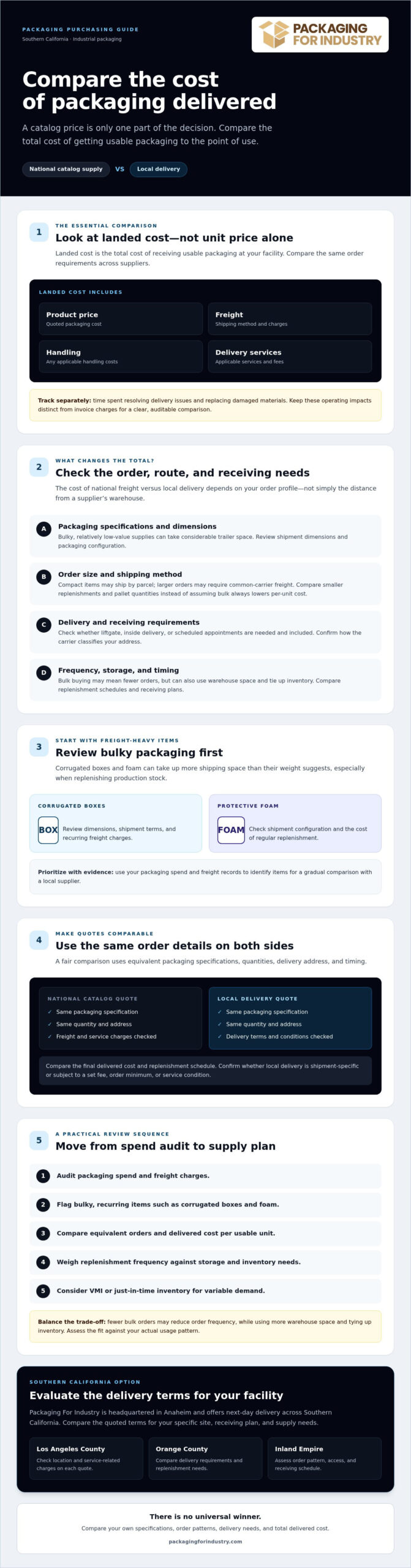
A catalog price is only one part of a purchasing decision. For industrial packaging, freight can be a significant share of the cost when bulky, relatively low-value products take up considerable trailer space. Compare the total expense of getting packaging to the point of use, not just the listed price per unit.
Landed cost is the total cost of receiving usable packaging at your facility, including product price, freight, handling, and applicable delivery services. You can also track related operating impacts, such as time spent resolving delivery issues or replacing damaged materials. Keep those indirect costs separate from invoice charges so the comparison remains clear and auditable.
Southern California includes distinct industrial and distribution areas in Los Angeles County, Orange County, and the Inland Empire. Congestion and facility access can affect delivery planning, but they do not establish that a particular surcharge applies. Ask each supplier to identify any location- or service-related charge on the quote. Compare how order frequency, packaging dimensions, and receiving requirements affect the total for your facility.
The Escalation of LTL and Small Parcel Surcharges
Review the checkout total and final invoice for the shipping method, handling, and optional delivery services. Orders that exceed parcel carrier limits may move through common-carrier freight. Services such as liftgate, inside delivery, or scheduled appointments can also carry additional charges. Confirm which services your facility needs and whether each is included in the quoted total. Residential delivery fees generally are not a default industrial-site charge, but verify how the carrier classifies your address.
For bulk orders, compare the quoted freight with the order size and delivery requirements instead of assuming that a larger order always lowers the per-unit cost. Less-than-truckload (LTL) shipping consolidates shipments through carrier networks, so transit and handling arrangements may differ from a direct local delivery.
Why Proximity Matters for Corrugated and Foam
Corrugated boxes and foam can take up more shipping space than their weight suggests. That makes shipment dimensions and packaging configuration important cost factors, particularly when replenishing production stock. Review the actual shipment dimensions and delivery terms on quotes for corrugated boxes and other bulky supplies.
For facilities in Orange County and Los Angeles, a local supplier may offer a different replenishment route from a national carrier shipment. PFI offers next-day delivery across Southern California. Compare the quoted terms for your specific site, then assess whether local delivery supports your receiving plan and supply needs as well as your landed-cost target.
Cost of Uline Freight to Southern California vs Local Delivery
A national catalog order and a local delivery quote may use different pricing structures. Direct shipping costs can vary with order weight, dimensions, destination, and shipping method. Local delivery terms can vary too, so ask whether the quote is shipment-specific or based on a set delivery fee, and confirm any order or service conditions. A “ships today” promise does not mean an order will arrive at your facility that day. Shipping speed and delivery time are separate parts of the comparison.
For procurement, compare equivalent orders: the same packaging specifications, quantities, delivery address, and timing. Then review the final delivered cost and replenishment schedule. The cost of Uline freight to Southern California vs local delivery depends on your order profile, not simply the distance from a supplier’s warehouse. Packaging For Industry (PFI) offers next-day local delivery across Southern California, providing a nearby option to evaluate against national freight service.
Freight Tier Comparison: Small Orders vs. Pallet Quantities
Small parcel orders and palletized shipments can follow different carrier pricing rules. A few compact items may ship by parcel, while larger orders may require common-carrier freight. That change can affect the delivery charge and handling requirements. Find your break-even point by comparing delivered cost per usable unit across typical order sizes, including smaller replenishments and full pallet quantities. Packaging For Industry (PFI) can quote packaging delivery for local industrial businesses. Confirm the applicable terms rather than assuming a flat fee.
Bulk buying may reduce the number of orders, but it can also take up warehouse space and tie up inventory. A local supply plan can help purchasing teams assess order frequency alongside freight and storage. For packaging with variable demand, discuss whether VMI or just-in-time inventory management fits your usage pattern. Packaging For Industry (PFI) is headquartered in Anaheim and serves Southern California, giving manufacturers a local supplier to evaluate.
Service Area Deep Dive: Los Angeles to San Diego
Local routes matter across a region with distinct manufacturing and distribution areas. A facility in Irvine, Santa Ana, or Huntington Beach may value a replenishment plan that does not rely on a shipment moving through a national carrier network. Inland Empire distribution centers can weigh the same factors: delivery timing, receiving requirements, and how much stock they need to keep on hand. Local delivery may reduce carrier handoffs, but confirm route coverage and timing for your specific site.
Handling also belongs in the comparison. Corrugated boxes and foam can be affected by repeated transfers or rough handling. A more direct local delivery route may mean fewer handoffs, but it cannot guarantee damage-free arrival. Packaging For Industry (PFI)’s custom packaging design and prototyping can also help align packaging with product and shipping requirements. To compare service and pricing for your operation, request a packaging quote with your current order quantities, delivery location, and replenishment schedule.
The "Freight Tax" on Bulky Industrial Supplies
Packaging freight can be disproportionate to the value of the product being shipped. Corrugated boxes and foam take up space, so carriers may calculate charges using shipment dimensions as well as weight. Dimensional weight (DIM) pricing can raise the billed freight for a light but bulky shipment. The effect depends on the carrier, service, package dimensions, and shipment terms, so check the rate basis on each quote.
This is the freight tax: paying to move packaging volume that does not directly add product value. It can make the cost of Uline freight to Southern California vs local delivery especially important for buyers ordering oversized packaging. Compare delivered cost and usable quantity, not just catalog price.
Corrugated Boxes: Shipping Air and Wasted Space
Double-wall and triple-wall boxes can differ in weight and dimensions, but neither label alone determines freight cost. Order quantities, packed dimensions, and carrier rating rules also affect the shipment. Standard sizes that do not fit a product or pallet plan can leave unused space in storage and transport. Custom sizing may improve the fit and reduce unnecessary volume, but it does not guarantee the removal of parcel DIM charges. Carriers apply their own rules.
PFI supplies custom and stock corrugated boxes and offers next-day delivery across Southern California. Its custom packaging services give local businesses an option to assess alongside catalog stock sizes. Include the dimensions and order quantities you actually use when comparing the delivered cost of corrugated boxes.
Protective Foam and Cushioning Surcharges
Foam can be freight-intensive because protective pieces and inserts may occupy substantial space relative to their weight. Polyethylene or polyurethane foam is not automatically the most expensive packaging item to ship, but large or awkwardly sized orders can have a high freight-to-product ratio. Compare packed dimensions, quantity, and delivery method rather than relying on material type alone.
Custom engineering can help match protective packaging to the product and assess whether a standard configuration is suitable. PFI offers custom packaging design, CAD support, and prototyping. Review the proposed dimensions and delivery terms when evaluating foam packaging. Local routes may reduce the distance bulky packaging travels, while an appropriate cushioning design can help address product protection needs. Actual freight and protection results depend on the shipment and application.
To compare options for your current box or foam specifications, request a packaging quote with dimensions, order quantities, and delivery location.
Beyond Freight: Total Cost Reduction with Local Partnerships
Freight is only one part of packaging cost. Excess stock takes up space, ties up working capital, and can make materials harder to manage on the production floor. A local supplier can help purchasing teams look beyond order-by-order pricing to inventory levels, replenishment timing, packaging fit, and damage risk. That broader view matters when comparing the cost of Uline freight to Southern California vs local delivery.
A Vendor Managed Inventory (VMI) program can coordinate packaging replenishment around agreed inventory levels and actual usage. Scheduled reviews and planned restocking may help reduce last-minute orders and avoidable emergency freight. A Just-In-Time (JIT) inventory program can also help align deliveries with operational needs and the amount of packaging held on site. Results depend on usage patterns, delivery arrangements, and inventory planning.
The "Hidden" Cost of Warehouse Space
To estimate the cost of excess packaging storage, measure the floor area it occupies and multiply it by your facility’s applicable cost per square foot. Include the value of space that could otherwise support production, picking, or finished-goods staging. Then compare that carrying cost with the cost and schedule of replenishment. Moving from large, infrequent buys to planned local deliveries may free space and reduce cash tied up in stock. First confirm that the proposed delivery schedule suits your operation.
Custom Engineering vs. Catalog Compromise
A “close enough” catalog box can create avoidable costs if it leaves excess space, requires additional protective material, or does not fit the product and handling process. Custom packaging design lets your team evaluate dimensions and protection as a system. PFI offers custom packaging design and prototyping for businesses assessing packaging requirements. Confirm the scope and terms when requesting a quote.
For heavy machinery, compare the delivered cost and protective fit of custom wooden crates with the alternatives in use. A useful evaluation considers packaging, handling, storage, and the consequences of shipping damage, not just the crate price. Businesses sourcing military packaging should specify applicable requirements and verify that the proposed solution meets them. Do not assume compliance from a product category alone.
Measure the business case using your own figures: space released, inventory on hand, replenishment frequency, damage experience, and total delivered packaging cost. This makes the comparison practical rather than relying on freight charges alone.
Switching to a Local SoCal Supplier: A 5-Step Transition
A supplier change works best when purchasing can show where costs come from and operations can confirm that supply remains dependable. Use these five steps to compare the cost of Uline freight to Southern California vs local delivery using your order history and facility requirements.
Auditing Your Current Freight Spend
A Landed Cost Audit reviews product, freight, handling, and related receiving costs to establish the true cost of packaging delivered to your facility. Start with catalog invoices and match each charge to its order, item, quantity, and destination. Flag recurring LTL shipments, accessorial fees, and bulky items where freight is high relative to product value. This creates a baseline for comparison.
- Audit recent packaging spend. Collect invoices and order records, then calculate delivered cost per usable unit for frequently purchased items.
- Prioritize candidate items. Focus first on packaging with meaningful order volume and recurring freight charges, such as boxes or foam. Confirm specifications and usage with the teams that pack and receive the materials.
- Compare local quotes and delivery terms. Request pricing for equivalent products, quantities, and delivery locations. Ask about custom sizes if a standard item creates excess space, and confirm the proposed delivery schedule and applicable terms.
- Plan replenishment. Review whether VMI or JIT inventory management could align supply with actual usage. Set practical reorder points with your supplier and operations team to reduce stockout risk without returning to excess bulk storage.
- Measure results over the first quarter. Compare delivered cost, inventory levels, urgent orders, and damage experience against the baseline. Normalize for quantity and specification changes so the comparison is useful. Base any expected savings on your own quotes, order patterns, and delivery requirements.
Partnering with a Local Anaheim Packaging Supplier
PFI is headquartered in Anaheim and offers next-day delivery across Southern California, making proximity relevant for businesses in Anaheim, Irvine, Los Angeles, and surrounding areas. A nearby supplier may support replenishment planning without relying on the same long-distance carrier route for every order. During supplier evaluation, ask who will coordinate quotes, inventory plans, and delivery questions, and confirm what support is included.
Use the audit to guide a focused comparison rather than switching every packaging item at once. Start with a few high-volume or high-freight products, confirm the fit and delivery process, then expand based on measured results.
Make Your Next Packaging Decision on Total Cost
The cost of Uline freight to Southern California vs local delivery depends on more than a catalog price. Freight, packaging dimensions, inventory storage, and replenishment timing all affect what each usable unit actually costs. A landed-cost review helps identify which high-volume or freight-heavy items are worth comparing first.
Local supply can also support a more manageable inventory plan. PFI offers next-day delivery across Southern California, custom corrugated boxes and foam, packaging design, and VMI and JIT programs. Compare these options with your current supply arrangement using the products, order patterns, and delivery requirements that apply to your business.
Start with a focused comparison of your current packaging orders. Use actual quantities, specifications, delivery locations, and freight charges to evaluate whether a local supplier can improve cost control and supply planning.
A clear cost baseline gives your team a practical way to improve packaging purchasing while keeping operations supplied.
Frequently Asked Questions
How much can I actually save by switching from Uline to a local SoCal supplier?
Your potential savings depend on the products, quantities, freight charges, and inventory practices involved. To estimate the opportunity, compare recent invoices with a local quote for equivalent specifications and delivery terms. Include storage and rush-order costs where relevant. This gives your team a practical, like-for-like view of the cost of Uline freight to Southern California vs local delivery.
Does PFI offer next-day delivery for stock corrugated boxes in Los Angeles?
PFI offers next-day delivery across Southern California, including the Los Angeles area. Timing for a particular stock box depends on the item, order, destination, and current arrangements, so confirm availability and the schedule when requesting a quote. Share the box dimensions, quantity, and delivery address. If a standard size does not fit your application, ask about custom corrugated boxes and the related design and production schedule.
What is the difference between freight cost and landed cost in packaging?
Freight cost is the charge to transport an order. Landed cost is the broader cost of getting usable packaging to your facility, including product price, freight, handling, and applicable delivery charges. For a more useful comparison, calculate landed cost per usable unit and consider relevant operational effects, such as storage requirements or packaging damage. This helps purchasing compare supplier quotes without mistaking a low catalog price for the lowest total expense.
Can I get custom-sized boxes and foam inserts locally in Orange County?
PFI is headquartered in Anaheim and provides custom packaging solutions, including corrugated boxes and protective foam. Its custom design services include CAD support, prototypes, and samples, so your team can evaluate product fit before a broader rollout. Bring product dimensions, shipping or handling requirements, current packaging samples, and order quantities to the discussion. This information helps the packaging team assess a suitable design and prepare a quote.
How does a Vendor Managed Inventory (VMI) program reduce my shipping costs?
A VMI program can help manage replenishment based on actual usage and agreed inventory levels. Scheduled reviews and planned restocking may reduce last-minute orders that require expedited freight, while keeping packaging available for production. It does not automatically eliminate shipping charges or guarantee savings. The supplier and your team should review usage history, lead times, storage capacity, and delivery locations to set workable stock levels and a replenishment schedule.
Are there minimum order requirements for local delivery in Southern California?
Order minimums and delivery terms can vary by product, quantity, and destination. Confirm requirements when requesting pricing, especially for mixed orders or recurring deliveries. Provide your delivery address and expected order frequency so the supplier can explain applicable terms. For regular packaging needs, ask whether a VMI or JIT stocking program could suit your purchasing and storage requirements.
Does PFI provide military-spec packaging for aerospace companies in SoCal?
PFI offers military packaging and aerospace and aviation packaging solutions, including custom packaging design. Specify the requirements that apply to your product and program, then ask PFI to confirm whether the proposed materials and design meet them. Do not assume compliance based only on a product description. For complex parts, provide drawings, dimensions, handling details, and existing packaging requirements so the team can assess the application.
What happens if I need an emergency packaging order for my production line?
Contact the supplier promptly with the item or specification, quantity needed, facility location, and deadline. PFI offers next-day delivery across Southern California, but emergency or same-day availability should be confirmed directly. For recurring production needs, consider planned replenishment through VMI or JIT inventory management to reduce the risk of shortages and rush orders. Set reorder points using actual usage and lead times.