
What if the box, not the equipment, is causing your line to stop? Small differences in dimensions, scores, or board behavior can lead to misfeeds, poor opening, and inconsistent closing. That’s why corrugated box design for automated assembly lines needs to account for the full path from blank to shipment, not just product protection.
A packaging change can affect established machine settings and production schedules. A box that protects well may also use more material or add avoidable freight and handling costs. This guide explains how to define box requirements around your equipment, product, and shipping process, then evaluate a proposed design before ordering production quantities.
You’ll learn what information to share with a corrugated box supplier, how to consider forming, filling, sealing, and palletizing as one process, and how prototypes and samples can help identify fit issues before a broader rollout. Packaging For Industry provides custom packaging design services, including CAD/CAM support, and can discuss recurring supply options such as VMI and just-in-time inventory management for predictable packaging needs.
Key Takeaways
- Map the carton’s full journey, from storage and feeding through forming, loading, closing, and shipment, before finalizing a design.
- Specify dimensions, box style, corrugated construction, and closures in relation to product fit and line handling.
- For corrugated box design for automated assembly lines, test representative samples with the actual product and equipment before approving a change.
- Prepare an RFQ with box drawings, product details, line requirements, current issues, and recurring order needs so suppliers can assess the request.
- Compare custom and stock options based on line fit, sample results, product protection, and replenishment needs.
Corrugated box design for automated assembly lines starts with the complete process
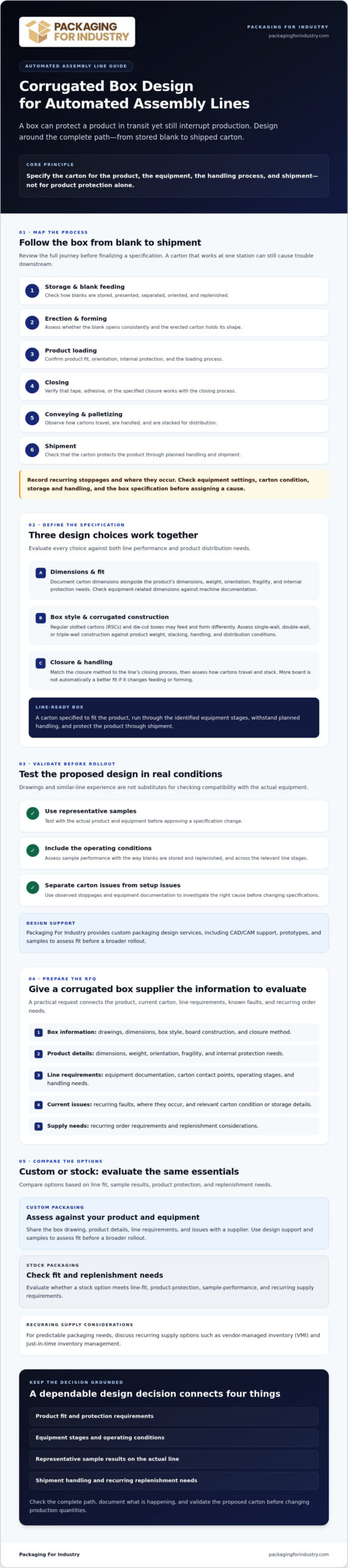
A box that protects a product in transit may still be a poor fit for a production line. Corrugated box design for automated assembly lines must account for the carton, equipment, product, operator handling, and shipment. Trace the box from storage and blank feeding through erection, loading, closure, conveying, and palletizing. A design that works at one station can still cause problems downstream if the carton does not close cleanly or travel steadily.
Corrugated box design includes foundational considerations such as handling and stacking strength. Apply that broader context alongside your equipment documentation and operating experience. Confirm compatibility with the actual equipment rather than assuming a design will work based on a drawing or a similar line.
Which automated line stages should the box support?
Review how blanks are stored and presented to the feeder, how cartons are erected, how products enter, and how the box is closed and conveyed. Note where guides, belts, suction devices, or operators contact the carton. Record recurring stoppages and the point where each occurs before changing specifications. A crushed edge, for example, may relate to handling or storage. A carton that does not open consistently may warrant checking both the blank and the equipment setup.
Separate possible causes before assigning blame to the box. Check equipment settings, carton condition, storage and handling, and the box specification. This helps the team avoid changing a specification to compensate for a setup issue, or overlooking a carton problem that repeatedly disrupts production.
What should buyers define before discussing box design?
Gather the product’s dimensions, weight, orientation, fragility, and internal protection needs. Document the current carton’s dimensions, board construction, closure method, and known line issues. Include the stages where misfeeds or damage happen, along with relevant equipment documentation. These details give a corrugated box supplier a practical starting point for discussing custom packaging.
- Product fit, orientation, and protection requirements
- Current carton details and recurring line faults
- Storage, feeding, forming, loading, closing, and shipping needs
- Equipment documentation and the points where the carton is contacted
Working definition: A line-ready box is a carton specified to fit the product, run through the identified equipment stages, withstand planned handling, and protect the product through shipment.
PFI’s custom packaging design services include packaging reviews, CAD/CAM support, and prototypes or samples to assess fit before a broader rollout. Check equipment-related dimensions against machine documentation, then evaluate samples on the actual line before approving a specification change.
How dimensions, corrugated construction, and closures affect line performance
In corrugated box design for automated assembly lines, dimensions, board construction, and closure choices work together. A carton can fit the product but feed poorly, or run smoothly on the line but provide inadequate protection during handling and shipment. Evaluate each choice against both the equipment process and the product’s distribution needs.
Choosing a box style for feeding and forming
Regular slotted cartons (RSCs) and die-cut boxes present blanks differently and may require different forming and closing steps. Assess each format against how your equipment separates, orients, and feeds blanks. Then check whether the erected carton holds its shape through loading. Neither style is right for every case erector. Test samples under actual operating conditions, including the way blanks are stored and replenished.
Matching board and closure choices to the use case
Single-wall, double-wall, and triple-wall construction are options to assess based on product weight, stacking, handling, and distribution conditions. More board is not automatically a better fit if it changes how blanks feed or cartons form. Closure choices matter too. Confirm that tape, adhesive, or another specified method works with the line’s closing process and stays secure through shipment. Validate material and closure choices with your packaging supplier and equipment documentation.
Keep internal and external dimensions distinct in drawings and discussions. Internal dimensions guide product fit and space for foam or other inserts. External dimensions affect how the carton moves through guides, conveyors, and downstream handling. Ask the supplier to clarify which dimensions a drawing identifies, and verify equipment-related dimensions against machine documentation rather than assuming a general tolerance.
Design factor
Operational question
Validation method
Box style
Do blanks separate, orient, and feed consistently?
Run samples through the intended feeder and forming process.
Dimensions
Does the product fit, and does the carton travel through the line?
Review drawings and test with the product and equipment.
Board and closure
Can the carton handle loading, stacking, and shipment?
Assess formed boxes, closure results, and shipping needs.
When inspecting RSC cartons, check the blank, erected box, and closure under the conditions relevant to your operation. Use inspection guidance as a prompt, not a substitute for testing your own box and line. If you’re comparing custom box options, you can request a corrugated box quote with your drawings, product details, and equipment requirements.
How to evaluate a proposed corrugated box design before changing production
A drawing can show dimensions and structure, but it cannot prove how a carton will behave on your line. Evaluate a proposed corrugated box design for automated assembly lines in stages: document requirements, review the design, test samples, assess results, then approve any change. Keep the current packaging as a comparison point and follow your team’s established trial and acceptance procedures.
What to include in a line trial
Record the proposed box specification, equipment involved, product configuration, and trial conditions. Note the line settings and handling conditions that matter to your evaluation, so the team can interpret results and compare them with the current carton.
Observe the complete run, not just whether a blank opens. Track:
- Blank separation, orientation, feeding, and carton erection
- Loading performance and any contact that damages the carton or product
- Closure problems and issues during downstream conveyance
- Product condition after packing, plus operator feedback
Compare the sample and current packaging using acceptance criteria your team has defined. For example, if the current carton occasionally misfeeds, record whether the proposed sample changes the frequency or type of stoppage under comparable conditions. Do not assume a short successful run establishes production readiness. Decide before the trial what evidence the team considers sufficient.
How to approve a change without avoidable disruption
Review results with operations, packaging, quality, and purchasing. Operations can report how the carton behaved; packaging can assess the design; quality can consider product condition; and purchasing can confirm the proposed specification and supply plan. If results point to a design issue, revise and test another sample before moving to broader production quantities.
Packaging For Industry offers custom packaging design services, including CAD/CAM support, packaging reviews, and prototypes or samples. Confirm the prototype scope and production feasibility with the supplier, then use the sample review to resolve fit or performance concerns before committing to a broader rollout.
Once approved, preserve the sample or its reference details and document the final specification for repeat orders. Include the accepted box style, dimensions, construction, closure, and relevant trial notes in supplier communication. Clear records help purchasing reorder the evaluated design and help operations check whether future cartons match the approved packaging.
Build an RFQ for automated-line corrugated boxes that suppliers can evaluate
A focused RFQ helps suppliers assess how a carton needs to fit your operation, not just what it costs. For manufacturers, warehouses, and distribution centers, provide enough detail to compare pricing alongside design fit, sample review, and recurring supply. This makes it easier to discuss custom sizes for your application and identify packaging changes that may help lower packaging costs or reduce shipping damage.
What information makes a corrugated box quote more useful?
Include a current box drawing or sample, dimensions, box style, construction, closure method, product configuration, and estimated order quantities. Describe the equipment and the carton’s path through feeding, forming, loading, closing, and downstream movement. Note observed failures and the outcome you want the new design to support. Add relevant shipping conditions so a supplier can consider both line performance and product protection.
For a useful corrugated box quote, ask the supplier to address:
- Which material, box style, and closure options should be evaluated
- Whether prototypes or samples can be reviewed before a larger order
- How bulk packaging pricing and recurring order requirements will be assessed
- What information is needed to confirm production feasibility and replenishment
PFI offers custom and stock corrugated boxes, including RSC, die-cut, double-wall, and triple-wall options. Compare them against your application rather than assuming a stock or custom design is automatically the better fit.
How to compare suppliers and manage repeat orders
Compare proposals on specification fit, communication, sample support, production repeatability, and supply planning, as well as price. For predictable demand, discuss expected usage and replenishment options such as VMI or just-in-time inventory management. If local packaging delivery matters to your schedule, confirm the arrangements for your location. PFI offers local next-day delivery throughout Southern California and nationwide support. Confirm the supply details that apply to your needs.
Keep the approved specification and sample reference with purchasing records so repeat orders can be checked against the design you evaluated. Clear documentation helps your team and supplier stay aligned as requirements change.
Choose a corrugated box supplier for dependable automated-line packaging
A validated carton is only part of a dependable packaging program. The supplier also needs to support the products you pack, the protection they require, and the way your operation replenishes packaging. For manufacturers, warehouses, and distribution teams, a suitable box can support consistent handling, product protection, and repeat purchasing. Match those needs to the supplier’s product range and supply capabilities.
When should a manufacturer consider a custom box?
Custom corrugated boxes may suit a production line when stock options do not meet product fit, handling, or shipping needs. PFI supplies custom and stock corrugated boxes, including RSC, die-cut, double-wall, and triple-wall options. Foam packaging can also be combined with a box when a product needs added internal protection. These options support packaging requirements across aerospace, electronics, medical device, automotive, food and beverage, and industrial equipment operations.
The benefit is not simply a different carton. A packaging review can help align protection and handling needs while assessing opportunities to reduce excess material or avoid shipping damage. PFI’s manufacturing packaging solutions serve production operations that need packaging selected around their products and processes.
What to prepare before requesting a quote
Bring together the information that helps a supplier assess the request and plan for ongoing needs:
- Product details, current packaging, and any internal protection requirements
- Line and shipping needs, plus the issues the packaging should address
- Estimated order quantities and expected repeat-order pattern
Packaging For Industry provides custom packaging design support that includes CAD/CAM, packaging reviews, and prototypes or samples. Buyers can discuss design options and assess fit before moving to broader production quantities. PFI also offers packaging kitting, VMI, and just-in-time inventory management for recurring packaging needs. Local next-day delivery is available throughout Southern California, with nationwide support for broader supply requirements.
Buyers can discuss box design, protective foam, and recurring supply with one industrial packaging supplier, then confirm the specification and replenishment arrangement for their operation. Share your requirements to start that conversation.
Put a validated box design to work
Reliable corrugated box design for automated assembly lines starts with the whole operation, not a single machine station. Define how the carton must fit the product, move through the line, protect goods in transit, and support repeatable supply. Review the proposed design and test samples on your equipment before approving a broader order.
A clear specification and documented trial results give your team a sound basis for choosing between custom and stock boxes. They also help operations, quality, and purchasing stay aligned when packaging changes or repeat orders are needed.
Packaging For Industry offers custom and stock corrugated packaging, with design support that includes CAD/CAM, prototypes, and samples. Local next-day delivery is available throughout Southern California, with nationwide support for broader supply needs.
Share your product, line, and supply requirements to start a practical conversation about packaging that supports dependable production.
Frequently Asked Questions
How do you design a corrugated box for an automated assembly line?
Start with the product, the carton’s full route through the line, and the specific equipment that handles it. Document the current box dimensions, construction, closure, and recurring issues, then review design options with a packaging supplier. Test samples with the intended product on the actual line before approving a change. For corrugated box design for automated assembly lines, verify equipment-related dimensions against machine documentation and record the approved specification for repeat orders.
What information should I provide for an automated-line corrugated box quote?
Provide product dimensions and weight, a current box drawing or sample, and details about the existing carton’s style, construction, and closure. Describe the line stages the carton passes through, the equipment involved, and any known feeding, forming, or closure problems. Include expected order quantities and relevant shipping conditions. These details help a supplier assess box options, sample needs, and potential recurring supply arrangements.
Can a custom corrugated box reduce automated line stoppages?
A custom box may help if the carton contributes to misfeeds, inconsistent forming, or closure problems, but it cannot be assumed to resolve every stoppage. Check whether equipment setup, carton storage, material condition, or handling may also be involved. Identify the likely cause, then evaluate samples on the actual line with the relevant product. Compare observed results with your current packaging and your team’s acceptance criteria before approving a specification change.
Should I use an RSC box or a die-cut box on an automated line?
Choose the format that performs suitably in your specific feeding, forming, loading, and closing process. RSC and die-cut boxes differ in blank design and may behave differently on a given line, so neither is automatically the right choice. Share your machine documentation and product configuration with the packaging supplier. Then compare candidate samples using established procedures on the equipment that will run them, including the actual blank presentation and closure process.
How do I test a corrugated box before approving it for production?
Run representative samples on the intended equipment with the product configuration they’re designed to handle. Observe blank feeding, forming, loading, closure, conveyance, and product condition. Record misfeeds, damage, closure issues, and operator feedback, then compare results with the current packaging using your team’s acceptance criteria. Include operations, quality, and purchasing in the review. Document the approved sample and specification so repeat orders can be checked against the validated design.
Do automated assembly lines always need custom corrugated boxes?
No. A stock carton can be appropriate if its dimensions, construction, product fit, and line handling meet your requirements. Consider custom corrugated boxes when stock options do not fit the product or create identified handling, protection, or process concerns. Assess both routes with samples and consider shipping and supply requirements too. Packaging For Industry offers custom and stock corrugated boxes for manufacturers in Southern California and supports broader nationwide supply needs.
How can a packaging supplier support recurring box supply for a production line?
A supplier can review the approved specification, expected usage, order pattern, and replenishment needs to help plan repeat supply. Discuss whether VMI or just-in-time inventory management may suit predictable consumption, and confirm the supply arrangement directly. Packaging For Industry offers these recurring packaging programs, along with local next-day delivery throughout Southern California and nationwide support. Clear records of the validated carton help purchasing and operations communicate requirements consistently when placing repeat orders.