
A larger catalog doesn’t automatically mean better packaging service. The right supplier understands your products, shipping requirements, and recurring order needs, then helps you find packaging that fits your operation. If your goal is getting better customer service than Uline for packaging, start by comparing suppliers against those practical needs.
It’s reasonable to expect clear answers, suitable packaging, and dependable replenishment without adding unnecessary purchasing work. Sourcing custom and stock supplies from different vendors can complicate the process, so compare suppliers against the requirements that matter to your business.
This guide offers a practical framework for evaluating responsiveness, custom packaging support, product fit, pricing, and supply reliability before requesting a quote. You’ll learn what to compare across corrugated boxes, foam, stretch film, and other industrial packaging supplies, and how to assess options for bulk orders and repeat needs. Packaging For Industry (PFI), based in Anaheim, supports industrial buyers with custom and stock packaging, design support, and recurring supply programs in Southern California and beyond.
Key Takeaways
- Define packaging requirements by product, shipment method, order frequency, and delivery location before evaluating suppliers.
- Assess supplier service by how it handles specifications, samples, order changes, and recurring needs.
- Match corrugated boxes, foam, stretch film, crates, and protective materials to each shipment’s fit and protection requirements.
- Review usage, lead times, storage limits, and production schedules to shape a practical replenishment plan.
- Prepare product dimensions, shipment details, usage patterns, and custom requirements to support a more focused packaging quote.
Start by defining the packaging service your operation needs
Packaging service problems can be frustrating, but they don’t look the same in every operation. Before changing suppliers, identify what is creating extra work or risk for your team. Record the issue and its effect so you can distinguish a one-time order concern from a recurring process problem and decide what needs to change.
Keep the review focused on commercial packaging for manufacturers, warehouses, distribution centers, and other industrial operations. Catalog access is only one part of the buying process. Consider whether your team also needs technical guidance, coordinated ordering, support for custom requirements, or a more predictable way to manage repeat purchases. The goal is to define your requirements, not assume every buyer needs the same service model.
Which packaging service problems are affecting your operation?
Track specific problems as they occur. Note the item involved, the order or shipment, what happened, and the operational effect. For example, record when a recurring packaging item is unavailable when needed, or when an order requires follow-up to clarify a specification. Keep the notes factual and distinguish the immediate symptom from its effect on production, packing, or shipping.
Look for repetition over time. One isolated concern may need clarification; repeated issues at the same point in the process may call for a broader supplier review. This helps your team focus on persistent friction rather than making a decision based on a single difficult transaction.
What should a packaging supplier be able to support?
Write down the operating context behind your purchases: the products you ship, packaging categories you use, order patterns, facility locations, and shipping methods. Note where requirements vary by product or site. Identify whether your process calls for design input, samples, packaging kitting, or inventory coordination. A short, accurate brief makes supplier discussions more focused.
Packaging serves practical roles beyond containing a product. A helpful overview of packaging and labeling can provide general context, but your supplier assessment should center on your own operating needs. Packaging For Industry (PFI) offers custom design support, including prototypes and samples, for buyers evaluating tailored requirements. Keep your documented brief as the baseline for the comparisons that follow.
Compare Uline and alternative packaging suppliers on service, not catalog size, to get better customer service than Uline for packaging
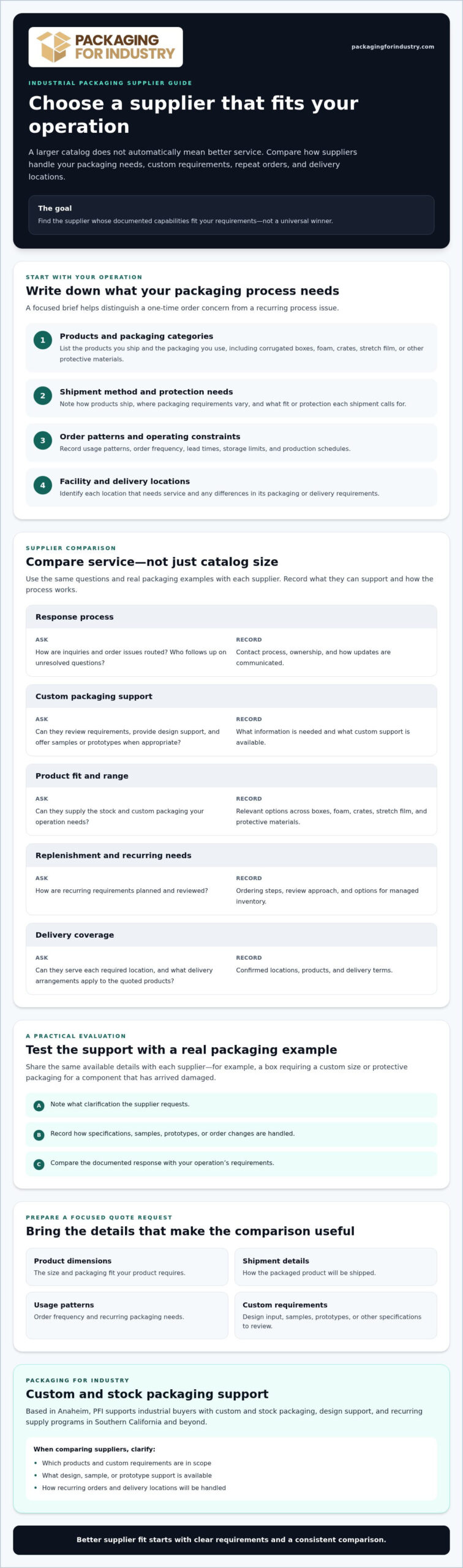
A broad catalog can make sourcing convenient, but it doesn’t show how a supplier will handle a specification question, custom requirement, order change, or recurring supply need. To assess whether getting better customer service than Uline for packaging is possible for your operation, compare suppliers using the same questions and real packaging examples. The goal isn’t to declare a universal winner. It’s to find the supplier whose documented capabilities fit your requirements.
| What to compare | Questions to ask each supplier | What to record |
|---|---|---|
| Response process | How are inquiries and order issues routed? Who follows up on unresolved questions? | Contact process, ownership, and how updates are communicated. |
| Custom support | Can you review packaging requirements, provide design support, and offer samples or prototypes when appropriate? | What information is needed and what support is available. |
| Product range | Can you supply the stock and custom packaging this operation needs? | Relevant options across boxes, foam, crates, stretch film, and protective materials. |
| Replenishment | How are recurring requirements planned and reviewed? | Ordering steps, review approach, and options for managed inventory. |
| Delivery coverage | Can you serve each required location, and what delivery arrangements apply to the products being quoted? | Confirmed locations, products, and delivery terms. |
How can you assess responsiveness and practical support?
Use a representative request, such as a box that needs a custom size or protective packaging for a component that has arrived damaged. Share the same available details with each supplier, then note what clarification they request and how they explain the next steps. Ask how specification questions, samples, order changes, and recurring requirements are handled. Compare communication from initial inquiry through quoting, design, ordering, and replenishment, not just the first reply.
How should you compare packaging range and customization?
Check whether each supplier can support both stock items and custom packaging where needed. A shipment may require a corrugated box, foam protection, and corner or edge protection as a coordinated solution. Packaging For Industry (PFI) offers a range of packaging materials that can be combined, along with custom design support. Review its custom packaging design services if standard options don’t match product or shipping requirements.
Compare the process, not just the promise. Ask what specifications the supplier needs, how proposed solutions are reviewed, and whether samples or prototypes are available for evaluation. For broader context on supply chain decisions, Supply Chain: The Insights You Need connects supplier choices to wider operational considerations.
For a consistent comparison, rate each response against your documented requirements and note any unanswered questions. If you’re ready to evaluate custom and stock options for your operation, you can request a packaging quote with your specifications and recurring needs.
Match packaging products and engineering support to your shipping requirements
Compare packaging against the job it needs to do, not just the item name or unit price. For each product or shipment, document its dimensions, how it’s handled, the protection it needs, the shipping method, and whether the packaging must work consistently for repeat orders. This gives suppliers the same basis for recommendations and helps you assess whether a solution may address shipping damage or unnecessary material use.
Product fit depends on the shipment. Stock corrugated boxes may suit standard items, while custom corrugated boxes can be considered when dimensions or packing steps call for a closer fit. Foam packaging can cushion products that need added protection; stretch film secures palletized loads; crates may suit products that require a more substantial shipping structure. Corner and edge protection can also help address handling risks. Ask each supplier to explain how its recommendation fits your product and shipping conditions.
When does custom packaging support add value?
Custom design support can help when standard packaging doesn’t fit the product or shipping process. Ask what design review involves and whether the supplier can provide prototypes or samples so your team can assess fit before establishing repeat orders. If a supplier proposes CAD/CAM tools or a particular review process, clarify what that includes rather than assuming every supplier offers the same capabilities. PFI provides custom packaging design services, including prototypes and samples.
For fragile, heavy, or high-value industrial products, discuss whether custom foam inserts or a crate may suit the application. Treat any projected change in damage, material use, or cost as something to validate with your own shipment and purchasing data, not as a guaranteed result.
How do you assess an integrated packaging solution?
Check whether components work together from packing through handling and shipment. A box, foam protection, stretch film, and edge protection each have a role, but the combined setup should also be practical for the people packing and moving the product. Ask how components are selected, what measurements or shipment details inform the recommendation, and how the setup can be repeated for future orders.
For box options, review PFI’s corrugated box solutions. If cushioning is part of the requirement, explore the custom foam packaging range and confirm which options match your product and application.
Useful engineering support means getting clear questions, recommendations tied to actual shipping requirements, and a process for checking fit. Compare those details alongside product availability and repeat-order needs before choosing a supplier.
Evaluate replenishment, delivery, and total purchasing effort before switching
A supplier change affects more than the purchase order. Review how packaging moves from forecast to receiving, including the time your team spends checking stock, placing repeat orders, tracking deliveries, and finding replacements when supplies run short. Better customer service should also include a replenishment process that fits your operating schedule and storage capacity.
Can a stocking program reduce purchasing friction?
Use a simple review sequence before comparing programs:
- Review usage: Identify the packaging items used regularly and how consumption changes with production or shipping schedules.
- Confirm lead times: Ask suppliers about expected timing for stock items and custom packaging, then consider when orders need to be placed.
- Check storage: Determine how much inventory your facility can hold without crowding work areas or tying up space.
- Align replenishment: Compare ordering needs with production schedules and agree on how inventory levels will be reviewed.
Frequent emergency purchases may signal a planning gap; excess on-site stock may suggest that order quantities or timing need review. A supplier-managed program can use agreed inventory levels and review cycles, but the right approach depends on actual usage, storage limits, and purchasing requirements. PFI’s Vendor Managed Inventory programs can use weekly, biweekly, or monthly review cycles. For custom packaging with longer lead times, include those timing requirements in the stocking discussion rather than treating it like a standard stock item.
Vendor Managed Inventory packaging may be relevant if your operation has recurring packaging needs and wants a defined process for reviewing stock. Ask what information the supplier needs to plan replenishment and how proposed inventory levels will be coordinated with your team.
How should local and nationwide delivery fit the comparison?
Confirm coverage by facility and product category. Ask which locations can be served, what delivery arrangements apply to the specific items you use, and how orders are coordinated across multiple sites. PFI serves industrial customers in Southern California, with local next-day delivery available in the region. Confirm current applicability for your location and products before relying on that timing. Nationwide support is available for certain products and larger programs, so verify that the items and locations in your plan are covered.
Finally, compare total purchasing effort alongside product pricing: ordering steps, inventory reviews, delivery coordination, and the work required from your team. This gives you a practical basis for deciding whether a supplier’s replenishment and delivery model fits your operation.
Choose a packaging supplier that fits your operation and request a quote
Use your supplier comparison to identify the best operational fit, not simply the largest catalog. Consider whether a packaging company can support your products, purchasing process, and supply requirements with suitable service and packaging options.
What information should buyers prepare for a packaging quote?
For a useful quote, provide product dimensions and weight, current packaging, shipping methods, estimated usage, order frequency, and delivery locations. Note custom requirements and specific problems you want to address, such as product damage or recurring supply gaps. These details help the supplier assess your needs and make the quote more relevant.
Which industries can PFI support?
Packaging For Industry (PFI) serves industrial and manufacturing buyers, including aerospace and aviation, electronics, medical device manufacturing, food and beverage, industrial equipment, construction and building products, warehousing, and distribution operations. Requirements differ by product and shipping process, so share your application and purchasing needs when discussing options.
What benefits should buyers look for?
A supplier that aligns packaging with product and operational requirements may help simplify purchasing, support product protection, and make repeat supply easier to plan. Evaluate these potential benefits against your own experience and requirements. Compare the proposed packaging and supply approach alongside pricing, rather than assuming a particular outcome.
Why consider Packaging For Industry?
PFI offers custom and stock industrial packaging, along with design support that can include prototypes and samples. Its recurring supply options include Vendor Managed Inventory and just-in-time programs. These capabilities may be relevant to buyers looking for an industrial-focused supplier that can discuss both packaging requirements and ongoing supply needs. Confirm which products and arrangements apply to your operation.
Share your documented requirements to compare options and determine whether PFI is a suitable fit for your business.
Choose a packaging partner that supports your next step
Getting better customer service than Uline for packaging starts with defining what your operation needs, then comparing suppliers against those requirements. Catalog size alone won’t tell you whether a supplier can support the right packaging fit, answer technical questions, or make recurring orders easier to manage.
Look for a practical match across service, product options, design support, replenishment, and delivery. Packaging For Industry (PFI) offers custom and stock industrial packaging, design support that can include prototypes and samples, and recurring supply options through Vendor Managed Inventory and just-in-time programs. Based in Anaheim, PFI serves industrial buyers in Southern California and supports nationwide needs for certain products and larger programs. These capabilities give manufacturers and other industrial buyers a basis for evaluating packaging support against their own operating needs, without assuming one supplier is right for every business.
Bring your requirements together and compare the proposed solution, purchasing process, and supply arrangements. A clear request is a useful first step toward packaging that fits your operation and supports dependable planning.
With the right information and a focused comparison, you can move forward with greater confidence in your packaging supply plan.
Frequently Asked Questions
How can I get better customer service than Uline for packaging?
Start by defining what better service means for your operation. Identify where support is falling short, such as unanswered specification questions, packaging that doesn’t fit, order coordination, or recurring supply gaps. Then compare suppliers using the same requirements and examples. For packaging for manufacturers, warehouses, and other industrial buyers, assess product fit, custom design support, communication, replenishment options, and confirmed delivery coverage rather than relying on catalog size alone.
What should I compare when choosing an alternative packaging supplier?
Compare how each supplier handles inquiries, specifications, samples, order changes, and repeat orders. Check whether it can supply the stock and custom packaging you need, and whether its recommendations reflect your products, shipping methods, and handling requirements. Also review how replenishment works, which facilities it serves, and what delivery arrangements apply to your products. Use identical questions and representative packaging needs so the comparison reflects operational fit.
Can a packaging supplier provide both custom and stock packaging?
Yes. Packaging For Industry offers both custom and stock industrial packaging, including corrugated boxes, foam packaging, stretch film, crates, and pallets. Stock supplies may suit routine packaging needs, while custom options can be considered when product dimensions, protection needs, or shipping methods call for a tailored design. Ask the supplier which items are available as stock, what custom design support involves, and how each option fits your order pattern.
How do I request a quote for custom packaging?
Provide the product’s dimensions, weight, fragility, current packaging, and shipping method. Include the locations that need supply, estimated usage, order frequency, and any custom size or protection requirements. If you’re addressing damage or supply interruptions, share concrete examples and identify the packaging involved. This information helps a supplier assess the request and discuss suitable options. For a recurring program, include replenishment needs and any custom items with longer lead times.
Can a packaging supplier help reduce shipping damage?
A supplier can review packaging fit and protection needs and recommend options for evaluation, but results depend on the product, packaging design, handling, and shipping conditions. Share examples of damage and details about the affected shipments, then ask how a proposed box, foam, crate, or protective material addresses the issue. Custom packaging design support, prototypes, and samples can help your team assess fit. Validate any expected improvement against your own shipment experience.
What is Vendor Managed Inventory for packaging?
Vendor Managed Inventory (VMI) is a recurring supply program in which the supplier reviews packaging usage and helps coordinate replenishment against agreed inventory needs. PFI’s VMI programs can use weekly, biweekly, or monthly review cycles. A program discussion may consider usage history, lead times, storage space, and production or shipping schedules. Buyers should clarify which products are included, how inventory levels are set, and how replenishment is coordinated with their team.
Does Packaging For Industry serve businesses outside Southern California?
Yes. Packaging For Industry is based in Anaheim and serves industrial customers in Southern California, with support for nationwide needs available for certain products and larger programs. Coverage depends on the products, locations, and requirements involved, so confirm availability for each facility and packaging category before planning a supply arrangement. If your business operates across multiple regions, provide the locations and recurring needs when discussing a quote or program.