
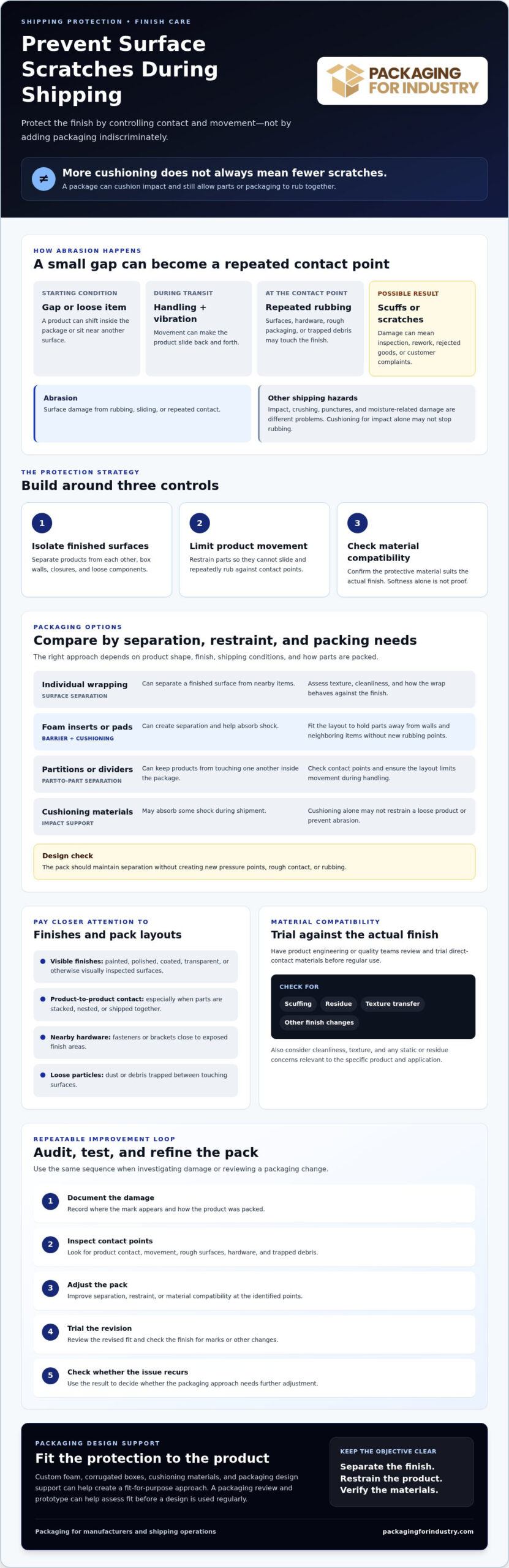
More cushioning does not always mean fewer scratches. A finished product can be protected from impact yet still rub against loose wrapping, a divider, or another item as the shipment moves. If you’re asking how to prevent surface scratching on finished products during shipping, start by controlling contact and movement, not by adding packaging indiscriminately.
Finding scuffs after delivery can mean rework, rejected goods, or customer complaints. The packaging needs to protect the product’s finish while fitting its shape and shipping conditions, without adding unnecessary materials or slowing down packing.
This guide explains how to identify abrasion risks, choose protective materials that suit the product finish, and create a repeatable packing process. Custom foam and corrugated packaging can help separate products from one another and from container walls. For manufacturers in Southern California and beyond, a packaging review and prototype can help assess fit before a design is used regularly.
Key Takeaways
- Scratches can result from rubbing, sliding, or repeated contact, leading to rework, rejected shipments, and customer complaints.
- To prevent surface scratching during shipping, assess product contact, movement inside the package, and whether materials suit the finish.
- Compare individual wrapping, foam inserts, partitions, and cushioning by how well they separate and restrain products, as well as by packing complexity and shipment frequency.
- Use a repeatable audit: document damage, inspect contact points, adjust the pack, trial the revision, and check whether the issue recurs.
- PFI’s custom foam, corrugated boxes, cushioning materials, and packaging design support can help create a fit-for-purpose scratch-prevention approach.
Why Finished Products Get Scratched During Shipping
A scratched finish can turn a completed shipment into rework, a rejected delivery, or a customer complaint. Even when the damage is cosmetic, the response may involve inspection, repacking, replacement, or disruption to the next step in production or delivery.
Shipping abrasion is surface damage caused by rubbing, sliding, or repeated contact between a product and another object during transit. Unlike impact damage from a sudden blow, crushing from compressive force, punctures from a sharp object, or moisture-related damage, abrasion develops where surfaces repeatedly touch and move against one another.
That distinction matters. Packaging that cushions a drop may still let two finished parts rub together. To understand how to prevent surface scratching on finished products during shipping, focus on stopping damaging contact and restraining the product, not just adding cushioning. The Package testing overview describes abrasion alongside vibration and shock as different shipping hazards that can affect package performance.
What causes scratches inside a shipping package?
Scratches can start at a small contact point and worsen as a shipment moves. Check for product-to-product contact, exposed hardware such as fasteners or brackets, rough packaging surfaces, and trapped debris. A loose item may slide against a box wall or another component. Dust or particles caught between them can also mark a finish.
Gaps in the pack allow movement. Vibration and handling can make a product shift back and forth, increasing friction wherever contact occurs. Cushioning may absorb some shock without controlling that movement, so inspect both the contact surfaces and how firmly the product is held in place.
Which products and finishes need extra surface protection?
Pay close attention to painted, polished, coated, and transparent surfaces, as well as any finish that customers or inspectors examine visually. A mark that does not affect function can still lead to rejection when appearance is part of the acceptance criteria. Do not assume a material is safe for direct contact. Confirm compatibility with the specific finish.
Review how parts ship: individually, stacked, nested, or assembled. Stacking and nesting can bring broad surfaces into contact, while assembled products may have hardware close to exposed finish areas. Ask product engineering or quality teams which surfaces need isolation and what kinds of contact are unacceptable. Their input gives packaging decisions a clear operational basis.
How Product Contact and Material Compatibility Affect Scratch Prevention
Scratch prevention depends on three controls: isolate finished surfaces, limit product movement, and avoid contact materials that may mark or affect the finish. A package can cushion impact and still permit abrasion if parts slide, touch a rough surface, or rub against an unsuitable wrap. That is why how to prevent surface scratching on finished products during shipping starts with the contact points inside the package, not cushioning alone.
Separate and restrain products so they cannot slide against each other, packaging surfaces, or loose components. This reduces repeated friction at the contact points most likely to abrade a finish. Before using a protective material in production, have product engineering or quality teams review and trial it against the actual finish. Check for scuffing, residue, texture transfer, or other changes. Softness alone does not confirm compatibility.
Choose a protective layer that suits the product finish
A clean separation layer prevents direct contact, while foam or other cushioning materials can create a barrier and help absorb shock. Protective wraps can also separate surfaces, but their texture, cleanliness, and behavior against the finish matter. Review static or residue concerns for the specific product and application rather than assuming a material is suitable because it looks or feels soft.
For shipments sent through the mail, the USPS packaging standards provide guidance on containers, cushioning, and closure. Those general package considerations do not establish compatibility with a particular finish, so teams still need to assess direct-contact materials for their own products.
Prevent movement with a fitted package layout
Use appropriately designed foam inserts, pads, partitions, or dividers to maintain separation throughout the package. The layout should keep each product away from box walls, closures, and neighboring items while holding parts in place without creating new pressure or rubbing points. Protective foam packaging can be configured as inserts, pads, or foam-lined boxes and crates to help separate products from one another and from the container.
Fit matters for repeat shipments. If a part sits loosely in its cavity or shifts when the package is handled, reassess the layout before using it across packing operations. A packaging review or custom design discussion can help teams consider product geometry, finish sensitivity, and shipping conditions together. To discuss a design based on your product and packaging needs, request a packaging quote.
Compare Packaging Approaches for Preventing Surface Scratches
The right packaging approach depends on the finish, product geometry, shipping conditions, and packing process. A corrugated box can contain and protect a shipment, but it may need interior materials to separate finished surfaces and limit movement. Compare each component by the job it performs rather than treating cushioning as a complete scratch-prevention solution.
| Approach | Contact prevention | Restraint | Packing complexity | Fit for repeat shipments |
|---|---|---|---|---|
| Individual wrapping | Separates a surface from nearby items when material compatibility is confirmed | Usually limited on its own | Can add a wrapping step for each part | Useful when the same wrapping process suits each product |
| Foam inserts | Separates products from each other and the container | Can hold a product in a fitted position | Requires a suitable insert and correct placement | Can support a consistent pack layout for recurring shipments |
| Partitions or dividers | Keep multiple items apart in a carton | Limit side-to-side contact, depending on fit | Must be placed and assembled in the right layout | Useful for repeated shipments of similar products |
| Protective cushioning | Can create a buffer between surfaces | May not restrain a loose product by itself | Depends on how it is applied and secured | Works best as part of a defined packing method |
When should products be wrapped, separated, or held in foam?
Use individual wrapping when the main need is direct surface separation and the material has been checked against the finish. Choose partitions when several products share a carton and need to remain apart. Consider fitted foam when parts need both separation and positional restraint. In every case, check that the package closes without forcing products against one another or the box walls.
When are custom crates or layered packaging appropriate?
Heavy, fragile, or high-value industrial components may call for a custom crate or a layered solution. A corrugated box can provide an outer container while foam separates and supports the product. A crate can add another containment layer when shipping conditions call for it. PFI offers corrugated box options and custom foam-lined crates as components that can be considered together.
No single material suits every finish or shipment. Match the design to product shape, contact points, and transit conditions, then review the pack before standardizing it. For abrasion-prone materials, ASTM’s standard for abrasion resistance describes a method for evaluating rub and abrasion performance. A packaging review can help teams decide which separation and restraint approach to assess for how to prevent surface scratching on finished products during shipping.
How to Audit, Test, and Improve Your Scratch-Prevention Packaging
Start a packaging audit with a record of the damage. This helps teams focus changes on likely causes instead of replacing materials without evidence. Note where scratches appear and whether they recur on the same product areas, across multiple units, or in separate shipments. For manufacturers, warehouses, and distribution centers, a shared record also helps quality, operations, and shipping teams work from the same information.
A practical review follows five steps: document damage, inspect contact points, revise the pack, run a controlled trial, and review results.
- 1. Document damage. Photograph affected surfaces and record the product, shipment, scratch location, and direction. Track whether the same marks recur.
- 2. Inspect contact points. Check product orientation, package fit, closures, and areas where the product meets interior packaging. Look for displaced inserts, loose components, or debris.
- 3. Revise the pack. Address the suspected cause. Where practical, change one relevant packaging variable at a time so you can assess its effect.
- 4. Run a controlled trial. Use the regular packing method and shipping process as closely as practical. Record the pack configuration and inspect the product afterward.
- 5. Review results. Compare trial observations with the damage record. Agree on acceptance criteria and packing steps before adopting a revision.
Inspect returned products and packaging for abrasion evidence
Photograph each mark and note its location, direction, and relationship to a possible package contact point. Inspect the packaging for shifted components, loose parts, debris, and exposed edges. Compare damaged and undamaged shipments for differences in pack configuration or handling records. A consistent pattern can help narrow the investigation to a specific area without assuming packaging is the only possible cause.
Run a packaging trial and document the result
Keep the trial as close as practical to normal packing and shipping conditions, and document any changes so the result is useful to the team. After shipment, inspect the finished surfaces for new marks and check whether the product or interior materials moved. Recording materials and packing steps also gives purchasing teams a clearer basis for comparing packaging options and considering cost reductions without removing needed protection. This process can inform how to prevent surface scratching on finished products during shipping without treating a trial as a guarantee.
Build a Repeatable Scratch-Prevention Solution with PFI
A dependable scratch-prevention pack combines surface separation, product restraint, and materials reviewed for compatibility with the finish. Packaging For Industry (PFI) offers protective foam, corrugated boxes, cushioning materials, and custom packaging design to address these needs as an integrated solution. This approach can help manufacturers reduce preventable damage while keeping packing steps consistent.
PFI supports industrial packaging needs in industries such as aerospace, electronics, and medical device manufacturing, where product geometry and finish requirements vary. To assess how to prevent surface scratching on finished products during shipping, provide details that can help identify the source of damage and shape a suitable design:
- Product dimensions, geometry, and finish details, including surfaces that need protection
- How items are oriented, stacked, nested, or assembled for shipment
- Photos or examples of observed damage and where it appears
- Current packaging materials, packing steps, and shipping method
- Recurring order needs and the packing team’s workflow
PFI’s packaging design support can connect those details to a repeatable pack layout. Prototypes and samples can help assess fit before broader implementation. Any material that touches the product should be reviewed for compatibility with its specific finish.
How can packaging design support consistent production and shipping?
A well-planned design aligns the product, protective materials, and packing process. Custom foam inserts or pads can help separate and position parts, while corrugated boxes provide the outer container. Clear component placement can reduce reliance on improvised packing and make the process easier to repeat. PFI’s custom packaging design support helps businesses consider product and shipping needs together.
For recurring shipments, packaging kitting or inventory support may help keep components and packing methods consistent. PFI serves industrial customers in Southern California and supports nationwide packaging needs. To discuss a packaging review or custom solution for your operation, share your product details and damage examples.
Make Scratch Prevention Part of Your Shipping Process
Preventing finish damage starts with a clear view of where products touch and move. Match surface separation and restraint to the product’s geometry, finish, and shipping conditions, then review the packaging process when scratch patterns recur. That is the practical foundation for how to prevent surface scratching on finished products during shipping.
PFI offers protective foam, corrugated boxes, cushioning materials, and integrated custom packaging solutions. Custom packaging design, reviews, samples, and prototypes can help assess fit before broader implementation. Any material that touches the product should be checked for compatibility with its specific finish. A considered packaging approach can help your team reduce preventable damage while keeping materials and packing steps purposeful.
With the right information and a repeatable process, your team can work toward more reliable shipments and greater confidence in how finished goods arrive.
Frequently Asked Questions
How can I prevent finished products from scratching each other during shipping?
Separate each finished surface, prevent parts from shifting, and use contact materials confirmed as suitable for the actual finish. Individual wraps can separate surfaces, while partitions or fitted foam can keep multiple parts apart and restrained. Before using a wrap or insert in production, have your quality or engineering team check it against the product finish. This addresses how to prevent surface scratching on finished products during shipping without adding cushioning that leaves movement uncontrolled.
What packaging material is best for preventing surface scratches?
No single material is best for every product finish, shape, and shipping method. A compatible protective wrap may provide direct separation; foam inserts can separate and position individual parts; partitions can keep several products apart in one carton. Select materials based on the contact points and restraint the product needs. Before standardizing the pack, check any material that touches the finish for possible marking, residue, texture transfer, or static concerns.
Can foam packaging prevent scratches during shipping?
Fitted foam can help prevent scratching by separating a product from box walls or neighboring parts and holding it in position. The insert must suit the product’s geometry and package layout. An ill-fitting cavity may still allow movement or create unwanted contact. Confirm that the foam is compatible with the actual finish before production use, then review the packed product after a shipment trial for movement or new marks.
Why do products get scratched even when they are cushioned?
Cushioning can help absorb shock, but it does not necessarily stop abrasion. If a product has room to shift, it may rub against a nearby item, insert, or box wall during handling and transit. Gaps, displaced materials, exposed hardware, or repeated contact can contribute to scuffing even when the package contains cushioning. Inspect whether the product is restrained and surfaces are separated, not just whether cushioning is present.
How do I know whether my shipping packaging is causing surface scratches?
Document each scratch’s location and direction, photograph it, and compare the mark with contact points inside the package. Check for shifted products, displaced inserts, loose components, exposed edges, and debris. Then compare damaged and undamaged shipments for differences in product orientation, package fit, or packing steps. If the same area is marked repeatedly, that pattern can help your team investigate a recurring contact point or movement issue.
Can custom packaging reduce shipping damage to finished products?
Custom packaging can address identified risks with product-specific inserts, dividers, pads, or box layouts that separate surfaces and limit movement. The right configuration depends on product geometry, finish sensitivity, and shipping conditions, so it should be reviewed rather than assumed to work. Packaging For Industry provides custom packaging design support, including protective foam and corrugated solutions. Prototypes and samples can help assess fit before broader implementation.
What information should I provide to get a custom packaging quote?
Share product dimensions, shape, finish details, and the surfaces that need protection. Include how items ship, such as individually, stacked, nested, or assembled, along with your current packaging materials and packing steps. Photos or examples of scratches can help identify possible contact points. Also describe the shipping method and expected order pattern, including recurring needs. These details help a packaging supplier consider fit, materials, and a repeatable packing approach.