
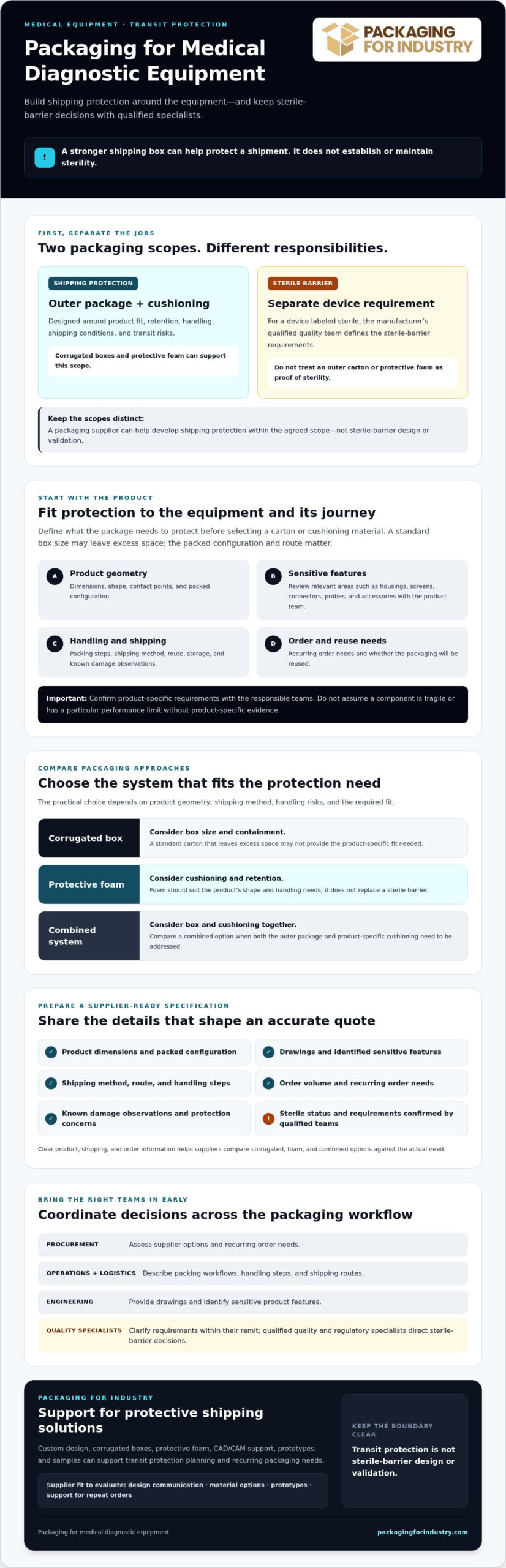
A stronger shipping box won’t solve every medical packaging risk. Custom packaging for medical diagnostic equipment starts by separating physical protection during transit from the sterile barrier requirements of a device labeled sterile. Fragile components, standard box sizes that leave excess space, and cushioning that doesn’t match the product can all complicate shipping. The packaging plan needs to suit the equipment and its handling needs, without treating a protective outer package as proof of sterility.
Damage prevention depends on more than choosing a sturdy carton. Before requesting a quote, define the packaging requirements, compare corrugated boxes, protective foam, and combined options, and identify questions for qualified packaging and regulatory specialists when sterile barrier packaging is involved. Product geometry, shipping methods, and recurring order needs all shape a practical protection plan. Packaging For Industry supports protective shipping solutions with custom design, corrugated boxes, foam, CAD/CAM support, prototypes, and samples. These services address transit protection, not sterile barrier design or validation.
Key Takeaways
- Match box and cushioning choices to the equipment’s dimensions, handling risks, shipping method, and reuse needs.
- Use custom packaging for medical diagnostic equipment to address product-specific fit and protection needs, not as a substitute for sterile barrier packaging.
- Prepare product details, shipping information, order volume, and damage observations to help suppliers develop a more accurate quote.
- Compare corrugated boxes, foam inserts, and combined systems to find a practical balance of protection and packaging efficiency.
- Evaluate suppliers for design communication, prototypes, material options, and support for recurring orders.
Custom packaging for medical diagnostic equipment starts with the protection need
Custom medical equipment packaging is designed around a product’s dimensions, contact points, handling steps, and shipping conditions. Define what the package must protect before choosing a box or cushioning material. A diagnostic unit traveling between manufacturing sites may need a different arrangement from one shipped with probes, cables, or other accessories. Consider the product’s shape, packed configuration, and route to its destination rather than relying on a standard carton size alone.
Several teams may need to contribute to the decision. Procurement can assess supplier options and recurring order needs; operations and logistics understand packing workflows and shipping routes; engineering can provide drawings and identify sensitive features; and quality can clarify product and packaging requirements within its remit. Bringing these perspectives together early helps define a practical shipping solution and keeps decisions with the right specialists.
Packaging serves functions such as protection and containment, while labeling communicates information. A general overview of packaging and labeling principles can help frame those distinct roles. For buyers seeking custom packaging for medical diagnostic equipment, the key question is which risks the shipping package must address and whether the product has separate sterility requirements.
What does custom packaging protect on diagnostic equipment?
Start with the actual device and its accessories. Depending on the design, areas to review may include housings, screens, connectors, probes, and components that need to stay organized during transit. Don’t assume a part is fragile or has a particular performance limit without product-specific evidence. Ask engineering and operations to document how the equipment is handled, stored, packed, and shipped, as well as any known damage observations.
Sterile barrier packaging versus protective shipping packaging
These systems have different jobs and are not interchangeable. A sterile barrier system is intended to maintain a device’s sterile condition under specified requirements. A corrugated outer carton and cushioning help protect products from handling and transit impacts. An outer carton does not establish sterility, and protective foam does not replace a sterile barrier.
If a device is labeled sterile, its manufacturer’s qualified quality team must define the sterile barrier requirements and identify the appropriate experts for standards, sterilization methods, and validation. Verify related claims with qualified sources before including them in a specification. A packaging supplier can help develop shipping protection within the agreed scope. Packaging For Industry provides corrugated boxes, protective foam, and custom packaging design services for industrial shipping needs, not sterile barrier design or validation.
How sterile and non-sterile medical instrument packaging needs differ
First confirm whether the instrument is supplied sterile or non-sterile, then define which packaging layers are in scope. This distinction affects who sets the requirements and what the shipping package is expected to do.
| Decision point | Non-sterile instrument | Sterile instrument |
|---|---|---|
| Product contact | Packaging is selected around the device and its handling needs. | The sterile barrier has requirements set by the manufacturer’s qualified team; secondary packaging is considered separately. |
| Sterility status | The device is not represented as sterile. | The sterile condition and applicable product requirements must be confirmed by the manufacturer. |
| Transit protection | Fit, retention, cushioning, and protection from shipping hazards. | Outer packaging protects the shipment; it must not be treated as evidence that sterility is maintained. |
| Responsible decision-maker | Product, engineering, operations, and logistics teams define needs together. | Quality and regulatory specialists direct sterile barrier decisions; packaging teams can address secondary transit protection. |
What should non-sterile instrument packaging account for?
Assess the route from packing station to destination and identify product-specific risks, such as movement inside the carton, impact, abrasion, or dust exposure. Review how accessories are held in place: loose probes, cables, or connectors may need separate retention to prevent them shifting against the instrument. Document observed issues rather than assuming a component’s limits.
Depending on the device and shipping conditions, foam inserts, end caps, pads, or dividers may help keep parts in position. PFI’s protective foam packaging can be considered as part of a shipping protection design. An academic review of medical device packaging discusses physical protection alongside sterile packaging considerations, reinforcing why buyers should define each packaging layer’s role.
What changes when an instrument must remain sterile?
Refer sterile barrier decisions to the manufacturer’s quality and regulatory specialists. They should identify applicable requirements and qualified expertise for any standards, sterilization methods, or validation claims. Don’t assume a particular cushioning material, carton, or package design preserves sterility without verified evidence.
Packaging requirements depend on intended use and validated product requirements. If PFI is being considered, clarify whether the request covers secondary transit packaging only. This keeps a custom packaging for medical diagnostic equipment quote focused on box and cushioning needs, without confusing them with sterile barrier design or validation. Buyers can share secondary packaging requirements for a quote.
Compare custom boxes, foam inserts, and combined packaging solutions
The right shipping package depends on the equipment’s geometry and how it will be handled, shipped, and possibly reused. A corrugated box provides an outer structure, foam can help locate and cushion a product, and a combined system can address both enclosure and fit. None is automatically the best choice for every diagnostic device. Compare options against the product and shipping route, then review a prototype where needed.
When are custom corrugated boxes a practical fit?
Custom dimensions can reduce excess space around a device, while partitions, pads, or dividers can separate instruments and accessories within one shipment. A stock carton may work if its dimensions and cushioning suit the packed product. A custom design may be worth evaluating when the product layout or packing process calls for a different fit. Compare custom corrugated box options with the equipment’s packed dimensions and handling requirements.
When can foam inserts improve product fit?
Die-cut foam, end caps, and pads are options to assess against the product’s shape and the contact areas that need support. Consider day-to-day use as well as fit: Can staff remove the device without difficulty? Can it be repacked consistently? Do accessories have defined positions, or could they shift against the equipment? PFI offers custom die-cut foam and design support, including prototypes and samples for review.
A combined box-and-insert system may be useful when the outer carton and product retention need to be designed together. Teams can review how the device sits in the package, where accessories go, and whether the arrangement works with packing and unpacking steps. PFI’s custom packaging design services can support protective shipping design and prototype discussions.
Choose materials based on documented requirements, not assumptions. If product specifications call for ESD or cleanroom packaging materials, confirm the intended application and material scope with the product team and supplier. Don’t add those materials simply because the equipment is medical. For a custom packaging for medical diagnostic equipment plan, compare box-only, foam-only, and combined approaches using product geometry, handling, shipping method, and reuse needs. Review samples or prototypes with the teams responsible for packing and product requirements before settling on a repeat-order design.
Build a packaging specification that suppliers can quote accurately
A clear specification helps a packaging supplier recommend a workable design and price the appropriate materials and quantities. Gather information in a consistent order: define the product, document known risks, provide dimensions, describe the shipping method, estimate order volume, and note reorder needs. This gives suppliers a practical starting point for a custom packaging for medical diagnostic equipment quote.
What information should a medical packaging quote request include?
Include the details that affect package fit, packing, and supply planning:
- Product: Dimensions, weight, shipping orientation, accessories, and handling constraints. Drawings or a product sample can help clarify the shape and contact points.
- Current packaging and risks: Share the existing package, if available, and describe observed damage or packing difficulties. Specific observations are more useful than general concerns.
- Shipping profile: Explain how the product is shipped, where it travels, and any handling conditions your team has identified as relevant.
- Order plan: Estimate packaging quantities, order frequency, and expected reorder needs. This helps suppliers consider both the initial design and recurring supply.
- Project scope: State whether you need secondary shipping protection or another defined packaging component. Keep sterile barrier, validation, and compliance decisions with the manufacturer’s qualified teams.
A useful custom packaging quote request includes product dimensions and weight, accessories, shipping conditions, order volume, reorder frequency, known damage concerns, and a clear statement of packaging scope. If some details aren’t available yet, identify what needs confirmation rather than filling gaps with assumptions.
How can prototyping reduce design uncertainty?
A prototype or sample lets teams check how the product fits, how accessories are arranged, and whether staff can pack and remove the equipment as intended. Share the design with engineering, operations, procurement, and quality so each group can assess its part of the workflow. Record requested changes before placing a recurring order.
Packaging For Industry offers CAD/CAM support, prototypes, and samples for shipping-package design review. A prototype helps assess fit and handling; it isn’t proof of sterile packaging validation or regulatory compliance. Keep those decisions with qualified specialists and define them separately from the supplier’s shipping protection scope.
Work with a custom medical equipment packaging supplier on repeat needs
A supplier relationship should support more than the first design. Assess how the supplier communicates with engineering and purchasing teams, reviews material options, gathers sample feedback, and plans repeat supply. Clear roles help keep packaging aligned with product and operational needs as orders recur.
Packaging For Industry serves medical device manufacturers as well as businesses in aerospace and aviation, electronics and semiconductor, and other manufacturing sectors. Packaging requirements vary by product and shipping process, so define the application and supply scope before selecting a solution.
Questions to ask before selecting a packaging supplier
Clarify responsibilities and expectations before approving a design or recurring order:
- Design review: Who coordinates drawings, sample feedback, revisions, and production approval?
- Scope: What can the supplier provide for protective shipping, and which decisions require qualified quality or regulatory specialists?
- Materials and prototypes: Which corrugated, foam, ESD, or cleanroom material options may suit the stated application, and can the supplier provide samples for review?
- Repeat orders: How will you communicate expected volumes, recurring demand, and stocking needs?
For operations in Orange County, Los Angeles, San Diego, and Riverside, discuss local delivery and replenishment requirements. PFI lists local next-day delivery throughout Southern California; confirm how delivery arrangements fit your location and order needs.
How PFI can support a custom packaging project
PFI offers custom design support, CAD/CAM, prototypes, and samples. For protective shipping, corrugated boxes and foam can be considered together around the product and agreed scope. PFI also lists ESD and cleanroom packaging materials; confirm current availability and application suitability. These capabilities don’t include sterile barrier design, sterilization validation, or regulatory compliance services.
Once your requirements are defined, request a custom packaging quote and share your specifications with PFI.
Put a practical protection plan into action
A sound packaging plan starts with the product and shipping risks, then matches box and cushioning choices to those requirements. Keep transit protection separate from sterile barrier requirements, and involve the qualified quality team for decisions about sterile products. Clear dimensions, shipping details, order volumes, and reorder needs also help suppliers respond with a more useful quote.
For custom packaging for medical diagnostic equipment, Packaging For Industry offers custom design support, CAD/CAM, prototypes, and samples for review. Corrugated boxes and foam can be considered together for shipping protection, with ESD and cleanroom packaging materials discussed only where the application calls for them. Recurring supply and inventory programs can support ongoing business needs. These capabilities don’t include sterile barrier design, validation, or regulatory compliance services.
Share your specifications and packaging scope to start a focused supplier discussion. A well-defined plan helps your team make informed packaging decisions and support more consistent purchasing.
With the right requirements in hand, you can move forward with greater clarity and confidence.
Frequently Asked Questions
What is custom packaging for medical diagnostic equipment?
Custom packaging for medical diagnostic equipment is designed around the device, its accessories, handling steps, and shipping conditions. A solution may combine a corrugated box with cushioning or compartments to organize components. The right configuration depends on product-specific requirements, not simply the closest stock carton size. This shipping package protects the shipment; it should not be mistaken for sterile barrier packaging or treated as evidence that a device is sterile.
What is the difference between sterile and non-sterile medical instrument packaging?
Sterile products have requirements for packaging intended to maintain their sterile condition, which the manufacturer’s qualified quality team should define. Non-sterile instruments generally need packaging selected for fit, organization, and protection during storage and transit. In either case, outer cartons and cushioning serve a transport-protection role. They don’t replace sterile barrier requirements, and supplier discussions should clearly distinguish secondary shipping packaging from sterile packaging.
Can a custom foam insert be used for sterile medical instruments?
A custom foam insert may be considered as part of secondary shipping protection, but don’t assume it can preserve sterility or serve as a sterile barrier. The manufacturer’s qualified quality and regulatory specialists should determine sterile packaging requirements and whether a proposed material or design is appropriate. Ask the packaging supplier to define its work, such as cushioning an outer shipping package, separately from any sterile packaging decisions.
How do I choose a box for medical diagnostic equipment?
Choose a box based on the equipment’s packed dimensions, weight, orientation, accessories, shipping method, and handling needs. Consider whether dividers or pads could keep separate components organized and whether cushioning is needed to limit movement inside the carton. A stock box may fit some products; custom corrugated boxes may suit products with unusual dimensions or a specific packing layout. Review the proposed configuration with your product and operations teams.
Does medical device packaging need to meet specific standards?
Requirements depend on the device, its intended use, and whether it is labeled sterile. The manufacturer’s qualified quality and regulatory specialists should identify applicable standards and determine any validation needs. A packaging supplier can discuss materials and protective shipping packaging within its scope, but don’t assume that a supplier’s box or foam design meets a particular standard or establishes compliance. Verify standards and claims with qualified experts before including them in a specification.
What information should I provide when requesting a medical packaging quote?
Share product dimensions and weight, orientation, accessories, handling constraints, shipping method, order volume, and reorder frequency. Include drawings, a product sample, current packaging, or documented damage observations when available. State whether the request is for secondary shipping protection or another defined scope. These details help a supplier assess box and cushioning options and prepare a more useful quote without making assumptions about product requirements.
Can a packaging supplier help with prototypes for medical equipment?
Yes, a supplier with custom design capabilities may provide prototypes or samples so teams can review product fit and packing workflow before recurring orders. Packaging For Industry offers custom design support, CAD/CAM, prototypes, and samples, along with corrugated boxes and foam packaging. The company serves business customers in Orange County, Los Angeles, San Diego, and Riverside. Prototype review supports shipping-package evaluation, not sterile validation or regulatory approval.