
For manufacturers in Southern California, custom printed corrugated boxes need to do more than carry a logo. They should fit the product, provide suitable protection, and work with the way your team packs, stores, and ships orders. A standard box that leaves too much room can waste space, while a poor fit or unsuitable construction can expose products to damage.
Choosing the right box means considering print, dimensions, construction, and replenishment together. Packaging For Industry provides custom packaging design services, CAD/CAM support, prototypes, and samples to help manufacturers evaluate fit and protection. Headquartered in Anaheim, PFI serves manufacturers across Orange County, Los Angeles County, the Inland Empire, and San Diego County, with local next-day delivery throughout Southern California. PFI can also support recurring packaging needs alongside the initial box design.
Key Takeaways
- Define product dimensions, shipping conditions, and protection needs before selecting a box design.
- Separate internal product dimensions from finished-box dimensions so the required fit is clear.
- Compare custom printed boxes, unprinted custom boxes, and stock cartons by fit, branding, protection, and repeat-order needs.
- Plan sourcing around recurring demand and delivery coordination when buying custom printed corrugated boxes for manufacturers in Southern California.
- PFI’s CAD/CAM support, packaging design, prototypes, and samples help connect box decisions to product and shipping requirements.
Why Southern California manufacturers choose custom printed corrugated boxes
Branded presentation matters, but a box must also protect its contents and fit the realities of production and shipping. A printed carton that fits poorly or has unsuitable construction can create handling and damage concerns, regardless of how it looks. Assess print alongside product fit, box construction, packing steps, and replenishment needs. A well-planned packaging solution can help reduce shipping damage and lower packaging costs, but printing alone does not deliver either result.
Corrugated packaging is used for manufacturer-to-customer shipments, distributor deliveries, and repeat orders where recognizable packaging helps identify the sender or contents. The material’s structure is also part of the decision: corrugated fiberboard combines paperboard layers to form shipping containers. PFI supplies corrugated boxes for manufacturing and shipping, with custom design support for product and operational requirements.
What custom printed corrugated boxes can communicate
Consistent logos, colors, and identifying information can help manufacturers present a recognizable brand across customer shipments and distributor deliveries. Clear package identification can also help teams distinguish products and shipments during routine handling. Printing communicates information, but it does not add cushioning or determine box strength. Protection depends on suitable fit and construction, as well as any additional packaging components the product requires.
When printed boxes make sense for manufacturers
Printed cartons can suit recurring branded shipments or products that benefit from clear identification. They are relevant across manufacturing sectors such as aerospace, electronics, medical devices, and industrial equipment, where packaging must meet operational needs as well as represent the shipper. Stock cartons can work when standard dimensions fit the product and recurring requirements. Consider custom boxes when product dimensions, repeat shipments, or branding needs call for a tailored approach.
PFI supplies custom printed corrugated boxes and provides custom packaging design services, including CAD/CAM support, prototypes, and samples. These services help purchasing and operations teams evaluate how a proposed package fits the product and shipping workflow. Considering print, fit, and protection together supports practical packaging decisions and consistent repeat orders, while helping teams identify opportunities to reduce shipping damage or lower packaging costs.
How to specify custom printed corrugated boxes for your products
A useful box specification connects the product to the journey it will take. Start with what’s being packed, then document how it moves through storage, packing, shipping, and delivery. California’s manufacturing economy includes businesses with distinct product and shipping requirements. Specify the box for the actual job, not just a general product category.
Start with product fit, handling, and shipping
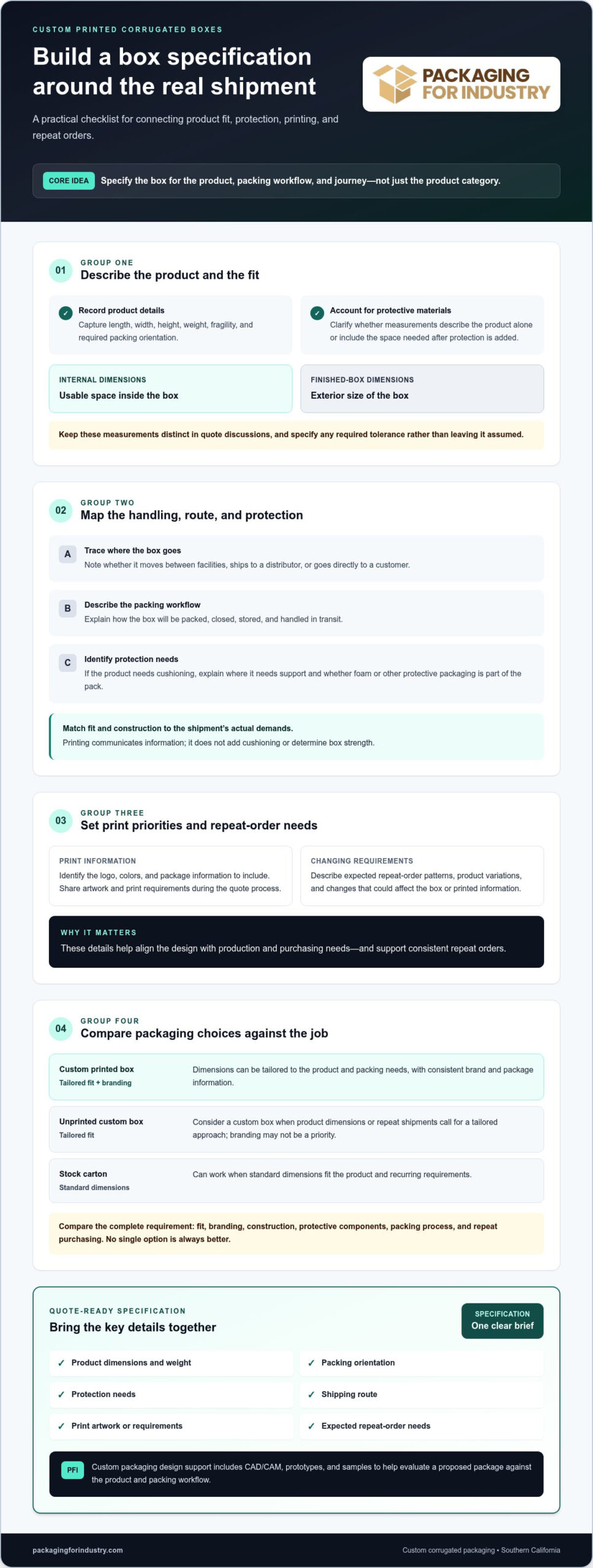
Record the product’s length, width, height, weight, fragility, and required packing orientation. Clarify whether measurements describe the product alone or the space needed after protective materials are added. Internal dimensions describe the usable space inside the box; finished-box dimensions describe the exterior. Keep these measurements distinct in quote discussions, and specify any required tolerance rather than leaving it assumed.
Next, describe the route and handling. Does the box move between facilities, ship to a distributor, or go directly to a customer? Note how it will be packed, closed, stored, and handled in transit. If the product needs cushioning, explain where it needs support and whether foam or other protective packaging is part of the pack. This context helps match box construction and fit to the shipment’s actual demands.
Define print priorities and repeat-order requirements
Identify the logo, colors, and package information to include, and share the artwork and print requirements during the quote process. Describe expected repeat-order patterns, product variations, and any changes that could affect the box or printed information. These details help align the design with production and purchasing needs. PFI’s custom packaging design support includes CAD/CAM, prototypes, and samples to help evaluate the design against the product and packing workflow.
For a custom box quote, prepare product dimensions and weight, packing orientation, protection needs, shipping route, print artwork or requirements, and expected repeat-order needs.
For custom printed corrugated boxes for manufacturers in Southern California, these details give the packaging team a practical basis for discussing fit, construction, printing, and supply together. They also help purchasing compare options against consistent product and shipping requirements. Request a custom box quote with these details to get started.
Printed corrugated boxes versus stock cartons and other packaging options
The right choice depends on how well a carton fits the product, packing process, and shipment. Stock cartons can meet the need when standard dimensions work and branding is not a priority. Review custom options when fit, recurring identification, or consistent branded presentation matters. Compare the complete packaging requirement rather than assuming one option is always better.
| Option | Fit | Brand presentation | Protection | Repeat orders and purchasing |
|---|---|---|---|---|
| Custom printed box | Dimensions can be tailored to the product and packing needs. | Carries consistent brand and package information. | Construction and any protective components should match the shipment. | Can support recurring specifications; artwork and replenishment need coordination. |
| Unprinted custom box | Custom dimensions can address a fit issue. | Plain exterior, with less emphasis on printed branding. | Construction is selected for the product and shipment requirements. | A defined box specification can support repeat purchasing. |
| Stock corrugated carton | Works when an available size fits the product and packing process. | Usually suited to shipments where printed branding isn’t a priority. | Assess whether the carton suits the contents and handling needs. | Can simplify selection when standard cartons meet ongoing requirements. |
When stock corrugated boxes may meet the need
Stock cartons are a practical option when their dimensions work and the shipment does not require printed identification. A manufacturer shipping a standard component in an established pack format may find a stock size suitable. Check the fit with the actual product and packing process, including any cushioning, rather than choosing by exterior appearance alone.
When custom printed boxes add practical value
Review custom packaging for distinctive product dimensions, recurring branded shipments, or specific handling and identification needs. A custom box can be considered alongside inserts or other protective components when the product requires them. PFI offers custom corrugated boxes as part of its corrugated packaging solutions.
Corrugated packaging may also support material recovery goals. The U.S. EPA reports a 96.5% recycling rate for paper and paperboard in 2018, and identifies corrugated boxes as highly recyclable. This historical figure is not a guarantee for every package or local recycling system, so consider the material alongside operational requirements.
A stock box may be sufficient when its size, protection, and workflow fit. Review customization when product dimensions, repeat branding, or identification needs call for a more tailored package. For custom printed corrugated boxes used repeatedly by manufacturers in Southern California, compare options against actual shipments and replenishment needs, not print alone.
Plan Southern California sourcing, delivery, and packaging supply
A custom box is useful only if it can be replenished in step with production. Map expected usage against manufacturing and shipping schedules, then consider where packaging will be stored and how much space is available. Custom items may need different planning from stock cartons, so account for ordering and replenishment timing when setting inventory levels. Include local packaging delivery in the sourcing discussion alongside order timing and warehouse capacity.
Coordinate custom box orders with production demand
Review box usage across product lines and note when demand changes. This helps purchasing teams plan repeat orders without filling valuable warehouse space with excess packaging. A stocking program, including vendor managed inventory packaging, can help keep packaging available as needed. Align the program with actual usage, available storage, and the production schedule.
PFI is headquartered in Anaheim and serves manufacturers across Orange County, Los Angeles County, the Inland Empire, and San Diego County, with local next-day delivery throughout Southern California. This regional service supports delivery coordination for recurring packaging needs. For custom printed box orders, consider expected usage, available storage, and delivery location when planning replenishment around your operation.
What Southern California buyers should include in a quote request
- Product dimensions, weight, and relevant packing or protection needs
- Shipping context, such as the route and handling involved
- Print goals, including required brand elements or package information
- Estimated usage and whether orders will recur
- Delivery location and useful receiving or storage considerations
These details help buyers compare packaging pricing and discuss bulk packaging pricing for expected order needs. They also give the packaging team context to consider the product, print purpose, delivery destination, and replenishment requirements together.
PFI supports custom packaging and recurring packaging needs across Southern California. Share your product and usage details to start a practical discussion about fit, printing, and replenishment.
Get custom printed corrugated boxes from PFI in Southern California
Manufacturers need packaging that fits the product, supports the shipping process, and presents the business consistently at delivery. Packaging For Industry supplies custom printed corrugated boxes and related industrial packaging, with design and supply support for manufacturing operations. Custom and stock packaging options help purchasing teams assess whether a tailored box is needed or a standard carton will meet the requirements.
What a manufacturer can bring to the packaging conversation
Start with the information that defines the job: product dimensions and weight, shipping method, handling conditions, known damage concerns, artwork or package identification needs, and expected repeat usage. Include details about how the box is packed and stored. These practical inputs connect packaging decisions to floor and warehouse workflows instead of treating printing as a stand-alone choice.
PFI provides custom packaging design support, CAD/CAM assistance, prototypes, and samples. These resources help manufacturers review how a proposed design fits the product and shipping requirements. If a shipment needs cushioning, foam packaging or another component can be part of the wider package. The design and supply discussion can account for the project, recurring orders, and relevant stock packaging needs.
Move from packaging requirements to a quote
With project details in hand, buyers can request pricing for custom printed corrugated boxes and compare the proposal against operational requirements. PFI is headquartered in Anaheim and serves manufacturers across Orange County, Los Angeles County, the Inland Empire, and San Diego County. Local next-day delivery throughout Southern California supports regional supply coordination. For recurring packaging needs, PFI offers vendor managed inventory and just-in-time inventory management programs.
PFI’s corrugated packaging offering includes corrugated cardboard boxes. For a quote, provide the product and box dimensions, shipping context, protection requirements, print goals, estimated usage, and delivery location. A clear request gives the packaging discussion a useful starting point and helps align the proposed box with the way your operation packs and ships.
Align your box design with the way your operation works
The right packaging decision brings print, product fit, protection, and shipping requirements together. Compare custom printed boxes with unprinted custom and stock cartons based on the dimensions you need, how products are handled, and whether repeat shipments call for consistent branding. For custom printed corrugated boxes used by manufacturers in Southern California, planning replenishment alongside box design can support a steadier packaging workflow.
Packaging For Industry provides custom printed corrugated boxes and custom packaging design services, including prototypes and samples to help assess a design against product and shipping needs. Headquartered in Anaheim, PFI serves manufacturers across Orange County, Los Angeles County, the Inland Empire, and San Diego County, with local next-day delivery throughout Southern California. Share your box requirements, artwork, expected usage, and delivery location to get a quote.
A well-planned box can support a professional delivery and fit the realities of production. Request a custom packaging quote from PFI to discuss packaging built around your operation.
Frequently Asked Questions
How do manufacturers choose custom printed corrugated boxes?
Manufacturers should evaluate product fit, shipping conditions, protection needs, packing workflow, print purpose, and repeat-order requirements together. Start with the product’s dimensions and weight, then consider how it will be packed, handled, and delivered. Decide which logos or identifying information the box needs to carry. This helps teams compare printed, unprinted custom, and stock options against operational needs rather than appearance alone.
Are custom printed corrugated boxes suitable for industrial shipping?
Yes. Custom printed corrugated boxes can be used for industrial shipping when their dimensions and construction suit the product and shipping conditions. Printing supports brand presentation or package identification, but it does not determine the box’s protective performance. Consider the product’s weight and fragility, handling during transit, and any cushioning required. PFI provides corrugated packaging and design support to help manufacturers assess packaging against product and shipping requirements.
Can custom corrugated boxes be designed around a product’s dimensions?
Yes. Custom corrugated boxes can be designed around product dimensions and packing requirements. Provide the product’s length, width, and height, and distinguish those measurements from the box’s interior and exterior dimensions. Include any protective materials that affect the space needed inside the package. PFI offers custom packaging design services with CAD/CAM support, prototypes, and samples to help evaluate a proposed design for fit and practical use.
What information should I provide for a corrugated box quote?
Provide product dimensions and weight, packing orientation, shipping method or route, protection concerns, print goals, estimated usage, and delivery location. Include artwork or required package information as well. Note whether the box will be used for recurring shipments and describe relevant packing or storage conditions. Clear details help PFI discuss a corrugated box design and quote in the context of your product and manufacturing workflow.
How do custom printed boxes compare with stock corrugated boxes?
Custom printed boxes can address specific dimensions, recurring brand presentation, or package identification needs. Stock corrugated boxes may suit the job when an available size fits the product and packing process and printing is not a priority. Neither option is automatically better. Compare fit, required protection, ease of packing, repeat-order needs, and purchasing workflow to determine whether standard cartons work or custom packaging is the better fit.
Does PFI supply custom printed corrugated boxes in Southern California?
Yes, PFI supplies custom printed corrugated boxes to manufacturers in Southern California. Headquartered in Anaheim, PFI serves customers across Orange County, Los Angeles County, the Inland Empire, and San Diego County, with local next-day delivery throughout the region. Custom packaging design support, prototypes, and samples help connect box decisions to product and shipping requirements. Share your project details to discuss packaging and supply needs.
Can printed corrugated boxes be ordered for recurring manufacturing needs?
Yes, PFI supports custom and repeat packaging needs for manufacturers. Share expected box usage and production or shipping schedules as part of the supply discussion. For recurring packaging requirements, PFI’s vendor managed inventory and just-in-time inventory programs help coordinate replenishment with operational demand. Planning around usage and available storage helps purchasing teams manage packaging supply rather than treating each order as an isolated project.