
Wall thickness alone won’t protect roll goods if the tube’s inside diameter or length doesn’t fit the product and winding process. For businesses sourcing heavy wall paper tubes for roll goods Orange County, the right specification starts with the roll, then accounts for winding, storage, handling, and shipping.
A heavier tube can seem like the safest option, but a poor fit can still create handling problems or disrupt production. Define the tube dimensions around your actual roll and operating requirements to reduce deformation risks and avoid mismatches that add cost or complexity.
This guide explains how inside diameter, length, and wall thickness relate to roll goods, what to consider across winding and shipping, and how to plan for custom sizes and recurring orders. Packaging For Industry supplies custom and stock industrial tubes and cores, with dimensions tailored to roll-goods requirements. For businesses in Orange County, Los Angeles, San Diego, and Riverside, local next-day delivery throughout Southern California and managed stocking or just-in-time programs can support reliable replenishment.
Key Takeaways
- Specify the tube around the roll and winding process, not a presumed wall thickness.
- Use inside diameter, tube length, and wall thickness to describe the fit your operation needs.
- Distinguish a roll-goods core from a tube designed primarily to contain and protect goods during shipment.
- Prepare roll dimensions, handling and shipping details, order patterns, and an existing sample before comparing packaging pricing for heavy wall paper tubes for roll goods Orange County.
- Custom tube dimensions and managed stocking or just-in-time programs can help align replenishment with recurring production needs.
Heavy wall paper tubes for Orange County roll goods: what buyers need to solve
Heavy-wall paper tubes are industrial tubes and cores specified around a roll’s dimensions and the conditions involved in winding, handling, storage, and shipment. They support roll goods during production or transit, but “heavy wall” alone doesn’t define the right tube. Buyers need a fit that works with the product, equipment, and handling steps.
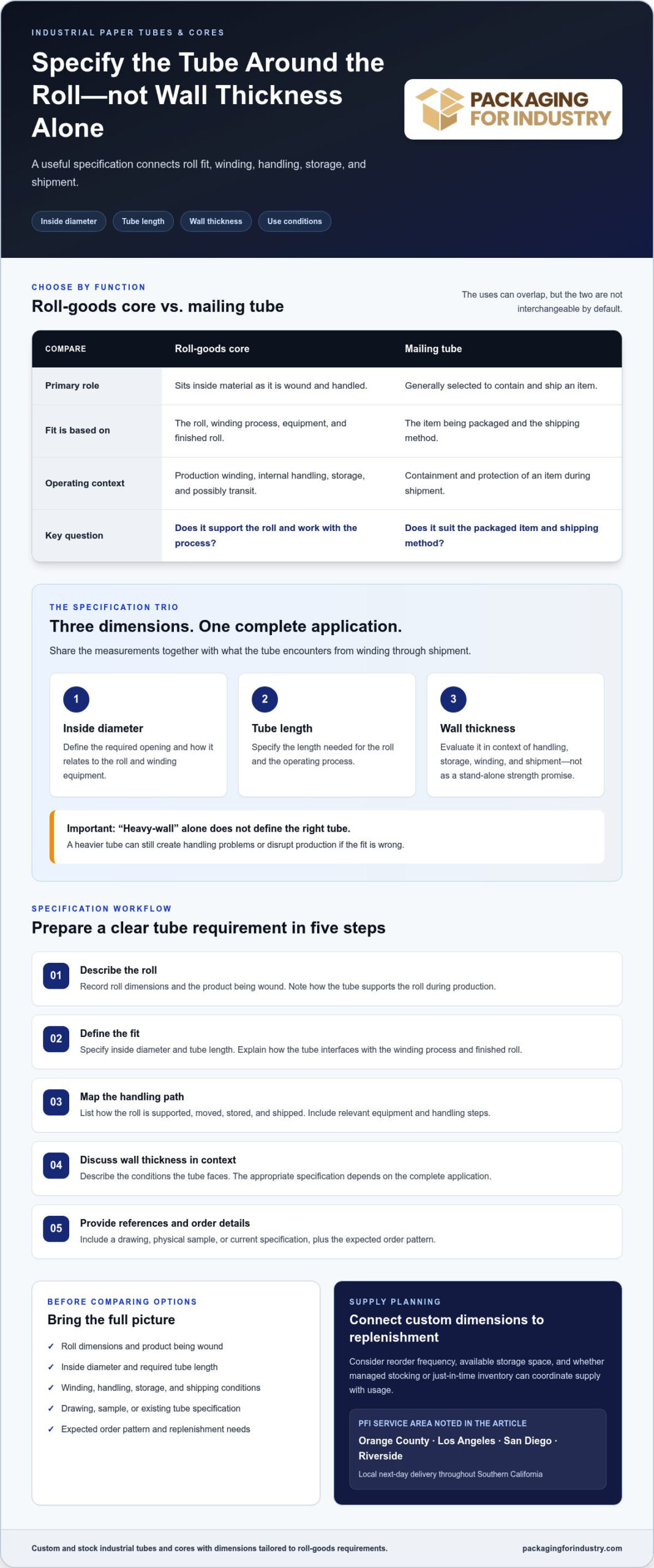
Paper tubes are made from layers of paperboard, a material described in Paperboard. For industrial buyers, the key decision is how the tube will be used. A roll-goods core sits inside material as it is wound and handled. A mailing tube is generally selected to contain and ship an item. The uses can overlap, but they aren’t interchangeable by default: a core must suit the roll and process, while a shipping tube must suit the packaged item and shipping method.
When sourcing industrial tubes and cores, align four priorities: a secure fit for the roll, compatibility with production equipment, suitable protection through handling and transit, and replenishment that supports ongoing operations.
When roll goods need a heavy-wall paper tube
Consider textile material wound on a production line and then moved through a warehouse before shipment. The tube’s role may change along that route: it can serve as a winding core, support internal handling, or remain with the roll during storage and transport. Each step can affect the specification. The right choice depends on the product and process, not a generic default based on the label “heavy-wall.”
A roll that stays on the production floor may have different handling and shipping requirements from one packed for delivery to a customer. Describe those conditions so the tube specification reflects the actual job. For facilities winding or converting large paper formats, you can also explore Wholesale Paper Distribution and Raw Paper Stock Export to coordinate primary roll stock with core specifications.
Why Orange County buyers should define the use case first
Before requesting a quote, identify where the tube is used: winding, internal handling, storage, shipment, or a combination. Note how the roll moves between those stages and who handles it. This gives purchasing and operations teams a shared basis for discussing fit, process compatibility, and transit protection.
For manufacturers and warehouses in Orange County, local sourcing can also support replenishment planning. Consider how often tubes are reordered, how much storage space is available, and whether managed stocking or just-in-time inventory can help coordinate supply with usage. PFI serves businesses across Orange County, Los Angeles, San Diego, and Riverside. Defining the use case first makes it easier to compare tube options and plan repeat orders without relying on assumptions.
How to specify paper tube dimensions for roll goods
Start with the roll and the process, not a guessed wall thickness. For buyers sourcing heavy wall paper tubes for roll goods Orange County, a useful specification explains how the tube fits the material and what it encounters from winding through shipment. PFI offers custom tubes and cores with varying inside diameters, lengths, and wall thicknesses.
Measure the roll and define the tube fit
Document the required inside diameter and tube length, then relate those measurements to the roll and winding equipment. Share a drawing, physical sample, or current tube specification when requesting a quote. Existing production details help clarify fit and keep the discussion focused on your operation.
Match wall thickness to handling and shipment
Wall thickness describes the thickness of the tube wall. It’s one part of the specification, not a universal promise of strength or a substitute for understanding the use case. Describe the winding equipment, handling frequency, storage conditions, and shipment method so the tube can be evaluated in context. The Technical Association of the Pulp & Paper Industry (TAPPI) provides resources for the pulp, paper, and packaging industries, including material and process information relevant to technical discussions.
Use this workflow to prepare a clear specification:
- Step 1: Describe the roll. Record the roll’s dimensions and the product being wound. Note how the tube supports the roll during production.
- Step 2: Define the fit. Specify the required inside diameter and tube length. Explain how the tube interfaces with the winding process and the finished roll.
- Step 3: Map the handling path. List how the roll is supported, moved, stored, and shipped. Include the equipment or handling steps that shape the tube’s job.
- Step 4: Discuss wall thickness in context. Share the conditions the tube faces rather than choosing a thickness based on “heavy-wall” alone. The appropriate specification depends on the complete application.
- Step 5: Provide references and order details. Include a drawing, sample, or existing specification, plus the expected order pattern. This helps align custom dimensions with repeat purchasing needs.
For a useful quote comparison, give your packaging supplier the measurements and process details together. That makes it easier to compare options without treating one dimension as the whole solution. Request a paper tube quote with your roll information, sample, or current specification.
Heavy-wall tubes versus alternatives for Orange County industrial rolls
The useful comparison isn’t simply “heavy-wall tube versus something lighter.” It’s whether the tube’s role matches the roll-goods workflow. A core may stay with material through winding and handling, while a shipping tube or outer package is selected to contain and protect goods in transit. One tube can serve both roles when its dimensions and intended use are specified accordingly.
| Use case | Key specification | Buyer consideration |
|---|---|---|
| Tube used as a roll core | Inside diameter, length, and wall thickness in relation to the roll and winding process | Describe how the tube fits the product and production equipment, plus how the roll is handled and stored. |
| Tube used primarily for shipment | Dimensions suited to the item being shipped and the shipping method | Explain what the tube must contain or protect during transit, and whether it also serves as the roll’s core. |
| Roll shipped with added packaging | Core or tube specification plus any required outer packaging | Consider boxes, cushioning, or a crate only if the shipment’s handling and protection needs call for them. |
Roll core or shipping tube: which function matters?
Start by stating the tube’s job at each stage. If it supports the material during winding, explain how it fits the process. If it also remains in place during storage or shipment, describe those conditions too. A tube used mainly to contain an item for shipping has a different primary function. If the tube must do both, include both requirements in the specification instead of treating “core” and “shipping tube” as interchangeable labels.
Buyers comparing heavy wall paper tubes for roll goods Orange County should consider product fit, process compatibility, handling, and shipment together. The Technical Association of the Pulp and Paper Industry (TAPPI) serves the pulp, paper, and packaging industries and provides broader industry information. The tube specification still needs to reflect the application.
When to combine tubes with other protective packaging
Additional packaging depends on the shipment, not on a rule that every roll needs an outer box. A tube may be sufficient for the intended handling, or the shipping plan may call for a box, cushioning, or a crate to address how the roll will be packed and transported. Describe the route through packing, storage, and transit so the packaging plan addresses the actual need without adding materials by default.
PFI supplies custom paper tubes and heavy-duty cores with dimensions tailored to roll-goods requirements. Consider paper tubes and cores as part of a packaging plan that connects the tube’s function to the rest of the shipment.
A practical buying checklist for heavy-wall paper tubes in Orange County
A complete quote request gives purchasing and operations teams a common set of details to compare. Before reviewing options for heavy wall paper tubes for roll goods Orange County, gather the roll information, process requirements, and order pattern. This connects custom sizing to the actual application and makes repeat purchasing easier to plan.
What to include in a heavy-wall tube quote request
Share the information you have, including the required inside diameter, tube length, wall thickness, quantity, and application. If a measurement is still being evaluated, explain how the roll is wound and used so the specification can be discussed in context. Drawings, physical samples, and details about current packaging can also clarify the fit.
- Roll dimensions: Record the roll size and the tube dimensions currently used or required.
- Intended use: State whether the tube serves as a winding core, supports internal handling, remains in storage, or travels with the roll.
- Handling steps: Describe how the roll is supported, moved, and stored, including relevant equipment or process details.
- Shipment method: Note how the roll is packed and transported, and whether additional protective packaging is part of the shipment.
- Order pattern: Share the requested quantity and how often your operation typically reorders.
- Reference materials: Include an existing sample, drawing, specification, or packaging details that help describe the current fit.
These details support a more useful comparison of packaging pricing and bulk packaging needs. Custom sizes can be tailored around the roll and process rather than forcing production to adapt to a standard dimension. Keep the specification consistent across purchasing documents and reorder records to reduce gaps between the approved tube and the one needed on the floor.
Plan for repeat orders and local packaging delivery
Use consumption patterns and internal lead-time needs to plan replenishment before inventory becomes urgent. PFI supports recurring packaging requirements through managed stocking and just-in-time programs, and offers local next-day delivery throughout Southern California. This helps Orange County buyers plan supply alongside operations in Los Angeles, San Diego, and Riverside.
For a quote, send the tube dimensions, application, quantity, and any sample or drawing together. A clear specification helps align the custom tube with production needs and repeat-order planning.
Source custom paper tubes for roll goods from PFI
For manufacturers and warehouses, the right tube needs to fit the roll and its place in the operation. Packaging For Industry is an industrial packaging supplier serving Orange County with custom and stock paper tubes and heavy-duty cores. PFI tailors tube dimensions to roll-goods applications, helping buyers align product fit, handling needs, and replenishment planning.
How PFI supports custom and recurring tube requirements
Custom paper tubes can be specified with different inside diameters, wall thicknesses, and lengths. Share how the tube functions in winding, storage, handling, or shipment so the specification reflects the actual work. Explore PFI’s tubes and cores as part of your industrial packaging plan.
For repeat-use applications, expected usage and reorder patterns can inform managed stocking or just-in-time packaging planning. These programs help coordinate tube supply with ongoing operational needs, rather than treating each order as a separate purchasing decision. PFI also offers local next-day delivery throughout Southern California, serving businesses in Orange County, Los Angeles, San Diego, and Riverside.
Well-matched dimensions and organized replenishment can support production continuity while keeping purchasing decisions grounded in the application. The objective is to select packaging that fits the job and supports dependable supply, not to add specifications or materials without a clear purpose.
Request a quote for Orange County roll goods
To discuss heavy wall paper tubes for roll goods Orange County, provide the roll dimensions, required inside diameter and tube length, desired wall thickness if known, application, and order quantity. Include how the tube will be handled and shipped, along with an existing sample, drawing, or specification if available. These details give the quote discussion a practical starting point focused on your operating requirements.
Whether you need a custom size for a specific roll or a plan for recurring orders, PFI can tailor tube options to your application. Share the information your team uses to evaluate fit, supply, and replenishment, then compare packaging pricing against clearly defined requirements.
Build a tube specification around your operation
The right tube starts with the roll and the work it needs to support. Define inside diameter, length, and wall thickness alongside winding, handling, storage, and shipment needs. This gives purchasing and operations teams a practical basis for comparing options and helps prevent a mismatch between the tube and the process.
For businesses sourcing heavy wall paper tubes for roll goods Orange County, PFI offers custom paper tubes and heavy-duty cores in tailored dimensions, as well as stock packaging. Orange County customers are served within PFI’s Southern California coverage, including Los Angeles, San Diego, and Riverside. Local next-day delivery and managed stocking or just-in-time programs can help coordinate replenishment with usage.
Share your roll dimensions, application, order quantity, and replenishment needs to start a quote discussion focused on your operation. A clear specification can support product protection, production planning, and dependable supply.
With the right details in hand, you can move forward with a tube plan that fits your roll goods and purchasing needs.
Frequently Asked Questions
How do I choose the right wall thickness for paper tubes holding roll goods?
Choose wall thickness based on the roll, the tube’s function, and the conditions it will encounter. Consider the winding or handling process, storage, and shipment method together. Wall thickness is one specification, not a standalone performance rating. To discuss the requirement, provide the current tube dimensions, explain the application, and share an existing sample or specification if available. The right specification depends on those project details.
What measurements should I provide for a custom paper tube quote?
Provide the required inside diameter and tube length, plus the wall thickness if you know it. Include the tube’s intended use, order quantity, and expected repeat-order pattern. A drawing, physical sample, or current tube specification can help clarify the fit. These details let the quote discussion account for the roll, production process, handling, and shipment rather than treating dimensions as isolated measurements.
Can heavy-wall paper tubes be used as both roll cores and shipping tubes?
Some tubes may serve more than one function, but suitability depends on the application. A tube used as a core supports the roll during winding or use. A tube used for shipment has a role in containing or protecting the roll in transit. If you need both functions, state each in your quote request and describe the handling and shipping conditions so the specification reflects the full job.
Are custom paper tubes available in different lengths and diameters?
Yes. PFI offers custom paper tubes with varying inside diameters, wall thicknesses, and lengths for industrial applications. Share the roll dimensions and explain how the tube will be used during winding, handling, storage, or shipment. This information helps align custom sizing with your process and purchasing needs. For bulk or repeat orders, include your anticipated quantities and ordering pattern with the specification.
Does PFI supply heavy-wall paper tubes to Orange County businesses?
Yes. PFI supplies heavy wall paper tubes for roll goods used by Orange County businesses, as well as custom tubes and cores for customers across Southern California, including Los Angeles, San Diego, and Riverside. PFI offers local next-day delivery throughout Southern California. Share your dimensions, application, and quantity through the quote request to discuss your requirements.
Can I arrange repeat orders for paper tubes used in production?
Yes. PFI supports recurring packaging needs through managed stocking and just-in-time inventory programs. Manufacturers and warehouses can use tube usage patterns, current inventory, and replenishment needs to inform a supply plan. Sharing how the tubes fit into production and how orders recur helps structure the discussion around ongoing requirements.
What details help compare pricing for heavy-wall paper tubes?
Compare quotes based on equivalent specifications: inside diameter, tube length, wall thickness, quantity, intended use, and order frequency. Include the same drawings, samples, or current tube details with each request so the dimensions and application are clear. Custom sizing and supply arrangements can affect a quote, so consistent information helps purchasing teams make a useful comparison of packaging pricing.