
Packaging supplies for automated fulfillment centers in SoCal need to match the products being shipped and the operation’s repeatable packing workflow. A box that varies in size, protective material that is difficult to apply consistently, or a supply shortage can slow fulfillment. Packaging choices affect product protection and the steady movement of orders through a facility.
Fulfillment teams need to balance consistent formats and materials with product protection, efficient use of space, and dependable replenishment. Start by documenting the products and packing steps, then compare packaging options and suppliers against those requirements. A clear buying framework also helps purchasing teams plan recurring inventory instead of reacting to shortages.
This article explains how to assess packaging materials for your products and workflow, when custom design may improve fit, and how vendor managed inventory or just-in-time programs can support ongoing supply. Packaging For Industry serves Southern California fulfillment operations from its Anaheim headquarters with custom and stock packaging and local next-day delivery throughout the region.
Key Takeaways
- Specify packaging around product dimensions, weight, fragility, shipping conditions, and the points where manual handling or material variation affects fulfillment.
- Compare corrugated boxes, foam, cushioning, stretch film, and tape by their purpose, customization options, and fit with your packing workflow.
- Plan replenishment around usage history, storage capacity, delivery schedules, and recurring needs. Vendor managed inventory can support scheduled reviews.
- Packaging supplies for automated fulfillment centers SoCal operations need should align materials, dimensions, and supply continuity with repeatable workflows.
- Share packaging types, dimensions, usage patterns, and delivery locations when requesting a quote to help assess operational fit and pricing.
Packaging supplies for automated fulfillment centers: what buyers need to solve
Automation equipment and fulfillment software coordinate storage, movement, and order processing. Packaging is a separate input, but it still needs to fit the workflow. A facility can move orders efficiently and lose time when box formats vary, cushioning is awkward to apply, or essential supplies run short.
Definition: Packaging supplies for automated fulfillment are the physical materials used to contain, protect, seal, identify, and prepare orders for shipment. Their suitability depends on how well they fit the products, handling steps, and packing process.
This distinction matters in facilities using automated storage and retrieval systems or other warehouse technology. Equipment manages goods and data; packaging materials remain the physical inputs used by employees or packing stations. Buyers need consistent formats, appropriate product protection, planned replenishment, and fewer emergency purchases. A packaging supplier can support these needs without supplying the automation machinery itself.
Which packaging inputs affect a fulfillment workflow?
Common inputs include corrugated boxes, mailers, cushioning materials, packaging tape, labels, and stretch film for securing grouped shipments or loads. Each serves a different purpose: boxes and mailers contain products, cushioning helps protect them during handling and transit, tape closes packages, labels identify shipments, and stretch film secures loads.
Choose materials based on product dimensions, weight, fragility, and handling requirements. A compact item may need a close-fitting box with limited cushioning, while a fragile product may need a more tailored protective arrangement. Consistent formats can make packing steps easier to repeat. A poor fit can mean extra handling, excess packaging, or avoidable product damage. PFI supplies foam packaging as part of its protective packaging options.
Why local supply matters to SoCal fulfillment operations
A supply plan needs to account for where packaging is used as well as what it contains. Packaging For Industry is headquartered in Anaheim and serves Orange County, Los Angeles County, Riverside and the Inland Empire, and San Diego County. Local next-day delivery throughout Southern California can support planned replenishment when recurring packaging needs are coordinated with expected usage.
For fulfillment teams shipping orders, PFI’s packaging range can help address the materials used to prepare and protect shipments. The aim is to align materials and supply continuity with daily operations rather than treat every shortage as a separate urgent purchase. For buyers evaluating packaging supplies for automated fulfillment centers SoCal facilities depend on, local service is most useful as part of a repeatable replenishment plan.
How to specify packaging supplies for automated fulfillment operations
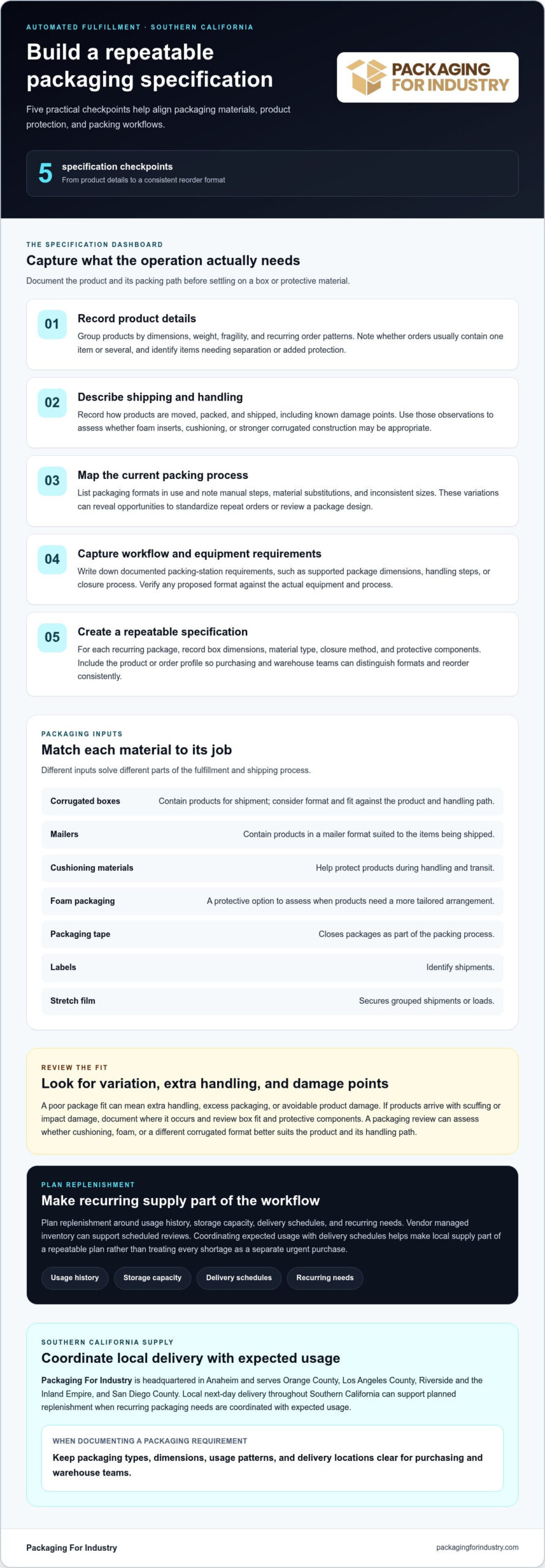
Start a packaging specification with the products and the work they move through, not with a preferred box or material. Document what each package must protect and how employees or equipment handle it. Separate confirmed equipment requirements from assumptions, then review packaging choices against the operation’s actual workflow.
- 1. Record product details. Group products by dimensions, weight, fragility, and recurring order patterns. Note whether orders usually contain one item or several, and identify products that need separation or added protection.
- 2. Describe shipping and handling conditions. Document how products are moved, packed, and shipped, including known damage points. Use these observations to assess whether foam inserts, cushioning materials, or stronger corrugated construction may be appropriate.
- 3. Map the current pack process. Record the packaging formats in use and where employees add manual steps, substitute materials, or encounter inconsistent sizes. These variations may point to an opportunity to standardize a repeat order or review its packaging design.
- 4. Capture workflow and equipment requirements. Write down documented requirements relevant to the packing station, such as supported package dimensions, handling steps, or closure process. Verify any proposed material or format against the equipment and process rather than assuming it is compatible.
- 5. Create a repeatable specification. For each recurring package, record box dimensions, material type, closure method, and protective components. Include the product or order profile the format serves so purchasing and warehouse teams can distinguish similar items and reorder consistently.
Turn product and workflow needs into a clear specification
If a product arrives with scuffing or impact damage, document where the damage occurs and review the box fit and protective components. A packaging review can assess whether cushioning, foam, or a different corrugated format better suits the product and its handling path. PFI offers custom packaging design services for operations that need a tailored format rather than a stock option.
Consistent specifications give purchasing a clearer basis for comparing materials and replenishment needs. They also help warehouse teams follow the same packing method for repeat orders. For teams refining packaging supplies for automated fulfillment centers SoCal workflows depend on, the Material Handling Industry (MHI) provides broader context on material handling and supply chain systems. Packaging specifications, however, should reflect the facility’s documented equipment requirements.
Once product profiles and workflow requirements are documented, request a packaging quote with relevant dimensions, materials, and order patterns. These details give the supplier a useful starting point for reviewing options.
Compare packaging materials and supplier capabilities for SoCal fulfillment
Choose materials based on the product, shipment pattern, and documented workflow requirements. A fragile item may call for cushioning or foam, while a recurring shipment with a consistent profile may suit a stock or custom corrugated box. Use the comparison below to identify which categories to review, then assess supplier capabilities against the operation’s needs.
| Material category | Typical role | Customization potential | Buyer considerations |
|---|---|---|---|
| Corrugated boxes | Contain and ship products | Stock or custom formats | Product dimensions, shipment pattern, and documented packing workflow |
| Protective foam | Help protect products during handling and transit | Custom foam formats, including die-cut options | Product shape, fragility, and protection needs |
| Cushioning materials | Provide protective fill or separation within a package | Selected to suit the product and packing process | Handling conditions and how the material is applied |
| Stretch film | Secure grouped shipments or loads | Format selected for the application | Load configuration and how film is applied |
| Packaging tape | Close packages | Selected for the closure process | Package format and packing method |
PFI supplies stock and custom corrugated boxes. Foam and cushioning are worth assessing for fragile or high-value products, while stretch film and tape support load securing and package closure. These materials perform different jobs, so review the package and process before considering one as a substitute for another.
Compare supplier capabilities beyond catalog breadth
A broad catalog is useful, but operational fit also depends on a supplier’s ability to coordinate recurring materials. The warehousing of the future report from PMMI examines packaging and automation in warehouse settings. It highlights why packaging procurement should account for workflow, not just the item list.
Compare suppliers on their ability to coordinate boxes, cushioning, film, and other repeat-use supplies; support custom design; and help standardize packaging formats. PFI provides design support, prototypes and samples, packaging reviews, and packaging kitting and assembly. These services help teams assess tailored formats and align packaging components with documented operating requirements.
For packaging supplies for automated fulfillment centers SoCal teams can plan around, consider recurring supply and service-area relevance alongside material selection. An industrial packaging supplier that coordinates custom design and ongoing materials can simplify purchasing across fulfillment needs. To discuss the mix of packaging your operation uses, request a packaging quote.
Plan packaging replenishment, inventory, and local delivery in Southern California
Packaging inventory should reflect actual consumption, available storage, and the timing of incoming shipments. Review usage history for corrugated boxes, foam, stretch film, tape, and other repeat-use materials alongside production or shipping schedules. Account for each item’s lead time and the space available to store it. This gives purchasing a practical basis for planned orders instead of reacting to shortages.
Set inventory targets around operating needs. Agreed minimum and maximum levels help purchasing teams see when replenishment is due and avoid holding more packaging than available space allows. Review targets when usage patterns or shipping schedules change. For example, an increase in orders can change consumption and call for an adjusted replenishment plan.
When a packaging stocking program can help
Recurring packaging use, repeated emergency orders, or limited warehouse space can signal that an informal ordering process needs more structure. With vendor managed inventory for packaging, scheduled reviews and planned replenishment are based on actual usage. This gives teams a clearer view of stock levels and upcoming needs, while agreed minimums and maximums help reduce guesswork for purchasing.
Choose a review schedule around consumption patterns, storage limits, and delivery needs. The goal is to notice changes in usage before they become urgent orders, not to apply a fixed cadence that ignores how the fulfillment center operates. A just-in-time inventory approach can also support planned supply for recurring packaging needs.
Coordinate custom packaging with recurring supply
Custom boxes, foam, and crates need to be included in replenishment planning alongside stock materials. Account for their lead times and align orders with production schedules, forecast changes, and available storage. When a custom format is used repeatedly, considering design and replenishment together can make purchasing easier to plan.
Packaging For Industry is headquartered in Anaheim and serves Orange County, Los Angeles County, Riverside and the Inland Empire, and San Diego County. Local next-day delivery throughout Southern California can support planned replenishment across these service areas. For packaging supplies for automated fulfillment centers SoCal operations rely on, connect actual usage, custom packaging needs, and delivery planning to help prevent avoidable shortages.
Choose a SoCal packaging supplier and request a fulfillment quote
A useful supplier comparison goes beyond unit pricing. Assess product fit, documented workflow requirements, material choices, replenishment support, and local service. A well-planned packaging supply can support manufacturers, warehouses, distribution centers, and fulfillment operations serving aerospace, electronics, medical device, and food and beverage businesses.
What to include in a packaging quote request
Share details that let a supplier evaluate both the materials and recurring supply needs:
- Packaging types: List boxes, foam, cushioning, stretch film, tape, and other supplies used in your operation.
- Dimensions and formats: Provide product or package dimensions and identify where custom sizes are needed.
- Usage and protection needs: Describe recurring usage, order patterns, and any damage or protection concerns.
- Delivery details: Include fulfillment locations and scheduling needs for your Southern California sites.
These details help PFI assess relevant custom and stock materials, design support, prototypes, samples, packaging reviews, or kitting. They also give your team a sound basis to compare packaging pricing and bulk packaging pricing for recurring requirements, rather than assuming every operation uses the same packaging mix.
Why consider Packaging For Industry in SoCal?
Headquartered in Anaheim, Packaging For Industry serves Orange County, Los Angeles County, Riverside and the Inland Empire, and San Diego County, with local next-day delivery throughout Southern California. PFI supplies corrugated boxes, foam, stretch film, cushioning, and related packaging materials. Its packaging solutions serve aerospace and aviation, electronics and semiconductor, medical device manufacturing, food and beverage, and industrial equipment businesses. Design support, kitting, vendor managed inventory, and just-in-time inventory management can also support recurring packaging needs.
For packaging supplies for automated fulfillment centers in SoCal, align product protection, workflow, materials, and supply continuity before comparing quotes. A clear request helps focus the discussion on packaging that fits your operation.
Build a more dependable packaging supply plan
Reliable fulfillment depends on packaging that fits the product, supports the actual workflow, and stays available as orders move through the operation. Start with clear product and process requirements, then select corrugated boxes, foam, cushioning, and other materials for consistent packing and shipment protection. Use actual consumption patterns to guide replenishment and reduce last-minute purchasing pressure.
For packaging supplies for automated fulfillment centers SoCal operations rely on, choose a supplier that can connect material selection with design support and ongoing supply. Packaging For Industry offers custom and stock packaging, along with design and prototyping support to help assess formats for your needs. Local next-day delivery throughout Southern California can support planned replenishment for fulfillment teams across the region.
Bring your packaging types, dimensions, usage patterns, protection concerns, and delivery locations together to start a focused supplier discussion. A practical plan can help your team improve consistency and manage packaging supply more effectively.
With clear specifications and a planned replenishment approach, your packaging can better support daily fulfillment and future operational changes.
Frequently Asked Questions
What packaging supplies do automated fulfillment centers commonly need?
Common supplies include corrugated boxes, cushioning, foam, packaging tape, labels, poly bags, mailers, and stretch film. The right combination depends on product dimensions, fragility, order patterns, shipping methods, and documented workflow requirements. Organize repeat-use items by purpose and specification, then assess whether stock or custom packaging fits each need. A consistent purchasing plan can still account for different protection requirements for different products.
How do I choose packaging supplies for an automated fulfillment center?
Start with product dimensions, weight, fragility, order patterns, and shipping conditions. Document current packaging formats, protection concerns, and workflow requirements that affect package handling. Then compare materials for product fit, repeatability, customization, and replenishment. This keeps decisions grounded in the operation’s actual equipment requirements rather than assumptions about universal machine compatibility.
Can custom boxes work in an automated fulfillment operation?
Custom boxes are worth considering when stock formats don’t fit the product, order profile, or shipping needs. Define the dimensions, construction, closure, and relevant workflow requirements before settling on a format. Consider how the package will be handled during packing and shipping, not only how it fits the product. Packaging design support, prototypes, and samples can help assess a proposed format before expanding its use across recurring orders.
How can a fulfillment center prevent packaging supply shortages?
Review usage history, replenishment timing, storage capacity, and shipping schedules to build a planned inventory process. Track recurring materials and account for changes in order volume or production needs. Vendor managed inventory can support scheduled reviews and replenishment based on actual usage and agreed stocking levels. This helps teams plan supply, manage warehouse space, and reduce reliance on emergency purchases when frequently used packaging runs low.
What should I include when requesting a packaging quote in Southern California?
List the packaging categories you need, product and package dimensions, protection concerns, and recurring usage. Include any custom boxes, foam, or crates, along with related supplies such as tape or stretch film. Identify the fulfillment location and delivery schedule needs. These details help shape a relevant quote for operations in Orange County, Los Angeles County, Riverside and the Inland Empire, or San Diego County.
Does Packaging For Industry deliver packaging supplies locally in SoCal?
Yes. Packaging For Industry provides local next-day delivery throughout Southern California. The company is headquartered in Anaheim and serves Orange County, Los Angeles County, Riverside and the Inland Empire, and San Diego County. Include your delivery location and recurring packaging needs when requesting a quote so supply planning reflects where materials are used and what your fulfillment operation requires.
What is vendor managed inventory for packaging supplies?
Vendor managed inventory is a packaging program built around scheduled inventory reviews and planned replenishment based on actual usage and agreed stocking levels. Reviews can be set on weekly, biweekly, or monthly cycles. A program can account for current packaging items, usage history, lead times, storage space, and shipping schedules. This helps purchasing teams plan recurring supply and manage inventory around their operation’s needs.