
Packaging for medical lab equipment should be designed around the equipment, not just the carton. If a unit or its accessories shift inside an oversized box, even sturdy packaging may not provide the support the shipment needs. Start with the equipment’s dimensions, weight, vulnerable components, and shipping conditions, then select a configuration that holds everything securely and suits the way your team packs and ships.
Protecting fragile or high-value equipment matters, but packaging also needs to fit purchasing and warehouse workflows. Standard sizes can leave gaps, while unclear specifications can slow ordering and replenishment. This guide explains how to define requirements, compare corrugated boxes, foam inserts, and crates, and prepare for a packaging quote. Packaging For Industry supports custom packaging design with CAD/CAM, prototypes, and samples, and can combine materials to suit the shipment. Use the practical checks below to clarify specifications, assess fit, and plan for repeat orders.
Key Takeaways
- Specify packaging for medical lab equipment using its dimensions, weight, vulnerable areas, accessories, and required shipping orientation.
- Compare foam inserts, corrugated boxes, and crates according to the equipment’s protection needs and handling conditions.
- Assess cushioning, the outer container, packing steps, and storage needs as one packaging system.
- Share clear equipment and shipment details to support a tailored design and accurate quote.
- Review a prototype or sample for fit and packing workflow before adopting the configuration for repeat shipments.
Packaging for Medical Lab Equipment Starts with the Shipping Risk
Fragile surfaces, projecting controls, removable parts, and bundled accessories can make a standard carton a poor fit for lab equipment. Buyers also need to consider how shipments will be handled and whether the same configuration must work for repeat orders. Plan packaging around the product and shipment, rather than selecting a box by size alone.
Shipping protection works as a system: inner cushioning positions and supports the equipment, while an outer container protects it during handling and transit. Corrugated boxes, foam, and crates can be combined to suit the shipment. Transit-protection packaging is distinct from sterile-barrier packaging or validated packaging for medical devices. For general background on medical device packaging, see Packaging standards for medical devices. PFI’s foam packaging solutions can be incorporated into a custom-fit shipping configuration for medical and laboratory equipment.
Which lab equipment characteristics affect packaging requirements?
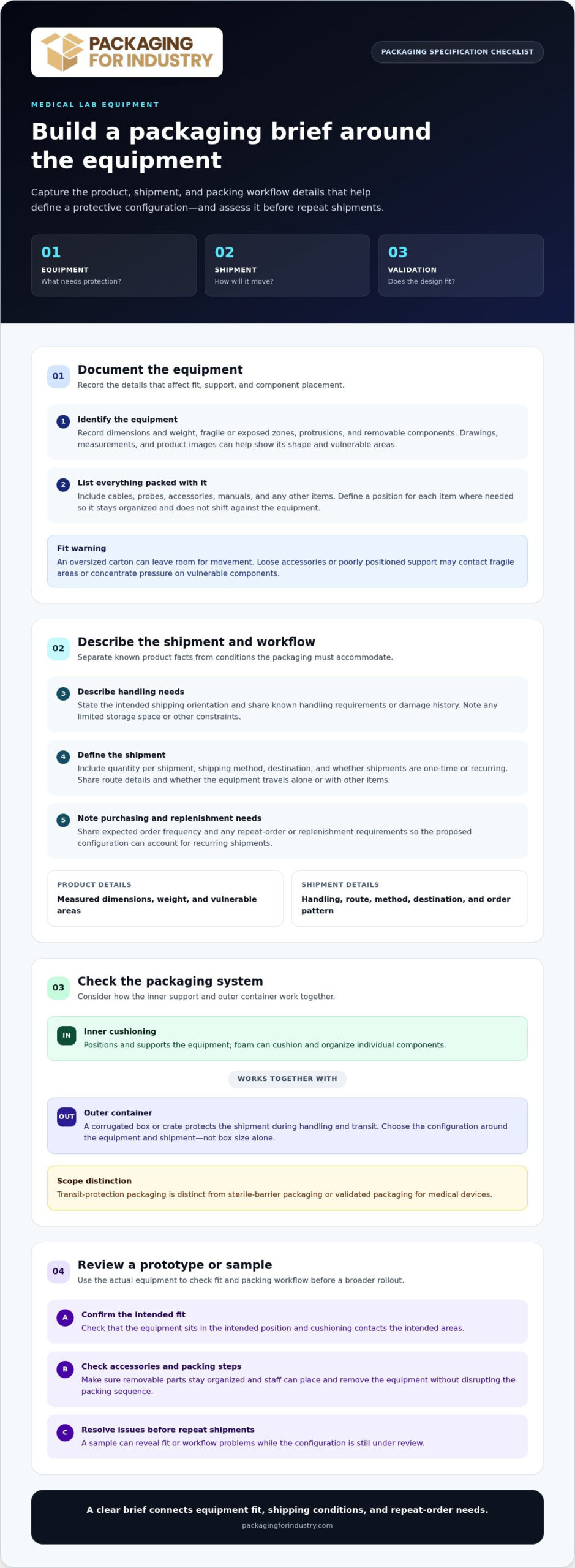
Start with details your team can document: equipment dimensions and weight, fragile surfaces, protrusions, and parts that can be removed. List everything packed in the shipment, including cables, probes, accessories, and manuals. Give each item a defined position where needed, so it does not shift against the equipment and is easy to locate when unpacking.
Then describe the shipment conditions that will inform the design. Include how the equipment is handled, the shipping route or method, and whether it travels alone or with other items. Product measurements and known vulnerable areas are facts about the equipment; handling and route details help define the packaging requirements. This information gives a packaging supplier a clearer basis for a project-specific proposal.
What can go wrong with a poor equipment fit?
An oversized carton can leave room for equipment to move, increasing the risk of impacts against the container or other packed items. A loose accessory can shift during transit and contact a fragile surface or protruding component.
Insufficient or poorly positioned support creates another risk: pressure may concentrate on a vulnerable area instead of being distributed around the equipment. Damage can mean rework, replacement coordination, and shipment disruption. A fitted cushioning layout and appropriately sized outer container help address these risks and make the packing approach easier to repeat.
How to Specify Protective Packaging for Medical Lab Equipment
A useful packaging brief includes more than a product name and an approximate box size. For packaging for medical lab equipment, document the equipment, what ships with it, how it moves through the supply chain, and whether the configuration must support recurring orders. A clear brief helps focus the design and quote on the actual project.
What information should a buyer provide?
Gather product details, then describe the shipment and purchasing requirements. Drawings, measurements, and product images can help communicate the equipment’s shape and vulnerable areas. Note constraints such as a required packing orientation or limited storage space.
- Identify the equipment. Record dimensions and weight, fragile or exposed zones, protrusions, and removable components.
- List everything packed with it. Include cables, probes, accessories, manuals, and any other items that need organized placement.
- Describe handling needs. State the intended orientation and share known handling requirements or damage history.
- Define the shipment. Include quantity per shipment, shipping method, destination, and whether shipments are one-time or recurring.
- Share purchasing needs. Note expected order frequency and any repeat-order or replenishment requirements.
- Review a prototype or sample. Assess fit and packing steps before moving to a broader rollout.
Separate known product facts from shipment conditions. The equipment’s measured dimensions are product details; its handling conditions in transit belong in the shipment brief. If your team is considering distribution testing, ASTM International provides information on Performance Testing of Shipping Containers. PFI’s custom packaging design services use project details to guide a tailored packaging approach.
How do prototypes help assess packaging fit?
A prototype or sample lets your team assess the design with the actual equipment before adopting it for repeat shipments. Check that the equipment sits in the intended position, cushioning contacts the intended areas, and removable parts stay organized. Review whether staff can place and remove the equipment without disrupting the packing sequence. These checks can reveal fit or workflow issues while the configuration is still under review.
To request a custom packaging quote, share the checklist details, drawings or images, shipment quantities, and recurring-order needs through PFI’s packaging quote request. A complete brief helps the team develop a proposal around your equipment and shipping requirements.
Foam, Corrugated Boxes, or Crates: Compare Equipment Packaging Options
The right configuration depends on the equipment, its accessories, and the shipment. Foam can position and cushion individual components, while a corrugated box or crate provides the outer container. These materials can work together. When comparing packaging for medical lab equipment, consider the role of each component rather than treating foam, boxes, and crates as interchangeable.
| Component | Purpose | When to consider it |
|---|---|---|
| Foam inserts, pads, or end caps | Cushion equipment, support specific areas, and organize accessories within the package. | When equipment has delicate surfaces, protrusions, removable components, or needs a defined position inside the container. |
| Corrugated box | Forms an outer shipping container around the equipment and protective cushioning. | When the shipment can be packed in a carton sized for the equipment and insert configuration. |
| Crate | Provides an outer packaging option to assess for a particular shipment. | When the equipment is heavy or complex, or the shipment’s handling plan calls for a different container configuration. |
| Combined system | Pairs cushioning and product positioning with a suitably selected outer container. | When both equipment fit and shipment handling conditions need to inform the packaging design. |
When can custom foam inserts improve equipment fit?
Custom die-cut foam, pads, and end caps can support equipment and keep accessories organized. Shaped cavities help define where the instrument, cables, probes, or removable parts sit within the package. The contact points and cushioning layout should reflect the actual equipment and shipment conditions. Explore PFI’s protective foam packaging as part of a configuration that may also include a corrugated box or crate.
When should buyers compare corrugated boxes and crates?
Custom corrugated boxes can be designed around equipment dimensions and protective inserts, creating a coordinated package instead of forcing the equipment into a standard carton. Buyers can also assess a crate for particular heavy or complex shipments. Compare options against the equipment, shipment quantity, handling plan, and packing workflow. The suitable configuration is the one designed for those project needs.
Foam, corrugated boxes, and crates are not always alternatives. Combining them can address different needs within the same shipment: cushioning supports the equipment, while the outer container is selected for the planned handling.
Evaluate the Full Packaging Configuration Before You Buy
A design can fit the equipment and still create problems if it is difficult to pack, close, store, or handle. Assess cushioning, the outer container, packing steps, and storage footprint together. For packaging for medical lab equipment, balance product protection with practical package dimensions and shipment handling requirements. Do not assume a particular configuration will meet every carrier’s criteria.
Review shipment history before finalizing the design. Note known damage, recurring packing difficulties, changes in shipment quantity, and the destinations or routes the package regularly serves. These details can help pinpoint whether the issue relates to product positioning, cushioning, container selection, or the packing process.
How should buyers assess shipping and handling needs?
Document the shipping method, destination patterns, and known handling points. Map how the package moves from packing through dispatch and receiving. Then review practical steps: Can staff place the equipment consistently? Does the container close securely using the planned method? Are labels visible and positioned as intended? At the receiving end, can the recipient open the package and remove the equipment without unnecessary handling?
Consider package dimensions alongside protection needs. Larger packaging can affect storage and shipping calculations, while reducing space without considering cushioning may compromise fit. Carrier acceptance and charges depend on shipment-specific details, so evaluate dimensions and handling requirements for the actual shipping plan rather than assuming a design guarantees a particular outcome.
How can packaging support recurring supply needs?
List the components used for each shipment, such as boxes, inserts, cushioning, and closure materials. Separate routinely consumed items from custom components that need additional purchasing or planning attention. For repeat shipments, consistent specifications and packing steps help purchasing and operations teams order and use the same configuration.
Custom corrugated boxes can be tailored to a recurring equipment configuration, including space for protective inserts. PFI’s vendor managed inventory and just-in-time inventory programs support recurring packaging replenishment. Aligning replenishment with actual usage helps teams plan supply needs and keep packaging available for scheduled shipments.
A complete packaging specification connects product protection, packing workflow, storage, and replenishment, giving purchasing and operations a consistent basis for repeat orders.
Get a Custom Medical Lab Equipment Packaging Quote from PFI
A useful quote starts with a clear picture of the equipment and the shipment it needs to support. Packaging For Industry works with manufacturers and medical device businesses on custom packaging design, prototypes and samples, foam, corrugated boxes, and crates. These components can be combined into a configuration tailored to the product and shipping project, rather than treated as separate purchasing decisions.
For buyers in Orange County, Los Angeles, San Diego, and Riverside, complete project details help connect the packaging proposal to transit protection and day-to-day purchasing needs. PFI’s design support can include CAD/CAM, prototypes, and samples to help evaluate a proposed configuration. This is support for transit packaging, not a claim of sterile-barrier design, regulatory validation, or lab-equipment-specific certification.
What should a packaging quote request include?
Make the request specific enough for the packaging team to understand what must fit, what needs protection, and how the package will be used. Include:
- Equipment dimensions and weight, plus photos or drawings that show its shape.
- Fragile or exposed areas, protrusions, removable parts, and accessories packed with the equipment.
- Order quantities, shipment frequency, shipping destinations, and relevant handling information.
- Current packaging challenges, such as poor fit, difficult packing steps, or known transit damage.
- Whether you need a custom configuration, prototypes or samples, or packaging for recurring supply.
These details help distinguish a one-time shipment from an ongoing packaging requirement. They also give purchasing and operations teams a shared project brief for reviewing options and planning repeat orders.
How does PFI support custom packaging projects?
PFI reviews project details, develops design support around the equipment and shipment, and can provide a prototype or sample for evaluation. Your team can assess how the product sits in the package, how cushioning and the outer container work together, and whether the packing approach suits the operation before a broader rollout. This review connects protection with practical packing and purchasing considerations.
The result is a tailored proposal for packaging for medical lab equipment, based on the project’s requirements and intended supply pattern. Include the information above in your request to support an accurate packaging quote.
Build a Packaging Plan You Can Reorder With Confidence
Reliable packaging for medical lab equipment starts with a clear specification: document the equipment and accessories, account for shipment conditions, then assess cushioning and the outer container as one system. Foam, corrugated boxes, and crates can be combined to fit the project. Reviewing packing steps and recurring order needs helps purchasing and operations plan consistently.
Packaging For Industry supports custom design with CAD/CAM, prototypes, and samples, helping teams review a proposed configuration before adopting it for repeat shipments. PFI can also coordinate foam, corrugated boxes, and crates with packaging supply programs for ongoing business needs. This gives your team a practical way to protect equipment and organize replenishment.
Share your equipment details and shipment requirements with PFI to request a custom packaging quote.
Frequently Asked Questions
Can medical lab equipment ship in a standard corrugated box?
A standard corrugated box may work for some shipments, but suitability depends on equipment fit, cushioning, and shipping conditions. Consider the instrument’s dimensions and weight, fragile areas, protrusions, and accessories before choosing a carton. If the equipment can shift or accessories lack secure positions, a custom configuration may be more appropriate. Share product details and shipment requirements so the packaging proposal reflects the application.
What information is needed for a medical lab equipment packaging quote?
Provide the equipment’s dimensions and weight, photos or drawings, fragile or exposed areas, and a list of accessories packed with it. Include order quantities, shipment frequency, destinations, and known damage or packaging issues. These details help the packaging team assess whether foam inserts, corrugated packaging, crates, or a combined configuration suit the project. A complete brief also helps purchasing plan for repeat orders.
How do foam inserts protect medical lab equipment during shipping?
Custom foam inserts can position equipment and accessories inside a package and cushion selected areas. Their layout can be shaped around the instrument, delicate components, and items such as cables or probes. The appropriate foam type and configuration depend on the equipment and shipment requirements, so do not assume a generic insert will fit every product. Reviewing a sample can help assess placement and cushioning contact points.
Should I use a crate or a corrugated box for lab equipment?
The choice depends on the equipment, shipment configuration, handling conditions, and protection needs. Corrugated boxes can be designed around the equipment and protective inserts. Crates can be considered for particular heavy or complex shipments. Compare the complete package, not just the outer container: review product fit, cushioning, packing workflow, storage, and planned handling. Sharing these details helps PFI develop a project-specific recommendation.
Can custom packaging include the equipment and its accessories?
Yes. A custom design can account for equipment and accessories such as cables, probes, and removable components. Provide measurements and identify which items need separate positions or protection. A prototype or sample can help your team check equipment placement, accessory organization, and the packing sequence before a broader rollout. This review can also help purchasing and operations establish a consistent configuration for recurring shipments. For teams also sourcing quality chemicals and consumables to pair with their analytical instruments, discover RMR Reagents to support your ongoing testing needs.
Does shipping packaging for lab equipment need to be sterile or validated?
Transit-protection packaging and sterile-barrier or validated medical-device packaging serve different purposes. Appropriate requirements depend on the product, its intended use, and the manufacturer’s quality process. This guide addresses protective packaging for shipping equipment; it does not establish regulatory or validation requirements. If your project has regulated packaging requirements, include them in the project specification so the packaging scope is clearly defined.
Can a packaging supplier support recurring orders for custom lab equipment packaging?
Yes. Recurring packaging needs can be planned around usage, order patterns, storage constraints, and replenishment expectations. PFI offers vendor managed inventory and just-in-time inventory management programs for packaging to support ongoing supply planning. For businesses in Orange County, Los Angeles, San Diego, and Riverside, sharing regularly used items and expected consumption helps shape a packaging supply approach around the operation.