
What if fewer packaging specifications could simplify purchasing without forcing every product into the same box? Packaging standardization for product families works best when it reduces unnecessary variation while preserving the fit and protection each item needs. Too many box and cushioning combinations can complicate inventory and packing, but one unsuitable standard can increase product damage and supply risk.
If you manage related products with different dimensions, weights, or protection requirements, the goal isn’t to make every package identical. It’s to identify which products can share specifications and which need a distinct design. This guide explains how to group products, assess packaging needs, and create a manageable set of repeatable standards. PFI can consider corrugated boxes and protective foam together, using packaging design support and prototypes to help refine the fit. The result is a more consistent approach to purchasing, stocking, and packing, with practical exceptions where product requirements call for them. Repeat orders and inventory programs can also support a more dependable supply process.
Key Takeaways
- Use a controlled set of repeatable specifications to simplify purchasing, packing, and replenishment across related products.
- Map each product’s dimensions, weight, fragility, handling needs, shipping method, and damage history before assigning packaging.
- Compare a universal pack, a tiered family system, and product-specific packaging to balance operational simplicity with product protection.
- Packaging standardization for product families works best when shared specifications have clear exceptions for products with distinct requirements.
- Pilot and document approved packaging before wider rollout, then use design support, prototypes, and reviews to refine the system.
Why Packaging Standardization for Product Families Matters to Operations
Packaging standardization for product families means managing a defined set of repeatable packaging specifications for related products. Instead of selecting a box and cushioning from scratch for every order, teams use approved options based on product dimensions, protection requirements, and shipping needs. This can make purchasing and replenishment more orderly while giving warehouse staff clear packing instructions.
The objective isn’t to put every item in an identical package. A box that suits a compact, durable component may not protect a larger or more fragile part. Share packaging components where requirements align, and keep justified exceptions where fit, protection, handling, or identification needs differ. Packaging design also considers how products are contained and identified. Packaging and labeling provides foundational context for those functions.
What counts as a product family for packaging decisions?
Group products by packaging requirements, not simply by product name or department. Compare dimensions and weight, fragility, handling needs, and shipping method. Variants can share a specification when these factors are meaningfully similar. For example, products with the same basic shape and protection needs may use a common box with a product-specific foam insert. Items that need different protection or handling should remain separate rather than being forced into the same configuration.
Which operational problems can consistent packaging address?
Excessive variation can leave buyers managing overlapping box and cushioning orders, while warehouse teams store more packaging options and spend time determining which combination goes with each product. Approved specifications and concise packing instructions help reduce that day-to-day ambiguity. The right corrugated box and protective foam can be planned together, with protective foam packaging addressing product-specific cushioning needs.
Consistency can also support repeat purchasing and more predictable replenishment. But process efficiency only matters if the package protects the item through its expected handling and shipment. Track damage concerns and packing feedback as specifications are used. If a shared design doesn’t fit a product or protect it adequately, revise the specification or keep that product as a deliberate exception. This balance helps manufacturers and warehouse teams simplify operations without trading away product protection.
How to Build Packaging Specifications Across a Product Family
A useful specification starts with product and shipping evidence, not a preferred box size. Follow a consistent process to keep purchasing, warehouse, and packaging decisions connected:
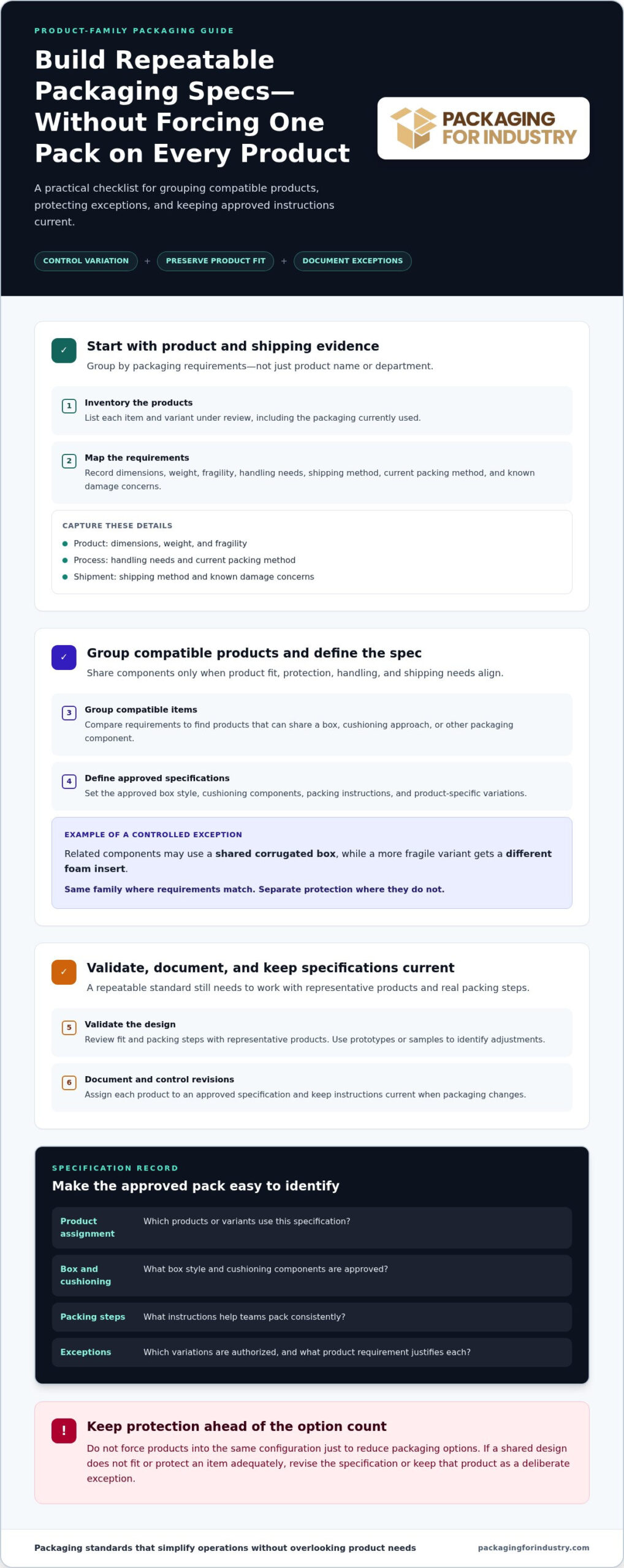
- Inventory the products. List each item and variant under review, including the packaging currently used.
- Map requirements. Record product dimensions, weight, fragility, handling needs, shipping method, current packing method, and known damage concerns.
- Group compatible items. Compare requirements to identify products that can share a box, cushioning approach, or other packaging component.
- Define specifications. Set the approved box style, cushioning components, packing instructions, and any product-specific variations.
- Validate the design. Review fit and packing steps with representative products, then use prototypes or samples to identify needed adjustments.
- Document and control revisions. Assign each product to an approved specification and keep instructions current when packaging changes.
Product requirements should determine family groupings, not the desire to reduce the number of packaging options.
Map product and shipping requirements before selecting materials
Use current measurements and weights, and document how products are packed and shipped. Where available, review damage reports and recurring problems such as movement inside the box or difficult handling. Flag products that need distinct cushioning, a crate, or another protective approach. This gives the design process a practical basis and helps prevent a shared specification from overlooking a real protection need.
Create a specification matrix with controlled exceptions
A matrix makes similarities and differences visible at a glance. Put products or variants in rows and packaging decisions in columns. Record the approved box style, cushioning approach, packing instructions, and any authorized variation. For example, related components may use a shared corrugated box while a more fragile variant receives a different foam insert. Keep exceptions clear, purposeful, and tied to a specific product requirement.
PFI’s custom packaging design services can help translate these requirements into practical specifications through design support and prototypes. Consider the box and protective foam together rather than treating them as unrelated purchasing decisions. Once reviewed, the matrix can guide repeat ordering and consistent packing across shifts or locations.
For a family with several packaging configurations, a custom packaging quote can help define the requirements for a design review and packaging plan.
One Standard or Tiered Packaging: How to Compare Approaches
The right approach depends on how closely related products match in size, protection needs, packing steps, and shipping method. A universal pack simplifies the specification list, but it can create poor fit or excess cushioning when products differ. Product-specific packaging can address distinct needs, though it may add purchasing and stocking complexity. A tiered system sits between these options, standardizing shared components while preserving purposeful differences.
One universal pack: Fit may be acceptable for similar items but less precise across varied dimensions. Protection depends on the most demanding product in the group, and a broad solution may use more packaging than some items need. Purchasing is simple, though one box or cushioning configuration may not support consistent packing for every product.
Tiered family system: Fit and protection can be matched to a few groups of compatible products. Shared boxes or cushioning components can simplify purchasing, while defined variations keep packing instructions consistent within each tier. Inventory remains more manageable than with a separate specification for every item, provided the tiers reflect actual product needs.
Product-specific packaging: Each specification can be tailored to an individual product’s fit and protection requirements. This approach supports distinct needs, but increases the number of packaging items to purchase, store, and manage. Operational consistency depends on clear product-to-package instructions.
These are tradeoffs, not rankings. Packaging standardization for product families often works as a tiered system when products share some requirements but not all. The aim is to reduce unnecessary variation without compromising protection.
When can products share boxes or cushioning components?
Products may share a specification when their dimensions allow a suitable fit, their protection needs align, and staff can pack them using the same steps for similar shipping conditions. A controlled set of box sizes can accommodate related products when the fit remains appropriate. Corrugated boxes provide a basis for comparing shared and custom packaging options, including how the box works with cushioning.
Review corrugated box options as part of that assessment. The box and cushioning should be considered together, not selected as independent components.
When should a product keep its own packaging specification?
Keep a distinct specification when size, fragility, handling, or protection requirements differ enough that a shared pack could leave the product poorly supported or make packing instructions unclear. A product may call for a custom foam insert, while a larger or specialized item may need a crate. Foam-lined crates can combine cushioning with an enclosing structure, but the design should follow the item’s actual transit and handling needs. Avoid retaining exceptions without a clear reason, and don’t remove them simply to make the specification list shorter.
How to Implement and Maintain a Standardized Packaging System
A specification only improves operations if teams can use it consistently and keep it current. Pilot the selected packaging with representative products before expanding it across the family. Use the pilot to check product fit, protective performance, packing steps, and whether the approved materials work within the actual warehouse process. Resolve issues before replacing packaging across multiple products or locations.
Roll out packaging changes without losing process control
Bring procurement, production, warehouse, and operations teams into the change process. Each group sees different risks: purchasing needs clear approved items, production needs packaging aligned with schedules, and packers need instructions they can follow. Review existing packaging inventory and plan how it will be used during the transition so old and new specifications don’t create confusion or unnecessary disruption.
Keep one controlled record for each product-family assignment. Document approved materials, packing instructions, revision dates, and the products covered. If a box or cushioning component changes, update the record and communicate the revision to the people who order and pack it. Samples or prototypes can help teams assess fit and workflow before a wider rollout.
Keep standardized packaging available for recurring demand
Review packaging usage alongside storage constraints, production schedules, and replenishment needs. A specification that works technically still needs a practical stocking plan. Track damage patterns and recurring supply issues, as well as changes to products, packing steps, or shipping methods. These signals can indicate that a specification needs review or that a product should move to a different packaging tier.
Vendor managed inventory (VMI) can support recurring packaging demand through scheduled reviews and replenishment based on actual usage. PFI’s VMI review cycles can be weekly, biweekly, or monthly, helping align packaging inventory planning with observed consumption. Learn more about vendor managed inventory for packaging.
Consistent specifications can make it easier to plan repeat orders and organize packaging stock, but they don’t guarantee a particular cost reduction or supply outcome. Maintain the system by reviewing usage, product changes, damage feedback, and replenishment performance. Revise documentation when the evidence calls for it.
To discuss packaging specifications and replenishment for your product family, request a packaging quote.
How PFI Supports Product-Family Packaging Standardization
Packaging For Industry (PFI) helps manufacturers turn product-family requirements into repeatable packaging specifications. Its custom and stock industrial packaging includes corrugated boxes, protective foam, and crates, which can be considered together to support fit, protection, and efficient packing. PFI serves businesses in aerospace, electronics, medical device manufacturing, food and beverage, and other industrial sectors, where product dimensions, handling, and shipping needs can vary.
Design support, CAD/CAM support, prototypes, samples, and packaging reviews help teams evaluate practical options before broader use. Packaging kitting can support consistent assembly of approved components. This combination of products and services helps purchasing and operations teams simplify specifications while retaining needed product-specific exceptions.
What to include in a packaging quote request
Prepare product dimensions and weights, family variants, shipping methods, and details about current packaging. Share known damage concerns, recurring order needs, storage constraints, and lead-time challenges. Include products that may share packaging components and identify items that need distinct protection. These details help PFI evaluate a practical packaging approach for your operation.
Move from packaging review to a repeatable supply plan
Document the agreed specifications and assign each product to the right family or exception. For recurring packaging demand, consider stocking or replenishment support alongside the design. PFI’s vendor managed inventory programs use scheduled reviews and replenishment based on actual usage, with review cycles available weekly, biweekly, or monthly. This connects packaging choices with ongoing purchasing and inventory planning.
With packaging design support and recurring inventory programs, PFI helps industrial buyers work toward consistent packing and dependable supply without compromising product protection. Learn more about custom packaging design services.
Build a Packaging System That Works Across Your Product Family
Effective packaging standardization for product families isn’t about making every shipment identical. It’s about setting repeatable specifications for products with compatible requirements and keeping clear exceptions where fit, handling, or protection calls for a different solution. That balance can help simplify purchasing and packing without compromising product protection.
Start with actual product and shipping needs, then pilot the specifications, document packing instructions, and review them as products or damage patterns change. Connect approved designs to repeat ordering and inventory planning so packaging remains practical for both the warehouse and procurement team.
PFI supports this work with custom and stock corrugated boxes, foam packaging, and crates, considered together where appropriate. Design support, prototypes, packaging reviews, and recurring inventory programs help translate product-family requirements into a workable supply plan.
A manageable specification system can make day-to-day packaging decisions clearer while preserving the flexibility your products need. For custom and stock packaging, design support, or recurring supply, request a packaging quote from PFI.
Frequently Asked Questions
How do you standardize packaging for products with different sizes?
Group products by packaging requirements, then create a limited set of specifications that covers compatible items. Compare dimensions, weight, fragility, handling needs, and shipping methods. Products may share a box style while using different cushioning, or use controlled box-size variations within the family. Keep separate specifications for items that need distinct protection. This approach to packaging standardization for product families reduces unnecessary variation without forcing a poor fit.
Should every product in a family use the same box?
No. A shared box makes sense only when it fits the products and supports their protection and packing needs. A universal box may simplify purchasing, but it can leave some items with excess space or insufficient support. A tiered system can use common box specifications for compatible products while allowing different sizes or cushioning for other variants. Keep product-specific packaging where requirements genuinely differ.
Can standardized packaging still protect fragile products?
Yes. Standardizing doesn’t mean using identical cushioning for every item. Fragile products can have an approved protective configuration, such as a custom foam insert paired with a shared corrugated box. Test the packaging with representative products and review packing feedback and damage concerns. If the shared design doesn’t provide suitable support, retain a distinct specification. Product protection should guide the standard, not be sacrificed for fewer packaging options.
What information is needed to create a packaging specification?
Gather each product’s dimensions, weight, fragility, handling requirements, and shipping method. Record its current box and cushioning, packing steps, and known damage concerns. Include variants in the product family and note any special protection needs, such as foam inserts or a crate. Storage constraints and recurring order patterns also help connect the packaging design to purchasing and inventory planning.
How can packaging standardization reduce purchasing complexity?
Approved specifications give purchasing teams a defined set of packaging items to order instead of requiring a new choice for every product or shipment. Grouping compatible products can reduce duplicate box and cushioning variations, clarify repeat orders, and make stock easier to organize. Documented exceptions keep specialized needs visible. The goal is a manageable specification set that supports consistent purchasing while retaining packaging that fits and protects each product.
Can a packaging supplier help design packaging for a product family?
Yes. Packaging For Industry can review product-family requirements and consider custom or stock corrugated boxes, foam packaging, and crates together. Design support, prototypes, samples, and packaging reviews can help assess fit and packing steps before wider use. PFI serves industrial businesses in Orange County, Los Angeles, San Diego, and Riverside, helping buyers align packaging choices with product protection and recurring supply needs.
How do you manage packaging inventory after standardizing specifications?
Track usage, production schedules, storage capacity, and changes to products or packaging. Review damage patterns and supply issues so specifications and stocking plans remain appropriate as needs change. For recurring demand, vendor managed inventory can support scheduled reviews and replenishment based on actual usage. PFI offers weekly, biweekly, or monthly review cycles, helping businesses plan packaging supply around observed consumption rather than assumptions.