
What if the strongest box isn’t the best fit for your shipment? A triple wall corrugated box supplier Anaheim businesses can rely on should match box construction to product weight, dimensions, handling, and shipping method, not simply recommend the heaviest option. When standard cartons fall short, the wrong specification can add bulk without addressing the actual protection problem.
Extra durability may be worth evaluating when damage, difficult handling, or recurring supply problems disrupt operations. This guide explains how to assess triple-wall corrugated packaging for your products and shipping conditions, and how to prepare clear specifications for comparing options and requesting a quote.
You’ll learn which details to provide about dimensions, weight, stacking, and handling, and how to consider the complete packaging setup, including foam or crates where appropriate. Packaging For Industry is headquartered in Anaheim and supplies custom and stock corrugated boxes, packaging design support, and recurring supply programs. Use this guide to evaluate supplier capabilities, custom sizing, bulk quantities, and local purchasing needs for ongoing operations.
Key Takeaways
- Assess product weight, dimensions, fragility, and shipping conditions to determine whether triple-wall protection fits the application.
- Prepare a quote-ready specification covering the product, packing process, handling, and replenishment needs.
- Compare triple-wall and double-wall options based on operating requirements, not board weight alone.
- Evaluate what a triple wall corrugated box supplier Anaheim businesses choose should support, from custom design to repeat orders.
- Consider how packaging reviews, samples, and coordinated protective materials can help refine your box choice before ordering.
When Does a Triple Wall Corrugated Box Make Sense for Anaheim Shipments?
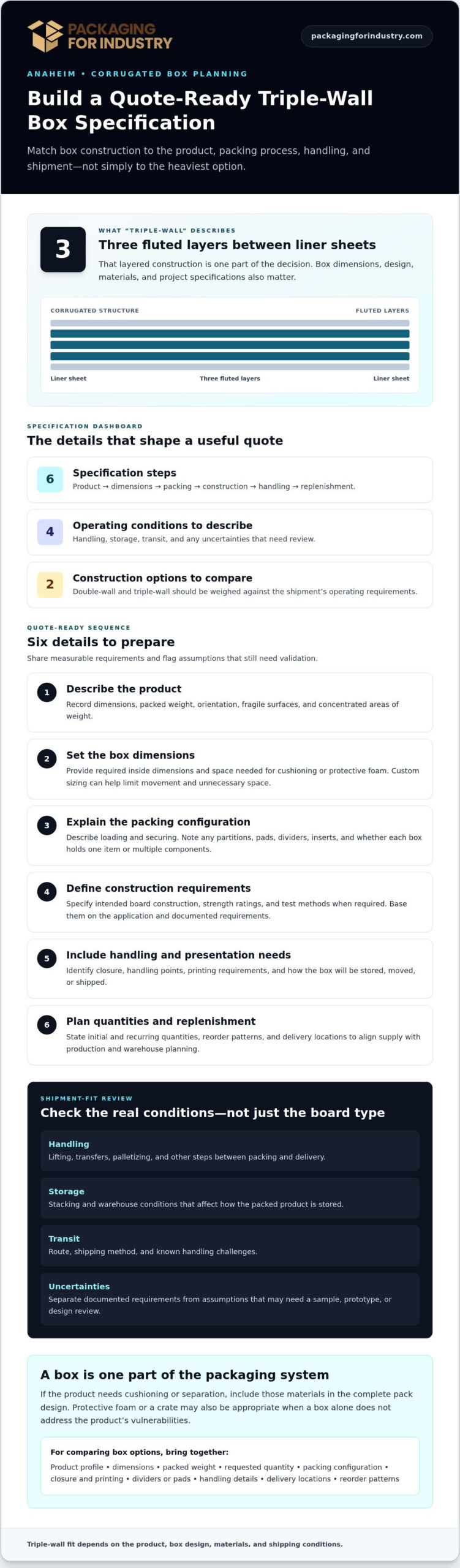
Triple-wall corrugated packaging has three fluted layers between liner sheets, creating a multi-layer structure compared with single-wall and double-wall options. For a plain-language overview of the material, see Corrugated fiberboard. More layers alone don’t determine how a finished box will perform. Box dimensions, design, materials, and project specifications matter, so assess the shipment rather than assuming every triple-wall box provides the same protection.
Evaluate triple-wall packaging when a product’s weight, fragility, size, or handling requirements make lighter cartons a concern. Consider how the box will be packed, moved, stored, and shipped. A bulky package stored in a warehouse has different demands from a compact component packed for a short route. A packaging review can help determine whether triple-wall construction is suitable or whether another protective setup better fits the job.
Which products and shipments may need triple-wall packaging?
Heavy or high-value industrial components are useful applications to assess, but they aren’t automatic candidates. A manufacturer shipping machinery parts may need to account for concentrated weight or surfaces that can be damaged by movement. An aerospace packaging team may handle components that need stable positioning through multiple transfers. Distribution operations should consider pallet storage, repeated handling, and the route from warehouse to recipient.
In Anaheim and Orange County, shipments may move between manufacturing sites, distribution facilities, and destinations across Los Angeles, San Diego, Riverside, and beyond. Consider how the product may encounter pressure, movement, stacking, or rough handling along its actual route. Protective foam or a crate may also be part of the packaging system when a box alone doesn’t address the product’s vulnerabilities.
What information helps determine box fit?
Start with measurable details, then identify what still needs review. Share the product’s dimensions, packed weight, intended orientation, and fragile areas. Describe protrusions, sensitive surfaces, or sections that need individual support. Include the packing workflow so the proposed design works for the team preparing shipments as well as for the product being protected.
- Handling: Note lifting, transfers, palletizing, and other steps between packing and delivery.
- Storage: Describe stacking and warehouse conditions that affect how the packed product is stored.
- Transit: Outline the route and shipping method, including known handling challenges.
- Uncertainties: Separate documented requirements from assumptions that need a sample, prototype, or design review.
This information gives a triple wall corrugated box supplier Anaheim buyers consult a practical basis for sizing and design discussions. Packaging For Industry supports Anaheim businesses with custom packaging design, samples, and reviews. See our Anaheim packaging services to learn about local support.
How to Specify Triple Wall Corrugated Boxes for Your Product
A useful box specification does more than name a construction type. It gives a supplier the information needed to design around the product, packing process, shipment, and repeat-order needs. Follow this sequence to prepare a clear corrugated box quote:
- Describe the product. Record its dimensions, packed weight, orientation, and any fragile surfaces or concentrated areas of weight.
- Set the box dimensions. Provide the required inside dimensions and note how much space is needed for cushioning or protective foam. Custom sizing can help limit movement and avoid unnecessary space and material.
- Explain the packing configuration. Describe how the product is loaded and secured. Note whether it needs partitions, pads, dividers, or inserts, and whether workers pack one item or multiple components in each box.
- Define construction requirements. Specify the intended board construction, strength ratings, and test methods when your project requires them. Match these details to the application and documented requirements, not assumptions or a general preference for the heaviest box.
- Include handling and presentation needs. Identify the closure, handling points, printing requirements, and how the box will be stored, moved, or shipped.
- Plan quantities and replenishment. State initial and recurring quantities, reorder patterns, and delivery locations. This helps align bulk packaging needs with production and warehouse planning.
Custom dimensions and internal protection can affect product fit, material use, and packing efficiency. Explore PFI’s custom corrugated box options alongside triple-wall designs. If the product needs cushioning or separation, include those materials in the complete pack design rather than treating the outer box as the only decision.
What should a corrugated box quote include?
For a useful quote, bring together the product profile, dimensions, packed weight, requested quantity, and packing configuration. Add details about closure, printing, dividers, pads, and how the shipment will be handled. Include delivery locations and expected reorder patterns, too. A triple wall corrugated box supplier Anaheim buyers consider can use this information to discuss a design that fits the product and ongoing supply requirements.
When should a design review or prototype be considered?
Request a design review when fit is uncertain, damage history points to a protection gap, or the packing workflow is difficult to repeat consistently. Packaging For Industry supports packaging design with CAD/CAM, prototypes and samples, and packaging reviews. These steps help evaluate the proposed configuration against the project’s requirements before routine purchasing. Request a packaging quote with your product and replenishment details.
Is Triple Wall Better Than Double Wall for Every Shipment?
No. Triple-wall construction adds corrugated layers compared with double-wall boxes, but more material isn’t automatically a better operational fit. A box should protect the product through its actual handling and storage conditions while supporting an efficient packing process. Compare candidate designs using the same product, route, packing configuration, and handling assumptions. This makes the trade-offs clearer than choosing by wall count alone.
Use these factors to guide the comparison:
- Protection needs: Consider the product’s fragility, value, shape, and vulnerability to movement or contact. Match the box and internal protection to the risks identified for the shipment.
- Product characteristics: Review dimensions, packed weight, weight distribution, and whether the item has sensitive areas that need support or separation.
- Handling and storage: Account for transfers, palletizing, stacking, warehouse storage, and the shipment route. A box that works for one packing and transit process may not suit another.
- Operating fit: Consider how quickly and consistently staff can pack the product, how the box uses storage space, and whether the design supports repeat orders.
Damage history can help show where protection is falling short. Review whether incidents involve crushing, shifting, exposed edges, or handling, then assess the complete package instead of assuming a heavier board will address the cause. Consider whether the added board is proportionate to the product and route. A project-specific design review can clarify specifications when the available information is incomplete.
How should buyers compare triple-wall and double-wall boxes?
Compare both options under consistent conditions: the same product, pack-out, shipping route, and handling steps. Include current damage patterns and the labor involved in packing, not just the box construction. Packaging For Industry’s design support can help review the application. A triple wall corrugated box supplier Anaheim businesses work with should assess the full packaging need rather than treat wall count as the only decision.
When could integrated protection improve the packaging system?
Internal protection can address movement and contact that the outer box alone may not resolve. Foam inserts can hold an item in position, while pads, partitions, and dividers can separate components or create support points. Explore custom foam packaging for products that need shaped cushioning or defined placement. For applications that call for another packaging format, consider crates separately from corrugated boxes. The right combination depends on product geometry, packing workflow, and shipping conditions.
How to Compare an Anaheim Triple Wall Box Supplier and Prepare a Quote
A supplier should help connect box design to the product and purchasing process, not just provide a board option. When evaluating a triple wall corrugated box supplier Anaheim businesses can work with, compare practical capabilities and communication alongside the quote. Clear specifications make it easier to assess fit, plan repeat orders, and avoid decisions based on assumptions.
What makes a supplier a fit for industrial purchasing?
Use this checklist to compare supplier capabilities with your operation:
- Custom design: Can the supplier tailor box dimensions and design around your product, packing workflow, and shipping method?
- Relevant product range: Can corrugated boxes be considered alongside foam or crates when the application calls for coordinated protection?
- Order planning: Can the supplier support your purchase quantities and discuss a repeat-order approach that fits production or warehouse demand?
- Specification clarity: Are construction and other project requirements documented clearly enough for purchasing and operations teams?
- Communication and delivery planning: Does the discussion account for your delivery locations and timing needs without treating every order as identical?
Packaging For Industry serves Anaheim, Orange County, Los Angeles, San Diego, Riverside, and surrounding Southern California areas. Local next-day delivery is available throughout Southern California, and PFI supports nationwide packaging needs. Review the Anaheim packaging supplier service area as part of your local purchasing plan.
What should Anaheim buyers include in a quote request?
Give the supplier enough detail to prepare a useful quote and discuss the application. Include the product description, dimensions, packed weight, order quantity, and shipping destination. Describe how the product is packed and handled, along with any damage concerns, printing needs, or protective materials used with the box.
For recurring demand, share typical reorder patterns and production or warehouse requirements that affect replenishment. Separate firm requirements from estimates, especially for dimensions, quantities, and timing. If delivery dates matter, state the target and destination so project logistics can be considered.
A complete request connects packaging design to purchasing and supply planning. PFI supplies custom and stock corrugated boxes, provides packaging design, and supports recurring supply through vendor managed inventory and just-in-time programs. These capabilities can help businesses organize packaging around actual operations and plan replenishment more reliably.
Why Work with PFI for Triple Wall Corrugated Boxes in Anaheim?
Packaging For Industry is an Anaheim-based industrial packaging supplier serving businesses across Southern California. PFI supplies custom and stock corrugated boxes, including triple-wall options, for manufacturers, aerospace and aviation companies, machinery businesses, and warehouse and distribution operations. These industries have different product dimensions, packing workflows, and shipping requirements, so packaging should reflect the application rather than rely on a one-size-fits-all approach.
PFI can coordinate corrugated boxes with foam or crates when the product and shipping process call for additional protection. Custom packaging design support helps align packaging with product fit, handling, and operational needs. CAD/CAM design, prototypes, samples, and packaging reviews give teams practical ways to assess a proposed configuration before wider use. This supports cost-conscious design and damage-reduction planning while keeping the solution specific to the shipment.
How can PFI support a custom packaging requirement?
PFI can review a box alongside internal cushioning or a crate format where appropriate. Prototypes and samples let teams assess product fit and packing steps before adopting a design more broadly. Packaging reviews can help identify areas to refine, such as product movement or the packing workflow, with design decisions tied to the actual application.
How can repeat supply be managed after the design is set?
For recurring packaging needs, planned replenishment can help align supply with production and warehouse demand. PFI offers vendor managed inventory and just-in-time inventory management programs for businesses with recurring purchasing needs. These programs support inventory planning and supplier coordination.
PFI serves Southern California, with local next-day delivery available throughout the region, and supports nationwide packaging needs. Include the destination and required delivery window in your planning.
Choose the Right Box and Plan Your Next Order
The right triple-wall box starts with the shipment, not a default preference for heavier packaging. Match the design to product dimensions, weight, handling, storage, and transit, then compare it with double-wall options under the same conditions. Clear specifications and a review of the packing process help you make a proportionate choice and prepare a more useful quote request.
For buyers evaluating a triple wall corrugated box supplier Anaheim can support, Packaging For Industry is headquartered in Anaheim and serves businesses across Southern California. PFI supplies custom and stock corrugated boxes, including triple-wall boxes, with packaging design support, prototypes, samples, and reviews. For recurring demand, vendor managed inventory and just-in-time programs support planned replenishment.
Bring your product details, packing requirements, quantity, and delivery needs. A well-specified packaging plan can help your team protect shipments and manage supply with greater confidence.
Frequently Asked Questions
When should a business use a triple-wall corrugated box?
Consider triple-wall packaging when a product’s weight, fragility, dimensions, or shipping conditions make lighter cartons unsuitable for the application. Heavy machinery components, awkwardly shaped parts, or products that face repeated handling may need a more tailored protective design. The box still needs to match the shipment. Review storage, transit, packing methods, and internal cushioning rather than assuming triple-wall construction is right for every heavy or valuable item.
Is a triple-wall box stronger than a double-wall box?
Triple-wall boxes have more corrugated layers than double-wall boxes, but that alone doesn’t establish how a finished box will perform. Design, dimensions, materials, and project specifications all affect the packaging decision. Compare both options for the same product, packing configuration, route, and handling conditions. Consider damage history and storage needs, too. A project-specific design review can help determine whether triple-wall construction is appropriate or whether double-wall packaging meets the application.
Can triple-wall corrugated boxes be made to custom dimensions?
Yes. Custom corrugated boxes can be designed around a product’s dimensions and packing configuration. Share the required inside measurements and describe any space needed for foam, pads, partitions, or other protective materials. A close fit can help manage product movement and make packing more consistent. Packaging For Industry supplies custom and stock corrugated boxes, with packaging design support, prototypes, and samples to help assess fit before broader use.
What information should I provide for a triple-wall box quote in Anaheim?
Include the product description, dimensions, packed weight, requested quantity, and delivery destination. Explain how the item is packed, handled, stored, and shipped. Note any fragile areas, damage concerns, printing needs, or inserts and dividers required. For recurring orders, share expected usage and reorder patterns. These details help a triple wall corrugated box supplier Anaheim buyers work with understand the application and prepare a useful quote and supply plan.
Can triple-wall boxes replace wooden crates?
Not in every application. Corrugated boxes and wooden crates are different packaging formats, and the right choice depends on the product, protection needs, handling, storage, and shipping method. A triple-wall box may suit some industrial shipments, while a crate may fit applications that call for a different structure. Compare complete packaging designs, including internal foam or other protective materials, rather than assuming one format replaces the other in every case.
Does PFI provide triple-wall corrugated boxes near Anaheim?
Yes. Packaging For Industry is headquartered in Anaheim and supplies custom and stock corrugated boxes, including triple-wall boxes, to businesses in Southern California and nationwide. Local next-day delivery is available throughout Southern California. For a quote, provide the box requirements, quantity, destination, and project timing needs so the request reflects your purchasing and shipping plans.
Can a supplier coordinate triple-wall boxes with foam inserts?
Yes. Packaging For Industry supplies corrugated boxes and foam packaging, including custom die-cut foam. Coordinating the box with foam inserts, pads, or other internal components can help position a product and address specific contact or movement concerns. Share the product shape, fragile areas, packing workflow, and shipping conditions during design discussions. Prototypes, samples, and packaging reviews can help assess the proposed fit and configuration before regular purchasing.