
More cushioning isn’t always the answer to transit damage. Effective shock and vibration resistant packaging depends on how the product, inner protection, outer container, and shipping journey work together. A package that performs well in palletized freight may need a different design for parcel handling or repeated transfers.
If products still arrive damaged despite existing packaging, look beyond material choice alone. Poor fit, product movement, shipment conditions, and oversized packaging can all affect protection and freight efficiency. The right design balances cushioning and restraint with practical dimensions, handling needs, and repeat supply.
This guide compares foam, corrugated, and crate-based approaches, including how they can be combined for industrial shipments. You’ll also learn which product, shipment, and design details to gather for a clear packaging quote. PFI supports custom packaging design with prototypes and samples, helping manufacturers evaluate fit before a broader rollout. Use the guidance to identify a fit-for-purpose solution that can reduce shipping damage without adding unnecessary packaging or handling burden.
Key Takeaways
- Match protection to the product, packaging structure, and actual shipping journey rather than choosing cushioning in isolation.
- Compare foam inserts, corrugated structures, and crate-based options by fit, cushioning, restraint, and handling needs.
- More material alone doesn’t ensure better protection; balance product movement with package dimensions and transit conditions.
- Use a clear design review to define product requirements, describe transit, compare concepts, and plan repeat supply.
- Explore how shock and vibration resistant packaging can combine foam, corrugated, and crates, with prototypes and samples to evaluate fit.
What Shock and Vibration Resistant Packaging Must Protect
Shock is a sudden impact, such as a package being dropped or struck during handling. Vibration is repeated movement during transit that can make a product shift, rub against its packaging, or experience repeated stress. Shock and vibration resistant packaging is a packaging system designed to cushion and restrain a product against impact and repeated movement during its expected shipping journey. That definition describes a design goal, not a universal protection level.
Protection depends on three connected factors: the product’s vulnerabilities, how the packaging supports and contains it, and the route it travels. The outer container, internal fit, handling steps, and shipment method all influence what the package needs to do. PFI supplies industrial packaging for aerospace, electronics, medical devices, machinery, and manufacturing, where product requirements and shipping conditions can vary significantly. For operations in Orange County, Los Angeles, San Diego, and Riverside, a packaging review can account for both the product and the way it moves through the supply chain.
Which products and shipping risks call for added protection?
Electronics may have delicate components or sensitive surfaces. Medical devices can include parts that must stay positioned and free from contact damage. Aerospace parts may combine precision features with surfaces that need protection. Machinery presents a different challenge: a heavy product may need cushioning against impact as well as firm restraint to limit movement inside its package.
Recurring damage patterns can help pinpoint where packaging needs review. Note whether damage tends to appear on the same edge, surface, or component, or whether products arrive shifted, scuffed, or loose. These observations give packaging designers practical clues about where support, cushioning, or restraint may need to change. Photos of damaged items and the packaging as received can make those patterns easier to explain during a design review.
What should buyers document before comparing options?
Start with the product itself. Record its dimensions and weight, required orientation, sensitive surfaces, fragile features, and any parts that must not move or bear pressure. Note how the item is packed today and describe the damage or handling concerns that prompted a review. These details give a custom packaging supplier a clearer basis for comparing concepts.
Then describe the journey: shipment method, carrier or freight handling, transfers between vehicles or facilities, and known damage points when available. A route involving parcel handling may place different demands on a package than a planned freight shipment. For background on mechanical shock, see the linked overview; packaging decisions still need to reflect the specific product and transit conditions.
These details also help buyers assess whether custom foam packaging could support the product as part of a broader package design. Use documented product and shipment details as the starting point for a packaging review and quote. If the package is used repeatedly, include the order frequency and typical quantities so the design can work with ongoing purchasing needs.
Compare Foam, Corrugated, and Crate-Based Protection
Choosing shock and vibration resistant packaging means evaluating how each component supports the product and the shipment. Foam can cushion and position an item, corrugated can provide an outer structure, and crates can serve as a more substantial outer package. The right configuration depends on product fit, handling, and the protection the application calls for. Compare how the parts work together rather than treating one material as a complete solution.
| Approach | Product fit and cushioning | Restraint and outer protection | Useful context |
|---|---|---|---|
| Foam inserts | Shaped inserts or end caps can support the product and separate sensitive areas. | Can help limit movement inside a separate box or crate; the outer package provides the external structure. | Consider for products with delicate features, specific contact points, or a need for a close-fitting interior. |
| Corrugated structures | Can be designed around the product and paired with cushioning where needed. | Forms an outer container; internal components can help position the load. | Consider for boxed shipments where the package needs a defined structure suited to the handling context. |
| Foam-lined crate or combined system | Foam can fit around the item while other components support its position. | A crate provides the outer structure, with foam and corrugated components coordinated inside as needed. | Consider for heavy, high-value, or awkwardly shaped industrial items that call for a coordinated design. |
When can custom foam inserts improve product fit?
Custom foam inserts can create shaped contact points that position a product, while cutouts can keep sensitive components apart. End caps may support selected areas without filling the entire package. Polyethylene and polyurethane are both foam options, but the choice should follow the application rather than an assumed universal advantage. During a design review, compare how the proposed contact points align with the product’s weight, shape, and vulnerable areas. A prototype or sample lets the team assess fit, access, and handling before a broader rollout. PFI’s protective foam packaging can be considered as part of a coordinated design.
When should packaging add corrugated or a crate?
Internal cushioning doesn’t replace an outer package. Corrugated boxes provide a structured container around the protected product; a crate may suit a shipment that needs a more substantial outer structure. For a heavy or irregular item, the design may combine a crate with foam to cushion and restrain the product. For a boxed configuration, custom corrugated and foam components can work together. When comparing options, consider how each component contributes to product fit, movement control, and handling, not which material is “best” in isolation.
For a project-specific comparison of foam, corrugated, and crate components, request a packaging quote with the product and shipment details.
Does More Cushioning Always Mean Better Protection?
No. Adding cushioning material alone doesn’t establish that a package is suitable. Protection depends on a coordinated package design, not simply cushion quantity. The insert must fit the product, support the right areas, and work with the outer package and handling conditions. Too little restraint can leave an item shifting; adding material without addressing that movement may make the package larger without solving the underlying problem.
How can poor fit undermine a protective package?
Excess space inside a box can let a product move during transit, leading to contact with the package or other components. An insert that doesn’t match the product’s shape can also leave critical areas unsupported or apply contact where it isn’t appropriate. For example, a sensitive surface may need separation from adjacent parts, while a heavier component may need stable support that limits shifting.
Review the insert’s contact points and positioning alongside the product’s fragile features. If damage appears repeatedly in the same area, compare that evidence with how the product sits in the package. Check whether the item is centered as intended, whether components can touch each other, and whether any contact point presses on a sensitive surface. A packaging review should look at fit and damage patterns together rather than simply adding more cushioning or switching materials without a clear reason.
How do shipping dimensions and operations affect the decision?
Protection is only one part of the package decision. Consider outer dimensions, pallet configuration, warehouse handling, and shipment method as a connected set. A package that works for an individual shipment may create different storage or handling demands when it’s staged or palletized for distribution. Avoidable bulk can also complicate freight planning, so the goal is a practical design that supports both the product and the operation.
For packaging for warehouses or distribution centers, review how the package is stored, moved, stacked, and prepared for shipment. These details can reveal whether the issue lies in the internal fit, the outer structure, or the package dimensions. PFI’s packaging cost analysis helps buyers assess the complete design with protection and operating needs in view.
For a project-specific review, share product details, current package dimensions, shipment methods, and any recurring damage evidence when you request a packaging quote. That context helps shape shock and vibration resistant packaging around the application instead of relying on a general assumption that more material means more protection.
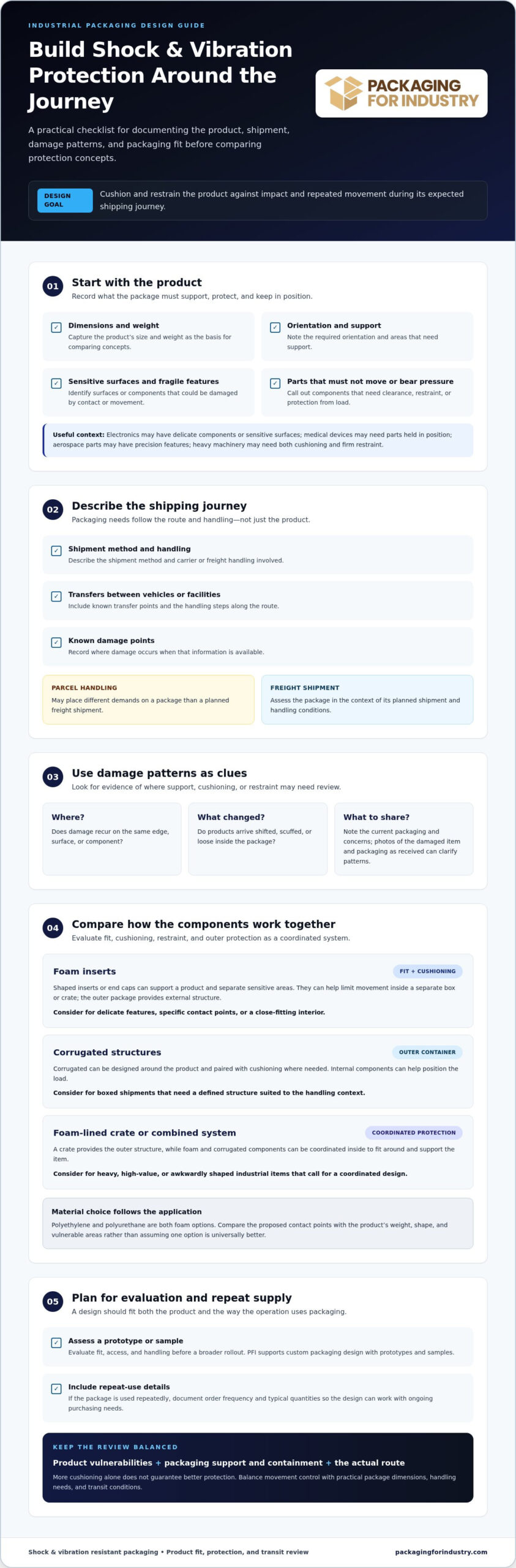
How to Evaluate a Shock and Vibration Packaging Design
A useful review compares how the complete package addresses the product and its shipping journey. For shock and vibration resistant packaging, look for a clear design rationale: what each component does, how it supports the product, and how the proposed configuration fits your operation. Broad labels alone don’t explain whether a concept suits your shipment.
Use this process to organize the evaluation:
- 1. Define product needs. Document dimensions, weight, orientation, sensitive surfaces, fragile features, and any areas that should not bear pressure.
- 2. Describe transit. Note the shipment method, handling steps, route details that affect packaging, and any recurring damage or known trouble spots.
- 3. Compare concepts. Review the role of each component, including how it positions the product, provides cushioning, forms the outer protection, or supports handling.
- 4. Review fit. Use a prototype or sample to assess product contact, movement, and how the package is assembled and opened by the team.
- 5. Plan supply. Clarify expected order frequency, required quantities, custom-size needs, and any operational constraints that affect repeat supply.
What belongs in a packaging quote request?
Share product dimensions and weight, plus drawings or photos if available. Identify fragile areas, sensitive surfaces, current packaging, and the damage or handling issue prompting a review. Describe shipment methods and relevant route or carrier handling, along with recurring order needs and any constraints for storage, packing, or unpacking.
Be specific about whether you need custom sizes, bulk quantities, or a repeat supply plan. Clear inputs help PFI develop a more useful custom packaging quote and make it easier to compare packaging pricing based on the intended design rather than an incomplete description. If you already use multiple packaging components, list them together so the design can account for the full package.
How should teams compare proposed packaging concepts?
Ask what each component is intended to do. Does it hold the product in position, cushion a vulnerable area, protect the outside of the package, or make handling more practical? Then review the prototype with the people who pack and unpack the product. Check that the product sits in the intended orientation, that the package can be assembled consistently, and that the packing steps fit your workflow. PFI’s custom packaging design support can help translate product and shipment requirements into a tailored concept, with prototypes and samples available to evaluate fit before a broader rollout.
Bring the product details, shipping context, current package information, and repeat-supply needs together to start a focused review.
Build an Integrated Protection and Supply Plan with PFI
A well-planned packaging system connects product protection with the way teams pack, store, and ship. PFI can combine corrugated boxes, foam, cushioning materials, and custom crates into a design tailored to the product and transit requirements. This approach supports packaging for manufacturers as well as packaging for warehouses and distribution centers, where fit, handling, and recurring supply all matter.
How can one packaging system support protection and operations?
Each component should have a clear role. An insert can position the product, cushioning can support vulnerable areas, and an outer box or crate can contain the shipment. Depending on the application, a coordinated design may combine these elements. Explore PFI’s foam packaging options as one component of an integrated approach.
Protection also needs to work on the warehouse floor. Review how easily employees can pack and unpack the product, how consistently the package can be assembled, and how its components will be stored. For Southern California operations in Orange County, Los Angeles, San Diego, and Riverside, local packaging delivery can be part of a plan for recurring supply. PFI also offers stocking programs to help businesses manage packaging they use regularly.
What is the next step for a tailored packaging solution?
Prepare product dimensions and weight, drawings or photos, orientation, fragile areas, current packaging, shipment method, known damage patterns, and packing or storage constraints. Include expected order frequency and whether you need custom sizes, bulk quantities, or repeat supply. These details help PFI tailor a packaging design to the project requirements.
Custom packaging design support, including prototypes and samples, gives your team a practical way to evaluate product fit and packing steps before a broader rollout. Review the sample with the people who handle the package, note adjustments, and use that feedback to refine the design.
Put Your Packaging Requirements to Work
Effective shock and vibration resistant packaging is designed around the product and its actual shipping journey, not a general promise or a larger amount of cushioning. Foam inserts, corrugated boxes, and crates each play different roles, and a coordinated design can combine them where the application calls for it.
Before comparing options, document product dimensions, weight, fragile areas, shipment method, handling concerns, and repeat supply needs. PFI’s custom packaging design support, prototypes, and samples help teams evaluate product fit and packing steps before a broader rollout. This practical review can help you choose packaging that supports both protection and day-to-day operations.
Share your product, shipment, and packaging requirements to start a project-specific review.
With clear requirements and a design tailored to the application, your team can move forward with a packaging plan that accounts for product fit, shipping conditions, and the way your operation handles repeat orders.
Frequently Asked Questions
What is shock and vibration resistant packaging?
Shock and vibration resistant packaging is a package designed to cushion and restrain a product against sudden impacts and repeated movement during handling or transit. It may use internal foam or other cushioning, a corrugated box, a crate, or a combination of components. The right design depends on the product’s vulnerable areas and the shipment journey. It describes a design goal, not a universal level of protection.
How do I choose packaging for a fragile industrial product?
Start with the product and its shipping conditions, then evaluate how the package will position, cushion, and contain it. Record dimensions, weight, orientation, delicate features, and sensitive surfaces. Describe shipment method, handling steps, and any recurring damage. A small electronic assembly, for example, may need separated components and support at specific contact points. Prototypes and samples can help assess fit and packing steps before a wider rollout.
Is foam always the best choice for shock protection?
No. Foam can cushion and position a product, but it isn’t automatically the right choice for every application. A corrugated structure or crate may also be needed to provide an outer container, while the internal design controls product movement. Consider the product’s shape, weight, vulnerable areas, shipment method, and handling process together. The goal is a coordinated package that fits the job, not the greatest amount of one material.
Can corrugated boxes protect products from vibration during shipping?
Corrugated boxes can form the outer structure of a protective package, but the box alone may not keep a product from moving inside it. Internal foam, cushioning, or fitted inserts can support and separate the item as the application requires. A design review should consider the product’s fit, the box structure, shipment handling, and how the package will be palletized or moved through the warehouse.
What information should I provide for a custom packaging quote?
Provide product dimensions and weight, orientation, drawings or photos, fragile areas, and details about current packaging. Describe shipment method, known damage points, packing or storage constraints, and expected order frequency. Note whether you need custom sizes, bulk quantities, or repeat supply. Packaging For Industry serves industrial customers in Orange County, Los Angeles, San Diego, and Riverside, and uses project details to evaluate an appropriate packaging approach.
How can I reduce shipping damage without adding unnecessary packaging?
Review the product’s fit and damage evidence before adding material. Look for excess space, movement inside the package, unsupported contact points, or a mismatch between the package and the shipment method. Then compare how each component contributes to cushioning, restraint, and outer protection. Reviewing package dimensions and packing steps alongside protection needs can help avoid unnecessary bulk while keeping the design suited to the product and operation.
Can foam, corrugated packaging, and crates be combined in one design?
Yes. Foam can position and cushion a product, corrugated packaging can provide an outer box structure, and a crate can serve as the outer package where the shipment calls for one. A custom design can combine these components based on product fit, handling, and shipping requirements. Packaging For Industry provides design support, prototypes, and samples to help teams evaluate an integrated configuration before a broader rollout.