
The most protective package isn’t automatically the right choice for every shipment. With packaging for air freight vs sea freight, the right design depends on the product, route, handling conditions, and the space and weight the package adds to the shipment. A bulky design can increase air freight charges, while a package that’s too light for a longer sea journey may leave the product exposed to moisture, stacking pressure, and repeated handling.
It’s reasonable to expect packaging to change with the shipping mode, but mode alone shouldn’t drive the decision. Product fragility, shipment dimensions, and the journey’s specific risks matter just as much. The goal is to protect the product without adding unnecessary material or volume.
This guide compares air and sea freight packaging considerations so you can select a practical solution for your product and route. You’ll see how protection, dimensional charges, and packaging costs affect the choice, and what shipment details to gather for a useful packaging quote. Packaging For Industry (PFI) designs custom solutions that can combine corrugated boxes, foam, crates, and other materials around your product’s handling needs. PFI serves manufacturers and other businesses in Orange County, Los Angeles, San Diego, and Riverside.
Key Takeaways
- Build a shipment profile with product fragility, weight, dimensions, value, route, and handling conditions before specifying packaging.
- Use inner cushioning, outer cartons, and unit-load protection to address different risks instead of relying on one layer of packaging.
- Compare packaging for air freight vs sea freight by evaluating material use, package dimensions, protection needs, and route-specific freight rules together.
- Prepare clear shipment details to support a practical packaging quote tailored to the product and shipping plan.
- Consider how corrugated boxes, foam, crates, and other materials can work together in an integrated packaging solution.
Air vs. Sea Freight Packaging: What Changes for Shippers?
Shippers face the same core trade-off in either mode: protect the product while controlling shipment dimensions and packaging spend. The right packaging for air freight vs sea freight isn’t determined by the mode alone. It’s designed around the product, route, handling, and shipment plan, including how goods are consolidated and loaded.
Air freight can make package size especially important because carrier chargeable-weight rules may account for dimensions as well as actual weight. Sea freight planning often gives greater attention to the shipment’s configuration, load stability, and exposure over a longer journey. Neither mode automatically calls for heavier packaging. A compact, well-supported design may protect a product effectively, while a fragile or high-value item may need added cushioning regardless of how it travels.
Compare the shipment conditions before choosing materials:
- Air: Package dimensions, shipment weight, transfers, and the carrier’s current chargeable-weight rules.
- Sea: Transit duration, handling stages, moisture exposure, load configuration, and stacking conditions.
- Both: Product fragility, value, orientation needs, and the amount of movement the package must control.
How air freight changes the packaging decision
For air shipments, reducing unnecessary size can help manage the space a package occupies. That doesn’t mean removing cushioning or reducing structural support the product needs. Review whether the box has avoidable empty space, whether a custom insert can hold the item securely, and whether the outer package fits the shipment plan. Understanding Cargo in Air and Sea Freight provides context on air cargo unit loads and marine containers, which shape how freight is consolidated. Carrier rules vary by route and service, so verify the current dimensional and chargeable-weight requirements for the shipment before finalizing package dimensions.
How sea freight changes the packaging decision
Sea freight planning should account for the full route, expected handling stages, and how the shipment will be arranged with other freight. Longer transit may increase the time packaging is exposed to changing conditions, so consider moisture protection as part of the design rather than assuming a material will prevent exposure in every situation. Load stability also matters: a package that shifts or bears uneven pressure can put the product at risk. Depending on the item and shipment configuration, corrugated packaging may provide an outer structure, cushioning may limit movement, and a crate may support a larger or more vulnerable load. PFI’s custom packaging design support brings these components together around the product and route.
Transfers, handling practices, carrier requirements, and final load configuration can change the specification for either mode. Treat each route as a design input, not a reason to apply a fixed air or sea packaging formula. A packaging review should connect the product’s needs with the actual shipment path, then remove excess material or dimensions only where protection remains appropriate.
How Transit Conditions Shape Air and Sea Freight Packaging Design
A useful packaging design brief starts with the product, not a material choice. Record what the item is, how it can be handled, and what conditions it must withstand. Then connect those needs to the planned route and shipment configuration. This helps prevent two common problems: packaging that adds bulk without addressing a real risk, and packaging that leaves a product vulnerable during transit.
Capture these details before specifying materials:
- Product: Fragility, weight, dimensions, value, shape, and any surfaces or components that need special protection.
- Shipment: Air or sea route, transfer points, handling stages, shipment frequency, and how the load will be consolidated.
- Package goals: Required restraint, stacking considerations, practical outer dimensions, and ease of packing at the facility.
Each packaging layer has a distinct job. Inner cushioning absorbs or distributes impact around the product. Blocking and bracing limit movement inside the package. The outer container supports the packaged item through handling and loading. Unit-load protection, such as securing packages together on a pallet, addresses stability across the larger shipment. A design works best when these functions complement one another rather than relying on one layer to solve every problem.
Match cushioning and containment to product risk
A custom foam insert can hold a fragile instrument or high-value component in a defined position and separate it from other parts. The insert’s role is different from blocking or bracing, which restrains movement, and from the carton or crate, which forms the outer container. PFI supplies protective foam packaging as part of coordinated designs, with cushioning selected around the product’s shape and handling needs.
Design the outer package around the shipment
Corrugated boxes can suit products that need a structured outer package in a manageable format. Double-wall or triple-wall boxes may be considered for selected industrial applications, with the final choice based on the product and shipment requirements. A wood crate may be more appropriate for a large, heavy, unusually shaped, or shipment-specific load. Neither option is automatically right for air or sea freight.
Design the outer package for the way the shipment will be handled and configured. Consider where the package may be lifted, how it will be stacked, whether it needs to remain stable as part of a unit load, and how much space its dimensions occupy. A package that fits the product closely can help avoid wasted volume, but it still needs adequate structure and clearance for protective materials. For a complex or high-value shipment, PFI can develop packaging around the route and product, including a crate where the application calls for one.
Board strength, foam density, and crate construction should follow project-specific engineering rather than a generic air-versus-sea rule. Sharing product dimensions, weight, handling details, and route information helps PFI shape a practical design and prepare a packaging quote around the shipment’s actual needs.
Compare Total Packaging and Freight Impact, Not Weight Alone
A lighter package doesn’t automatically produce a lower total shipping cost. Freight charges depend on the carrier’s rules and shipment details, while packaging choices affect material use, dimensions, protection, and how efficiently goods fit into a load. Compare these factors together to understand the trade-offs for packaging for air freight vs sea freight.
Use the comparison below as a starting point, then verify route-specific carrier terms and shipment requirements before selecting a design.
| Consideration | Air freight | Sea freight |
|---|---|---|
| Package dimensions | May affect chargeable weight under the carrier’s rules. Verify for the route and service. | Can affect how packages fit into a pallet or container load. Confirm the planned configuration. |
| Package weight | Actual weight may be considered alongside dimensional weight. Verify current terms. | Weight matters to shipment planning and load configuration. Confirm applicable requirements. |
| Protection needs | Set cushioning and structure according to product risk and handling. | Account for the route, shipment arrangement, and expected handling conditions. |
| Design trade-off | Reduce unnecessary volume without removing needed protection. | Use space efficiently without compromising containment or stability. |
How package size and chargeable weight affect air freight
Some air carriers consider the space a package occupies as well as its scale weight. This is often described as dimensional or volumetric weight: a way of accounting for shipment volume when setting chargeable weight. The calculation and applicable thresholds depend on the carrier, service, and route, so don’t rely on a universal formula when comparing options.
Review each package’s outside dimensions, including cushioning and closures. If an outer carton contains avoidable empty space, a right-sized design may improve shipment efficiency. But removing protective material simply to reduce dimensions can expose the product to damage. Compare designs using the same product, quantity, protection assumptions, and route, then apply the carrier’s current terms to each scenario.
How load configuration affects sea freight
For sea freight, package footprint and orientation influence how cartons can be arranged on a pallet or within a container. Inconsistent dimensions may leave unusable gaps or make a stable load harder to build. Overly large cartons can also consume space without adding useful protection. Compare corrugated box options by fit, construction, and their role in the shipment, not weight alone.
For a fair comparison, keep the product quantity and protective requirements consistent across air and sea scenarios. Record package dimensions and weight, packaging materials, pallet or container arrangement, and route-specific carrier terms. This makes it easier to identify whether a cost difference comes from freight rules, package design, or the way the load is configured. To compare packaging pricing against your shipment details, request a packaging quote.
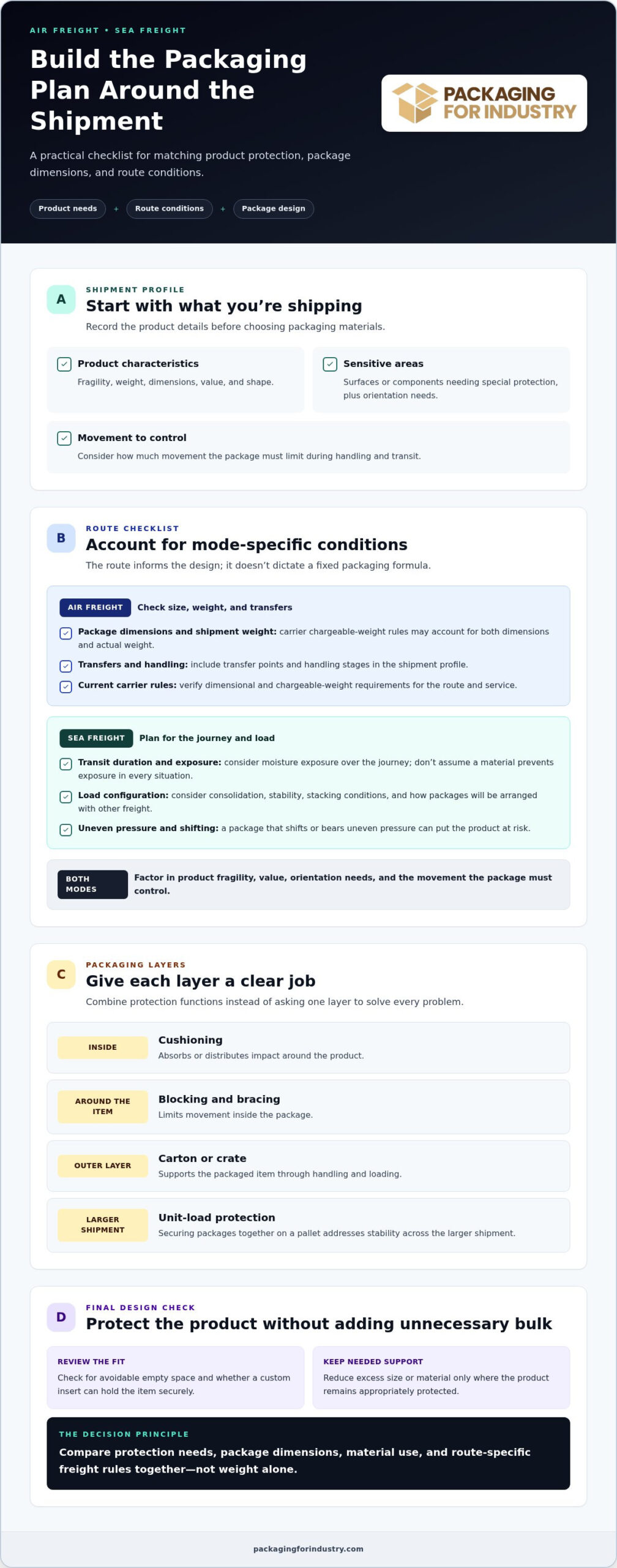
Choose Air or Sea Freight Packaging With a Shipment-Profile Checklist
A consistent shipment profile gives packaging decisions a practical starting point. Instead of choosing materials based on freight mode alone, document what is being shipped, how it will move, and what has caused problems before. Then translate those details into packaging requirements. This sequence helps manufacturers compare options on a like-for-like basis and prepare a useful request for a custom packaging quote.
Work through the checklist in order:
- Document the product: Record dimensions, weight, fragile areas, value, and sensitivities such as surfaces that can be scratched or components that must stay in position.
- Map the route: Note origin, destination, planned air or sea mode, known transfers, and shipment frequency.
- Describe handling: Include how the product is packed, lifted, stacked, consolidated, and unpacked, along with any customer handling steps that affect protection.
- Identify current problems: Record damage patterns, excess package dimensions, difficult packing steps, or packaging supply issues that disrupt operations.
- Separate facts from open questions: Mark measured product and package dimensions as known facts. Flag carrier chargeable-weight rules, destination-specific requirements, and unconfirmed handling details for verification.
Build a useful shipment and product brief
Be specific enough for someone outside your facility to understand the shipment. Note which product edges or components are vulnerable, whether the item ships alone or with other goods, and how often the same configuration moves. If damage has occurred, describe where it appears and at what point in the process it was found. Separate observed conditions from assumptions so the packaging plan responds to evidence rather than guesswork.
Turn shipment risks into packaging requirements
Use the brief to define what each packaging layer must do. Specify whether the outer container needs to support stacking or contain a bulky item, whether cushioning must limit movement, and whether the unit load needs stabilization. Carrier, route, destination, and customer procedures can affect final requirements, so distinguish those items from established product facts. PFI’s custom packaging design can align corrugated boxes, foam, crates, and other materials with the shipment’s actual needs.
Before comparing designs, keep the product, quantity, route, and protection goals consistent. This makes it easier to assess whether a proposed change addresses damage risk, package dimensions, packing efficiency, or a supply issue. For recurring shipments, document the approved package configuration so purchasing and operations teams can use the same specification as volumes change. For one-time or changing shipments, include the latest dimensions and route details in the design brief.
A clear shipment profile turns packaging for air freight vs sea freight into a defined purchasing and engineering decision. Share the product, route, handling conditions, and current packaging concerns to support a relevant quote.
Develop an Air or Sea Freight Packaging Plan With PFI
A sound packaging plan starts with the shipment problem, not a preset box or material. PFI works with industrial and manufacturing businesses to tailor packaging to the product, shipping method, and operating needs. That may mean adjusting package dimensions, improving restraint, or coordinating several materials so each layer has a clear role.
For example, a component that shifts inside its carton may need a fitted foam insert as well as a corrugated outer box. A large assembly with demanding handling needs may call for a crate that supports the load while fitting the planned shipment configuration. PFI combines boxes, foam, crates, and other packaging materials into integrated solutions, helping buyers address product protection and practical handling together.
When custom packaging can address recurring shipment problems
Repeated damage, a product that doesn’t fit stock packaging, unnecessary package volume, or frequent changes between air and sea routes can signal that the current design needs review. PFI tailors packaging to the product and shipping method rather than applying one standard to every order. A design review can assess protection, packing practicality, and opportunities to reduce excess material or dimensions as part of a cost-reduction effort.
For recurring shipments, consistency matters as much as the initial design. A package should work for the product and fit the way staff prepare, move, and load it. PFI’s custom packaging design support includes CAD/CAM, prototypes, and samples to assess fit before a broader rollout. Packaging reviews can also help teams evaluate an existing setup when products, shipment routes, or damage patterns change.
Prepare a quote request that supports a useful recommendation
Include shipment details so the recommendation can be based on the application, not a generic product label. Useful information includes:
- Product dimensions, weight, fragile areas, and handling sensitivities.
- Planned freight mode, origin, destination, known transfers, and shipment frequency.
- Current package dimensions and materials, plus any damage or packing concerns.
- Photos of the product and existing packaging, where available.
- Dimensional constraints, expected order pattern, and any known customer handling requirements.
Separate measured information from assumptions. For example, provide actual product and package dimensions, but mark carrier or destination requirements that still need route-specific verification. This gives PFI a clearer basis for assessing packaging for air freight vs sea freight, comparing design options, and preparing a quote around your operation’s needs.
Whether you need a custom size for a one-time shipment or a repeatable design for ongoing orders, a clear brief helps connect protection with packing efficiency. Share the product and route details, along with the problems you want the packaging to solve.
Put Your Packaging Plan Into Practice
A packaging specification can do more than guide the next shipment. It gives purchasing, warehouse, and shipping teams a shared reference for how a product should be protected and prepared for its route. Keep the specification tied to the product and shipment profile, then revisit it when dimensions, handling steps, order patterns, or freight plans change.
That makes packaging for air freight vs sea freight an ongoing operational decision, not a one-time material choice. A project-specific design can help your team evaluate protection and package fit together, while prototypes or samples support review before a broader rollout. The goal is a workable standard that supports reliable shipping and gives your team a clear basis for future packaging decisions.
PFI supplies custom and stock packaging for businesses in Orange County, Los Angeles, San Diego, and Riverside, with local next-day delivery across Southern California. Share your product and route details, along with the issue you want to solve, to plan a packaging solution for your operation.
With a clear specification and the right design process, your next shipment can move forward with a packaging plan built around its actual requirements.
Frequently Asked Questions
Does sea freight always require wooden crates?
No. A wooden crate is one option, not a requirement for every sea shipment. A properly selected corrugated box with internal support may suit a packaged component, while a large machine part or irregular assembly may need a crate for containment and handling. The product’s size, weight, vulnerability, and load arrangement should guide the decision. Choose the least complex design that provides the support the shipment needs.
Can corrugated boxes be used for international sea freight?
Yes. Corrugated boxes can be suitable for international sea freight when their construction and packing method fit the item and shipment configuration. For example, a manufacturer shipping boxed assemblies on a pallet may use cartons with internal dividers to keep parts separated. Consider how cartons will be secured, stacked, and handled as a group. The appropriate box design depends on the product and route, not simply the fact that it travels by sea.
Does air freight packaging need to be as light as possible?
No. Packaging should be as efficient as practical, but not so light that it fails to protect the product. Removing a needed insert or weakening the outer package can create damage and replacement work that outweighs the material reduction. For packaging for air freight vs sea freight, compare the packaged dimensions and weight against the carrier’s current terms while keeping protection requirements constant. A right-sized design is more useful than weight reduction alone.
When should a company use foam inserts instead of loose cushioning?
Foam inserts are useful when a part needs a repeatable, defined position, such as an instrument with protruding controls or a machined component with surfaces that must not rub against other items. They can also separate multiple pieces within one package. Loose cushioning may suit items that don’t need a fixed cavity, but packers must apply it consistently. Evaluate how the product is loaded and removed, not just how it fits inside the box.
Do export wood crates need to meet destination requirements?
Yes. Export wood packaging may be subject to requirements that depend on the destination and shipment, so account for them before finalizing the crate specification. Don’t assume that a crate accepted on one route will meet another destination’s requirements. Include the origin, destination, and wood packaging details in the planning brief, then verify current requirements for that specific movement. This helps avoid late design changes or shipment delays related to packaging acceptance.
What details should I provide for an air or sea freight packaging quote?
Provide the product’s dimensions, weight, fragile areas, and handling sensitivities, along with the planned mode, origin, destination, and shipment frequency. Photos, existing package dimensions, order quantities, and a description of damage or packing problems can make the request more useful. Buyers in Orange County, Los Angeles, San Diego, and Riverside can include their shipping and operating context so PFI can assess the packaging need for their specific application.