
Reducing packaging labor costs on the factory floor often starts with changing the workflow, not asking employees to work faster. Manual steps, inconsistent pack-outs, awkward material storage, and packaging shortages all take time away from production. These process challenges can create bottlenecks and rework, even when the actual packing step seems straightforward.
A more efficient packaging operation begins by identifying where labor time goes and addressing the causes of extra handling. This guide explains how to assess packaging tasks, compare workflow and workstation improvements, and determine whether packaging design or replenishment changes could support smoother production. Custom boxes and foam inserts designed around a product, packaging kitting for repeatable pack-outs, and vendor managed inventory (VMI) or just-in-time inventory management can help reduce avoidable steps and interruptions. The aim is a practical plan that makes packing more consistent without shifting the bottleneck or compromising product protection.
Key Takeaways
- Track direct packing time alongside setup, movement, rework, and supply interruptions to see where labor is being lost.
- Map each pack-out at the workstation to spot repeated handling and opportunities to improve component placement or packaging design.
- Match the improvement to the bottleneck: kitting can simplify component gathering, while redesign or planned replenishment can address other workflow delays.
- Start reducing packaging labor costs on the factory floor with a focused pilot, then compare pack-out time, interruptions, rework, and material availability against a consistent baseline.
- Explore how custom design, prototypes, corrugated and foam packaging, kitting, VMI, and just-in-time inventory management can support a more repeatable workflow.
Where packaging labor gets lost on the factory floor
Packaging labor is easy to underestimate when supervisors count only the time an employee spends sealing a carton. The full workload also includes finding supplies, moving materials, assembling boxes, selecting protective components, correcting pack-outs, and waiting for replenishment. These activities can interrupt production even when the packing step itself is simple.
Packaging labor is the work required to prepare, protect, and replenish a shipment. That includes direct pack-out work as well as the setup, movement, rework, and supply interruptions around it. Looking at the whole process gives manufacturers a more useful starting point for reducing packaging labor costs on the factory floor.
Observe a representative shift at the workstation rather than relying only on estimates or a single unusually busy order. Record each task, handoff, delay, and workaround as it occurs. Packaging serves several functions, including containment and protection, as outlined in this overview of Packaging and labeling. On factory floors in Orange County, Los Angeles, San Diego, and Riverside, the distance between storage and a packing station can make material movement a visible part of the work. Packaging design that accounts for the workstation and product can help address repeated handling. Custom packaging design can be tailored to the product and shipping workflow.
Which packaging tasks create avoidable work?
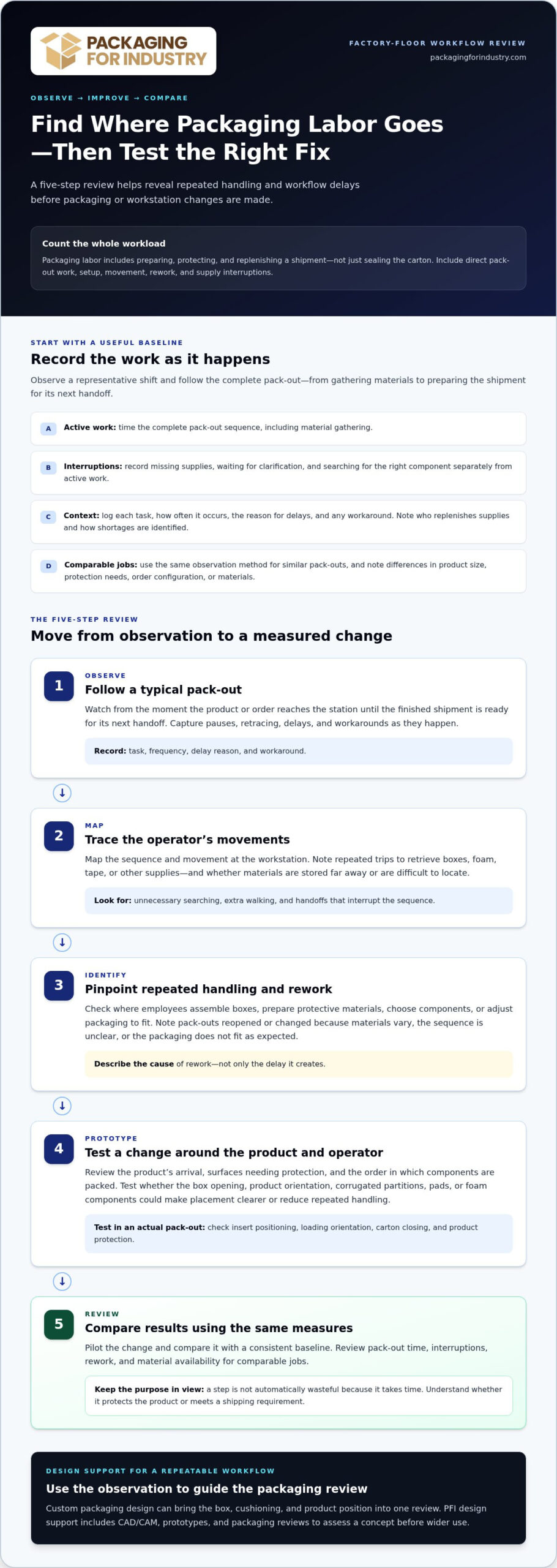
Watch the sequence from the moment an order or product arrives at the station until the finished shipment is ready for its next handoff. Note where employees pause, retrace steps, or handle the same item more than once. A short observation log can capture the task, how often it occurs, the reason for a delay, and any workaround used to keep the order moving.
- Repeated trips: Record walks to retrieve boxes, foam, tape, or other packaging supplies. Note whether materials are stored far from the workstation or in a location that requires searching.
- Assembly and selection: Track manual box setup, protective-material preparation, and decisions about which components to use. Include adjustments made to fit the product.
- Rework: Note pack-outs reopened or changed because materials vary, the sequence is unclear, or the packaging does not fit as expected. Describe the cause, not just the resulting delay.
These observations help distinguish necessary product protection from extra effort created by the process. Don’t assume a task is wasteful simply because it takes time. First establish what the step accomplishes and whether it prevents damage or meets a shipping requirement.
How to establish a useful labor baseline
Time the complete pack-out sequence, from gathering materials through preparing the shipment for its next handoff. Track active work separately from interruptions, such as missing supplies, waiting for clarification, or searching for the right component. Also record who is responsible for replenishment and how a shortage is identified. This makes recurring supply problems visible instead of blending them into a general packing-time estimate.
Compare similar products or orders, but account for meaningful differences. Product size, protection needs, order configuration, and packaging materials can change the sequence. Use the same observation method for comparable pack-outs, and note exceptions rather than forcing every job into one standard. The result is a practical baseline for finding where labor is concentrated and deciding what to examine next.
How packaging design and workstation setup reduce pack-out time
Once the work sequence is visible, use it to shape the packaging and workstation around the product. A practical review follows five steps: observe a typical pack-out, map the operator’s movements, identify repeated handling, prototype a change, and review the results using the same measures. This helps teams test whether a design addresses an observed issue instead of adding a step based on an assumption.
For example, if an operator repeatedly turns a component to position it in a carton, examine whether the box opening, product orientation, or protective insert contributes to that handling. If the operator pauses to choose among cushioning materials, consider whether the pack-out sequence or component presentation can be clearer. Packaging design should support both protection and a repeatable process, not simply change the material.
Design the pack-out around the product and operator
Review how the product arrives at the station, which surfaces need protection, and the order in which each component is packed. Then assess whether corrugated partitions, pads, or foam components could guide placement or keep parts organized. The right arrangement depends on the product and shipping workflow. Test the proposed design in an actual pack-out before treating any labor or protection improvement as established.
Custom packaging design can bring the box, cushioning, and product position into one review. PFI’s design support includes CAD/CAM, prototypes, and packaging reviews, giving teams a way to assess a concept before wider use. A prototype can reveal practical details that a drawing alone may not show: whether an insert is easy to position, whether the product can be loaded in the intended orientation, or whether closing the carton requires extra adjustment. Explore custom packaging design support when a recurring pack-out needs a closer fit with its product and handling sequence.
Arrange materials for efficient point-of-use access
Station layout matters as much as packaging geometry. Place frequently used components within practical reach while keeping work surfaces and movement paths clear. Present materials in the order they’re used, so the operator can move from carton setup to product placement to closure without searching through mixed supplies. The goal is a logical sequence, not a crowded workstation.
- Map the reach: Note where the operator turns, steps away, or crosses the station to collect each component.
- Group by sequence: Keep the parts for a pack-out together and arrange them in the order they’re needed.
- Trial the arrangement: Use a small prototype or controlled run to check fit, access, and handling before wider adoption.
During the trial, observe whether the operator can follow the intended sequence without extra searching, repositioning, or compromising product protection. Compare the pack-out with the original process, including any new handling steps the design introduces. This measured approach supports reducing packaging labor costs on the factory floor without assuming an untested change will deliver a result. If you’re reviewing a packaging redesign, request a packaging quote based on the product and workflow requirements.
Compare packaging kits, redesign, and replenishment for labor impact
The right improvement depends on the constraint observed at the workstation, the mix of orders, and how packaging materials are used over time. Kitting addresses repeated component gathering. Redesign targets recurring fit or handling problems. Replenishment programs address shortages and the purchasing or floor interruptions they cause. These approaches solve different problems, so match the intervention to the evidence rather than treating one option as a universal fix.
Pack-out improvements change how people prepare shipments; inventory-management improvements change how packaging supplies are planned and replenished. Both can support reducing packaging labor costs on the factory floor, but their impact should be measured against the specific bottleneck each is intended to address.
Bottleneck | Suitable intervention | Expected workflow change | Measure to monitor
Operators repeatedly gather the same box, cushioning, and other components | Packaging kitting | Components are prepared together for recurring orders, reducing separate collection steps and supporting a consistent sequence | Component-gathering time, trips to storage, and pack-out variation
Repeated adjustments to a carton, insert, or product position | Custom packaging design | Box and protective components are tailored to product fit and handling, potentially reducing repeated repositioning | Adjustment frequency, pack-out time, rework, and product protection issues
Packaging shortages prompt searches, urgent requests, or work interruptions | VMI or just-in-time inventory management | Planned replenishment based on actual usage helps coordinate supply with recurring demand | Stockout frequency, interruption time, and emergency replenishment requests
When packaging kitting fits the problem
Kitting is worth evaluating when employees repeatedly collect the same combination of packaging components for a standard order or product family. Preparing those components together can simplify staging and help operators follow a repeatable pack-out sequence. Kitting is less likely to address a problem caused by a poorly fitting box or unpredictable material demand. PFI provides packaging kitting and assembly to organize packaging components around recurring workflows.
When custom design or replenishment is the better fit
If operators routinely adjust the carton, reposition cushioning, or handle the product multiple times to achieve a suitable fit, review the packaging design. Corrugated and foam components can be considered together around the product’s protection needs and handling sequence. If the main delay is missing stock, evaluate replenishment instead. PFI’s VMI program uses scheduled reviews and planned replenishment based on actual usage, while just-in-time inventory management can support recurring supply needs.
Before choosing an approach, check whether the issue repeats across orders or appears only in a specific configuration. A kit may help a stable pack-out, while a varied order mix may call for different component groupings. A design change should address a demonstrated handling or fit issue. Replenishment planning should reflect actual usage patterns, not simply a preferred stock level. Track the relevant measure after the change and watch for new steps or interruptions. That comparison helps teams assess the labor effect without assuming an improvement in advance.
How to pilot labor-saving packaging changes without disrupting production
A controlled pilot lets a team test a packaging change in real production conditions before extending it across the floor. Choose one product family, workstation, or repeat order with a clear, recurring workflow. Keep the scope narrow enough to observe, but representative of the work the change is meant to improve. Evaluate labor, product protection, consistency, and supply needs together, rather than optimizing one measure at the expense of the others.
Run a controlled factory-floor trial
Before the trial, document the current pack-out sequence and the proposed change. Use the same observation method for both, tracking full pack-out time, interruptions, rework, and packaging availability. Include product and order details that could affect the comparison, such as configuration differences or protection needs. This gives the team context for interpreting results instead of attributing every difference to the packaging change.
Walk participating operators through the revised sequence before the trial begins. Invite them to flag unclear steps, awkward handling, or materials that are difficult to access. Their feedback can reveal issues a timing log won’t capture. Keep product protection and shipping needs in the evaluation criteria throughout the pilot. A faster pack-out is not a useful improvement if it creates inconsistent packaging or additional product risk.
Review results and standardize the workable change
Compare the pilot with its baseline using the same measures, then account for differences in product or order mix. Review labor indicators alongside pack-out consistency, protection, operator feedback, and material availability. If results are mixed, identify which step caused the difference and revise the process or packaging before deciding whether to continue. Avoid expanding a change simply because one run went smoothly.
Use clear decision criteria, without setting arbitrary numerical thresholds. For example:
Continue: The change addresses the target bottleneck, maintains product protection, and can be supplied and repeated reliably.
Revise: The change shows promise, but operator feedback, pack-out variation, material access, or replenishment needs point to adjustments before wider use.
Stop: The change creates new handling or supply problems, increases rework, or fails to meet product protection and shipping requirements.
Before extending a successful pilot, decide where packaging materials will be stored and how the workstation will stay supplied. Confirm the revised process works across relevant order variations, not only the simplest configuration. Then document the approved sequence, component placement, and handling notes so operators can follow the same method. This disciplined approach helps manufacturers pursue reducing packaging labor costs on the factory floor while protecting production continuity.
How PFI supports lower-labor packaging workflows
Reducing packaging labor costs on the factory floor calls for packaging that fits both the product and the operation supplying it. Packaging For Industry (PFI) works with manufacturers to consider product protection, workstation needs, and recurring supply requirements together. Its industrial packaging range includes custom and stock corrugated boxes, foam packaging, stretch film, pallets, crates, tubes and cores, and corner and edge protection.
PFI serves manufacturers and industrial businesses, including aerospace, electronics, medical device, food and beverage, warehouse, and distribution operations. As an Orange County packaging supplier, PFI serves customers across Southern California, including Los Angeles, San Diego, and Riverside. PFI also supports national packaging needs through distribution and manufacturing partners.
Match PFI capabilities to the factory-floor bottleneck
PFI’s custom packaging design support can address product fit, protection, or consistency requirements through design reviews and prototypes. Packaging kitting and assembly services suit recurring workflows that use coordinated components. For customers managing repeat packaging needs, PFI also offers VMI and just-in-time inventory management. These options can help simplify packaging purchasing, support reliable supply, and reduce avoidable handling without compromising product protection.
Working with an industrial packaging supplier that provides both design and supply support can connect a packaging review to the materials and recurring needs that follow. PFI’s approach focuses on industrial applications, with packaging selected around the customer’s product and shipping workflow rather than a one-size-fits-all pack-out.
Prepare a useful packaging quote request
For a focused review, describe the products being packed, current materials, recurring order patterns, and the steps that create extra handling or delays. Note any product protection or shipping requirements, along with storage or replenishment constraints. This context helps PFI consider whether a packaging design, kitting, or inventory approach best fits the operation.
You can also identify the product family or workstation you want to address and the outcome you want to evaluate, such as consistent pack-outs or dependable material availability. These details help shape a quote request around your factory’s actual needs.
Make packaging workflow review part of continuous improvement
Packaging processes can drift as products, order patterns, and production priorities change. Review the workflow when those conditions shift, rather than treating improvement as a one-time project. Assign an operations owner to capture emerging friction and bring it forward for review. That keeps efforts to reduce packaging labor costs on the factory floor connected to how work actually runs and gives teams a clear point of responsibility.
A focused packaging discussion can turn workstation observations into a practical next step. PFI can help assess packaging needs in the context of product protection, recurring pack-outs, and supply requirements, so the proposed direction fits the operation instead of adding complexity. Start with the issue that most affects flow, then build from there.
A dependable workflow comes from careful review and changes that work for the people using them. With a clear operational priority, your team can move forward with a practical next step.
Frequently Asked Questions
How can manufacturers measure packaging labor on the factory floor?
Use a simple task log that separates hands-on packing from waiting, searching, and coordination. Record the product or order type with each observation, then compare similar work rather than combining dissimilar pack-outs. Note who handles each step and where time is lost between departments. This gives operations and purchasing teams a shared view of labor demands and helps identify which process issue deserves attention first.
Can packaging kitting reduce manual work during production pack-outs?
It can, particularly when the same order repeatedly requires employees to collect a known set of packaging components. A kit can bring those materials together for staging and reduce the need to select each item separately. Before using kits across a production area, consider how often order configurations vary and how components should be replenished. Packaging kitting is most useful when the gathered components match recurring work.
How does custom packaging design help reduce packaging labor?
Custom packaging can be sized and arranged around the product, which may limit unnecessary adjustments during packing. For example, repeated difficulty positioning a component can prompt a review of the box opening, protective insert, or placement sequence. If standard packaging causes fit issues, consider custom sizes and assess the proposed design in an actual pack-out. Measure any labor benefit rather than assuming it.
What packaging tasks should a factory review first?
Prioritize tasks that repeatedly interrupt production or require workarounds. These may include retrieving materials from distant storage, choosing among similar supplies, preparing boxes, applying protection, or correcting a pack-out before shipment. Consider which tasks affect multiple orders and which are tied to a specific product. This ranking helps teams focus on a recurring operational constraint instead of making broad changes without a clear target.
How can packaging shortages increase factory-floor labor?
A shortage can trigger searches for substitute materials, extra messages between production and purchasing, or trips to another storage area. Employees may also need to adapt a pack-out to whatever is available, creating inconsistent handling. Packaging for warehouses and distribution centers depends on materials being available where work occurs. Reviewing usage and replenishment patterns can help teams spot repeated gaps and consider a planned supply approach.
Can packaging changes reduce labor without increasing shipping damage?
Assess packaging changes against both handling and protection requirements. During a trial, inspect how the product sits in the package, whether protective components stay in place, and whether different operators can follow the same method. Review damage reports and rework alongside pack-out observations. If the design makes assembly easier but product protection becomes inconsistent, adjust the materials or layout before adopting the change more widely.
What information should I include when requesting a packaging quote?
Share product details, current packaging, order frequency, shipping needs, and recurring labor or supply issues. Include quantities relevant to your purchasing plan so PFI can help compare packaging pricing and discuss bulk packaging pricing where appropriate. Southern California buyers can also describe local packaging delivery needs. Clear requirements make it easier to scope a quote for a custom packaging project or recurring supply program. Request a packaging quote from PFI to discuss your factory-floor requirements.