
The largest box isn’t always the safest choice for broadcast equipment. Oversized packaging can add avoidable shipping costs, while a poor fit leaves gear exposed to movement and impact. Custom packaging for broadcast equipment Hollywood buyers need should be designed around the equipment, how it will travel, and how crews handle it.
It’s reasonable to expect packaging to protect sensitive gear without making shipping and storage harder. The right combination of cushioning, a corrugated box, or a crate can help reduce shipping damage while keeping package dimensions practical for carrier handling. Fit matters, but so do repeat orders, warehouse processes, and dependable supply.
This guide explains how to compare foam, corrugated boxes, and crates for different equipment and shipping needs. You’ll also learn which dimensions and handling details to include in a quote request, and how design support, prototypes, and samples can help assess fit before a rollout. For Hollywood and Los Angeles operations, a project-specific packaging plan can connect protection, purchasing, and local supply needs.
Key Takeaways
- For custom packaging for broadcast equipment Hollywood operations, document each item’s dimensions, weight, accessories, and handling needs before requesting a design.
- Match internal cushioning to the gear, then select an outer package based on shipment conditions and how the equipment will be handled.
- Compare quote scope, prototype needs, package dimensions, and repeat-order assumptions to make purchasing decisions clearer.
- Review samples or prototypes to assess fit and refine the packaging plan before a broader rollout.
- Coordinate foam, corrugated boxes, and crates as needed to align equipment protection with shipping and production workflows.
Custom Packaging for Broadcast Equipment in Hollywood: What Buyers Need to Protect
Broadcast equipment has to arrive in working condition, with the right accessories accounted for and ready for setup. A damaged camera, monitor, audio component, or control unit can interrupt a production schedule and create replacement or repair work. Custom packaging for broadcast equipment Hollywood buyers specify should coordinate the equipment, cushioning, outer package, and shipment rather than treat the box as a one-size-fits-all container.
This is equipment protection, not presentation packaging for discs, promotional items, or retail displays. The packaging plan should reflect what is being shipped and how it will be handled. Electronic packaging offers useful background on packaging considerations and levels; for a shipping plan, buyers also need to account for the specific gear, accessories, and route. Packaging fit helps limit movement in transit and reduce exposure to impact damage.
Which broadcast equipment needs a purpose-built packaging plan?
Cameras, monitors, audio gear, control equipment, and production accessories can each call for different packaging arrangements. Their dimensions, weight, fragile areas, protruding parts, and included accessories inform the design. A project-specific assessment is more useful than assuming one cushioning layout will suit every item.
Start by distinguishing the shipment type:
- Standalone equipment: Plan for the main unit’s shape, contact points, and protection needs.
- Accessory kits: Account for each cable, power component, mount, or related item so it stays organized and doesn’t shift against the primary equipment.
- Multi-item shipments: Consider how separate pieces will be positioned and protected together, while keeping them accessible for unpacking and inventory.
That inventory helps clarify whether each piece needs its own fitted cushioning, whether components can share an outer container, and how the package should be opened and repacked during operational use.
Why Hollywood and Los Angeles shipping context matters
Production-area buyers often balance equipment movement between locations with storage constraints and the need to replenish packaging for ongoing work. Shipment route, handling steps, and repeat frequency all matter: a package used for recurring transfers may call for a different plan than one prepared for a single outbound shipment. Note these conditions in the packaging brief so the design reflects the actual workflow.
PFI serves Los Angeles County, including buyers in the Hollywood area, as part of its Southern California service area. Local next-day delivery is available throughout Southern California. PFI’s custom packaging design can bring the product, cushioning, and outer package into one coordinated plan, with prototypes and samples available to assess fit before a rollout. Share equipment dimensions, included accessories, shipment context, and expected reorder frequency to make the project review more precise.
How to Specify Custom Broadcast Equipment Packaging Around the Gear
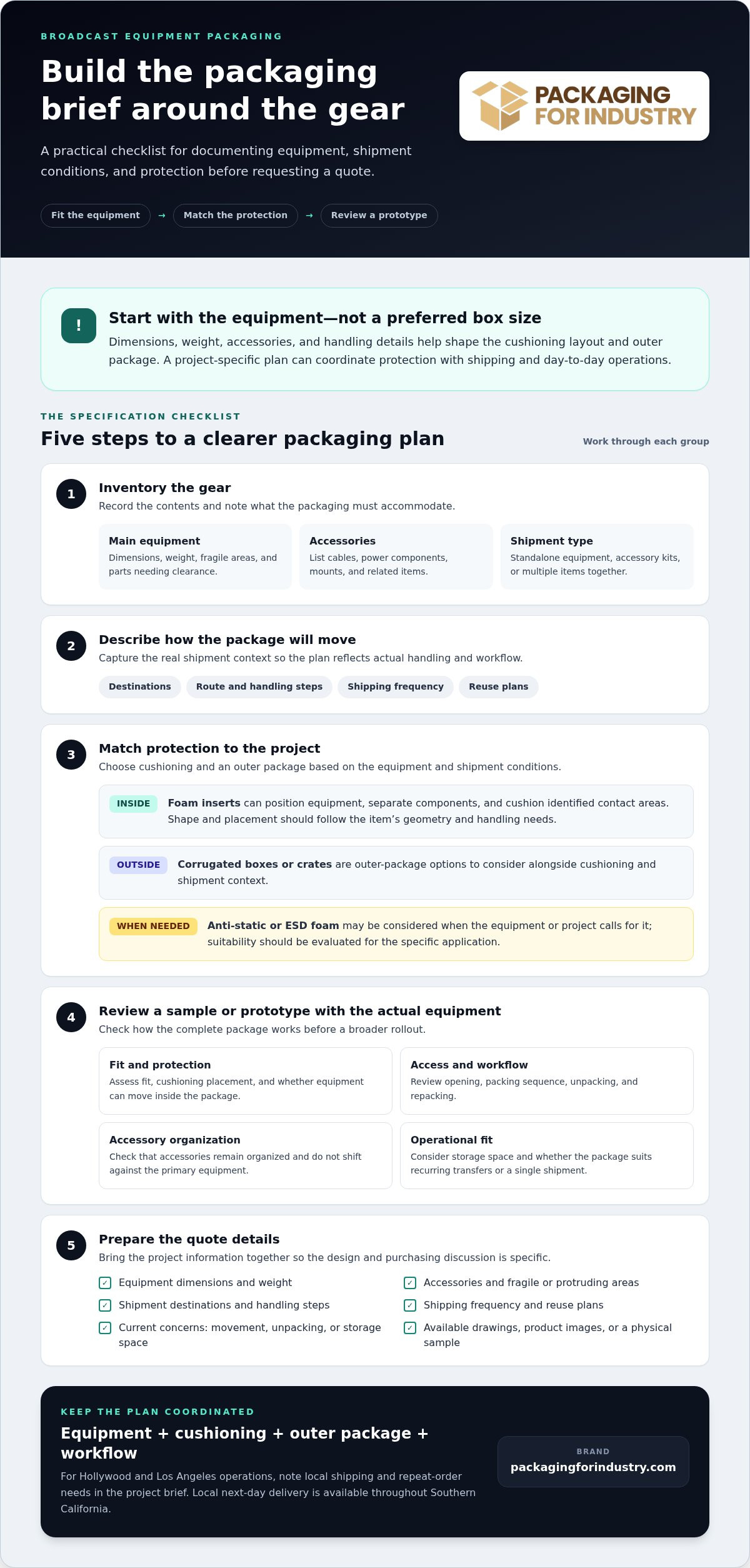
A useful packaging specification begins with the equipment, not a preferred box size. For custom packaging for broadcast equipment Hollywood buyers are sourcing, the design process should account for what is being packed, how it will move, and what the packaging needs to do in daily operations. Dimensions, weight, accessories, and handling details help determine the cushioning layout and outer package, while shipment frequency and reuse plans influence the overall approach.
Use this sequence to develop a clear brief:
- Inventory the gear: Record each item and its accessories, noting dimensions, weight, fragile areas, and parts that need clearance.
- Document shipment conditions: Describe destinations, route or handling steps, shipping frequency, and whether the package will be reused.
- Select protection: Match internal cushioning and the outer package to the equipment and shipment context.
- Prototype: Review a sample or prototype with the actual equipment before moving to a wider production run.
- Review: Check fit, access, packing sequence, and whether accessories remain organized after handling.
What information should buyers gather before requesting a quote?
Prepare equipment dimensions and weight, identify fragile or protruding areas, and list every accessory packed with the main unit. Include current packaging concerns, such as unwanted movement, difficult unpacking, or a package that takes up too much storage space. Add shipment frequency, destinations, handling steps, and whether the packaging will be reused. Available drawings, product images, or a physical sample can make a design discussion more specific and help clarify the relationship between the equipment and its cushioning.
How do foam inserts and ESD materials fit the design?
Custom foam inserts can position equipment inside a package, separate components, and provide cushioning around identified contact areas. Their shape and placement should follow the item’s geometry and the project’s handling requirements, rather than a generic cutout. Anti-static or ESD foam may be considered when the equipment or project calls for it; material selection and suitability should be evaluated for the specific application. PFI’s custom packaging design services support project-specific design and prototyping, helping buyers assess fit before a broader rollout.
Where a project has defined requirements for a fiberboard box, the Standards for fiberboard boxes provide a reference to construction criteria. Don’t assume a particular regulation applies to every equipment shipment; base packaging decisions on the actual shipment requirements.
A prototype review is also a chance to check the packing and unpacking sequence. Confirm that equipment can be placed into and removed from the package as intended, and that accessories have designated positions. If you’re preparing a custom packaging quote, include these details with your drawings or sample so the proposed design can address protection and workflow together. You can request a packaging quote with the project information gathered above.
Foam, Corrugated Boxes, or Crates: Compare Packaging Options for Broadcast Gear
Each packaging component serves a different purpose. Foam provides internal cushioning, corrugated boxes form an outer container, and crates offer a structural option for shipments that call for one. Comparing those roles helps buyers plan a complete package instead of choosing a material without considering how it works with the rest of the shipment.
| Option | Primary role | Shipment context to assess | Buyer considerations |
|---|---|---|---|
| Foam | Internal cushioning and positioning | Items that need a defined place inside a package | Fit, component separation, and ease of packing and unpacking |
| Corrugated box | Outer shipping container | Shipments suited to a carton based on contents and handling | Exterior dimensions, construction choice, and fit with the cushioning |
| Crate | Structural outer protection | Large, heavy, or complex shipments | Shipment configuration, handling workflow, and interior support needs |
These options can be combined rather than treated as substitutes. Foam inside a box or crate can position items while the outer package serves as the shipment’s container or structure. Evaluating the assembled configuration helps purchasing and operations teams consider package size, storage, and the packing sequence together.
When do foam inserts and corrugated boxes make sense?
Fitted foam can keep individual equipment pieces in position and organize accessories into distinct spaces. The insert’s layout should account for the shapes and placement of the contents, as well as how staff will pack and remove them. Corrugated cartons can be selected from standard or heavier-duty options according to the shipment’s needs, without assuming one construction suits every load. PFI’s custom corrugated boxes can be considered alongside the insert as a coordinated package. Review how the closed package handles and whether the contents remain in their intended positions.
When should buyers consider a custom crate?
A crate may be worth assessing for equipment that is large, heavy, or difficult to arrange in a carton, or when the shipment calls for a rigid outer structure. Foam lining can be part of a crate configuration if the project requires both interior cushioning and structural support. Consider the equipment, shipping method, and handling steps together; a crate’s structure does not replace the need to plan internal positioning.
For recurring shipments, a documented configuration can help teams pack consistently and identify changes that may affect the design. Compare the full package, including how its components fit together and how it will be stored or handled. This supports a practical material choice for the shipment without assuming a single option will suit every piece of gear.
How to Evaluate a Broadcast Packaging Quote for Hollywood Operations
A useful quote makes it possible to compare complete packaging approaches, not just the price of one component. For custom packaging for broadcast equipment Hollywood buyers should give each supplier the same equipment details, order quantity, shipment route, and protection requirements. Then review what the proposed scope includes, what assumptions shape the design, and how the packaging will support the operation after delivery.
Which quote details make options easier to compare?
Use a consistent request for each option. Include the gear being packed, required quantities, destinations, handling conditions, and whether packages need to support repeat shipments. Ask for the proposed packaging components and services to be described clearly, such as foam, corrugated boxes, crates, prototype work, or assembly. If one quote includes a fitted insert and another covers only the outer container, the options aren’t directly comparable.
Separate confirmed specifications from planning assumptions. For example, a measured equipment size or approved shipment route is a project input; a proposed package configuration may still be an assumption until a prototype is reviewed. Identify open items in the quote so purchasing and operations teams know what they’re evaluating. A practical comparison can include:
- Scope: Which packaging components and design or prototype steps are included?
- Quantity: Is the quote based on the same initial order volume and expected repeat quantity?
- Dimensions: Are the proposed package’s exterior measurements stated for carrier review?
- Workflow: Does the scope account for packing, unpacking, storage, or assembly needs?
Dimensions deserve attention alongside protection. Carriers may assess package size as well as actual weight, and applicable dimensional rating or surcharge rules can affect shipping costs. Compare the proposed outer dimensions against the shipment plan and review them with the carrier’s current terms. Right-sizing is a cost-control consideration, not a guarantee that a surcharge will be avoided.
How should recurring equipment shipments affect the decision?
Repeat use can change the design priorities. Packaging that returns between locations may need a practical storage footprint and a consistent packing sequence; packaging used for recurring outbound orders may need predictable specifications for purchasing and warehouse teams. Include expected use and storage conditions in the quote request so the proposal reflects the workflow, not only the first shipment.
For ongoing packaging needs, discuss whether stocking support or a just-in-time inventory program fits the purchasing process. PFI’s just-in-time packaging management can be considered when recurring demand makes coordinated replenishment relevant. Set expectations around quantities and timing in the project terms rather than assuming inventory levels or replenishment intervals.
Hollywood and greater Los Angeles buyers can also factor local sourcing into planning: consider where packaging will be received, stored, and used, along with delivery coordination for the operation. A clear scope and shared assumptions make it easier to compare packaging pricing and plan repeat purchasing.
Custom Broadcast Packaging from PFI: From Design Review to Quote
Packaging For Industry (PFI) supports industrial buyers with custom packaging design, foam packaging, corrugated boxes, and crates. For a broadcast equipment project, the design review can bring these products together around the shipment’s needs rather than treating each component as a separate purchase. The same design capabilities serve businesses in electronics, aerospace, medical device manufacturing, and other industrial sectors with equipment protection requirements.
How PFI can combine packaging materials for equipment shipments
PFI evaluates how cushioning and the outer container work as a system. Foam can be designed to position equipment, while corrugated boxes or crates provide the selected outer structure. The appropriate configuration depends on the project’s equipment, shipping method, and handling workflow. PFI’s custom packaging design services include CAD/CAM support, prototypes, and samples to help teams review a proposed design before a wider rollout.
This coordinated approach can help buyers assess package fit, packing steps, and material use in one review. It also gives operations and purchasing teams a chance to consider whether the proposed solution suits storage and recurring orders. PFI’s experience serving industrial packaging needs makes the project review useful for translating equipment and workflow requirements into a packaging plan, without assuming one standard configuration suits every shipment.
What to include in a Hollywood-area quote request
Give the quote team practical details about the equipment and the job it needs to perform. Include:
- Product information: Equipment dimensions, weight, quantity, accessory details, and any current damage concerns.
- Shipping requirements: Destinations, shipping method, handling conditions, and whether packages will be reused.
- Design references: Drawings, images, or product samples when available.
- Supply planning: Recurring order needs and delivery requirements for your operation.
Clear inputs help PFI develop a quote around the actual project scope, including the combination of foam, boxes, and crates under consideration. The potential benefit is a packaging plan that supports product protection while accounting for purchasing, storage, and shipping needs. Share known specifications separately from estimates so the project review can focus on confirmed requirements and identify assumptions for evaluation.
For packaging buyers who need custom sizing, coordinated materials, and a practical design review, PFI can help move the project from requirements to a quote.
Put Your Packaging Plan Into Motion
The next step is to turn your equipment and shipping requirements into a clear project brief. Identify the packaging issues you want to address, the gear involved, and how often it moves. That gives the design discussion a practical starting point and helps keep protection, package dimensions, and purchasing needs aligned.
For custom packaging for broadcast equipment Hollywood operations, PFI can bring custom design and CAD/CAM support into the review, then use prototypes and samples to assess the proposed fit. Foam, corrugated boxes, and crates can be considered together as a coordinated packaging system. With Los Angeles County included in PFI’s Southern California service area, local buyers can discuss their project requirements with a supplier familiar with regional operations.
Bring your equipment details, shipping workflow, and recurring order needs into the conversation. A well-defined brief can help move the project from an operational concern to a packaging plan your team can evaluate and use.
Start with the requirements you know, and build a more dependable packaging approach from there.
Frequently Asked Questions
Can custom packaging help reduce carrier surcharges for broadcast equipment?
It may, but compare actual shipping records to determine whether a packaging change affects charges. For custom packaging for broadcast equipment Hollywood shipments, track carrier billing for the package types you currently use, then compare it with billing after adopting a revised configuration. Review the carrier’s current terms as part of that check. This gives your purchasing team evidence for deciding whether a packaging adjustment supports its cost-control goals.
Should every piece of broadcast equipment have its own foam insert?
No. A dedicated insert is most useful when an item’s shape, value, or handling needs call for its own support. For equipment with shared footprints across a product family, a common design may work, while variations in size or configuration can require different inserts. Consider how often models change and whether staff can identify the correct insert quickly during packing.
Can custom packaging be reused for broadcast equipment?
Yes, if the package remains in suitable condition and continues to fit the equipment. Before each reuse, inspect the cushioning for wear or loss of shape, check the outer container and closures, and confirm that the contents don’t shift during packing. A simple inspection record can help teams spot recurring wear patterns and replace packaging before it creates handling or protection problems.
What should I send with a request for a broadcast equipment packaging quote?
Along with product information, describe operational constraints that may affect the design. For example, note available space at the packing station, how packages are stored before use, and whether staff need a particular unpacking sequence. Internal item names or part numbers can also help purchasing and warehouse teams connect the proposed packaging to the right equipment and keep specifications organized as models change.
Can one packaging solution protect equipment and its accessories together?
Yes, when the equipment and accessories are intended to move as a set. Decide whether staff will pack the full kit at once or assemble it from separate components, and define what the receiving team should find in each shipment. A consistent kit list can reduce missing-item confusion during dispatch and receiving, especially when teams prepare multiple equipment sets for different production jobs.
Is ESD foam appropriate for all broadcast equipment?
No. Use ESD foam when static-sensitive components or handling requirements call for it, not as a default material for every item. If only certain modules require static-control packaging, identify them separately in the packing specification so teams can distinguish them from other gear. Keep any internal handling instructions with the relevant item records, and treat foam selection as one part of the packaging plan.