
Bulk foam can protect products effectively, but a poorly planned order may take up valuable warehouse space or leave your team short when production needs more. Choosing a bulk foam sheet supplier Southern California operations can rely on means looking beyond unit price. Foam type, sheet format, product fit, and replenishment planning all affect how well packaging protects shipments and fits your workflow.
For manufacturers and distribution teams, the right foam depends on what you’re shipping, how it moves, and where it needs protection. A useful specification connects the material and format to the product, packing steps, and outer package. Planning recurring supply around actual usage and available storage space also helps prevent last-minute orders and unnecessary inventory.
Packaging For Industry, based in Anaheim, supplies polyethylene and polyurethane foam, foam pads and planks, and custom foam design. Samples and prototypes can help your team assess fit before broader use. This guide explains how to define foam requirements, compare supplier capabilities, and balance bulk purchasing with storage needs. It also covers how related packaging materials and local delivery can support operations in Orange County, Los Angeles, San Diego, and Riverside.
Key Takeaways
- Define whether foam sheets need to cushion, separate, or protect your product before setting a bulk order quantity.
- Choose polyethylene or polyurethane foam and a sheet format based on product contact points, shipping conditions, and packing steps.
- When comparing a bulk foam sheet supplier Southern California businesses can work with, assess material fit, custom design, samples, recurring orders, and local service.
- Prepare product dimensions, protection requirements, estimated usage, and order frequency to make a foam packaging quote more useful.
- PFI supplies foam pads and planks and offers custom foam design, samples, and prototypes to help assess fit before broader use.
Why Southern California manufacturers buy foam sheets in bulk
Foam sheets are flat protective material used as supplied or converted for packaging. They can cushion products, separate components, or create a protective layer inside a shipping package. Their usefulness depends on how the foam fits the product and packing process, not just on the material name. A sheet may be part of a wider protective packaging design that also includes a box or crate.
Manufacturers, warehouses, and distribution teams often buy foam to support repeatable packing tasks. Keeping a planned supply of the same material can help maintain consistency between shifts and reduce urgent orders when stock runs low. Bulk purchasing can also simplify procurement when orders align with recurring production needs. Set the quantity according to actual usage, replenishment timing, and the space available for storage. A larger order is not automatically a better value if the material occupies needed work or warehouse space.
Specify foam for the product and shipping application rather than assuming every foam format serves the same purpose. Industrial protective packaging addresses product contact, handling, and shipment requirements. Insulation, theatrical, and residential foam may have different intended uses, so don’t treat them as equivalent to packaging material. General information about the properties of foam can provide background, but the product and its journey should guide the packaging decision. PFI’s industrial foam packaging can be considered as part of a system designed around that application.
- Consistency: A defined material and sheet format can make a recurring packing task more repeatable.
- Order planning: Usage estimates help coordinate foam purchases with production schedules and replenishment needs.
- Storage control: Matching order quantities to available space helps keep bulk materials from crowding work areas.
Where bulk foam sheets fit in industrial packaging
Foam sheets can be used as pads between components, cushioning around equipment, or separators between parts stacked for storage or shipment. A manufacturer might place foam between finished surfaces to reduce contact, while a distribution team may use it to separate packaged items. For example, if a part is packed in a corrugated box, foam can be placed between the product and the box or between multiple components. Buyers can also consider foam with crates, based on the product, handling process, and shipment requirements.
When bulk purchasing supports a production operation
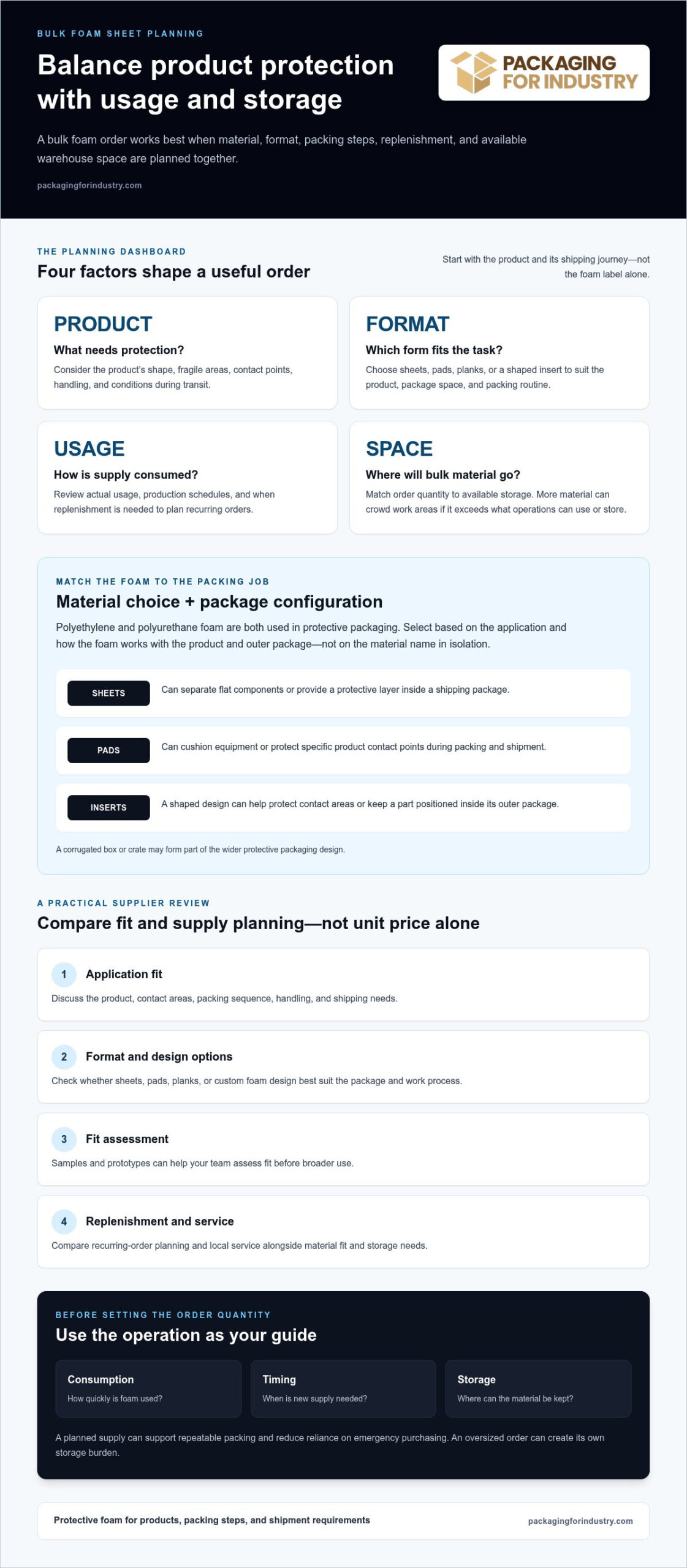
Bulk ordering can suit an operation that uses foam regularly and can plan replenishment around production schedules. Review how quickly the material is consumed, when new supply is needed, and where it will be stored before setting the order quantity. Planned replenishment can reduce reliance on emergency purchasing, but ordering more than the operation can use or store creates its own burden. When comparing a bulk foam sheet supplier Southern California manufacturers can work with, discuss usage and storage alongside the protective packaging application.
How to match foam sheet material and format to the application
Start with the product and its shipping journey rather than selecting a material name in isolation. Consider the product’s shape and fragile areas, where packaging will make contact, how the item will be handled, and what conditions it may encounter in transit. Also consider whether the same configuration must work consistently across repeat orders. These details help determine whether sheets, pads, inserts, or a combination will fit the packing process.
Foam selection should follow the product’s protection requirements and packaging configuration, not the material label alone. A broad sheet may work for separating flat components. A shaped pad or insert may better protect specific contact points or keep a part positioned inside an outer package. The selected format should protect the product and fit the way employees pack, handle, and ship it.
Polyethylene and polyurethane foam in packaging decisions
Packaging For Industry works with polyethylene and polyurethane foam for protective packaging applications. Neither category should be selected by name alone. Product shape, contact areas, packing sequence, and the space inside the outer package all inform the design. The Polyurethane Foam Association’s overview of foam performance characteristics describes factors used to assess flexible polyurethane foam. Relevant terminology can help buyers make specifications more precise, but a material category by itself does not determine suitability.
For example, a production team separating finished components may need a sheet that can be cut to match its stacking or packing routine. Equipment with uneven contact points may call for a designed pad or insert instead. PFI’s foam packaging solutions connect material choices to the package and work process, rather than treating each sheet as a standalone purchase.
Specify sheet dimensions, thickness, and conversion needs
Base dimensions and thickness on the actual product and package configuration. Use a part drawing, sample, or existing package as a reference where possible instead of relying on estimates. If the foam must fit a specific space or support repeatable packing, include conversion details with the sheet requirements. PFI’s custom design process can connect sheet material to pads, inserts, or foam assemblies. Samples or prototypes can help assess fit for the project.
- Product and contact points: Share the product’s dimensions and shape, identify fragile areas, and describe the surfaces the foam must protect.
- Sheet specification: Provide requested sheet dimensions and thickness based on the application and available package space.
- Conversion details: Describe cut patterns or openings, and say whether sheets need to become pads, inserts, or assemblies.
- Order planning: Include the expected quantity and whether the configuration will be used repeatedly.
Before placing a larger order, assess how the specified foam fits the product, outer package, and packing process together. A sample or prototype can reveal fit issues that dimensions alone may not capture. With those details organized, a bulk foam sheet supplier Southern California manufacturers rely on can prepare a more relevant foam packaging quote. Request a foam packaging quote with your application and conversion requirements.
How to evaluate a bulk foam sheet supplier in Southern California
A supplier should help you solve a packaging problem, not just quote a sheet. Compare how its materials and services fit your product, packing process, and replenishment needs. A supplier that understands packaging workflows can help determine whether sheets are suitable as supplied or need custom sizing, conversion, or coordination with the outer package.
Choose a foam supplier that connects product fit and replenishment planning to the goal of reducing shipping damage. Use these points to compare capabilities:
- Material fit: Can the supplier discuss your product, contact points, and shipping conditions before recommending a format?
- Custom sizing: Can the foam be designed around your package dimensions and packing steps?
- Samples and prototypes: Can your team evaluate the proposed fit before using it for recurring orders?
- Order continuity: Can you discuss expected usage and repeat orders to plan replenishment?
- Local service: Does the supplier serve your operating area and understand how packaging supply relates to production schedules?
Supplier capabilities beyond selling foam sheets
Custom design, samples, and prototypes can turn a general material request into packaging that fits the actual product. Packaging For Industry takes an industrial approach, considering foam alongside the box, crate, or other protective materials used for a shipment. This helps teams assess how the components work together instead of sourcing each item without considering the complete package. Explore PFI’s foam packaging solutions as part of a coordinated protection plan.
Local supply and recurring-order considerations
For operations in Anaheim, Orange County, Los Angeles County, Riverside, San Diego County, and the Inland Empire, regional service can support packaging coordination. Discuss how foam usage relates to production schedules, where material will be received, and how much storage space is available. PFI offers vendor managed inventory programs with scheduled inventory reviews and planned replenishment. Discussing usage and stock needs can help purchasing plan for supply without overlooking storage limits.
Assess supplier fit using your real workflow. Describe how employees load the product, position the foam, close the box or crate, and prepare the shipment. Consider whether a packaging change affects other materials or packing steps. A foam specification that works on paper may still be awkward to handle on a production line, so include the people who pack and ship the product in the review.
A bulk foam sheet supplier Southern California businesses choose should bring material knowledge, custom design support, and a practical view of recurring supply together. Packaging For Industry is based in Anaheim and serves businesses across Orange County, Los Angeles, San Diego, and Riverside with foam and integrated packaging solutions. This gives manufacturers and warehouse teams a local resource for evaluating protective packaging in the context of their operation.
What to include when requesting bulk foam sheet pricing
A useful foam packaging quote starts with clear application and purchasing details. A supplier can better assess material, format, and order planning when your request describes what needs protection, how the foam will be used, and how often you expect to reorder. Use the steps below to prepare a practical specification.
Prepare a usable foam sheet specification
Start with the product and packaging task, then record dimensions and conversion needs as accurately as possible. If a sample or prototype review would help validate fit, include that in the request. For engineered foam requirements, PFI’s custom packaging design services can connect the specification to the intended package.
- Describe the application. Identify the part or product being protected, its dimensions and shape, and the packaging step where the foam will be used. Note fragile areas, contact points, and known handling or shipping concerns.
- Explain the protection need. Describe what the foam should do, such as cushion the product, separate parts, or prevent contact with a package surface. Include relevant handling and shipment details rather than relying on a material name alone.
- Specify the sheet format. Provide required sheet dimensions and thickness when known, along with cut patterns, openings, or other converting needs. If you’re still determining the specification, share the package configuration and product information that will guide the design.
- Include related packaging materials. Describe the box, crate, or other protective materials used with the foam. This helps the supplier consider how the components fit together and whether pads, inserts, or an assembly better suit the packing process.
- Estimate usage and order frequency. Share expected weekly or monthly consumption, anticipated order quantity, and how often replenishment is needed. Note production schedule considerations and available storage capacity so the supply plan fits the operation.
- Plan delivery and validation. Provide the receiving location and any scheduling considerations tied to production. If a sample or prototype would help confirm fit before broader use, include that in the request. For custom packaging, account for design and production steps in the replenishment plan instead of waiting until stock is nearly depleted.
Specific information makes it easier to compare bulk foam pricing on an equivalent basis. If dimensions or thickness are still being determined, identify them as open requirements instead of guessing. A buyer seeking a bulk foam sheet supplier Southern California operations can rely on should be able to use the application brief to discuss material fit, custom design, and recurring supply together.
Source bulk foam sheets from PFI in Southern California
Packaging For Industry is an Anaheim-based industrial packaging supplier serving businesses across Southern California, including Orange County, Los Angeles, San Diego, and Riverside. Foam sourcing works best when it supports the whole packing process: the product, protective materials, work area, and replenishment plan. PFI supplies polyethylene and polyurethane foam, foam pads and planks, and custom foam design to help buyers develop protection around their operation’s requirements.
Foam sheets may be one part of a larger packaging system. A box provides the outer container, while foam can cushion or separate the product inside. For larger or specialized shipments, foam can also be considered alongside a crate or other cushioning materials. Planning these components together helps teams evaluate how a package will be assembled and handled, rather than sourcing foam without considering what surrounds it.
A packaging supplier for manufacturing and warehouse operations
Recurring packaging needs require more than a one-time material purchase. Manufacturers need foam that fits their packing routine, while warehouses and distribution teams need supply planning that keeps materials available as work moves through the operation. Coordinating foam with other materials can simplify purchasing and support efforts to reduce shipping damage. PFI also provides manufacturing packaging solutions for businesses managing broader production packaging needs.
From foam requirements to a practical supply plan
Share how the product is packed, which surfaces need protection, and whether the foam will be used as sheets, pads, or part of a custom design. If the shipment uses a crate, describe how the foam will fit inside and support the product. This gives the packaging team useful context for considering foam and related materials together, including a foam-lined crate where appropriate.
PFI’s custom design capabilities include samples and prototypes, which can help your team assess fit before broader use. Pair that evaluation with a clear picture of recurring consumption, storage limits, and production schedules. A practical supply plan accounts for both packaging design and the time needed to replenish materials, without ordering more than your operation can store or use efficiently.
PFI provides local next-day delivery throughout Southern California. Connecting local supply with recurring production and warehouse requirements can help purchasing teams plan packaging needs with fewer last-minute decisions. For a bulk foam sheet supplier Southern California businesses can work with on product protection and supply planning, PFI brings foam and related packaging solutions together.
To request pricing, share your product or part specifications, preferred foam format, expected volume, order frequency, and delivery needs. Include details about boxes, crates, or other materials used with the foam so the quote reflects the complete packaging configuration.
Make your foam requirements part of a dependable supply plan
Turn your packaging needs into a specification that purchasing and operations can use consistently. Record what the foam must protect, how it fits into the package, and how usage relates to production and storage. This gives your supplier a practical basis for discussing fit and future replenishment, rather than treating each order as an isolated purchase.
When selecting a bulk foam sheet supplier Southern California businesses can work with, look for a partner that connects foam design to the realities of your packing process. Share the details you have, including product requirements, expected volumes, and delivery needs. PFI can help shape a foam packaging plan around your operation.
A clear starting specification makes the next purchasing decision more straightforward. Share your foam requirements with PFI and request a quote for a supply plan that fits your packing process.
Frequently Asked Questions
What information should I provide when requesting a bulk foam sheet quote?
Identify the product and include its part number and drawing revision, if applicable, so the quote reflects the correct version. Clarify whether foam is used for each individual unit, a kit, or a shipment containing multiple parts. If the packaging process has changed recently, distinguish the current configuration from the one being replaced. This helps purchasing and operations review the proposed specification together.
Can foam sheets be cut or designed for a specific industrial product?
Yes. Custom foam design can account for the product’s geometry and how it fits inside its package. For example, a component with handles, connectors, or protruding features may need matching clearances so the foam does not interfere with assembly or removal. A drawing or representative part can help communicate those details. PFI provides custom foam design for industrial packaging applications.
Which foam is better for bulk packaging sheets, polyethylene or polyurethane?
There isn’t one universal choice. PFI works with both polyethylene and polyurethane foam, and the application should guide the decision. For electronic components, identify whether static control is part of the packaging requirement. PFI offers ESD foam packaging as a distinct consideration. Don’t assume a general material category addresses a specialized requirement. Describe the product and handling context so the packaging design can account for the full use case.
Is buying foam sheets in bulk suitable for a small warehouse?
It can be suitable when consumption is steady and inventory can be managed without disrupting warehouse operations. A small team can review recurring packaging items through a vendor managed inventory program. Scheduled inventory reviews and planned replenishment can coordinate supply with usage, helping the team avoid treating every bulk purchase as a large receipt that must occupy space all at once.
Can a Southern California supplier provide foam and other packaging materials together?
Yes. Packaging For Industry supplies foam and other industrial packaging materials, so buyers can organize related requirements in one purchasing discussion. For easier internal review, group quote items by finished product or packing line, then identify which items are used together. Procurement can compare the complete packaging configuration instead of evaluating unrelated material quotes in isolation. PFI serves business customers across Orange County, Los Angeles, San Diego, and Riverside.
How do I reduce product damage when choosing bulk foam sheets?
Run a controlled packing trial before making a new configuration routine. Have the packing team follow the intended steps, then inspect whether the product stays positioned and whether workers can load and remove it without forcing the fit. Record contact marks, shifting, or packing inconsistencies and use those observations to refine the design. This review can surface issues that a written specification may not reveal.
Does PFI deliver bulk packaging locally in Southern California?
Yes. PFI provides local next-day delivery throughout Southern California. For a bulk order, include receiving hours, dock instructions, and site-specific delivery coordination details with your request. This helps your team plan receiving and material handling around normal warehouse or production activity. If several facilities receive packaging, identify each location and its requirements so the order plan reflects how materials move through your operation.