
What if the lowest-priced box is increasing your total packaging cost? A packaging cost reduction audit for manufacturers looks beyond material prices to reveal how labor, freight, product damage, and inventory affect the full cost of getting products packed and shipped. A unit-price cut can shift expenses elsewhere, while shortages and excess stock can disrupt production or take up valuable warehouse space.
If you’re considering automation, build a credible baseline before comparing it with other improvements. This audit offers a practical way to identify cost drivers using your own operating data, then assess automation alongside packaging design, materials, purchasing, and inventory changes. The goal is a realistic business case that lowers packaging costs without compromising product protection or operational flow.
We’ll cover the data to gather, the costs to compare, and the tests an improvement should pass before you invest. PFI’s custom packaging design, coordinated packaging materials, and inventory programs can support the review. The focus stays on the right solution for your operation, not automation by default.
Key Takeaways
- A packaging cost reduction audit for manufacturers can uncover expenses across materials, labor, freight, damage, and inventory, not just unit prices.
- Set a clear audit boundary and use purchasing, shipping, production, and inventory records to build a baseline you can validate.
- Compare automation with process changes, packaging redesign, material adjustments, and inventory programs using consistent measures.
- Make the business case transparent by documenting assumptions, operational impacts, risks, and how results will be measured.
- Turn approved findings into practical packaging specifications and supply actions that support product protection and reliable operations.
Where a Packaging Cost Reduction Audit Finds Hidden Manufacturing Costs
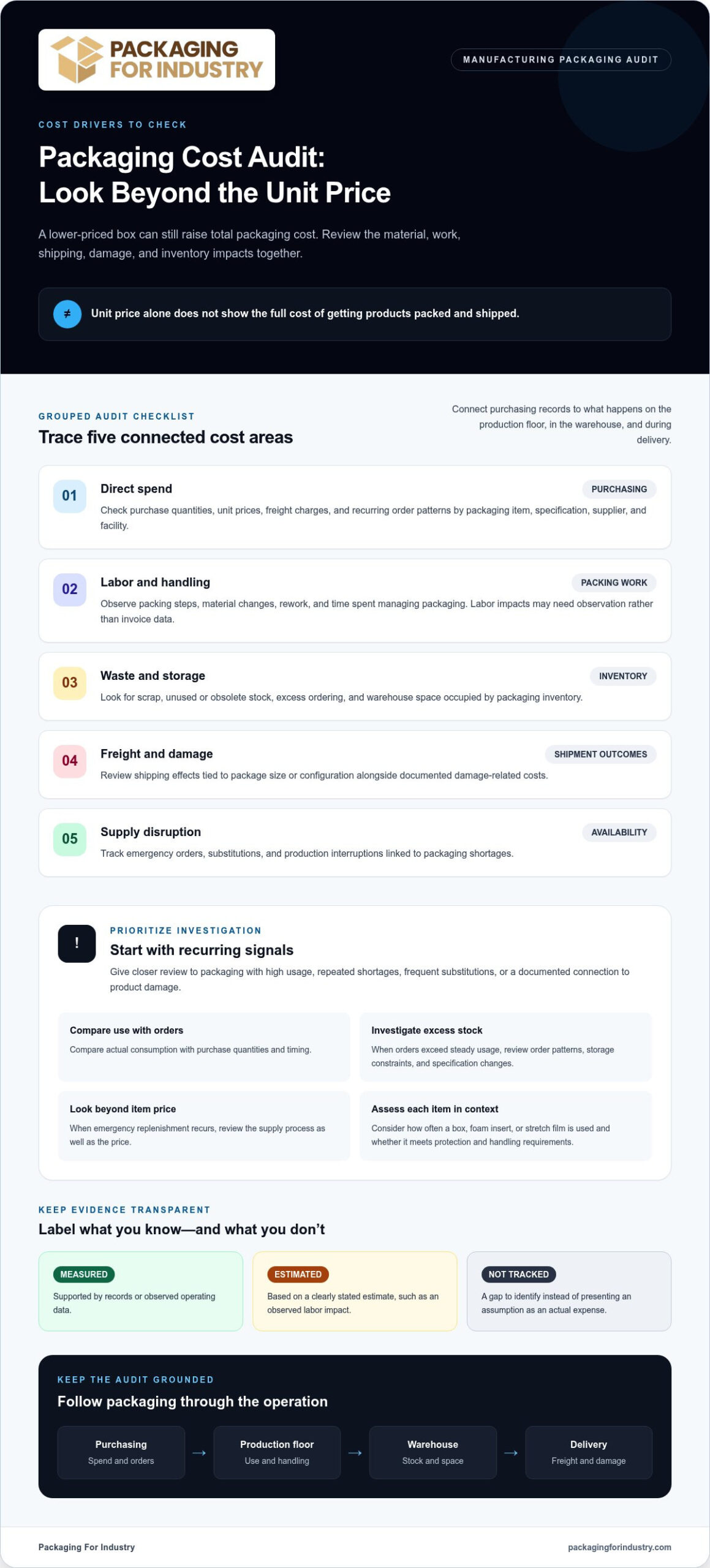
Packaging expenses rarely sit in one budget line. A box or roll of stretch film has a visible purchase price, but the full cost can also include packing time, wasted materials, freight effects, damaged products, emergency replenishment, and inventory taking up warehouse space. A lower unit price can still leave the operation spending more if it adds labor, increases damage, or creates shipping inefficiencies.
A packaging cost reduction audit for manufacturers is a structured review of packaging specifications, material use, supply practices, and results. It connects purchasing records with operational evidence so the team can see where costs accumulate and which issues deserve investigation. Total packaging cost includes materials and the operational impacts of handling, shipping, damage, and inventory.
This broader view helps distinguish a genuine cost opportunity from a price change that simply moves expense elsewhere. For example, a packaging change may lower material spend but add packing steps or provide inadequate protection in transit. A useful audit follows packaging through purchasing, the production floor, the warehouse, and delivery.
Which packaging cost categories belong in the audit?
Start with spend by packaging item, specification, supplier, facility, and recurring order pattern. Then connect those records to the work and outcomes associated with each item. Assess a corrugated box, foam insert, or stretch film specification in context, including how often it is used and whether it meets the product’s protection and handling requirements.
- Direct spend: Purchase quantities, unit prices, freight charges, and recurring order patterns.
- Labor and handling: Packing steps, material changes, rework, and time spent managing packaging.
- Waste and storage: Scrap, unused or obsolete stock, and warehouse space occupied by packaging inventory.
- Freight and damage: Shipping effects tied to package size or configuration, plus documented damage-related costs.
- Supply disruption: Emergency orders, substitutions, and production interruptions linked to shortages.
Label each finding as measured, estimated, or not yet tracked. An invoice can confirm material spend, while labor impacts may require observation or a clearly stated estimate. Keep assumptions visible rather than presenting them as actual expenses. If equipment is one possible process change, this overview of packaging machinery and automation can help frame the range of equipment involved without assuming that automation is the answer.
How do you identify the highest-priority audit targets?
Prioritize packaging items with high usage, repeated shortages, frequent substitutions, or a documented connection to product damage. Compare actual consumption with purchase quantities and timing. If usage remains steady but orders repeatedly exceed demand, investigate whether order patterns, storage constraints, or specification changes are driving excess stock. If emergency replenishment recurs, review the supply process as well as the item price.
Use local operating context to sharpen the questions, not to assume every facility has the same cost profile. Manufacturers in Orange County, Los Angeles, San Diego, and Riverside can compare packaging delivery timing, warehouse capacity, and replenishment patterns across their own sites. PFI’s packaging cost-reduction support includes reviewing specifications, product protection, supply, and operational flow to identify practical areas for improvement before comparing options.
How to Build a Reliable Packaging Cost Baseline
A dependable baseline gives purchasing, operations, and finance a shared view of current packaging performance before they compare changes. For a packaging cost reduction audit for manufacturers, start with a defined boundary: one facility, product family, shipping method, or packaging process. Keep the scope narrow enough to trace records and observe work, but broad enough to capture the costs connected to that boundary.
A useful baseline pairs packaging spend with operational and protection measures. It shows not only what the materials cost, but how they are used, supplied, and performing in production and shipment.
- Set the scope. Name the facility, products, shipping method, and process included. For example, an audit might follow one product family from packing through outbound shipment at a single site. Record what falls outside the boundary so later comparisons stay consistent.
- Collect records. Gather invoices and purchasing records alongside current specifications for boxes, foam, film, crates, and cushioning. Add usage, order frequency, lead times, stock levels, substitutions, rush orders, freight data, shipping dimensions, damage records, and production interruptions where available. Labor observations can document packing steps that invoices cannot show.
- Classify costs and measures. Organize data into comparable categories, such as material spend, labor activity, freight, scrap, inventory, and documented damage-related costs. Pair each cost with a relevant operational measure, such as packages shipped, units packed, or orders fulfilled. Choose measures that match the audit boundary rather than mixing unlike products or processes.
- Validate observations. Check purchasing totals against usage and inventory movement. Walk through the packing process with the people doing the work, and compare documented steps with actual handling. Resolve discrepancies where possible. If a cost or activity cannot be verified, mark it as an estimate or a tracking gap instead of presenting it as a measured result.
- Document the baseline. Record the data source, time period, units, facility boundaries, and assumptions. Preserve the current specifications and operating conditions so proposed changes can be compared against the same reference point. This record becomes the basis for evaluating options and checking results after implementation.
Use consistent periods and units across the comparison. Don’t compare one item’s monthly purchases with another’s annual usage, or combine facilities with different shipping methods without separating the results. Keep measured values distinct from estimates, and note who supplied each observation. That discipline makes the baseline useful for decisions, not just a spreadsheet of costs.
For further context, packaging optimization for cost and waste reduction connects material use and process efficiency to manufacturing outcomes. PFI’s packaging cost-savings reviews can help organize a practical review of specifications, supply, protection, and operating flow. Once the baseline is assembled, manufacturers can request a packaging quote based on defined items and requirements.
Compare Packaging Automation with Other Cost-Reduction Options
A packaging cost reduction audit for manufacturers should compare automation with simpler changes before recommending equipment. The right option depends on what the baseline shows: a slow packing step, an oversized carton, excess protective material, inconsistent work methods, or recurring stock problems. Evaluate each proposal against the same operating conditions, product protection requirements, and comparison period.
Use a decision table to make trade-offs visible. Investment inputs include more than equipment: account for design or material changes, implementation effort, and ongoing operating needs where applicable. Set validation measures before making a change so the team can distinguish an improvement from a cost shift.
| Baseline issue | Proposed change | Expected operational effect | Investment inputs | Validation measure |
|---|---|---|---|---|
| Repeated delays at a manual packing step | Reorganize workflow or balance tasks | May reduce waiting and unnecessary handling | Process review, training, and transition time | Observed cycle time, labor steps, and throughput |
| Carton fit or protection does not match the product | Redesign the box or protective foam configuration | May improve pack-out efficiency and product protection | Design work, samples, and specification changes | Material use, packing steps, and documented damage |
| Material use appears higher than the product requires | Adjust the packaging material specification | May reduce material consumption, subject to protection needs | Testing, qualification, and purchasing changes | Use per shipment, waste, and damage outcomes |
| Shortages, rush orders, or excess on-site stock | Adjust replenishment or use a managed inventory program | May improve availability and inventory flow | Usage review, replenishment planning, and coordination | Stock levels, shortages, rush orders, and obsolete inventory |
| Repetitive, high-volume packing work limits flow | Evaluate packaging automation | May change labor requirements, throughput, or task consistency | Equipment, integration, training, maintenance, and operating assumptions | Throughput, labor, downtime, quality, and total cost |
When might packaging automation deserve evaluation?
Look for a repeatable task, a documented bottleneck, and enough consistent volume to assess the process. Define what would count as improvement, such as completed units per shift, labor steps, error rates, or downtime. Model equipment investment and ongoing operating assumptions separately from any packaging material change. Include changeovers, maintenance, training, and supply continuity in the comparison.
Which non-automation changes may solve the same cost problem?
Some constraints respond better to box sizing, foam configuration, material specification, or a revised packing sequence. PFI’s custom packaging design can support a review of fit, protection, and material use. If the baseline points to shortages or excess stock, assess replenishment practices and vendor-managed inventory alongside purchasing changes.
Keep the protection test central. Lower material spend isn’t a successful result if damage, rework, or production disruption rises. Compare options using both cost and operating measures, then confirm that proposed packaging continues to protect the product and fit the process. Automation merits a business case only when its measured benefits and practical requirements compare favorably with the alternatives.
How to Write and Validate the Packaging Automation Business Case
A credible automation proposal explains what problem it solves, what the current process costs, and how the team will know whether the change works. Use the baseline as the reference point, then present the proposed process, comparison period, assumptions, operational impacts, risks, and decision required. A packaging cost reduction audit for manufacturers should support a decision, not imply a guaranteed return.
What should the business case include?
Describe the current process and the evidence behind the opportunity, such as a recurring bottleneck or labor constraint. Separate equipment investment from packaging material changes, and document operating assumptions, implementation needs, maintenance, training, changeovers, and dependencies. State how the comparison is calculated, which costs are included, and which are estimates. Show automation alongside feasible packaging design, procurement, and inventory alternatives.
Make the calculation easy to follow. Compare current and proposed costs over the same period and at a clearly stated volume or output level. Include relevant labor, materials, operating inputs, downtime, and documented damage or rework. Avoid counting a cost reduction in one category while ignoring a new cost in another. For example, a faster packing step may not improve the business case if it requires more material or creates a supply constraint.
Assign decision owners before requesting approval. Purchasing can validate supplier and material assumptions; operations and production can assess workflow and throughput; finance can review calculation methods; warehouse and logistics teams can evaluate stock availability and shipping outcomes. Name who approves the investment, who owns implementation, and who reports results. If carton fit or protective components affect the case, review them through custom packaging design.
How can a manufacturer validate the proposal before rollout?
Define a controlled trial with a specific product, process, or production area, and compare it with the documented baseline under comparable conditions. Set acceptance criteria in advance. Track product damage, packaging consumed per unit, process time, throughput, stock availability, and shipping outcomes. Record disruptions, changeovers, maintenance needs, and training requirements as well as favorable results.
Use prototypes or samples when a packaging redesign forms part of the proposal. Check product fit and protection through the relevant handling and shipping process before changing specifications at scale. If automation is being considered, keep the equipment trial distinct from material substitutions where practical. That separation helps identify which change affected the result and reduces the risk of crediting automation for an improvement caused by packaging redesign.
At the review point, compare actual results with the agreed measures and document exceptions. If the trial misses a protection, workflow, or supply requirement, revise the proposal or stop before broader deployment. The final decision should state whether to proceed, adjust, extend validation, or reject the investment, with the evidence and unresolved risks visible to every stakeholder.
Turn Audit Findings into a Practical Packaging Supply Plan
An audit creates lasting value when approved changes become clear purchasing and operating actions. Convert each finding into an item specification, action owner, target date, and review measure. For example, a revised box specification should identify the product and shipping use it supports, who approves the change, when purchasing will adopt it, and how the team will monitor protection and material use.
Match each packaging item to its actual job. Corrugated boxes provide the outer container, foam or cushioning protects vulnerable areas, stretch film secures pallet loads, and crates support appropriate shipping needs. Record current and approved specifications in a shared item list so purchasing, production, warehouse, and logistics teams work from the same requirements. This is especially important when a process change affects pack-out steps or packaging quantities.
How do you maintain cost and supply improvements?
Set an agreed review cadence for usage, stock levels, purchasing patterns, and damage reports. Compare results with the baseline and investigate changes before they become recurring costs. Update specifications when products, shipping methods, or production requirements change. For recurring items with timing or availability concerns, just-in-time packaging inventory management can align replenishment with planned needs and support supply continuity.
Give each action a named owner and a defined follow-up point. Purchasing can track order patterns and supplier changes; operations can confirm that packaging still fits the work sequence; warehouse teams can monitor stock and space; logistics can flag shipping or damage issues. A packaging cost reduction audit for manufacturers should lead to these practical controls, not just a one-time adjustment to an item price.
What should manufacturers include in a packaging quote request?
Share the products being packed, packaging items in use, known dimensions or specifications, and typical order patterns. Include shipping methods, protection concerns, recurring supply requirements, and operational constraints such as storage space or pack-out steps. If a specification is incomplete, provide the current sample or available details so the requirement can be understood in context.
PFI supplies custom and stock packaging, including corrugated boxes, foam, stretch film, crates, pallets, and cushioning materials. A tailored review can connect packaging choices with product protection, purchasing needs, and supply reliability. Manufacturers can share audit findings that point to redesign, material, or replenishment opportunities. PFI also provides packaging kitting and inventory programs for recurring packaging needs.
Before placing orders, confirm the agreed specifications, quantities, delivery expectations, responsible contacts, and measures for follow-up. That gives teams a clear reference for comparing pricing and checking whether the approved plan is working as intended. Manufacturers ready to put audit findings into a supply plan can include the relevant packaging requirements in a quote request.
Move from Audit Findings to a Stronger Packaging Plan
Turn analysis into accountable action by confirming which recommendation is ready to advance, who will make the decision, and what evidence they need before implementation. A focused decision keeps the work moving without treating automation as the default answer.
Set a review point after the approved change begins. Compare actual operating results with the expectations in the business case, and capture any unexpected effects that should shape the next decision. This creates a practical feedback loop, so future improvements build on what the operation has learned.
If your team is ready to discuss packaging requirements or audit findings, share the details of your manufacturing operation to start a quote conversation.
A clear decision and a defined follow-up give your team a practical way to move forward with confidence.
Frequently Asked Questions
What is a packaging cost reduction audit for manufacturers?
It’s a decision process for determining which packaging issue deserves attention first and what evidence would support a change. The scope might focus on one recurring production constraint rather than every packaging item at once. PFI works with manufacturers, including aerospace, electronics, and medical device companies, where product handling and operating requirements can differ substantially.
How do manufacturers calculate total packaging costs beyond box prices?
Compare costs using a shared output measure, such as cost per shippable unit, and make sure the measure reflects the same product mix and shipping conditions. If a facility handles several product families, separate them instead of blending their results. This prevents high-volume, simple shipments from masking costly packaging needs for lower-volume or more complex products.
What information should I collect before a packaging cost audit?
Prepare a consistent item-identification system before comparing records. Match internal item numbers, supplier descriptions, and approved specifications, then note when an item changed or was substituted. This prevents an old and a current packaging version from appearing to be the same product. Aerospace, electronics, and medical device operations may also need to flag special handling or product-sensitivity requirements that affect packaging decisions.
How can I tell whether packaging automation is worth evaluating?
Check whether the packing task is the constraint limiting the next production step. If output is held up elsewhere, automating the packing station may not improve overall flow. Compare the task’s actual operating pattern across product types and shifts, and note changeover demands. PFI can help review packaging requirements and related process considerations, while equipment decisions remain part of the manufacturer’s own evaluation.
How can manufacturers reduce packaging costs without increasing shipping damage?
Set a clear protection requirement before changing a specification. Define acceptable product condition at arrival and identify the handling points most likely to affect it, such as internal movement or load stability. Keep the approved configuration available during a transition and route exceptions for review. This helps teams distinguish a packaging-related issue from damage caused by handling or other parts of the shipping process.
Can vendor-managed inventory help reduce packaging shortages and excess stock?
It can be a useful fit for packaging items with predictable repeat demand, especially when purchasing teams spend time managing routine replenishment. Before adding an item to a program, consider whether its usage history is stable enough to guide stocking decisions and whether product or specification changes could make on-site inventory obsolete. PFI’s VMI programs support recurring packaging needs, rather than one-time purchases.
How often should a manufacturer review packaging costs and specifications?
Use both planned reviews and change-triggered reviews. A new product, a shift in shipping routes, a production-line change, or repeated damage can justify an earlier check than the normal planning cycle. Assign a role to capture these triggers and route them to the people responsible for packaging approval. That keeps specifications aligned with operating needs without reopening every packaging decision unnecessarily.