
Which documents belong in the shipment file, and which requirements apply to the crate itself? Getting that distinction right can help prevent paperwork gaps from delaying a shipment. The documentation needed for international wood crate shipping depends on the shipment, route, and destination, so a standard export document set is only a starting point.
Customs paperwork describes the goods and their movement. Wood-packaging checks relate to the crate and any applicable treatment or marking requirements. This guide separates the two and explains the typical roles of a commercial invoice, packing list, and transport document, along with the wood-packaging details to review before dispatch.
It also outlines who typically prepares or supplies each item, so responsibilities are clear across the shipper, carrier, and packaging team. Product dimensions, weight, handling, and route all inform the crate plan. PFI provides custom wood crates and packaging design support to help manufacturers plan packaging around shipment needs. A well-planned crate and a consistent document set give your team a clearer path to dispatch.
Key Takeaways
- Separate export paperwork, transport records, and wood-packaging evidence to identify which parts of the shipment checklist need attention.
- Use the documentation needed for international wood crate shipping as a shipment-specific checklist, since requirements can vary by route and destination.
- Assign someone to prepare, review, and receive each record to reduce handoff gaps before dispatch.
- Review applicable wood-packaging treatment and markings separately from customs and transport documents.
- Use product and shipment details to plan a custom crate that supports protection needs and the shipping process.
International Wood Crate Shipping: Why the Document Checklist Matters
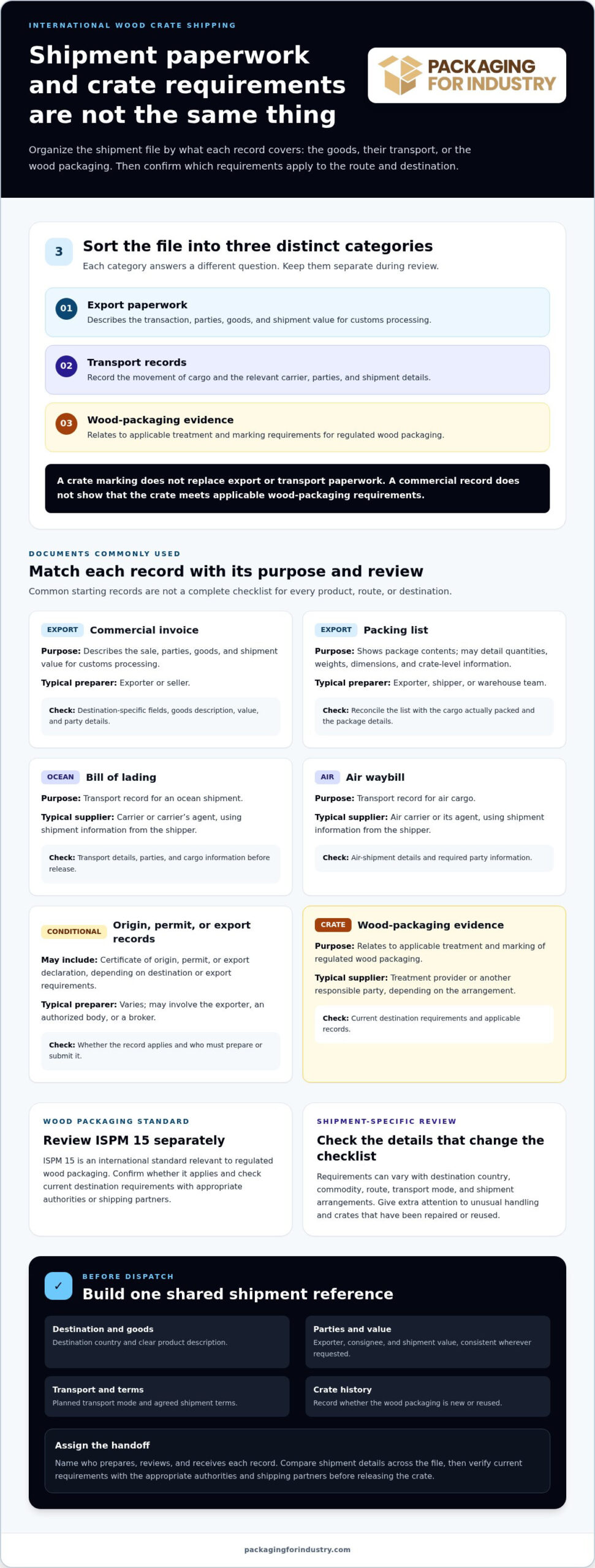
An international shipment can require records for the goods, documents for transportation, and evidence related to the wood crate. Each serves a different purpose. A complete product description does not establish that the packaging meets applicable requirements, and a crate marking does not provide customs or transport details.
Organize the documentation needed for international wood crate shipping into three categories: export paperwork, transport records, and wood-packaging evidence. A checklist for each category helps your team identify potentially relevant records, assign responsibility, and compare details across the shipment file. Use it to prepare, then confirm current requirements for the destination and shipment.
Requirements can vary with the destination country, commodity, route, transport mode, and shipment arrangements. Before finalizing paperwork or releasing a crate, verify current requirements with the appropriate authorities and shipping partners. Give extra attention to unusual handling arrangements and crates that have been repaired or reused.
Which shipment details determine the paperwork?
Start with the facts that describe the transaction and cargo. Record the destination country, a clear product description, shipment value, and exporter and consignee details. Then document the transport mode, agreed shipment terms, and whether the crate is new or reused. These details help the responsible parties identify which documents and declarations may apply and prepare them consistently.
- Destination and commodity: Identify where the goods are going and what the crate contains.
- Parties and value: Keep exporter, consignee, and shipment-value information consistent wherever it is requested.
- Transport and crate history: Record the planned transport mode and whether the wood packaging is new or reused.
Gathering these details early gives purchasing, shipping, and packaging teams a shared reference before paperwork is prepared. It also helps the crate design team understand the product and shipment context, rather than planning protection around the product alone.
Customs paperwork versus wood crate compliance
Shipment paperwork describes the goods and their movement. Wood-packaging evidence relates to the crate, including any applicable treatment and marking requirements. ISPM 15 is an international standard relevant to regulated wood packaging. The ISPM 15 Wikipedia article provides background on its purpose and scope. Confirm current applicability and destination requirements with appropriate authorities or shipping partners.
Keep the two categories separate during document review. A crate marking does not replace export or transport paperwork, and a commercial record does not demonstrate that the crate meets applicable wood-packaging requirements. Assign a reviewer to each category, then check that shipment details agree across the records. This makes it easier to spot missing information before dispatch.
Documents Commonly Needed for International Wood Crate Shipping
Each document for an international shipment serves a different purpose. A commercial invoice and packing list are common starting records, but they may not cover every requirement for a particular product, destination, or route. Use the table to assign a likely owner and identify what still needs shipment-specific review.
| Document | Purpose | Typical preparer or supplier | Shipment-specific verification |
|---|---|---|---|
| Commercial invoice | Describes the sale, parties, goods, and shipment value for customs processing. | Exporter or seller | Check required fields, goods description, value, and party details for the destination. |
| Packing list | Shows package contents and may detail quantities, weights, dimensions, and crate-level information. | Exporter, shipper, or warehouse team | Match the actual packed cargo and package details. |
| Bill of lading | Transport record for an ocean shipment, issued through the carrier or its agent. | Carrier or carrier’s agent, using shipment information supplied by the shipper | Review transport details, parties, and cargo information before release. |
| Air waybill | Transport record for air cargo. | Air carrier or its agent, using shipment information supplied by the shipper | Confirm the air-shipment details and required party information. |
| Certificate of origin, permit, or export declaration | Provides origin information or satisfies a conditional destination or export requirement. | Varies by document and shipment; may involve the exporter, an authorized body, or a broker. | Determine whether it applies and who must prepare or submit it. |
| Wood-packaging evidence | Relates to applicable treatment and marking of regulated wood packaging. | Packaging treatment provider or other responsible party, depending on the arrangement | Verify current destination requirements and applicable records. The IPPC publishes information on ISPM 15 standards. |
Commercial invoice and packing list
The invoice describes the transaction and goods being shipped. The packing list focuses on what is physically packed, including quantities and crate-level details. If one shipment contains several crates, organize the list so the contents and package details can be reconciled with the cargo. Neither record is universally sufficient on its own, so confirm what the destination and shipment require.
Review the invoice and packing list together. Product descriptions, quantities, weights, and exporter and consignee details should align with the information supplied to the carrier. Resolve discrepancies before the documents are finalized instead of relying on a crate mark or later handoff to explain them.
Transport and destination-dependent documents
A bill of lading applies to ocean transport, while an air waybill accompanies air cargo. These records relate to different transport modes and are not interchangeable. Certificates of origin, permits, and export declarations are conditional, not automatic additions to every shipment file. The exporter, carrier, broker, and consignee may each have a role, depending on the route and arrangement.
Use the documentation needed for international wood crate shipping as a shipment-specific record set, then verify document requirements with the appropriate authorities and shipping partners. To plan the packaging, share the product and shipment details when you request a custom crate quote.
Wood Crate Requirements: ISPM 15, Marks, and Supporting Evidence
Export paperwork describes the goods and their movement. Wood-packaging compliance addresses the crate material and any applicable treatment, marking, or supporting evidence. These are related parts of shipment planning, but they are not interchangeable. Shipment documents describe the cargo; wood-packaging evidence addresses the crate.
ISPM 15 is an international standard relevant to regulated wood packaging used in international trade. Its application depends on the packaging and destination, so do not assume every crate follows identical requirements. Treat the wood, mark, and supporting records as separate items to review, rather than assuming there is one universal “ISPM 15 document.”
When to check ISPM 15 requirements
Check destination rules for solid wood packaging before the crate is built or dispatched. The material used in the crate and the importing country can affect which requirements apply. If the shipment uses a new or reused crate, include that information in the review and confirm how the destination treats that packaging.
Use current guidance from the relevant destination authority or plant protection authority, and coordinate with the shipping partners involved. A general checklist can organize the review, but it cannot determine whether a particular crate and route are subject to the same rules as another shipment.
- Identify the packaging: Record the wood and other materials used in the crate so reviewers can assess which requirements may apply.
- Check the destination: Confirm current rules for the importing country and shipment.
- Review before dispatch: Leave time to address questions about treatment, marks, or records before the crate enters the shipping handoff.
Checking crate marks and supporting records
If a mark is required, check that it is legible and consistent with applicable requirements. Inspect the crate itself, not just a photograph or a document in the shipment file. A damaged, obscured, or difficult-to-read mark can make it harder for others to assess the packaging during handling or inspection.
Treatment, marking, and supporting records are distinct. A mark communicates information on the packaging; a treatment record, when required, documents an associated process. Retain relevant supplier or treatment records and include them in the shipment file when the destination or shipping arrangement calls for them. Confirm what form of evidence is expected rather than assuming one record works for every route.
A visible mark alone does not establish that all import requirements have been met. Consider the mark, any supporting records, the crate materials, and destination rules together. This separation makes the documentation needed for international wood crate shipping more useful: teams can track cargo paperwork separately from crate-specific checks, then review both before dispatch.
For manufacturers planning export packaging, crate design and material selection belong in the same preparation process as protection planning. Capture the shipment destination and product details early so the packaging plan and compliance review can proceed with the right information.
A Pre-Dispatch Checklist for International Wood Crate Shipments
A practical pre-dispatch review follows a sequence: confirm the shipment, assemble its records, inspect the crate, and complete the handoff. Assign an owner to prepare each item, a reviewer to check it, and a recipient who needs it next. This turns the documentation needed for international wood crate shipping into a working process, not just a folder of files.
Build the document set before dispatch
Start with confirmed shipment facts. Use the same destination, route, cargo description, package count, and transport mode across planning records. If any detail changes, update affected documents and notify the people relying on them. Build the file around the actual shipment, not an earlier estimate.
- Confirm shipment details. The exporter or shipping coordinator records the destination, route, goods description, crate count, and transport mode. The consignee reviews its identifying details and intended delivery information.
- Assemble core records. The exporter or seller typically prepares the commercial invoice. The shipper or warehouse team can provide packing details for the packing list. The carrier or its agent supplies the transport document for the selected mode, using shipment information from the shipper.
- Check conditional paperwork. The exporter, broker, consignee, and relevant shipping partners establish whether certificates, declarations, permits, or destination-specific forms apply and who will prepare or receive them.
For additional planning context, Engineering Custom Crates for International Transit addresses how crate engineering supports shipment needs. Keep design work distinct from preparing export records.
Inspect the crate and complete the handoff
Before release, compare the built crate with the cargo and planned handling conditions. Check that its design and materials support the intended protection plan. PFI’s custom packaging design services support crate planning around product and shipment details.
- Packaging team: Check the crate condition, relevant materials, and any marks or supporting records required for the destination.
- Shipping coordinator: Compare crate count, contents, weights, and consignee details against the shipment records. Resolve mismatches before the handoff.
- Carrier or receiving party: Provide the transport document and shipment information required for the next stage, according to the shipment arrangement.
Make the final review against the physical shipment, not only the paperwork. If the packing list describes several crates, confirm the count and contents against what is ready to leave. Check that applicable marks are visible and that names and cargo details align across records. Document who completed the review and who received the file, so your team can trace the handoff if a question arises.
Plan the Crate and Documentation Handoff with PFI
For an international shipment, the crate should reflect the product, handling plan, and operational requirements. The exporter and shipping partners coordinate the shipment paperwork. PFI provides industrial packaging design and custom wood crates, helping manufacturers plan around the cargo rather than relying on a generic container. This connects the packaging plan to the shipment and its protection needs.
Align crate design with cargo and route needs
Dimensions and weight help determine how the product will fit and be supported inside its crate. Fragility and expected handling conditions inform cushioning and restraint decisions. These inputs matter for a range of industrial shipments, from machinery and components to aerospace and electronics products. A crate designed around the cargo can help limit unwanted movement and reduce the risk of shipping damage.
PFI provides custom wooden crates, export crates, and foam-lined options for industrial shipments. Pairing a crate with suitable cushioning supports a protection plan tailored to the item. This practical approach is useful for manufacturers shipping products with specific dimensions, handling needs, or protection requirements.
Custom packaging design support connects product details to the packaging plan. PFI’s design work includes CAD/CAM support, prototypes, and crate design, giving teams a way to evaluate packaging fit and refine the approach for the application. That can help align packaging with the product before it enters a recurring or larger-scale shipping process.
Prepare a useful quote request
For a custom crate quote, share the product dimensions, weight, fragility, destination, and known handling needs. Include product features or packing constraints that may affect protection. Clear project information helps the packaging team develop a solution suited to your operation, whether you are shipping industrial equipment, aerospace components, electronics, or other manufactured goods.
Keep the documentation handoff distinct from the crate design process. Exporters and their shipping partners coordinate shipment-specific invoices, transport records, declarations, and other required documents. PFI handles packaging design and crate options, helping your team plan product protection while the parties responsible for paperwork manage their respective records.
Industrial teams in Orange County, Los Angeles, San Diego, and Riverside can work with PFI on custom packaging for export shipments. For nationwide shipping needs, PFI also supports businesses through distribution and manufacturing partners in multiple regions.
Set Up Your Next Export Crate with Confidence
Make the documentation needed for international wood crate shipping part of export planning from the start. A shipment-specific checklist gives your team a practical reference that can be adapted as products, destinations, and shipping arrangements change.
For your next shipment, review the plan with the people responsible for preparing and receiving its records. Clear ownership and timely coordination help your team address open questions before dispatch, rather than during a last-minute handoff.
Plan the packaging for your next industrial shipment around the product and its journey. PFI supplies custom crates and packaging design support for manufacturers shipping from Orange County, Los Angeles, San Diego, and Riverside, as well as businesses with nationwide packaging needs.
Share your product dimensions, weight, destination, and handling requirements to request a custom wood crate quote from PFI.
Frequently Asked Questions
Do all international wood crates need ISPM 15 treatment?
No. Do not assume every crate has the same treatment requirement. Applicability depends on the wood packaging, destination, and rules in effect for that shipment. Before dispatch, identify the crate materials and check the importing country’s current requirements with the relevant authority or shipping partners. Confirm any required treatment, marking, or supporting evidence. ISPM 15 compliance addresses wood packaging where applicable; it does not replace records describing the goods or their transport.
Is an ISPM 15 mark enough to ship a wood crate internationally?
No. A mark may address an applicable wood-packaging requirement, but it does not identify the cargo, transaction, or transport arrangement. For example, a crate mark does not tell a carrier what goods it is handling or give an importer the shipment details it needs. Review the mark and any supporting evidence against destination rules, then check the separate paperwork required for the goods, route, and selected transport mode.
Who prepares the documents for an international wood crate shipment?
Responsibility varies by document and shipment arrangement, so assign owners before the cargo is ready to leave. The exporter commonly supplies goods and transaction information, while a carrier, broker, consignee, or another party may prepare or handle particular records. Exporters in Orange County, Los Angeles, San Diego, and Riverside can use a responsibility matrix with their shipping partners to clarify who drafts, reviews, submits, and receives each item.
What details should match across the invoice and packing list?
Check that the records refer to the same transaction and physical shipment. Compare exporter and consignee names, goods descriptions, quantities, package count, and shipment information. If the packing list identifies crates separately, make sure the crate-level breakdown matches the cargo that was actually packed. Use the same product naming convention across records where practical, and resolve differences before submission or handoff. Destination and route can affect which fields are required.
Does air freight require different documents from ocean freight for a wood crate?
Yes. The transport record generally differs by mode: air cargo commonly uses an air waybill, while ocean cargo commonly uses a bill of lading. That difference does not establish the complete paperwork set for either shipment. Give the carrier accurate cargo and party details, then compare its transport record with the exporter’s shipment file. Other documents may depend on the goods, destination, route, and arrangements.
Can I reuse a wood crate for an international shipment?
Potentially, but prior use does not establish that a crate is suitable or compliant for a new shipment. Inspect for damage, loose components, or changes that could affect product protection, and identify the materials and marks present. Then review current destination requirements for the crate’s intended use. A crate that previously traveled internationally still needs a fresh shipment-specific review, particularly if it has been altered, repaired, or repacked.
Are customs documents and wood crate compliance records the same thing?
No. Shipment paperwork concerns the goods, parties, transaction, or transport, while wood-packaging checks concern the crate and any applicable treatment, marking, or supporting evidence. Keep these review tracks distinct. A complete invoice and packing list do not establish that a crate meets destination requirements, and a crate mark does not document the shipment contents. Build a file that covers both categories based on the specific cargo and route.