
The lowest-priced packaging quote can become the costliest choice when product damage, freight complications, or missed replenishment erase the apparent savings. Comparing suppliers fairly means looking beyond unit price. A packaging supplier scorecard template for vendor evaluation gives purchasing and operations teams a consistent way to weigh documented performance against business needs.
Proposals can be difficult to compare when they use different specifications, order quantities, service assumptions, or delivery terms. A low quote also says little about packaging protection, quality consistency, or how reliably materials arrive. A practical scorecard turns those concerns into clear criteria, helping teams document trade-offs and compare suppliers on total cost and supply fit.
This guide provides a reusable framework for comparing packaging suppliers on total purchasing cost, product protection, delivery, responsiveness, and operational support. Use it to record evidence, tailor criteria to custom packaging or routine replenishment, and explain the sourcing decision. The goal is a comparison that reflects your operation’s requirements, not just the number on a quote.
Key Takeaways
- Use a packaging supplier scorecard template for vendor evaluation to record requirements, weighted ratings, supporting evidence, and notes in one worksheet.
- Assess product fit, total purchasing cost, quality, delivery, service, and operational support against documented packaging needs.
- Set clear rating anchors so reviewers apply the scale consistently. Treat any scoring model as an example to adapt to your operation.
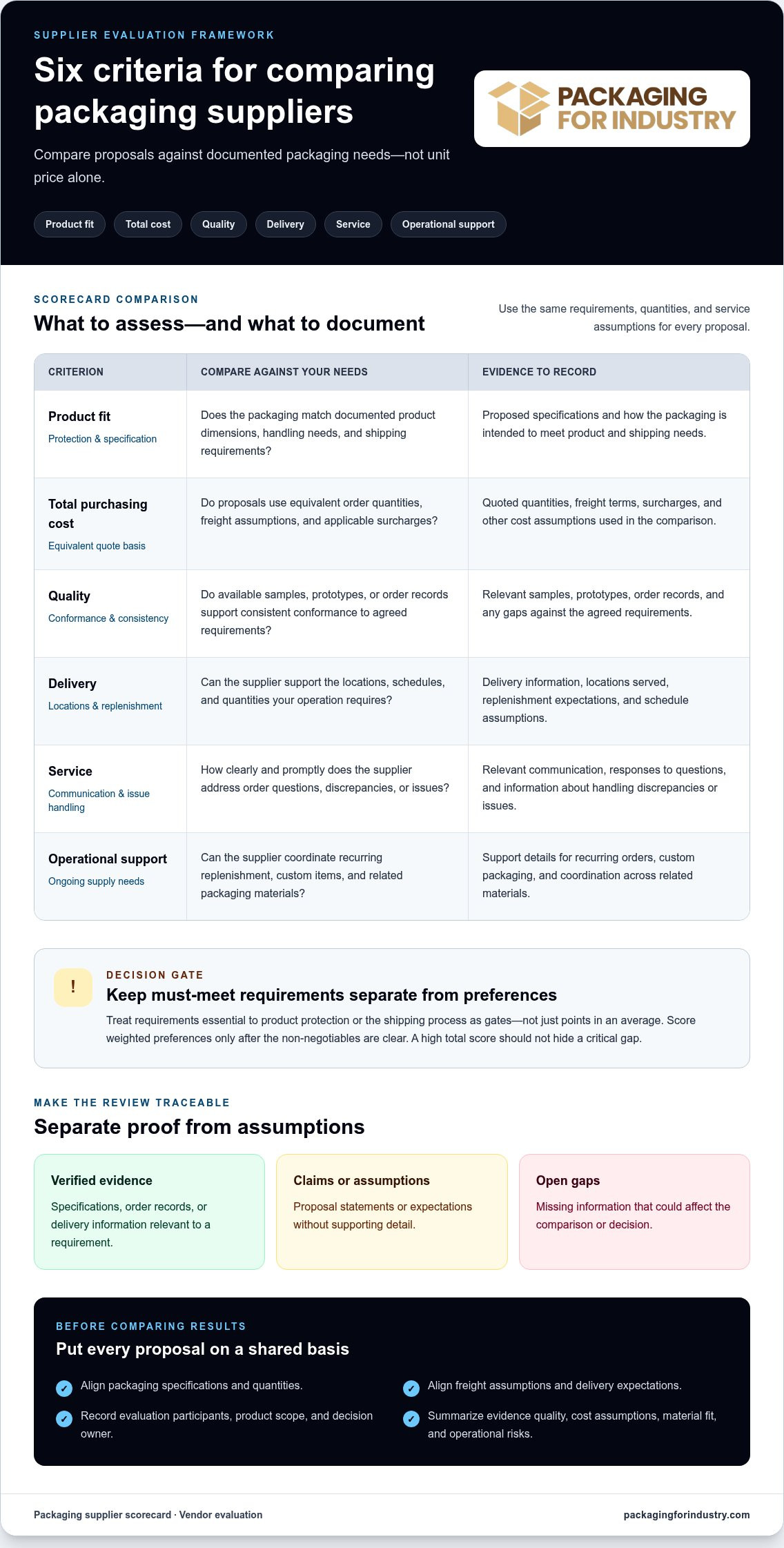
- Compare supplier results side by side, but treat must-meet requirements as decision gates. A high total score should not hide a critical gap.
- Summarize the decision with evidence quality, cost assumptions, material fit, and operational risks. Consider custom design or prototypes when stock packaging falls short.
Why use a packaging supplier scorecard for vendor evaluation?
A packaging supplier scorecard is a repeatable framework for comparing suppliers against documented business needs. Instead of relying on impressions or proposal formats, buyers define requirements, record evidence, and assess each option consistently. A packaging supplier scorecard template for vendor evaluation helps purchasing, warehouse, and shipping teams identify a supplier that supports the operation, not just the quoted price.
Quotes can appear comparable while covering different packaging specifications, quantities, freight assumptions, or delivery expectations. A lower unit price may not account for product damage, extra handling, urgent replenishment, or materials that occupy more warehouse space. A structured review helps teams weigh protection and supply reliability alongside cost. For manufacturers, distributors, and warehouses, those factors affect how consistently products move through packing, storage, and shipment.
Set the scope around the sourcing need. The review might cover a packaging supplier, distributor, manufacturer, or combination of partners. Packaging For Industry supplies industrial packaging such as corrugated boxes, foam packaging, stretch film, pallets, and crates. Its packaging solutions support manufacturers, warehouses, distribution operations, and aerospace businesses. Comparing product fit and operational support can help buyers find a solution suited to their handling and shipping requirements while supporting cost control and dependable supply.
Separate must-meet requirements from weighted preferences before scoring begins. A requirement essential to product protection or the shipping process should remain a decision gate, not just another point in an average. Set the non-negotiables first, then score preferences such as ordering convenience or coordination across packaging materials. PFI’s range of industrial packaging products and services can support evaluations involving more than one material or recurring supply needs.
When does a packaging vendor scorecard add value?
Use a scorecard for a sourcing review, supplier change, recurring packaging orders, or a new packaging requirement. It is especially useful when purchasing, operations, and warehouse teams all influence the decision, because each group can assess the same criteria from its perspective. A simple purchase with no meaningful alternatives may not need a full scoring exercise. Match the effort to the decision’s cost, complexity, and operational impact.
What should the evaluation compare?
Start with one shared basis of comparison. Align packaging requirements, quantities, delivery assumptions, and service expectations before reviewing proposals. If sustainability matters, define the material or end-of-life criteria the team intends to assess. Sustainable packaging criteria can help frame that discussion.
Keep documented evidence separate from sales claims, assumptions, and unanswered questions. Record the evaluation date, participants, product scope, and decision owner so the comparison can be understood and revisited. For businesses in Orange County, Los Angeles, San Diego, and Riverside, include delivery locations and replenishment expectations in the evaluation. Those details help distinguish a local packaging supplier’s role from broader supply needs.
- Verified evidence: Specifications, order records, or delivery information relevant to a requirement.
- Claims or assumptions: Proposal statements or expectations without supporting detail.
- Open gaps: Missing information that could affect the comparison or decision.
This approach gives industrial buyers a consistent way to compare packaging options, make operational trade-offs visible, and select support that fits their business requirements.
Which criteria belong in a packaging supplier evaluation scorecard?
A packaging supplier evaluation should compare evidence against the buyer’s requirements. Criteria need to reflect the packaging category and how materials move through purchasing, storage, production, and shipping. A useful scorecard groups the review into six areas:
- Product fit: Does the packaging match documented product dimensions, handling needs, and shipping requirements?
- Total purchasing cost: Do quotes use equivalent order quantities, freight assumptions, and applicable surcharges?
- Quality: Do samples, prototypes, or order records support consistent conformance to agreed requirements?
- Delivery: Can the supplier support the locations, schedules, and quantities the operation requires?
- Service: How clearly and promptly does the supplier address order questions, discrepancies, or issues?
- Operational support: Can the supplier coordinate recurring replenishment, custom items, and related packaging materials?
For corrugated boxes, compare proposed packaging with product and shipping requirements, not just the box description. A review of corrugated box options can help frame the category-specific discussion. For foam, document how the material and design are intended to protect the product through its actual handling and shipping conditions. For recurring packaging supplies, include replenishment processes, inventory coordination, and planning for custom-item lead times.
How should buyers assess packaging quality and product protection?
Compare samples or prototypes with the documented product, handling, and shipping requirements. Record damage history, packaging changes, and relevant review findings when available, then connect each observation to the requirement it informs. Assess the complete packaging system too: a box and protective foam may need to work together to meet protection needs. A government reference on packaging inspection and evaluation methodology can inform how teams structure inspection criteria.
How should cost and supply reliability be scored?
Compare pricing using equivalent assumptions, including order quantities, freight considerations, and relevant surcharges. Then evaluate availability and replenishment planning against recurring demand, storage constraints, and custom-item lead times. Score local delivery or nationwide support only in relation to the operation’s actual locations and requirements. This prevents a quote from receiving a strong cost rating when its assumptions do not match the purchasing plan.
To make the packaging supplier scorecard template for vendor evaluation practical, attach evidence to each rating and leave information gaps visible. A proposal statement, sample review, and documented delivery history are different kinds of evidence, so note what supports each score rather than treating them as equivalent. When comparing custom and stock packaging or coordinating boxes with foam, a packaging quote based on your requirements can provide a defined scope for evaluation.
How to build a packaging supplier scorecard template buyers can use
Build the worksheet around the decision your team needs to make, not around a supplier’s proposal format. A useful packaging supplier scorecard template for vendor evaluation shows each requirement, its importance, the supplier’s rating, and the evidence behind that rating. Set scoring rules and weights before comparing vendors so a persuasive presentation or low quote does not shift the goalposts.
What fields should the scorecard template include?
Start with a header for supplier name, quote date, packaging category, product scope, order assumptions, evaluation date, reviewers, and decision owner. These details show what the team compared and who is responsible for the decision. Then give each criterion its own row, with fields for:
- Requirement: State the operational need in specific, assessable terms.
- Importance or weight: Assign a value based on business priorities.
- Pass/fail status: Mark must-meet requirements separately from preferences.
- Rating: Record the score using the agreed scale.
- Evidence and notes: Cite the supporting document or observation, and explain gaps or context.
Keep pass/fail requirements outside the weighted total. For example, a supplier that does not meet a required packaging specification should not appear qualified because high preference scores raised its average.
How can teams score vendors consistently?
Use a simple scale with plain-language anchors. The following 1-to-5 scale is an example for teams to adapt, not an industry standard: 1 means the requirement is not met or evidence shows a material gap; 2 means substantial gaps remain; 3 means the requirement is partly met or evidence is incomplete; 4 means it is met with adequate evidence; 5 means it is met with strong, directly relevant evidence. Use “not assessed” when there is not enough information to rate a criterion.
Before reviewing proposals, agree on the specifications, order assumptions, and evidence requests every supplier will receive. Assign weights at this stage too. A recurring supply requirement may matter more to one operation than ordering convenience, while another project may prioritize product protection or custom packaging. Weighting should reflect the buyer’s needs, not a supplier’s strengths.
For a basic weighted comparison, multiply each criterion’s rating by its weight, then add the results for criteria that passed any applicable must-meet gate. Keep the underlying ratings visible. The total helps organize comparisons, but it does not replace procurement judgment. Reviewers still need to consider evidence quality, unresolved gaps, and operational consequences.
Score only criteria supported by comparable evidence, or clearly label the gaps. If reviewers assign noticeably different ratings, discuss the requirement and evidence, record the reason for the final score, and preserve relevant comments. Do not silently average conflicting views. This gives purchasing, operations, and warehouse stakeholders a shared record they can use to explain the recommendation and revisit assumptions if requirements change.
How to compare scorecard results without choosing on price alone
Put supplier ratings, evidence, gaps, and operational implications side by side. A simple comparison view helps distinguish a real performance difference from a proposal based on different assumptions. Keep must-meet requirements visible as decision gates: a high weighted total cannot offset a failed requirement that makes the packaging unsuitable for the operation.
Supplier A: Record the rating and supporting evidence, note any information gap, and state what the result means for product protection, replenishment, or warehouse handling.
Supplier B: Use the same fields and requirements. This shows whether a difference comes from demonstrated performance, an unresolved question, or a variation in proposal scope.
Decision implication: Note whether each supplier meets must-have requirements and what trade-offs remain. Keep verified findings separate from assumptions.
Before interpreting the price gap, check whether quotes cover equivalent materials, order quantities, freight assumptions, surcharges, and packaging design scope. One quote may include custom design work while another prices a stock item. A quote may also assume a different order quantity or delivery arrangement. Without normalizing these inputs, the scorecard can make unlike proposals appear comparable.
What should buyers do when the lowest quote scores poorly elsewhere?
Compare the quoted difference with documented risks, such as prior damage, freight impacts, supply shortages, or added handling. Do not assign a monetary value to a possible benefit unless the team can support its estimate. Record which trade-off the business accepts and why, tying the decision to stated priorities such as protection, cost control, or dependable replenishment.
How should teams address missing or conflicting evidence?
Mark missing information as unknown, not as a neutral or favorable score. Route the same clarification requests through the same procurement process for each candidate, then document the response and its source. If reviewers disagree, capture the reason and the evidence considered. Before selection, assign an owner to each unresolved concern and record how it could affect the decision or operation.
For recurring packaging needs, assess replenishment as part of supplier performance, not as a side issue. Buyers evaluating managed inventory can include inventory coordination, availability, and purchasing workload in the comparison. Vendor-managed inventory for packaging is one capability to consider when comparing sourcing approaches.
The packaging supplier scorecard template for vendor evaluation should clarify trade-offs, not produce an automatic winner. Procurement judgment still matters, especially when evidence quality differs or the operation faces a critical supply risk. A defensible recommendation explains which requirements were met, what remains uncertain, and why the selected balance of cost and operational fit is appropriate.
Turn the packaging supplier scorecard into a sourcing decision
A scorecard is useful when it leads to a clear decision, an assigned owner, and a plan for managing the supply relationship. Summarize each candidate against five points: requirements met, evidence quality, material fit, cost assumptions, and operational risks. Keep must-meet gaps visible, and explain any trade-off the team accepts. The packaging supplier scorecard template for vendor evaluation then becomes a decision record, not just a set of ratings.
- Requirements met: Identify which essential needs each option satisfies.
- Evidence quality: Note whether the decision rests on documented information, a sample review, or an unresolved assumption.
- Material fit: Explain how the proposed packaging aligns with the product and shipping needs.
- Cost assumptions: State the order, freight, and scope assumptions used in the comparison.
- Operational risks: Record concerns related to replenishment, storage, or changing demand.
Stock packaging may suit standard applications, while a particular product shape, protection requirement, or workflow may call for a tailored approach. Custom design, prototypes, and coordinated materials help assess a solution before it becomes part of routine purchasing. PFI supplies both custom and stock packaging and provides design support that can bring boxes, foam, and other materials together around the application. For an engineered requirement, custom packaging design can connect product protection with handling and operational needs.
What information should buyers prepare before requesting a quote?
Gather the details a packaging supplier needs to understand the application and prepare a relevant proposal. Include packaging dimensions, product protection needs, quantities, order frequency, and delivery locations. Describe current packaging problems, shipping constraints, and custom-item requirements. Specify whether the request covers corrugated boxes, foam, stretch film, crates, or an integrated packaging solution. Clear inputs make it easier to compare the resulting scope and assumptions.
How can buyers connect supplier selection to ongoing operations?
Name an owner for the supplier relationship and agree on what the team will monitor, such as quality, replenishment, and changes in packaging requirements. For recurring demand, consider whether vendor-managed inventory or just-in-time packaging could align supply with storage capacity and purchasing workload. Keep the completed scorecard as a baseline. If quantities, products, delivery locations, or protection needs change, update the requirements and revisit the decision using the same evidence-based process.
PFI supports manufacturers and other industrial operations with custom and stock packaging, design and prototype support, and inventory programs for recurring needs. Share your packaging requirements, quantities, order frequency, and delivery locations to start a practical sourcing discussion. Submit your requirements and request a packaging quote.
Make your next packaging decision more dependable
Use the packaging supplier scorecard template for vendor evaluation as a working baseline, not a one-time purchasing form. As products, order patterns, and shipping needs change, update the requirements and evidence so future sourcing decisions reflect current operating conditions. This gives purchasing and operations teams a practical way to keep supplier choices aligned with product protection and supply continuity.
PFI supports packaging programs with custom and stock options, design and prototype work, and coordinated materials. For recurring needs, vendor-managed inventory and just-in-time inventory management can also support the sourcing program. The right approach depends on the application, order pattern, and how packaging fits into your workflow.
Share your packaging requirements, quantities, order frequency, and delivery locations to start a focused conversation about the right fit for your operation.
A clear next step can turn a documented evaluation into a stronger, more reliable packaging program.
Frequently Asked Questions
How do you evaluate a packaging supplier?
Evaluate a packaging supplier by involving the people who handle packaging after purchasing places the order. Ask receiving staff about delivery handoffs, production teams about material usability, and shipping staff about recurring packing bottlenecks. Their observations can reveal supplier-fit issues that do not appear in a proposal. For packaging for manufacturers, this cross-functional input connects purchasing decisions to work on the floor.
What should a packaging supplier scorecard include?
Along with evaluation data, include clear instructions so different buyers can use the template consistently. Define who maintains it, how reviewers should interpret its rating anchors, and where supporting records are stored. Keep a dated copy of each completed review rather than overwriting the previous version. This creates a usable history for procurement teams and makes it easier to understand how requirements or supplier performance changed over time.
How do you compare packaging supplier quotes fairly?
Give each supplier the same request format and ask for pricing in a consistent unit of measure, such as per box or per order, where applicable. This makes it easier to compare packaging pricing line by line and spot differences in how items are presented. Keep the original quotes with the normalized comparison so reviewers can trace each figure to its source.
Can a supplier scorecard work for both custom and stock packaging?
Yes. Keep separate worksheets or sections for packaging categories when their evaluation details differ, and avoid combining unrelated items into one score. A warehouse team comparing standard replenishment items may need a different review from a project team assessing packaging for a new product. Shared review procedures can keep records consistent while each group captures the details relevant to its sourcing decision.
How often should a company reevaluate its packaging suppliers?
Use planned sourcing or operations reviews to revisit supplier performance, and bring the review forward if an issue affects production or shipping. Looking at patterns across order records can help distinguish a recurring concern from an isolated problem. Teams supporting packaging for warehouses or distribution centers can also use routine planning meetings to raise upcoming demand changes before they affect purchasing decisions.
What evidence should a packaging supplier provide during evaluation?
Request records that let reviewers connect the proposal to the item being purchased. For example, confirm that a sample or prototype corresponds to the design and revision described in the quote, and retain that reference with the purchasing file. For repeat orders, keep relevant order confirmations and receiving records together. An organized record helps the team resolve later questions about what was specified and supplied.
Is the lowest-cost packaging supplier always the best choice?
No. The lowest quote can still be the right choice if it covers the required scope and fits the operation’s purchasing and handling process. The decision should reflect the organization’s priorities, not a blanket preference for the cheapest or most expensive option. Before approval, make sure the budget owner understands the assumptions behind the quoted amount and that the selected approach supports the planned use of the packaging.