
A polished package can’t reinforce your brand if the product arrives damaged or the box feels out of step with its value. Premium B2B packaging that reinforces brand value brings presentation and performance together: it protects the product, suits the shipping process, and creates a consistent experience with every order. For manufacturers and distributors, the challenge is finding that balance without adding avoidable costs or making packaging difficult to reorder.
Packaging has to work on the warehouse floor and in transit, not just look good when opened. The right specifications can support both goals, from choosing stock corrugated boxes for standard shipments to developing custom sizes and protective foam for specific products. Reliable replenishment matters, too, so the same packaging stays available as orders continue.
This article explains how to define packaging requirements around product protection, brand presentation, dimensions, and production needs. You’ll learn how to compare stock and custom options and assess a supplier’s ability to support design, samples, integrated materials, and recurring supply. Use these steps to make packaging a dependable part of your customer experience and shipping operation.
Key Takeaways
- Assess premium B2B packaging that reinforces brand value by how well it protects the product, presents your brand, and delivers a consistent experience.
- Match materials to shipping demands. Combining corrugated boxes, foam, and crates can address different protection needs.
- Compare stock, customized, and engineered packaging based on product fit, branding priorities, repeat-order needs, and warehouse storage.
- Build a practical packaging brief that covers product dimensions, fragility, handling, shipment method, volume, and replenishment.
- Consider how custom design, prototypes, kitting, and inventory programs can support packaging consistency and reliable supply.
What Premium B2B Packaging Means for Brand Value
Premium B2B packaging is fit-for-purpose packaging that protects a product while delivering a deliberate, consistent brand experience. It isn’t defined by elaborate decoration or the highest-cost material. Its value comes from how well the packaging suits the item, the shipment, and the recipient’s expectations. For a manufacturer shipping a precision component or a distributor sending equipment to a business customer, the package should arrive in a condition that reflects the care invested in the product.
Brand value is shaped by more than what appears on a box. Product condition, presentation, consistency across shipments, and confidence in the delivery all contribute. These practical signals influence how a business’s standards are perceived. Brand equity describes the value associated with a brand. In B2B shipping, packaging helps make that value tangible by protecting what the brand promises.
Protection preserves the product; presentation communicates the care behind it. Together, they shape the recipient’s experience from delivery through unpacking and handling.
How industrial packaging communicates brand standards
A clean, well-fitted box with consistent labeling can signal organized operations without relying on decorative extras or promising a particular customer reaction. For example, a manufacturer shipping assemblies can use clear identification and a repeatable package format to support receiving and handling. A distributor sending equipment can pair corrugated packaging with protective materials suited to the shipment, rather than leaving the item to shift inside an oversized carton.
Visible brand elements, such as printed graphics, labels, or a consistent presentation, are only one part of the system. Less visible decisions matter just as much: carton fit, internal cushioning, closure, and preparation for handling. PFI’s custom packaging design brings these considerations together so presentation supports the product and shipping process.
Why premium does not mean decoration alone
A polished appearance can’t compensate for packaging that fits poorly or doesn’t suit the shipment. Material choice, dimensions, closure, and repeatability all contribute to quality. A custom die-cut foam insert, for instance, can position a component inside a corrugated box. A shipment with different handling needs may call for another combination of materials. The goal is to match the design to the job, not to add features without a clear purpose.
Premium requirements depend on product risk, delivery channel, and business objectives. A recurring shipment may need consistent specifications that warehouse teams can use reliably. A fragile or unusually shaped item may need a more tailored design. In either case, weigh presentation alongside product protection and practical handling. That’s how premium B2B packaging that reinforces brand value supports a dependable experience without confusing decoration with performance.
How Protection, Presentation, and Consistency Reinforce Brand Value
Packaging choices affect more than the moment a shipment arrives. A suitable fit helps keep a product positioned as intended, while appropriate protective materials address handling and shipping demands. If the product arrives in good condition and the package is organized and easy to identify, the delivery can reflect the care behind the business’s work. Poor fit or mismatched protection can lead to damage or a difficult receiving experience, weakening that impression.
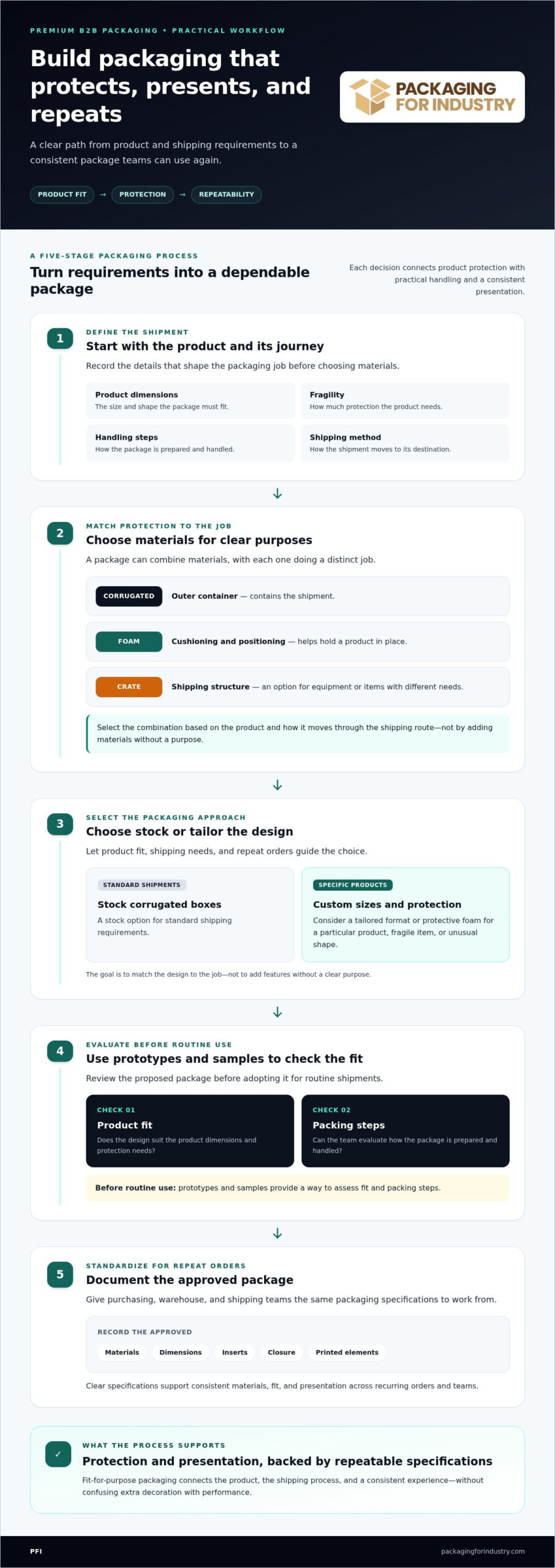
A package can use several materials for different jobs. A corrugated box forms the outer container, foam can cushion or hold a product in place, and a crate can provide the shipping structure for equipment or other items that need a different approach. Choose the combination based on the product and how it moves through the shipping route, not on adding materials for their own sake.
Packaging consistency means repeatable materials, fit, and presentation across shipments. That repeatability matters when different warehouse teams prepare orders or products move through multiple distribution points. Clear specifications help teams use the intended box, insert, closure, and approved printed elements. They also reduce ad hoc decisions that can lead to uneven packing or substitutions.
Match protective materials to the product and shipping route
Start a packaging review with practical details: product fragility, dimensions, handling steps, and shipping method. Corrugated packaging contains the shipment, foam can cushion or position items, and crates provide a structural packaging option. A manufacturer shipping components may need an organized combination that keeps parts arranged, while larger equipment may require a different format. PFI’s custom packaging design services can align packaging requirements with the product and shipping process. Prototypes and samples give teams a way to evaluate fit and packing steps before adopting a design for routine use.
Keep brand presentation consistent across repeat shipments
Document the approved materials, dimensions, inserts, and printed elements so purchasing, warehouse, and shipping teams work from the same specifications. This record is useful when orders recur or move through more than one facility. It also gives a packaging supplier a clear basis for maintaining the intended setup, rather than relying on memory or last-minute substitutions.
Plan replenishment around actual packaging use, not just a one-time order. PFI’s vendor managed inventory uses scheduled reviews and replenishment based on usage to support continuity for recurring needs. Pairing documented specifications with a replenishment plan makes it easier to maintain the same materials and presentation as demand changes.
For a packaging review that brings product protection and repeat-order requirements together, request a packaging quote with the product and shipping details your team already tracks.
Compare Stock, Customized, and Engineered Packaging Options
The right packaging approach depends on product fit, protection needs, shipping conditions, and how consistently the order repeats. Appearance matters, but it shouldn’t determine the format on its own. A stock carton may meet the requirements, while a recurring shipment with a specific product profile may benefit from adjustments or a design built around the item. Compare the options against operational needs before choosing a package.
| Option | Fit and protection | Branding and recurrence | Storage considerations |
|---|---|---|---|
| Stock packaging | Works when available formats suit the product and shipping method; add suitable cushioning if needed. | Supports a straightforward, repeatable presentation; labels can help identify shipments. | Standard formats can simplify purchasing, though teams need room for the selected sizes and quantities. |
| Customized stock | Uses a stock format with selected additions, such as an insert or cushioning, to address a particular need. | Can support consistent identification or presentation across recurring orders. | May require space for the base package and any added components. |
| Engineered packaging | Designed around specific dimensions, protection needs, handling, and shipment requirements. | Can establish a defined format for repeat orders and approved brand elements. | Plan storage for custom components and coordinate replenishment with expected use. |
When stock packaging may meet the requirement
Stock packaging is a practical starting point when standard formats fit the product and shipment without unnecessary void space or complicated packing steps. Stock corrugated boxes and related supplies can support routine purchasing. They aren’t inherently lower quality or inconsistent with a professional brand. A suitable stock box, packed and labeled consistently, can present a clean, dependable shipment.
When customization or engineering adds value
Customization is useful when a product’s shape, fragility, handling, or shipping process calls for a closer fit. Custom sizing, foam inserts, partitions, and crates can all be considered as parts of a packaging solution. PFI supplies stock and custom corrugated box formats for different packaging needs.
For recurring orders, prototypes and samples let a team review fit and packing steps before wider use. Purchasing and warehouse staff can assess whether the proposed format suits the workflow, rather than relying on appearance alone. Custom packaging doesn’t automatically cost less or prevent every damage issue. Evaluate its design against the product, shipment, and handling conditions.
Use these decision points to compare alternatives:
- Product fit: Does the package hold the item appropriately and accommodate its dimensions?
- Protection needs: Does the product require cushioning, separation, or a more substantial outer structure?
- Branding: Which visible elements are necessary for a consistent business presentation?
- Repeat orders: Can the same specifications support purchasing and packing across teams?
- Storage: Can the operation manage the package sizes and related components it needs to keep on hand?
The best choice balances these requirements. That’s the practical basis for premium B2B packaging that reinforces brand value: selecting a package for its fit, function, and repeatability, not decoration alone.
Build a Packaging Brief That Balances Brand and Operations
A useful packaging brief gives design and purchasing teams the same working picture of the job. It turns broad goals, such as a consistent brand experience or fewer handling issues, into details a packaging supplier can use to evaluate materials, fit, and replenishment. Record current problems as well as desired outcomes. That makes it easier to compare options against the realities of production, shipping, and storage.
Specify the product, route, and recipient experience
Start with what ships, how it moves, and what the recipient needs to see and handle on arrival. Include packaging volume and any cushioning, partitions, corner protection, or moisture-related requirements your team has identified. For a crate project, describe the item and shipping route so the packaging approach can reflect the shipment’s needs.
- Describe the product. Record dimensions, weight if available, shape, fragile areas, and any components that ship together or separately.
- Map the shipment. Note the shipping method, route, handling steps, and whether the package moves as an individual carton, palletized load, or crated shipment.
- Document protection concerns. Describe past damage, movement inside the package, difficult packing steps, and any cushioning, partitions, or edge protection already in use. If moisture is a concern, state the requirement rather than assuming a material will address it.
- Set presentation priorities. Specify labels, approved printed elements, and what the receiving team should be able to identify or access easily.
- Capture operating constraints. Include packaging volume, storage limits, packing-space considerations, and issues with current sizes or supplies. Note any shipping surcharges your team has encountered so the review can account for them.
- Plan repeat demand. Share usage patterns, production schedules, order frequency, replenishment needs, and the time your team needs to receive and stage packaging.
For shipments requiring a crate, PFI’s wooden crate packaging can be considered alongside the product, route, and handling details in the brief. Clear inputs help align the package with the item’s movement instead of treating the crate as a standalone purchase.
Plan for repeat orders and inventory realities
Include expected usage and the lead time your operation needs to keep packaging available. Note warehouse capacity and whether demand changes with production schedules. These details connect the package specification to purchasing and replenishment, rather than treating each order as a separate decision.
For recurring needs, vendor managed inventory or just-in-time inventory management can organize replenishment around usage and production requirements. Cost analysis should look beyond unit price. Consider materials, freight, potential damage exposure, storage, and staff effort involved in purchasing and packing. A general estimate can’t replace a project-specific comparison. PFI can use the brief to review packaging needs and compare packaging pricing against your documented requirements.
How PFI Connects Custom Packaging with Reliable Supply
Packaging For Industry (PFI) is an industrial packaging supplier for manufacturers, warehouses, distributors, and other B2B operations. Its products include corrugated boxes, foam, stretch film, crates, tapes, tubes and cores, and corner and edge protection. PFI also provides custom packaging design, packaging kitting and assembly, vendor managed inventory (VMI), and just-in-time inventory management for recurring requirements. The company serves businesses in Orange County, Los Angeles, San Diego, and Riverside, with local next-day delivery throughout Southern California and fast nationwide shipping.
Products and Industries Served: Combine Packaging Materials Around the Shipment
Packaging materials can be considered together rather than specified in isolation. A project for industrial equipment may combine a corrugated box with foam and protective materials; another shipment may call for a crate. PFI serves industries including aerospace and aviation, electronics, medical device manufacturing, food and beverage, and construction. The suitable materials depend on each product and shipping operation.
Benefits and Why Choose PFI: Turn a Packaging Brief into a Practical Next Step
Custom design support includes prototypes and samples, giving teams a way to assess a proposed configuration before wider use. Kitting and assembly can support organized packaging workflows, while VMI and just-in-time programs address recurring supply needs. PFI’s local delivery across Southern California and nationwide shipping support businesses with regional operations and shipments across the country.
For a project-specific quote, share the product, dimensions, shipping route, order volume, damage concerns, and schedule. These details help PFI consider suitable stock or custom packaging options and provide a basis for comparing them.
Make Your Next Packaging Decision More Deliberate
Packaging requirements can shift as products, shipping routes, and production schedules change. Use your next review to focus on a recurring shipment and identify what your operation needs to learn before adjusting its packaging. Choose practical measures to track, such as reported damage, packing time, storage demands, or substitutions. This gives purchasing and operations teams a shared basis for deciding whether to keep the current format, refine it, or evaluate another option.
For businesses investing in premium B2B packaging that reinforces brand value, connect the recipient experience you want to create with details your team can assess in daily operations. Bring those priorities into the same conversation as the packaging specification and replenishment plan. A project-specific quote lets you compare approaches using your shipment requirements rather than general assumptions.
Start with a clear operational question, involve the people who handle the shipment, and build from what they observe. For a custom packaging quote, share your product and shipping requirements with PFI.
Frequently Asked Questions
What makes B2B packaging feel premium to business customers?
Premium packaging can make receiving and inspection more orderly, especially when a shipment contains multiple components or product variants. Clear part identification and a package that supports the recipient’s intake process can make the transaction feel considered and professional. For premium B2B packaging that reinforces brand value, consider what the customer’s team needs to identify, verify, and route after delivery, not just what the outer package looks like.
Can custom packaging reinforce a brand without changing the product?
Yes. Custom packaging changes how a product is prepared for shipment, not the product itself. For example, a manufacturer can use partitions to keep existing components organized as a set, or an insert shaped around an unchanged item. If the product design later changes, update the packaging specification as a related controlled document so the packing process stays aligned with the current product configuration.
How can a business compare custom packaging with stock packaging?
Start by grouping shipments by product family and order profile. A standard carton may suit stable, regularly shipped items, while a less common configuration may call for a tailored format. Review the mix of items handled at each packing station and note where staff switch between package types or improvise. This makes the decision more specific than choosing one packaging approach for every SKU across the operation.
Does premium industrial packaging have to include custom printing?
No. Custom printing is one option, not a requirement for premium industrial packaging. It may help distinguish product families or communicate an approved identity, but it should serve a defined operational or brand purpose. For other shipments, standardized labels or existing documentation may provide the necessary identification. Decide which information belongs on the package and which belongs in the accompanying shipping paperwork.
What information should I include when requesting a custom packaging quote?
Along with project requirements, include current packaging item numbers, the components used per shipment, and the order quantities you want priced. If you’re evaluating more than one format, identify each option separately so the quote comparison stays clear. List ship-to locations if orders go to multiple facilities, and note whether your team can use approved alternatives or needs a specific configuration for each item.
Can packaging inventory programs support consistent repeat orders?
They can support consistency when teams maintain a shared record of approved packaging specifications and control changes to that record. For multi-site operations, assign responsibility for approving revisions and make sure each facility uses the same current version. This is especially useful during product or process changes, when an outdated package instruction could lead to different packing practices across locations.