
A dry-looking container can still deliver a damp, corroded, or weakened load. Preventing condensation damage in ocean freight containers takes more than adding a moisture absorber. Temperature shifts can turn moisture already present in the air, cargo, pallets, and packaging into water that collects on container walls and drips onto goods. If packaging must protect products without adding unnecessary bulk or handling steps, choose materials and a design that fit the shipment.
This guide explains how container condensation forms, where moisture comes from, and how damage can affect metals, paper packaging, wood, and other cargo. It compares the roles of desiccants, ventilation, dry loading materials, vapor barriers, and protective packaging, then outlines a pre-shipment process for assessing cargo and selecting controls. Packaging is one layer of moisture management, not a substitute for addressing moisture sources. Custom packaging design can combine corrugated boxes, protective foam, crates, and moisture-barrier bags to suit product geometry and freight needs, helping manufacturers balance protection, space, and operational efficiency.
Key Takeaways
- Identify moisture from cargo, packaging, and loading conditions before selecting controls for an ocean shipment.
- Compare source reduction, desiccants, moisture barriers, and protective packaging by their roles and limitations.
- Use a pre-shipment process to assess cargo, choose controls, and document packaging materials and damage observations.
- For preventing condensation damage in ocean freight containers, treat packaging as one layer of a broader moisture-management plan.
- Coordinate corrugated boxes, foam, moisture-barrier bags, and crates to suit cargo dimensions and shipping needs.
What Causes Condensation Damage in Ocean Freight Containers?
Moisture during an ocean shipment can corrode metal components, soften cartons, and stain or obscure labels. The cause isn’t always water entering through a hole or faulty seal. Container condensation occurs when water vapor already inside the container cools and changes into liquid water on a surface. The dew point is the temperature at which that change begins. Temperature shifts during transit can bring air or cargo surfaces to that point, even when the container isn’t leaking.
This distinction matters when preventing condensation damage in ocean freight containers. A leak introduces water from outside; condensation forms from moisture within the shipment environment. The source may be humid air or moisture held in cargo and packaging. Both can leave goods wet, but identifying where moisture appears helps teams decide what to inspect and which protection layers to consider.
How container rain differs from cargo sweat
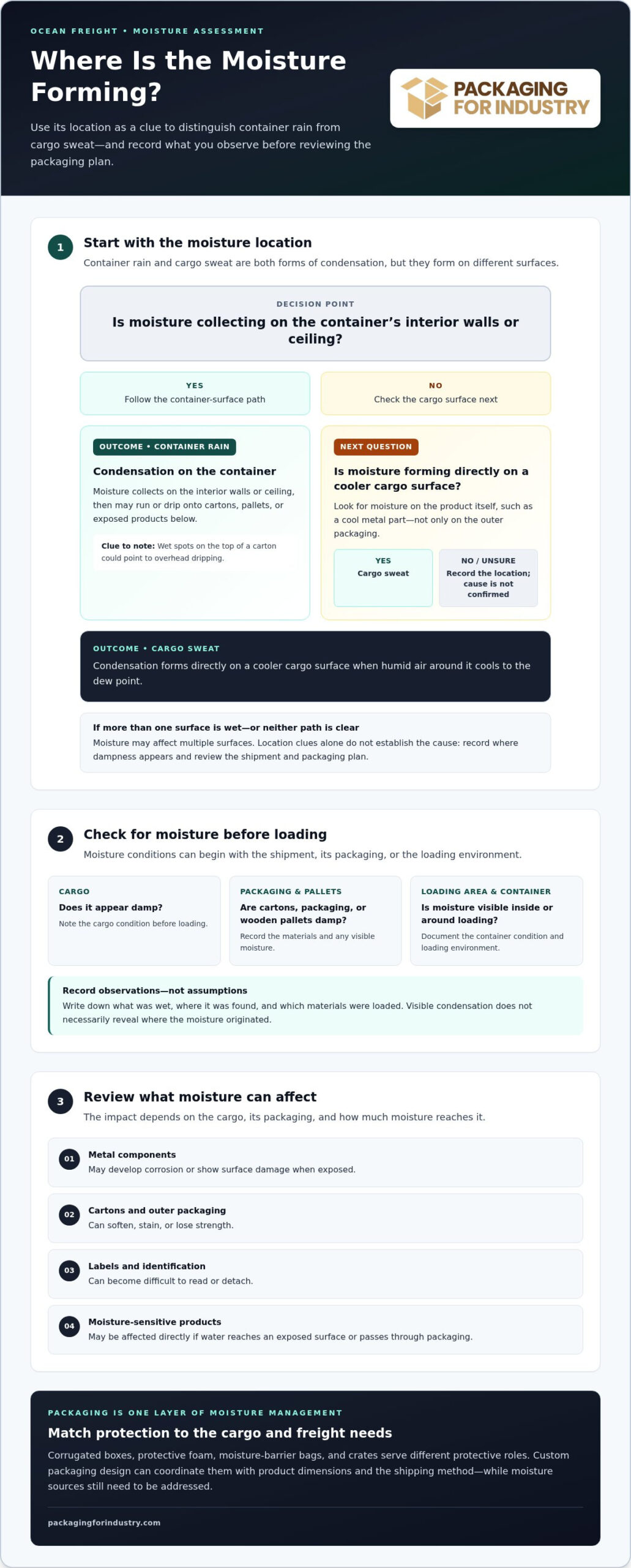
Container rain is condensation on a container’s interior surfaces that can drip onto the cargo below. As the metal walls or ceiling cool, moisture may collect there and run or fall onto cartons, pallets, or exposed products. Cargo sweat is different: condensation forms directly on a cooler cargo surface when humid air around it cools to the dew point. The location of the moisture can help distinguish the two, although outcomes depend on shipment and environmental conditions.
A load may show one pattern more clearly than the other, or moisture may affect multiple surfaces. Wet spots on the top of a carton, for example, could point to overhead dripping, while moisture on a cool metal part may form directly on the product. These clues don’t establish the cause on their own. Record where dampness appears and use those observations to review the shipment and packaging plan.
Which cargo and packaging can be affected?
Moisture can affect both products and protective packaging. Metal components may develop corrosion; cartons can soften, stain, or lose strength; and labels may become difficult to read or detach. Moisture-sensitive products can also be affected directly if water reaches an exposed surface or passes through packaging. The outcome depends on the cargo, its packaging, and how much moisture reaches it during transit.
- Direct product exposure: Bare metal parts or moisture-sensitive goods may become damp or show surface damage.
- Outer packaging damage: A wet carton or label can compromise identification and handling, even if the product inside appears unaffected.
- Protection that needs review: Inspect how the product is separated from the outer carton, especially where water could collect or contact the load.
Packaging is one part of moisture management, not a substitute for addressing moisture sources. Corrugated boxes, foam, moisture-barrier bags, and crates serve different protective roles. Custom packaging design can coordinate these materials with product dimensions and the shipping method, giving buyers a practical plan for repeat freight.
How Moisture Builds Up and Condenses Inside an Ocean Freight Container
Moisture conditions can be set before a container leaves the loading area. Cargo may carry moisture, packaging materials may be damp, and the air enclosed during loading may already contain water vapor. During transit, changing temperatures can alter how much moisture the air holds and whether that moisture remains vapor or condenses on cooler surfaces. Because these factors interact, preventing condensation damage in ocean freight containers starts with examining the shipment as a whole rather than assuming a single cause.
Dew point is the temperature at which air holding water vapor becomes saturated and moisture begins to condense. It isn’t a single temperature that signals the same level of risk for every shipment. The amount of moisture in the air, the temperature of the air and surfaces, and the cargo’s condition all matter.
Moisture sources before and during loading
Potential sources include damp cargo, cartons or other packaging, wooden pallets, and moisture in the loading environment. Some products may also contain or release moisture, depending on their material and condition. Visible condensation doesn’t necessarily identify where moisture originated. Keep observations separate from assumptions: record what was wet, where it was found, and which materials were loaded.
A pre-loading review can establish useful context:
- Note whether cargo, cartons, pallets, or the loading area appear damp.
- Record the packaging materials and any visible moisture before loading.
- Document the container’s condition, including any signs of moisture inside.
Why transit temperature changes matter
Container surfaces and cargo don’t necessarily warm or cool at the same pace as the surrounding air. When moisture-bearing air meets a cooler surface, it may reach its dew point and condense. A change in ambient temperature can therefore alter conditions inside the load without any water entering through a leak. The likelihood and location of condensation depend on the shipment and its environment, not on a universal route rule.
Route and weather influence exposure, while cargo and container conditions shape how moisture behaves within a particular shipment. Treat these as shipment-specific factors. A route alone can’t establish that condensation will occur, and the absence of visible water at loading doesn’t mean conditions will remain unchanged during transit.
After delivery, document evidence before changing the load. Note the location and extent of dampness, which layers are affected, and whether the product itself or only its outer packaging shows signs of moisture. Compare those observations with loading records. This helps distinguish a confirmed condition from a suspected source and gives packaging teams useful information for the next shipment.
For repeat freight or unusual product dimensions, a custom packaging quote can help align packaging materials with the cargo and shipping method as part of a broader moisture-management plan.
Comparing Ocean Freight Condensation Prevention Methods
No single control fits every load. The right combination depends on the cargo’s moisture sensitivity, its condition before packing, the packaging materials, and the shipment environment. Source reduction, desiccants, moisture barriers, and protective packaging address different parts of the problem. Treat them as complementary controls rather than expecting one measure to manage every moisture source.
Desiccants can help manage moisture in a container, but they don’t guarantee a condensation-free shipment. Their effectiveness depends on appropriate selection and use, and they don’t remove moisture already held in damp cargo or packaging. Barriers and outer packaging also have specific roles. A barrier may separate a product from moisture exposure, while a carton or foam insert can organize or cushion the load.
| Method | Role | Suitable context | Important limitation |
|---|---|---|---|
| Source reduction | Reduces moisture introduced through cargo, packaging, pallets, or loading conditions. | Loads where damp materials or handling conditions can be addressed before departure. | Doesn’t control moisture that enters or forms later during transit. |
| Desiccants | Manage moisture within the shipment environment. | Loads where moisture control is needed alongside suitable loading and packaging practices. | Incorrect selection or use may leave moisture sources unaddressed; desiccants alone aren’t a guarantee. |
| Moisture barrier bags | Separate suitable products from external moisture exposure. | Products whose packaging requirements call for a barrier layer. | Suitability depends on the product and material specifications; a bag doesn’t dry damp cargo. |
| Cargo packaging | Contains, separates, organizes, or cushions products within the load. | Items that need organized packing or physical protection during handling and transit. | Ordinary cushioning and cartons aren’t automatically moisture barriers. |
When desiccants or moisture barriers may fit
Consider desiccants as one part of a moisture-management plan, not as a substitute for dry cargo and packaging. Moisture-barrier bags may suit products that need a defined protective layer, provided the material and packaging approach match the shipment’s requirements. Select materials using verified guidance and the cargo’s needs, rather than relying on a one-size-fits-all assumption.
Where protective packaging adds another layer
Corrugated boxes can organize products and keep individual units separated within a shipment. Foam can cushion items against handling impacts, but it doesn’t replace moisture controls. For cargo that needs cushioning, protective foam packaging can be considered alongside other packaging layers, with the design matched to the product.
For manufacturers planning repeat ocean freight, preventing condensation damage in ocean freight containers means matching controls to the cargo rather than choosing a universal solution. PFI’s custom packaging design can coordinate corrugated boxes, foam, moisture-barrier bags, and crates around product dimensions and shipping needs. A custom packaging quote can help you evaluate packaging options for a specific load.
A Pre-Shipment Process for Reducing Condensation Damage
A repeatable pre-shipment process gives operations teams a consistent way to assess moisture exposure and choose packaging before cargo is loaded. It also creates records that can help explain damage after delivery and improve the next shipment. Preventing condensation damage in ocean freight containers takes more than selecting materials: cargo condition, packaging fit, loading practices, and shipment configuration all inform the plan.
Use this sequence for each load, adapting it to the cargo and shipment requirements:
- Assess the cargo. Identify moisture-sensitive surfaces, components, labels, and product features that need protection.
- Identify exposure. Review cargo condition, packaging, pallets, loading-area conditions, and container interior for visible moisture or other concerns.
- Choose controls. Decide which measures address the observed needs, including suitable packaging layers and any moisture-management measures specified for the shipment.
- Pack for the load. Match package dimensions and product placement to the cargo configuration, handling needs, and space available.
- Inspect and document. Record the materials used, packing arrangement, shipment method, and any condition concerns before dispatch.
Assess cargo and define the protection requirement
Start with the product, not a standard packaging choice. Note exposed metal, sensitive components, labels, and surfaces that could be affected if moisture reaches them. Then consider the product’s shape, how units are arranged, and how the shipment will be handled. These details help determine whether the load needs separation, cushioning, a barrier layer, or a coordinated combination.
Custom packaging design can align materials with product geometry and shipping needs instead of adding layers without a defined purpose.
Pack, inspect, and capture lessons for repeat shipments
Before packing, check that cargo and packaging materials are in suitable condition for loading. Keep the packing method consistent where practical, including product orientation, separation, and placement within each package. A correctly sized package can help limit unnecessary movement and make the load easier to handle, while poor fit can leave products exposed or cause shifting.
After packing, document what was used and how the cargo was arranged. On arrival, record observed damage and its location, distinguishing product impact from damage to outer packaging. These records help teams compare shipment outcomes and adjust future packaging decisions. Pre-shipment checks support good preparation, but they don’t replace technical specifications or carrier requirements that apply to the shipment.
For product-specific packaging planning, request a packaging quote.
Building a Packaging Solution for Condensation-Sensitive Ocean Freight
Packaging should be designed around the product, its loading arrangement, and the demands of transit. Corrugated boxes, foam, moisture-barrier bags, and crates each serve different roles: containing and organizing cargo, cushioning products, or adding a barrier layer. They don’t control container humidity or guarantee damage-free delivery, so packaging should support a broader moisture-management plan.
Coordinate packaging materials around the shipment
Start with product dimensions, shape, and handling needs. A corrugated box can contain and organize parts, while cushioning can help protect them during handling. A moisture-barrier bag may suit a product that needs a barrier layer, based on its requirements and the material guidance. Larger or specialized loads may call for a crate designed around the item and shipment configuration.
Give each layer a clear purpose. A package with excess space may allow products to shift; a closer fit may suit the cargo if it still supports handling needs. Foam cushions but doesn’t replace moisture controls, and a barrier doesn’t dry damp cargo or packaging. PFI’s custom packaging design brings these materials together for manufacturers shipping industrial equipment, aerospace components, and electronics, with the aim of matching protection to the load without unnecessary packaging.
For freight that needs a crate, wooden crate options can be incorporated into a coordinated design. PFI combines corrugated packaging, foam, and crates, and provides prototypes and samples to help buyers evaluate fit and refine packaging around their products and shipping methods.
Turn shipment requirements into a repeatable specification
Record product details, package configuration, material choices, and handling requirements so the design can be repeated. Include how products sit inside each package, where cushioning or barriers are positioned, and how units are arranged for loading. A clear specification helps purchasing and warehouse teams follow a consistent approach on repeat shipments and communicate packaging needs.
Prototypes and samples can help teams assess fit before a broader rollout. Review whether the product sits as intended, materials are positioned correctly, and the package suits the handling process. Record any adjustments so future orders follow the agreed design. This supports repeat ordering and a more reliable packaging supply, while leaving room to update the specification if the product or shipping method changes.
When preventing condensation damage in ocean freight containers, keep packaging connected to moisture-source management and shipment preparation. PFI supports industrial buyers with custom packaging design and nationwide shipping for packaging needs across repeat freight programs.
Make Your Next Ocean Shipment Easier to Specify
Use your next shipment to create a clear, repeatable packaging specification. Packaging for manufacturers should fit cargo dimensions and handling needs, with custom sizes available where standard options don’t suit the load. A defined plan helps teams compare packaging pricing, assess bulk packaging pricing, and identify opportunities to lower packaging costs while maintaining focus on product protection.
PFI supports industrial packaging needs with custom design, prototypes and samples for evaluating fit, and coordinated corrugated, foam, and crate options. With nationwide shipping and local packaging delivery across Orange County, Los Angeles, San Diego, and Riverside, PFI can support recurring supply needs as your operation plans future shipments.
A well-defined specification gives your team a practical starting point for the next shipment.
Frequently Asked Questions
What causes condensation inside an ocean freight container?
Condensation develops when moisture inside the container meets air or surfaces cool enough for water vapor to turn into liquid. Moisture may come from the air enclosed during loading, cargo, pallets, or packaging. A shipment of dry metal parts packed with damp cartons, for example, still introduces moisture through its packaging. Consider cargo condition and loading materials together rather than assuming the container itself is the only source.
How are container rain and cargo sweat different?
Container rain forms on the inside of the container, often on its ceiling or walls, and may drip onto the load. Cargo sweat forms directly on cooler cargo surfaces. Check where moisture appears: water marks on the upper side of a carton may suggest overhead dripping, while droplets on a cool component may point to condensation on the product. These clues can guide an investigation, but they don’t prove the cause by themselves.
Can desiccants prevent condensation damage in every ocean freight shipment?
No. Desiccants can be one moisture-management measure, but they aren’t a guarantee for every cargo type or shipment condition. They don’t dry damp products, pallets, or cartons, and selection should suit the shipment. For preventing condensation damage in ocean freight containers, review moisture sources and packaging together. If desiccants are part of the plan, use guidance appropriate to the shipment rather than relying on a generic placement or quantity.
What packaging helps protect products from moisture during ocean freight?
The right packaging depends on what needs protection and how the cargo will be handled. A moisture-barrier bag may suit a product that needs a barrier layer; corrugated boxes can contain and organize parts, while foam can cushion them. A crate may suit larger or specialized freight. Packaging For Industry provides custom and stock packaging options for industrial buyers in Orange County, Los Angeles, San Diego, and Riverside.
How can I tell whether cargo damage came from condensation or a container leak?
Look for evidence and document it, but don’t rely on one wet spot to identify the cause. Record where moisture appears, whether it’s concentrated near a wall, roof, door, or floor, and which cargo layers are affected. Photograph visible damage and inspect the container for apparent openings or damaged seals. Condensation and water entry can have overlapping effects, so these observations can support an investigation but may not establish a definitive cause.
Is stretch film enough to protect palletized goods from container condensation?
Stretch film holds palletized loads together, but it shouldn’t be treated as a moisture barrier or a complete condensation-control plan. Wrapping a pallet doesn’t remove moisture already present in the goods or packaging. For a load with moisture-sensitive products, consider the packaging around each item as well as pallet stabilization, and select any barrier materials to match the product and shipment requirements.
What should a shipper check before loading a container for ocean freight?
Before loading, check the container interior for visible moisture, openings, or damaged seals, and assess whether the cargo, pallets, and packaging are dry and in suitable condition. Confirm packages fit the products and planned load arrangement, and identify any items that need a barrier or added separation. Record the container condition, packaging materials, cargo condition, and shipment method so the team has a useful baseline if damage is reported later.