
Could molded foam protect a sensitive component without complicating packing or repeat orders? When evaluating custom molded foam packaging Southern California, look beyond the molding method. Product geometry, shipping conditions, packing steps, and order patterns all affect whether a design fits your operation.
A close-fitting insert can help position a product inside its package, but it also needs to be practical for the people packing and receiving it. The right approach should support the product, fit the outer box or crate, and work with your ongoing supply needs. Use the considerations below to assess your requirements and prepare a useful brief for a Southern California packaging quote.
This guide covers what to include in a project brief, how to compare molded foam with other custom-fit foam approaches, and how to plan foam alongside boxes or crates. Packaging For Industry provides custom foam design, CAD/CAM support, prototypes, and samples. These services help teams review fit and workflow before planning repeat orders.
Key Takeaways
- Document product geometry, orientation, and contact points so the foam design can locate the item and support the areas that need it.
- Compare molded foam with other custom-fit options based on product shape, package layout, packing steps, and order pattern.
- For a custom molded foam packaging Southern California quote, provide dimensions, weight, fragile points, shipping method, and the full packaging configuration.
- Assess the foam with the outer box or crate to see how the complete package fits your shipping and packing process.
- Use design support, prototypes, and samples to review a packaging approach before planning repeat orders.
Custom Molded Foam Packaging in Southern California: When Custom Fit Matters
Custom molded foam packaging is shaped to hold and protect a particular product. Its fitted cavity helps locate a component inside the package, rather than leaving it to shift among general-purpose cushioning. For industrial buyers, that fit can make packing more consistent and help reduce movement during handling and transit, especially when a part has sensitive surfaces or an unusual profile.
The decision involves more than choosing an insert. Consider how the product is packed, how the package moves through the warehouse, and how the complete shipment is prepared for transport. Foam supports and positions the product; the outer box or crate contains the packed assembly and provides its shipping structure. PFI provides custom foam packaging, boxes, and crates, allowing teams to consider these components together.
Which products may need custom molded foam protection?
A custom fit can be useful for fragile, irregular, high-value, or frequently shipped items where movement or contact with other surfaces is a concern. Examples include aerospace components with projecting connectors, electronic assemblies with exposed controls, medical devices with delicate housings, and industrial equipment parts with uneven shapes.
Product geometry helps determine where support and clearance are needed. A protrusion may need space around it, while a broad finished surface may need support positioned to limit contact. Orientation matters too: a component packed on its side may need different locating points from the same item packed flat. Review these details alongside the way staff place and remove the product during routine packing.
What molded foam is expected to do in a package
A fitted cavity locates the product and helps keep its position consistent during handling. The shape should correspond to the areas that need support while allowing the package to be assembled and opened practically. The broader principles of package cushioning include considering how cushioning helps protect items from shock and vibration during shipment.
Molded foam packaging is a product-shaped insert designed to position and support an item inside its shipping package. That role differs from the outer carton or crate, which forms the package around the protected product. Evaluate the insert, outer packaging, and packing process together rather than judging the foam by itself.
This is particularly relevant for Southern California manufacturers and distributors coordinating shipments between production, warehouse, and customer locations. A project may involve recurring orders, multiple handling steps, or packaging that needs to fit an established packing process. For buyers searching for custom molded foam packaging Southern California, PFI offers custom foam design, CAD/CAM support, prototypes, and samples to help evaluate a packaging approach. PFI is based in Anaheim and supports businesses across the region.
How Custom Molded Foam Packaging Is Designed for Product Geometry
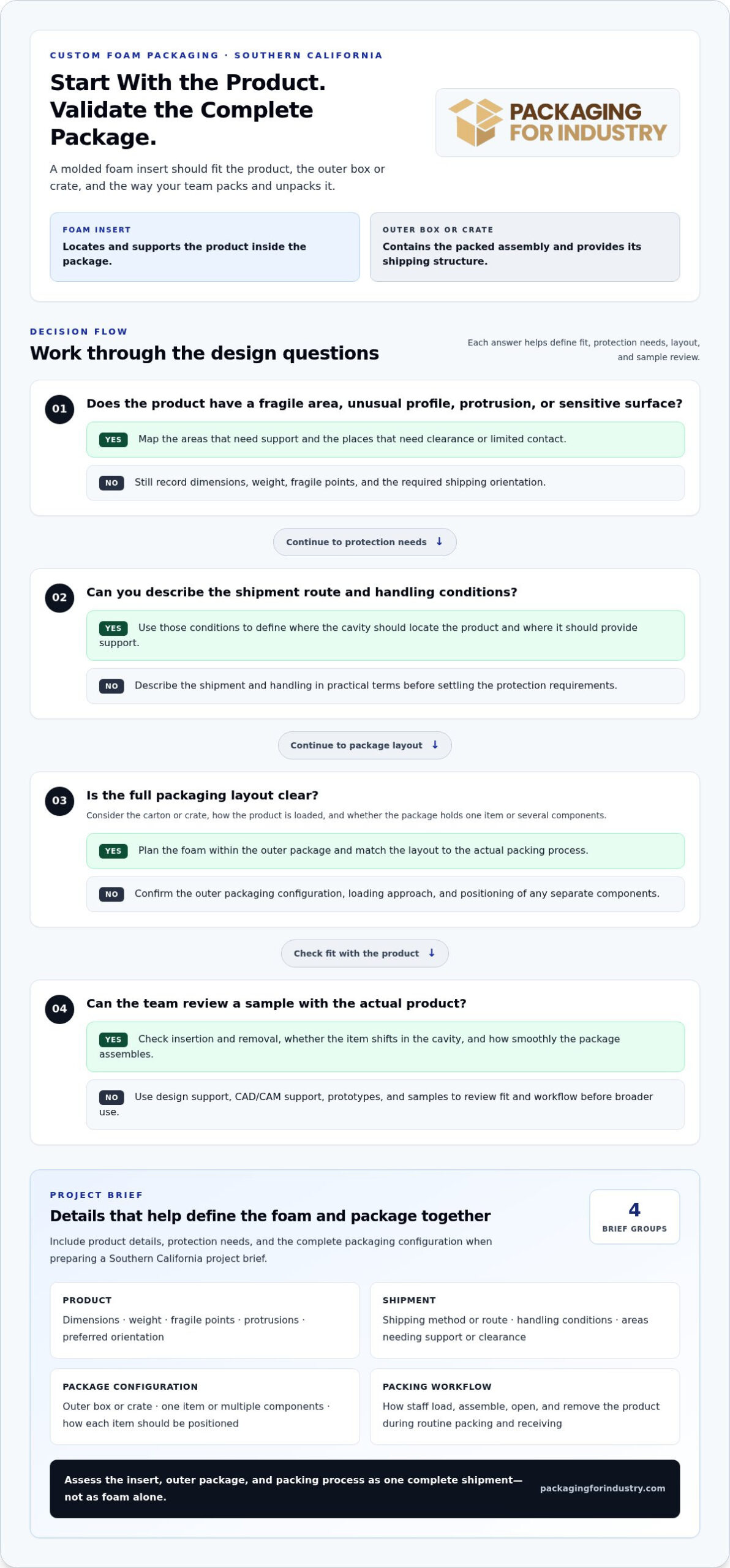
A useful design starts with the product and shipment, not a standard cavity shape. Review the item, define its protection needs, plan the package layout, and evaluate a sample. Each step supplies practical information about fit and use. For custom molded foam packaging Southern California projects, clear inputs help align product protection with packing operations and the outer package.
- Review the product. Record dimensions and weight, note fragile areas and protrusions, and identify the required shipping orientation. Product drawings or a physical sample can clarify the shape and surfaces the foam must accommodate.
- Define protection requirements. Describe the handling conditions the shipment may encounter and identify areas that need support or clearance. Product geometry and handling inform where the cavity should locate the item and where contact should be avoided.
- Plan the packaging layout. Decide how the foam will sit inside the carton or crate, how the product will be loaded, and whether the package holds one item or several components. The layout should match the actual packing process.
- Evaluate a sample. Review the fit and assembly with the product before broader use. Feedback can reveal adjustments needed to the cavity or overall layout.
Product and shipment details that shape the design
Dimensions alone don’t describe the full packaging need. Provide the product’s weight, fragile points, protrusions, preferred orientation, and any areas that should avoid contact. Describe the shipment route and handling conditions in practical terms, and include the outer packaging configuration. If the shipment includes separate components, explain how each should be positioned and kept organized.
These details help distinguish a cavity that simply follows an outline from one that supports the way the product is packed, moved, and unpacked. Foam provides cushioning and product positioning; the carton or crate provides outer containment. Both need to suit the shipment plan.
Why prototypes and samples help assess fit
A prototype or sample lets the team evaluate the design with the actual item before broader use. Check whether the product can be inserted and removed as intended, whether it shifts in the cavity, and whether the package can be assembled smoothly. These checks connect the design to the daily work of packing and receiving.
PFI provides design support, CAD/CAM support, prototypes, and samples. Its custom packaging design services help organize product and shipment details into a packaging layout for evaluation. Once you’ve outlined the item, handling needs, and package configuration, you can request a packaging quote with a defined project scope.
Molded Foam vs. Other Custom Foam Packaging: How to Compare
Molded foam is one way to create a product-specific fit, but it isn’t automatically right for every packaging program. Compare options against the product’s shape, the number and arrangement of parts, repeat-order needs, and the outer package. For buyers evaluating custom molded foam packaging Southern California, the goal is to choose a configuration that suits the entire shipping and packing task, not simply the most tailored-looking insert.
Comparison point: Product geometry
Molded foam: Consider it when the product shape calls for a carefully planned cavity and consistent placement.
Other custom-fit options: Inserts, end caps, or pads may suit a layout that needs support at selected areas or has a simpler arrangement.
Comparison point: Repeatability and placement
Molded foam: Assess whether a dedicated cavity supports consistent placement across recurring orders.
Other custom-fit options: Consider whether separate foam components can organize or support the product as required.
Comparison point: Packaging layout
Molded foam: Review how the insert fits within the carton or crate and how the packed item is loaded and removed.
Other custom-fit options: Check how inserts, pads, or end caps use the available space and work with the outer packaging.
These are decision points, not universal performance or cost claims. The right fit depends on product details, shipment requirements, order pattern, and packaging configuration. The design needs to work for the people packing the item as well as protect the product in transit.
When a molded approach may suit the packaging brief
A molded approach may be worth assessing when a recurring packaging program benefits from repeatable product placement or when a complex shape calls for a cavity designed around its geometry. In the brief, identify which surfaces need support, where protrusions require clearance, and how the item is oriented in the package. Molded foam isn’t the default for every industrial product. Let the project requirements guide the comparison.
When to assess other custom foam or integrated options
Custom inserts, end caps, and pads address different support and layout needs. Foam can also be part of a larger configuration with a box or crate: the foam positions and supports the product while the outer package contains the shipment. PFI provides protective foam packaging, including die-cut foam inserts, end caps, and pads, for teams comparing custom foam approaches.
For a useful comparison, share the product shape, order requirements, shipment method, and outer packaging plan. PFI can use these details to discuss a suitable foam configuration. Request a packaging quote to discuss your packaging program.
Prepare a Custom Molded Foam Packaging Brief for a Southern California Quote
A clear brief turns a packaging concern into a project purchasing and operations teams can evaluate. For custom molded foam packaging Southern California, connect the product’s protection needs with its shipping setup and expected order pattern. This gives the quote discussion a practical scope and helps teams compare packaging pricing for the configuration they need.
Information to include in a foam packaging quote request
Gather the details below before requesting a quote. Drawings, photos, or a product sample can clarify fit requirements. Include current damage concerns and packing challenges as well. These details define the project more clearly than a general product description.
- Product details: Provide dimensions, weight, quantity, orientation, fragile points, protrusions, and any surfaces needing special consideration. Note whether custom sizes are required.
- Shipment method: Describe how the product ships and the handling conditions it may encounter along the route.
- Packaging configuration: Identify the carton, crate, or other outer packaging used with the foam. Explain whether the package holds one product or multiple components.
- Current issues: Describe damage concerns, packing difficulties, or other problems with the existing setup.
- Order expectations: Share expected volume, order frequency, and relevant production or shipping schedules. This information helps evaluate bulk packaging pricing and replenishment needs.
Explain how the packaging is used in your operation. Packaging for manufacturers may need to align with production schedules, while packaging for warehouses or distribution centers may need to support handling and outbound shipping workflows. Clear requirements help teams look for ways to lower packaging costs while accounting for protection and supply needs.
How to evaluate the proposed packaging solution
Review a prototype or sample with the people who pack and handle the product. Check that the item fits as intended, staff can insert and remove it smoothly, and package assembly works with the normal workflow. Note any difficult steps or adjustments needed before adopting the design for routine use.
Assess foam alongside the outer packaging. The insert supports and locates the product, while the carton or crate contains the shipment. If the project uses a crate, include its dimensions and configuration in the brief so the components can be considered together. PFI provides wooden crate packaging as part of custom packaging solutions.
Also share whether the packaging will be reordered and how replenishment fits your schedule. PFI provides design support, prototypes, and samples to help align a proposed solution with project and operational requirements.
Custom Foam Packaging Support from PFI Across Southern California
Packaging For Industry helps industrial buyers plan foam as part of a complete packaging setup, with attention to product requirements and the way teams pack and ship. The goal is a practical fit for the operation, not an isolated insert.
Integrated packaging for industrial products
Products: PFI provides custom foam packaging, corrugated boxes, and crates. Considering the components together helps teams plan how the foam fits inside the outer package and how the package is assembled.
Industries served: Manufacturers, aerospace businesses, electronics companies, and medical device operations can bring product and shipping requirements into the packaging discussion. For example, a production team may need an insert and carton that fit an established packing workflow.
Benefits: An integrated approach connects product support, package assembly, and shipment needs. Reviewing these requirements together gives purchasing and operations teams a clearer basis for evaluating a packaging configuration.
Local support for recurring packaging requirements
Why choose PFI: PFI supports projects across Anaheim, Orange County, Los Angeles County, the Inland Empire, and San Diego County. Design support, prototypes, and samples help teams evaluate packaging as part of project planning.
For repeat requirements, share usage patterns and replenishment needs so the packaging plan can account for ongoing supply. PFI offers stocking and replenishment programs, including vendor managed inventory and just-in-time inventory management, for recurring packaging needs.
Bring your product and supply requirements together in a quote request to discuss your packaging project.
Move Your Foam Packaging Project Forward
Turn your packaging requirements into a decision your operations and purchasing teams can support. For custom molded foam packaging Southern California, align stakeholders on what the design needs to accomplish: protect the product, fit the packing workflow, and support ongoing procurement. Shared criteria keep the project focused as the proposed solution is reviewed.
Bring production, warehouse, shipping, and purchasing perspectives into the discussion early. Each team sees a different part of the packaging process, and their input can surface practical considerations before a design is adopted. With a clear scope, PFI can help evaluate the project and plan a suitable path forward.
A well-planned packaging project gives your team a clearer basis for protecting products and managing supply. Request a quote from PFI to discuss your foam packaging requirements.
Frequently Asked Questions
Is custom molded foam packaging suitable for fragile industrial products?
It can be suitable when the design matches the product and its shipping conditions. For custom molded foam packaging Southern California projects, explain which areas are fragile, how the item must be oriented, and how staff handle it during packing. For example, a component with a delicate surface may need a layout that limits contact in that area. Review a sample with the product before adopting the design for routine shipments.
Can custom foam packaging be combined with a box or crate?
Yes. Foam can be planned as part of a package that also uses a corrugated box or crate. The foam helps position the product, while the outer package contains the shipment. Describe how the complete package is assembled and shipped so the design accounts for space, loading, and handling. If a product is packed into a crate at your facility, include that setup in the packaging discussion rather than treating the foam insert as a separate item.
What information should I provide for a custom foam packaging quote?
Provide the product’s dimensions, weight, orientation, fragile areas, and protrusions, along with the shipping method and outer packaging. Add drawings or photos if they clarify the shape, and explain any damage or packing issues you’re addressing. Include expected order quantities and whether you anticipate repeat purchases. This context connects the foam design to the package your team uses and the way products move through production or fulfillment.
Does PFI support custom foam packaging projects in Orange County and Los Angeles?
Yes. PFI supports industrial packaging projects across Orange County and Los Angeles County, as well as Riverside, the Inland Empire, and San Diego County. Buyers can share product and shipment details for a project-specific foam packaging discussion, with design support, prototypes, and samples. This regional support helps manufacturers coordinate packaging with local production and distribution operations and consider foam as part of a complete packaging setup.
Can custom foam packaging support recurring production orders?
Yes. A custom packaging project can account for repeat purchasing alongside product protection. Include expected usage, order frequency, production schedules, and timing needs for custom packaging in your planning discussion. PFI offers stocking and replenishment programs, including vendor managed inventory and just-in-time inventory management. These programs help organize recurring packaging supply around operational requirements rather than leaving each reorder to an unplanned purchasing decision.
How do I compare molded foam with die-cut foam inserts?
Compare both options against the product’s shape, the placement needed inside the package, and your order pattern. A molded design can be considered for a specifically shaped cavity, while die-cut foam is another custom option to assess for the layout. Neither approach is automatically right for every shipment. Share the product and package details, then review a sample with the actual item and packing process before settling on a design.