
What if the packaging selected to protect a high-value aerospace component creates the very risk it was meant to prevent? For Gardena-area operations, choosing an aerospace packaging supplier in Gardena means looking beyond standard box sizes. Fit, cushioning, handling, transit, and replenishment all matter. These considerations apply across aerospace operations in Los Angeles County and Southern California, including Orange County and San Diego.
Sensitive components need dependable protection, and recurring supply matters just as much as the initial design. This guide explains how to compare packaging materials and supplier capabilities, prepare a useful quote request, and plan for repeat orders without relying on an unsuitable off-the-shelf option.
Packaging For Industry supports aerospace packaging needs with custom design services, foam, corrugated boxes, crates, and related protective materials. Foam, corrugated, and wood packaging can be designed together to suit the component and shipping requirements. CAD-engineered designs, free prototypes and samples, plus VMI and just-in-time inventory programs, can connect packaging design with production demand. For local planning, next-day delivery is available in Los Angeles County. The sections ahead cover material selection, custom sizing, quote details, recurring supply, and delivery for Gardena-area manufacturers.
Key Takeaways
- Assess component shape, fragile areas, handling, and shipping route before choosing a packaging format.
- Compare foam, corrugated boxes, and crates by the role each material needs to play in protecting and moving the part.
- Evaluate an aerospace packaging supplier in Gardena on design support, material range, prototypes, delivery coverage, and replenishment options.
- Prepare a stronger quote request with part dimensions, photos, shipment details, protection concerns, and recurring volume.
- PFI’s packaging design, VMI, and JIT programs can support custom packaging needs and ongoing supply in Los Angeles County.
Aerospace Packaging Supplier in Gardena: What Buyers Need to Evaluate
Protecting components, keeping shipments consistent, and maintaining packaging availability are connected purchasing priorities. The right aerospace packaging supplier in Gardena should help assess the part and its journey, not simply offer a product from a catalog. A packaging format that works for one component may leave another exposed to movement, contact, or handling damage.
Start with the component’s value, geometry, surface sensitivity, and fragility. Then map how it will be handled, stored, and transported, including the route and packaging formats used at each stage. These details help determine whether a stock option fits or a custom design is a better match. Aerospace manufacturing covers varied products and processes, so the packaging should reflect the specific component and operation.
What makes aerospace packaging requirements distinct?
Shape and contact points matter. Avionics may have delicate surfaces or components that need stable positioning, while oversized structural components can require packaging planned around their dimensions and handling. Neither example calls for one universal material or design. Packaging should support the specific part without adding unnecessary size or making warehouse handling more difficult.
Give the packaging design practical context: where the part can be touched, which surfaces need protection, how it is lifted or moved, and what happens between packing and receipt. This connects design decisions to the actual handling sequence rather than a generic description such as “fragile.” Keep the buyer’s packaging specification central, especially when the project includes specific performance or compliance requirements.
What should a Gardena-area buyer expect from a supplier?
Look beyond product availability. Assess how the packaging is designed for nonstandard geometry, which material categories can be coordinated, and how the proposed package fits your production and shipping workflow. For repeat orders, consider how packaging details will stay consistent and how ordering can adapt as demand changes.
For Gardena buyers sourcing across Los Angeles County and Southern California, include receiving locations, order patterns, and communication needs in the evaluation. These details help purchasing and operations compare product fit with the practical requirements of ongoing supply. PFI’s aerospace packaging solutions page describes its industry-focused approach. Evaluate the packaging against your component, shipment, and operating requirements.
Aerospace Packaging Materials: Match Foam, Corrugated, and Crates to the Part
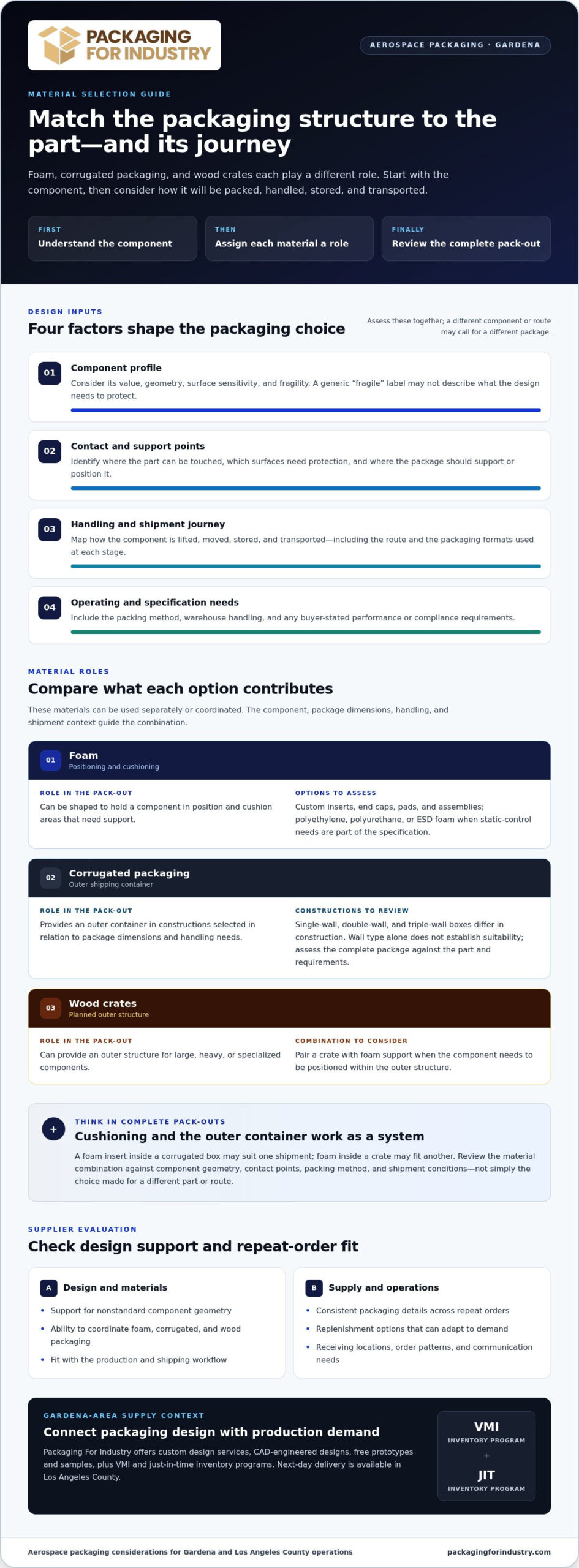
Choose packaging materials according to the job they need to do for a particular part and shipment. Foam can position and cushion a component, while corrugated packaging or a wood crate can provide an outer structure. Some shipments need a combination. The right arrangement depends on the part’s dimensions, contact points, handling, and the buyer’s packaging specification, not a one-size-fits-all rule.
Compare the main options by their role in the pack-out:
- Foam: Can be shaped to hold a component in position and cushion areas that need support.
- Corrugated: Provides an outer shipping container in different constructions, selected in relation to package dimensions and handling needs.
- Wood crates: Can provide a planned outer structure for large, heavy, or specialized components.
Consider how the materials work together. A foam insert inside a corrugated box may suit one shipment, while foam inside a crate may be appropriate for another. Component geometry, packing method, and shipment conditions should guide the combination. Avoid choosing a material only because it was used for a different part or route.
When do foam inserts or ESD foam fit an aerospace shipment?
Custom foam inserts, end caps, pads, and assemblies can be designed around a component’s shape and support points. Options include polyethylene, polyurethane, and ESD foam. When component requirements call for static-control packaging, include ESD foam in the full pack-out review and compare it with those requirements. PFI’s custom foam packaging can be designed for parts that need a tailored fit.
When should buyers consider corrugated boxes or custom crates?
Relate corrugated construction to package dimensions, load, and handling requirements. Single-wall, double-wall, and triple-wall boxes have different constructions, but wall type alone does not establish whether a box suits a particular shipment. Assess the complete package against the part and the buyer’s stated requirements.
For large or unusually shaped components, consider wood crates alongside corrugated packaging. A crate can be paired with foam support to position the part within the outer structure. This integrated approach lets buyers assess custom foam-lined crates as a packaging format, rather than treating cushioning and the exterior container as unrelated choices. The design should account for component contact points and shipment handling.
For an aerospace packaging supplier in Gardena, a useful comparison starts with the component, required support, and shipment context. Describe those needs when you request a packaging quote for a project-specific packaging approach.
How to Compare Aerospace Packaging Suppliers Serving Gardena
A supplier comparison should cover more than the unit price of a box or insert. For aerospace operations, design fit, material availability, delivery coverage, and repeat-order support all affect whether packaging works in day-to-day production. Use consistent criteria to compare the practical value of each option.
How should buyers assess design and protection support?
Review how the packaging design accounts for a part’s dimensions, sensitive surfaces, handling method, and shipping route. CAD-engineered design support, prototypes, and samples give your team a way to review fit before adopting a solution for recurring use. When a shipment needs more than one material, consider whether foam, corrugated, and crate components can be planned as an integrated system.
Keep the buyer’s packaging specification at the center of the review. Performance and compliance requirements depend on the project, so compare the proposed material and design with the applicable specification.
How do delivery and inventory programs affect supplier fit?
Map delivery coverage to your receiving locations. PFI offers next-day delivery in listed Southern California counties, including Los Angeles County. For Gardena-area operations, this local coverage can be considered alongside packaging replenishment needs. Nationwide shipping serves requirements beyond the local delivery area, but local next-day timing does not apply nationwide.
For recurring packaging needs, match inventory programs to your ordering pattern. PFI offers Vendor Managed Inventory (VMI) for managed replenishment and Just-In-Time (JIT) inventory management to align packaging supply with operational demand. Custom design and replenishment work together: buyers can plan the packaging fit and how an approved design will be supplied over time.
Use this framework to compare packaging options consistently:
- Design support: Does the design account for your component and shipping method, including combined materials where appropriate?
- Material range: Can the solution cover the packaging categories your operation needs instead of forcing each requirement into a standard format?
- Prototypes and samples: Can your team assess a proposed design before routine ordering?
- Delivery area: Does coverage match your Gardena-area facility and other receiving locations?
- Recurring supply: Do VMI, JIT, or repeat-order processes fit your usage and inventory practices?
A packaging review can identify opportunities to reduce shipping damage, simplify materials, or streamline ordering. Results depend on the part, specification, and operating conditions. PFI’s stated cost-savings positioning is 15 %-40 % versus national competitors. Treat any project evaluation as specific to your packaging needs, not as a guaranteed result.
Compare options against your current packaging and supply requirements, then request an aerospace packaging quote for your Gardena-area operation.
Prepare an Aerospace Packaging Quote for a Gardena-Area Operation
A useful quote request gives the packaging team enough context to assess both the design and how your operation will use it. When seeking an aerospace packaging supplier in Gardena, include the component, shipment, protection concern, preferred packaging format, and expected order pattern. Clear inputs make design discussions more practical and help compare options for fit, handling, and replenishment.
What information helps define the packaging requirement?
Separate confirmed requirements from assumptions that need engineering review. Dimensions, weight, fragile areas, surface concerns, and packaging constraints help define the part. Photos and an existing packaging sample, when available, can clarify geometry and show how the current pack-out works. Include the shipping method, handling stages, and how the package is opened or reused at the receiving end.
Use this sequence to organize the request:
- Describe the part: Provide dimensions, weight, photos, and notes about delicate features or surfaces.
- Describe the shipment: Explain the shipping method, route context, handling stages, and pack-out constraints.
- Define the concern: Identify the damage risk or packaging issue the proposed solution needs to address.
- Identify the format: Note the current or preferred packaging format, if known, and include a sample where practical.
- Estimate repeat demand: State expected order quantities and whether the packaging is for recurring shipments or a one-time project.
Mark buyer-approved specifications clearly. Flag estimates, including a proposed material or performance expectation, so they can be reviewed against the project’s packaging requirements rather than treated as established facts.
How can buyers plan for repeat aerospace shipments?
For recurring shipments, include the packaging items used, typical consumption patterns, desired delivery cadence, and relevant purchasing or production lead times. Explain whether the same component and pack-out repeat or whether quantities shift with production. This connects the initial design to the operational plan for ordering and storage.
PFI’s CAD support can develop a design from the details provided, while free prototypes or samples let your team assess fit before rollout. PFI’s custom packaging design services connect the design stage with packaging needs across repeat orders. PFI also offers Vendor Managed Inventory (VMI) and Just-In-Time (JIT) inventory management for recurring requirements. Program details include a 30-60 day supply buffer. Share usage patterns and desired delivery cadence in your quote request so design and replenishment can be considered together.
PFI for Aerospace Packaging in Gardena and Los Angeles County
Packaging For Industry is a Southern California industrial packaging supplier serving aerospace operations across Los Angeles County. For Gardena-area buyers, local coverage matters alongside packaging design and supply planning. PFI offers next-day delivery in listed Southern California counties, including Los Angeles County. This local delivery supports packaging replenishment planning, while nationwide shipping serves needs beyond the local service area.
PFI’s aerospace packaging experience includes custom crates and foam inserts used by AeroTech Manufacturing in Los Angeles. That project shows how an outer package and internal cushioning can be considered together for aerospace components. Each application still depends on the part and the buyer’s packaging specification. The goal is a practical fit for the shipment, not an assumption that a previous design or material suits a different component.
What can PFI coordinate for aerospace packaging buyers?
PFI coordinates custom foam, corrugated packaging, wood crates, and CAD-engineered packaging support. Free prototypes and samples let buyers assess fit before a design moves into regular use. A packaging review can help teams consider whether the current pack-out matches the component and handling process, and whether adjustments could improve protection or simplify packaging use.
These capabilities are useful when a buyer needs more than one packaging item. Foam can support positioning, while corrugated packaging or a crate can serve as the outer structure. The right combination depends on the part, shipping context, and stated requirements. PFI’s aerospace packaging solutions support buyers evaluating design and supply for aerospace operations.
- Custom foam: Inserts and related cushioning can be designed around component shape and support needs.
- Corrugated packaging: Box options can be evaluated in relation to package dimensions and handling.
- Wood crates: Crates can provide a planned outer structure for components that need one.
- Design and evaluation: CAD support, prototypes, and samples help teams review fit before repeat orders.
How can a buyer take the next step?
Prepare the part’s dimensions and photos, shipment method, handling context, and protection concern. Include the packaging format currently in use, if applicable, and note whether the requirement is a one-time shipment or recurring. For ongoing needs, share expected usage and desired delivery cadence so packaging design and replenishment can be considered together.
As an aerospace packaging supplier in Gardena, PFI can help evaluate your packaging challenge using the details your team provides. A focused request gives purchasing and operations a clear starting point for discussing fit, local delivery, and supply support. Share the part, protection needs, and replenishment requirements in a quote request.
Build a Packaging Plan That Supports Production
Choosing an aerospace packaging supplier in Gardena is an opportunity to make packaging a deliberate part of production planning. Treat the quote process as a working discussion between procurement, operations, and the people responsible for the component. Their shared perspective can clarify what the packaging must accomplish, where the current process creates friction, and how supply planning can support consistent pack-outs.
Bring together the details that shape the decision, then distinguish essential requirements from preferences that may be open to refinement. A well-defined packaging plan can help your team make informed choices, manage ordering, and connect protection needs to the realities of shipping and production. Start with the challenge your operation needs to solve.
With a clear brief and the right supply partner, your team can move toward a packaging approach built for its operation.
Frequently Asked Questions
What packaging materials are commonly used for aerospace components?
Common options include foam packaging, corrugated boxes, and wood crates, used separately or together depending on the component and shipment. A multi-piece assembly may need internal dividers or separate cushioning for individual parts, while a larger item may call for a different outer package. Start with the buyer’s packaging specification, then match materials to the part’s shape, handling process, and shipping method.
How can packaging help protect aerospace parts during shipping?
Packaging can help limit unwanted movement and contact by holding a component in position and separating sensitive areas from surrounding surfaces. The pack-out should account for how the part is placed into the package, closed, moved, and removed at destination. Reviewing those steps can reveal practical handling issues, such as a part shifting during packing or a package that is difficult to open without contacting the component.
Can aerospace packaging be customized for unusual component dimensions?
Yes. Custom packaging can be designed around unusual dimensions, contours, or support points rather than forcing a part into an unsuitable standard size. Provide accurate measurements and, where useful, photos or an existing sample to clarify the shape and pack-out. PFI offers CAD design support and free prototypes or samples, allowing the proposed fit to be reviewed before a custom design is used for routine shipments.
Does PFI provide next-day packaging delivery in Gardena?
Yes. Gardena is in Los Angeles County, which is included in PFI’s listed Southern California counties for next-day delivery. When planning packaging replenishment for production or shipping, include local delivery coverage in the schedule. Share the receiving location and packaging requirements in your quote request so delivery needs can be considered alongside the packaging itself.
What information should I provide when requesting an aerospace packaging quote?
Include the part’s dimensions and weight, photos or drawings if available, and the protection concern you want to address. Describe the shipping method, how the part is packed and handled, and any constraints in the current process. For a more useful quote, identify the packaging format you use now and whether demand repeats. Flag which details come from an approved specification and which still need review.
Can aerospace packaging requirements include ESD foam?
Yes. ESD foam can be part of a packaging plan when a component’s requirements call for static-control packaging. The buyer’s specification should guide whether ESD foam is appropriate and how it fits into the complete pack-out. Include relevant component requirements in the quote request rather than assuming a general foam selection addresses them. PFI offers ESD foam as part of its protective foam packaging options.
Are military-spec boxes automatically suitable for every aerospace shipment?
No. A military-spec box description alone does not establish that a package meets every aerospace project’s requirements. Suitability depends on the buyer’s specification, the part, and the shipment context. Include applicable packaging requirements in the design or quote request, then evaluate the proposed package against them. A material or box designation is not proof of project-specific compliance on its own.
How can an aerospace supplier manage recurring packaging inventory?
Recurring needs can be managed through Vendor Managed Inventory (VMI) or Just-In-Time (JIT) packaging programs. PFI’s VMI program uses scheduled inventory reviews and replenishment planning based on actual usage; review cycles can be weekly, biweekly, or monthly. JIT inventory management aligns packaging supply with operational demand. Usage history, item types, lead times, and production schedules help shape a replenishment approach for recurring supplies.