
What if the packaging station is creating the waste your 5S effort is designed to remove? Supplies that are hard to find, stored differently from one workstation to another, or poorly matched to the task add handling friction. Excess packaging takes up production space, while a shortage can interrupt work. Effective packaging solutions for 5S lean manufacturing need to address both the workstation and the flow of supplies into it.
Sorting and labeling matter, but orderly shelves alone won’t sustain a standard if packaging sizes, protection, or replenishment routines keep changing. This article explains how to align packaging design, point-of-use organization, and supply planning with 5S goals. It covers practical ways to assess work areas and compare stock and custom packaging, including corrugated boxes, foam, stretch film, and packaging kits. It also explains how VMI and JIT programs support recurring needs in different ways, so you can build repeatable standards that reduce unnecessary handling and help prevent supply disruptions.
Key Takeaways
- Use the five 5S steps to review packaging supplies, clear unnecessary stock, and make essential materials easier to access.
- Match packaging to each workstation’s tasks and protection needs to support repeatable handling without crowding the work area.
- Compare stock packaging, custom designs, kitting, and managed replenishment against fit, storage space, consistency, and supply requirements.
- Set a baseline using measures such as search time, shortages, damage reports, and space use, then pilot and review changes.
- Coordinated packaging solutions for 5S lean manufacturing connect workstation standards with replenishment practices that support steady operations.
How Packaging Solutions Support 5S Lean Manufacturing on the Floor
5S organizes work through five practices: Sort, Set in Order, Shine, Standardize, and Sustain. Packaging affects each one because boxes, cushioning, film, and other supplies take up space, move between storage and workstations, and shape how consistently employees prepare products for shipment. The 5S (methodology) offers an overview of the approach and its five pillars.
Place packaging where it supports a defined task. A workstation may need a standard box size, protective foam, and tape within easy reach. Keeping those materials accessible can reduce searching and unnecessary movement. Duplicate supplies, outdated packaging, and stock without a clear point of use can crowd aisles and work surfaces. The goal isn’t to remove useful inventory. It’s to distinguish task-ready materials from excess that obstructs the workflow.
Standardized packaging makes a workstation more repeatable: approved materials have known locations and are used consistently for the task. That consistency helps employees follow the packing process and spot when a shortage, damaged material, or packaging mismatch interrupts the normal routine. Packaging solutions for 5S lean manufacturing should address both the physical setup and the supply routine that keeps it working.
Where packaging creates friction in a 5S work area
Look for supplies scattered across shelves, inconsistent box sizes at nearby stations, unclear storage locations, and excess stock stacked around work areas. These conditions make it harder to find and return materials, and to see when replenishment is needed. They may also point to deeper issues: packaging specifications that don’t fit the task or deliveries that arrive in quantities the area can’t use efficiently.
Unsuitable containers or cushioning can complicate packing and product handling. Employees may need to adjust a box, add extra material, or pause to find a better fit. Separate routine housekeeping issues, such as supplies left out after a shift, from recurring design or replenishment problems. The first calls for a clear workplace standard; the second may require a change to the packaging or supply plan.
Which packaging decisions belong in a 5S review?
Review packaging types, quantities, storage locations, access frequency, and point-of-use needs. Consider the full production and shipping workflow, not just the packing bench. Packaging for manufacturers should support how materials move from production through preparation for shipment. The packaging for manufacturers page provides context for packaging needs across manufacturing operations.
- Identify which materials each task requires and how often employees use them.
- Check whether storage locations make supplies easy to identify and return.
- Review whether containers and cushioning suit the product and handling steps.
- Note shortages, damaged supplies, and excess stock that takes up working space.
These observations help distinguish useful point-of-use inventory from clutter and identify packaging changes worth evaluating. They also provide a starting point for the next 5S steps: organizing materials, setting consistent work standards, and maintaining them through regular review.
Apply the Five 5S Steps to Packaging Materials and Workstations
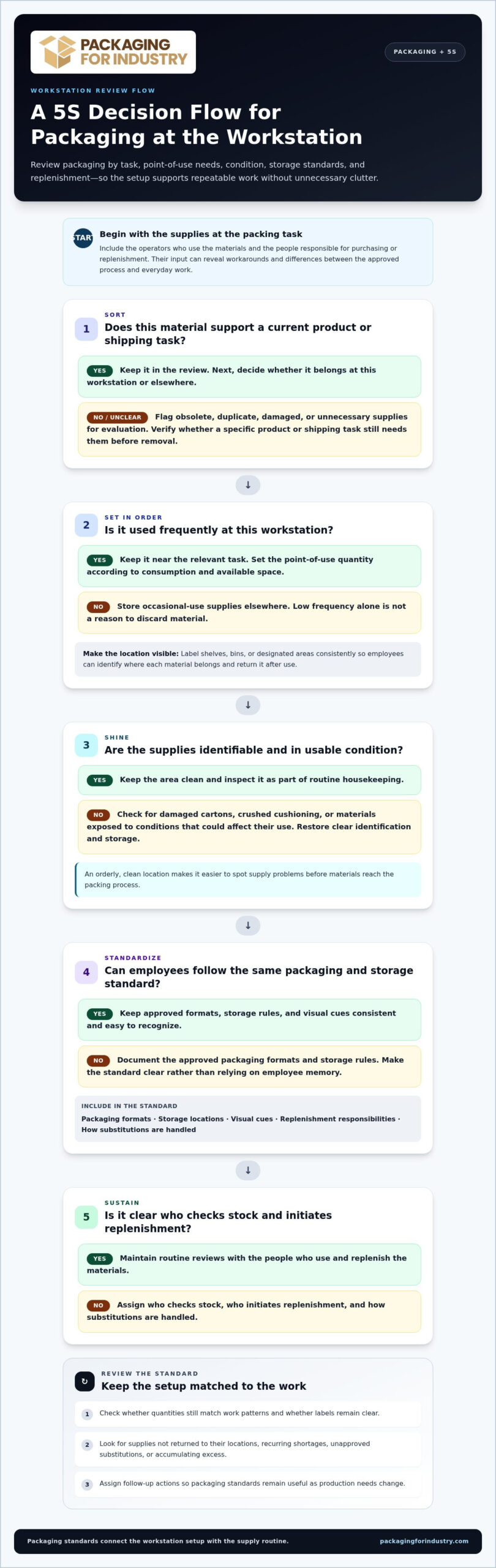
Apply the five steps in order so packaging standards reflect how work is actually done, not just how a storage plan assumes it happens. Include operators who use the materials and the people responsible for purchasing or replenishment. Their input can reveal differences between the approved process and everyday workarounds.
- Sort: Review packaging supplies and flag obsolete, duplicate, damaged, or unnecessary materials for evaluation. Separate frequently used items from occasional-use supplies, then decide what belongs at the workstation and what should be stored elsewhere. Don’t discard material just because it’s rarely used. First establish whether a specific product or shipping task still requires it.
- Set in Order: Assign clear storage locations based on actual work patterns. Keep frequently used packaging near the relevant task, and set point-of-use quantities according to consumption and available space. Label shelves, bins, or designated areas consistently so employees can identify where each material belongs and return it after use.
- Shine: Inspect the packaging storage area as part of routine cleaning. Check that supplies remain identifiable and in usable condition, and look for damaged cartons, crushed cushioning, or materials exposed to conditions that could affect their use. A clean, orderly location makes it easier to spot problems before supplies reach the packing process.
- Standardize: Document approved packaging formats, storage rules, visual cues, and replenishment responsibilities. Specify who checks stock, who initiates replenishment, and how substitutions are handled. If a task uses a particular box and cushioning combination, make that standard easy to recognize and follow rather than relying on employee memory.
- Sustain: Schedule routine reviews with the people who use and replenish the materials. Check whether quantities still match work patterns, labels remain clear, and supplies are returned to their locations. Track recurring shortages, unapproved substitutions, or accumulating excess, then assign follow-up actions so the standard stays useful as production needs change.
These steps work as a connected system. Sorting without a storage plan can leave useful materials misplaced; clear labels without replenishment ownership can’t prevent an empty point-of-use location. A packaging standard supports consistent work by making each approved material easy to identify and placing it where the task requires it.
Keep the review practical. Walk through the packing sequence, observe which supplies employees reach for, and compare that routine with the documented standard. If a material repeatedly ends up outside its assigned location, the layout, quantity, or standard may need adjustment. A workstation should make the correct process straightforward, not depend on repeated reminders.
Refine these packaging solutions for 5S lean manufacturing as product mix or production needs change. A packaging review can turn workstation observations into a consistent supply plan. If you’re evaluating packaging changes, request a packaging quote based on your materials and workflow.
Compare Packaging Options for Lean Manufacturing and 5S Workflows
The right packaging approach depends on the product, packing sequence, available storage, and how supplies are replenished. Stock materials work well when their formats fit the task. Custom designs address product-specific dimensions or protection needs. Kitting and managed replenishment answer different operational questions: how materials reach the workstation and how recurring supply is maintained.
| Option | Fit | Storage footprint | Handling consistency | Protection needs | Replenishment complexity |
|---|---|---|---|---|---|
| Stock packaging | Suitable when available formats fit the product and work sequence | Depends on sizes and quantities kept on hand | Repeatable when the same materials are specified | Works when standard materials meet the task’s needs | Track the stock items used at each station |
| Custom packaging | Designed around product dimensions or process requirements | Can reduce mismatched formats, while requiring space for the selected design | Supports consistent packing when the approved design is followed | Can be tailored to the product’s protection requirements | Coordinate replenishment for defined formats |
| Packaging kits | Groups materials for a repeatable packing sequence | Stores task components together | Helps present the selected materials as a set | Contents can reflect the product and packing steps | Plan kit quantities and assembly alongside use |
| Managed replenishment | Fits recurring packaging needs across work areas | Set supply levels around the operating plan | Helps maintain access to established materials | Maintains the selected packaging approach | Requires clear usage and replenishment coordination |
Stock versus custom packaging for standardized work
Start with fit, not a preference for standard or custom. Stock packaging is practical for repeat tasks when available sizes suit the product and packing sequence. If dimensions or protection needs call for a closer fit, evaluate custom boxes or foam inserts. Custom corrugated boxes can align a box format with a defined packing task.
Different packaging materials can serve separate stages of one workflow. Corrugated boxes contain the shipment, foam cushions a product within its package, and stretch film secures a prepared load. In a 5S review, assess each material where it is used rather than treating all packaging as one interchangeable supply category.
Point-of-use kits versus separately stored supplies
Separate supplies suit work where employees select materials for varied products or tasks. A kit can group the components used in a repeatable sequence, such as a specified box and cushioning, so the materials are handled together. Set kit contents from the actual process, then assess whether kits improve access or simply create another item to store. Packaging kitting and assembly can bring task-based materials together.
Use the comparison to identify where stock formats fit, where custom design may address a mismatch, and whether kitting or managed replenishment could simplify access. To evaluate packaging against your product and workflow, request a packaging quote.
Build a Practical 5S Packaging Improvement and Review Process
Make packaging changes through a controlled process, not a broad rollout based on assumptions. A focused pilot lets your team compare the current setup with a proposed one and identify unintended effects before expanding the standard. For packaging solutions for 5S lean manufacturing, use measures the plant already tracks and review the results alongside employee feedback.
Assess the current process and define the pilot
Follow packaging from storage through production, packing, and shipment. Document formats in use, where materials are stored, how often employees retrieve them, and where shortages or substitutions occur. Select a defined work area with a clear task or product flow. Agree on what the pilot will change and which measures will show whether the setup works better.
Establish a baseline before making changes. Keep the measures simple and consistent:
- Search time: Record how long employees spend locating packaging supplies.
- Shortages: Log when a required material isn’t available at the point of use.
- Damage reports: Track reports associated with the packaging process or product handling.
- Space use: Note the area occupied by packaging at the workstation and nearby storage.
Then test the change in the selected area. It might involve revising storage locations, changing a packaging format, grouping materials for a repeat task, or adjusting how replenishment is triggered. Pilot packaging changes in a defined work area before standardizing them across the plant, so the team can identify fit and supply issues while the change is still contained.
- Observe the work: Walk through the existing sequence with operators, noting material movement, workarounds, and interruptions.
- Document the current setup: Record the packaging formats, quantities, storage locations, and known supply problems.
- Test a focused change: Define the revised setup and monitor it against the baseline without assuming a particular result.
- Compare and adjust: Review the measures and operator feedback. Address problems before adopting the change more broadly.
- Standardize and review: Document the approved process, train affected teams, and schedule follow-up checks.
Standardize, train, and review the new packaging setup
Write down approved materials, storage locations, visual identifiers, and replenishment triggers. Name who checks supply levels and who acts when stock reaches the agreed trigger. Train employees who handle or replenish the packaging, and make instructions accessible at the work area. PFI provides custom packaging design to help evaluate formats for a defined product and process.
At planned intervals, compare current results with the baseline and ask whether the setup still matches the work. Review excess, substitutions, recurring shortages, and employee feedback. If products or processes change, revise the documented standard and communicate the update. A routine review keeps the packaging arrangement connected to actual production needs instead of letting an outdated setup become the default.
Coordinate 5S Packaging Design and Replenishment with PFI
Packaging For Industry supplies industrial packaging products and provides related design and inventory programs. Manufacturers can coordinate corrugated boxes, protective foam, stretch film, and packaging kits around the work being done, rather than treating each supply as a separate purchasing decision. PFI serves operations in industries including aerospace, electronics, food and beverage, medical devices, and industrial manufacturing. For businesses in Orange County, Los Angeles, and San Diego, PFI provides local packaging delivery, with next-day delivery across Southern California counties including Orange, Los Angeles, and San Diego.
Match packaging design to the work and product
Packaging needs vary with the product, its handling requirements, and the shipping process. PFI supplies corrugated boxes and protective foam packaging, which can be considered together when a product needs both an outer container and cushioning. Custom CAD-engineered designs, prototypes, and samples help teams evaluate fit before adopting a format for repeat work.
This coordinated approach supports operations that need packaging suited to a specific product or task. PFI’s custom packaging solutions connect packaging selection with production and shipping needs, while packaging kitting and assembly support defined packing sequences.
Choose a replenishment approach that supports the standard
For recurring supplies, VMI and JIT offer different ways to coordinate replenishment. VMI uses scheduled inventory reviews and planned restocking, while JIT supports on-demand deliveries with a 30-60 day supply buffer for production spikes. PFI provides both programs and can align the approach with the operation’s usage pattern and supply plan. Vendor managed inventory is one option for coordinating recurring packaging requirements.
Pairing a packaging standard with a suitable supply program helps teams maintain access to selected materials while keeping ownership and replenishment expectations clear. PFI brings product selection, custom design, and supply coordination together for manufacturers managing ongoing production needs.
Turn Your 5S Packaging Review Into a Working Standard
Choose one packaging issue your team can address with clear ownership, such as a difficult-to-access supply or a format that interrupts a packing task. Define what a workable standard looks like, involve the employees who use the materials, and build a review point into the process. This gives your team a practical way to keep packaging aligned as products and workflows change.
Packaging solutions for 5S lean manufacturing work best when they support the real task at the workstation and fit the way your operation manages supplies. A focused assessment can identify where a packaging change deserves a closer look and give your team a clear basis for comparing options with PFI.
Share your packaging requirements and workflow with PFI to request a quote for a 5S packaging setup that fits your operation.
Frequently Asked Questions
Can packaging changes support all five steps of 5S?
Yes. Packaging is part of the work system, not just a shipping input. For example, a plant can check whether packaging instructions align with workstation audits and whether employees at connected stations follow the same handoff expectations. Assess each area separately, since a receiving zone, production cell, and shipping station may have different packaging responsibilities and controls.
How do manufacturers decide between stock and custom packaging for a 5S workstation?
Compare the options against the plant’s product mix and changeover pattern. Stock formats may suit stable, recurring work; a custom format may be worth evaluating if product variation creates repeated workarounds or inconsistent pack-out. Also consider how a format affects SKU management. Adding a custom item can improve task fit, but it needs a clear identifier and an owner responsible for keeping its specification current.
What packaging materials are useful for organizing a manufacturing packing station?
Choose materials for the job each station performs, then separate them by process stage. For example, designate one area for forming containers, another for preparing product protection, and a separate location for securing completed loads. This arrangement clarifies which supplies belong at each step and which should remain elsewhere. The right mix depends on the product and shipping process, and may include corrugated boxes, foam, stretch film, tape, or other packaging supplies.
Can packaging kitting help reduce clutter at a production workstation?
It can help when a kit matches a stable task and arrives at the point of use in a manageable quantity. Establish a process for reviewing kits when product configurations change; otherwise, obsolete components can remain bundled and take up space. Track unused kit contents during a pilot. That feedback helps determine whether to revise the kit, its quantity, or the task it supports.
How can a manufacturer measure whether a 5S packaging change is working?
Use the same observation method before and after the change, and compare similar work conditions. For example, separate results by product family or shift if the workload varies, so a change in the mix doesn’t distort the comparison. Ask operators what has become easier or harder, then investigate outliers instead of relying on a single overall result. Use the findings to decide whether to keep or revise the setup.
What is the difference between VMI and JIT packaging inventory?
The distinction is how replenishment is organized. VMI uses scheduled inventory reviews and planned restocking, while JIT provides on-demand deliveries with a 30-60 day supply buffer for production spikes. Consider VMI when recurring usage supports scheduled oversight; consider JIT when deliveries need to align more closely with production demand. The right fit depends on how your team plans and communicates packaging requirements.
Can custom packaging help standardize repeat production work?
Yes. A custom format can provide a consistent specification for repeat work when the design suits the product and process. To prevent variation over time, document the approved version and make the specification easy for employees and purchasing staff to identify. When a product or process changes, review the packaging through a controlled process before updating the workstation standard. This helps teams avoid informal substitutions.