
What if your internal transfer route keeps adding packaging costs after a product reaches its destination? Reusable packaging for inter-facility transfers can reduce reliance on single-use materials, but reuse only works when products stay protected and containers have a practical path back. If repeated handling, return trips, tracking, and storage already complicate operations, include those requirements in the decision from the start.
This guide compares reusable and single-use packaging against transfer frequency, route patterns, and product protection needs. You’ll learn how to assess return flows between facilities, specify packaging for handling and storage, and plan replenishment for recurring demand. It also explains where custom packaging design, foam, corrugated products, crates, and pallets may fit into a transfer workflow, alongside vendor managed inventory and just-in-time programs for packaging supplies. The goal is a practical system that balances protection, handling, and returnability, not a switch to reuse without accounting for the full cycle.
Key Takeaways
- Use route consistency and transfer frequency to judge whether reusable packaging for inter-facility transfers fits your operation.
- Specify packaging in sequence: product, handling, route, protection, then return requirements.
- Compare reusable and single-use options across the full cycle, including empty-container movement, storage, and purchasing.
- Start a pilot on one route and assign facility owners for handling, condition checks, and empty returns.
- PFI’s custom packaging design, prototypes, and material options can help align packaging with your transfer workflow.
Reusable Packaging for Inter-Facility Transfers: When Does It Fit?
Inter-facility transfers move goods between locations in the same operating network, such as a plant supplying a warehouse or a production site sending components to another facility. Since the receiving location is part of the same network, there may be a way to return packaging for another trip. Reusable packaging for inter-facility transfers is worth assessing when routes, shipment requirements, and handling steps are repeatable. Reuse is not automatically the better option, though: the return process needs to work in day-to-day operations.
Reusable transport packaging is designed to protect goods across multiple trips, while single-use packaging is generally used for one shipment before disposal or recycling. The Reusable Packaging overview explains the broader concept. For an industrial buyer, the key question is whether the actual transfer cycle can support repeated use. Product protection, empty-container movement, storage, and purchasing all affect the decision.
Which transfer patterns are strongest candidates for reuse?
Start with recurring movements between plants, warehouses, distribution centers, or production sites. A stable route with consistent products and handling is easier to assess than shipments with changing destinations or unpredictable return opportunities. For example, a manufacturer in Orange County sending the same components to a nearby warehouse may be able to coordinate empty packaging on return trips. Treat that as a scenario to evaluate, not an assumed cost or operational benefit.
Map transfer frequency and shipment consistency, then identify how return trips will be coordinated. Can the receiving facility stage empty packages? Is there room and a defined process to move them back? If goods travel on irregular, one-way outbound shipments, packaging may leave the network and become difficult to recover. In that case, reuse could add handling or storage work without enough return trips to support the effort.
What should buyers establish before comparing packaging?
Build a clear transfer profile before reviewing packaging options. Document product dimensions, weight, fragility, and the points where goods are lifted, stacked, loaded, or unloaded. These details clarify the protection and access the package needs. A broad label such as “fragile” or “heavy” is not enough to specify a useful design.
Next, map each movement from origin to destination, including transfer frequency and current packaging steps. Note who packs, handles, opens, inspects, and stages the goods at each point. Confirm that facilities have a practical way to stage, return, and store empty packaging without disrupting production or taking needed warehouse space. This information gives purchasing and operations teams a consistent basis for comparing reusable and single-use packaging on the same route.
How to Specify Reusable Packaging for Transfer Protection
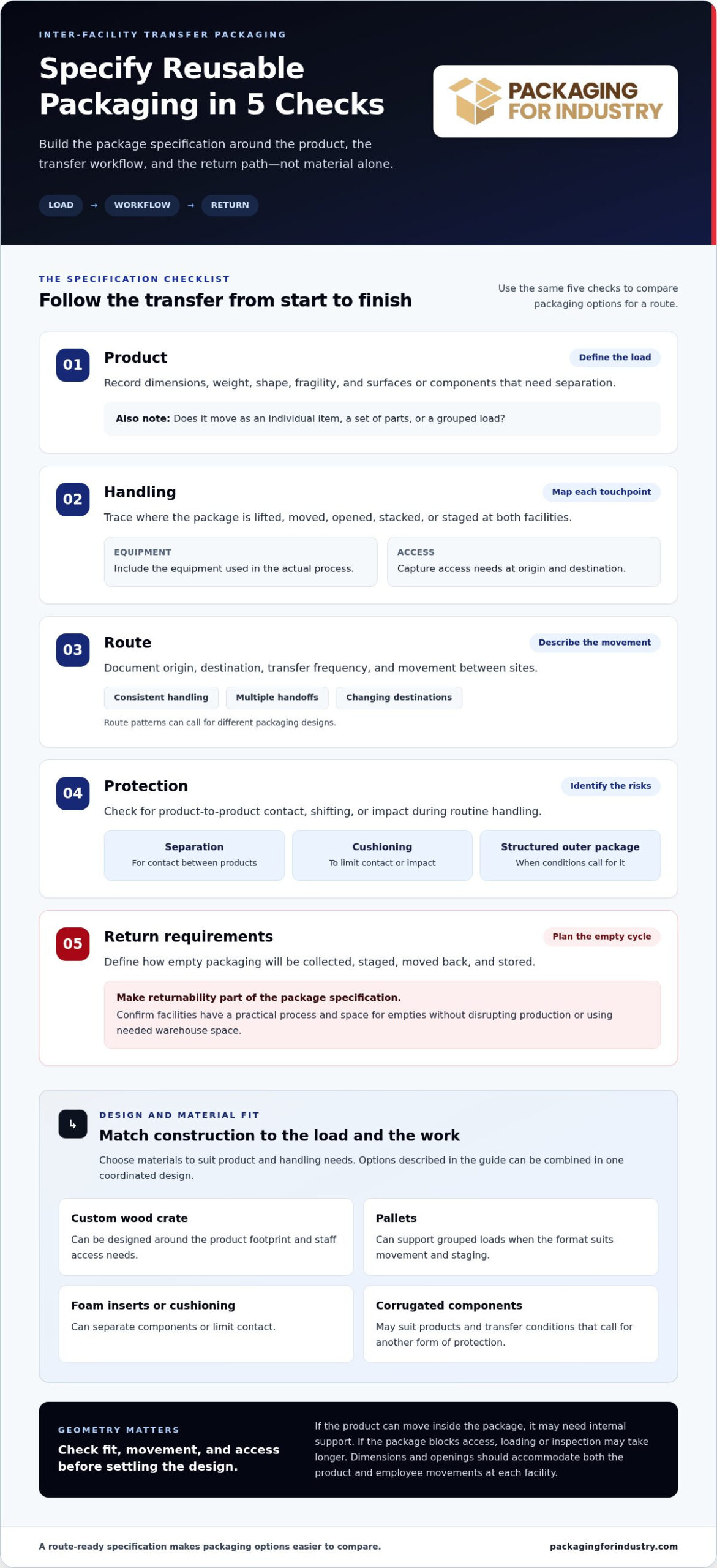
A useful specification starts with the load and follows it through the transfer, rather than selecting a package by material alone. Packaging specifications should reflect both the product and the transfer workflow. Document what needs protection, how employees handle it, and what happens to the packaging after delivery. This sequence helps buyers compare options against consistent operating requirements and share the right information when requesting a custom packaging quote.
- Product: Record dimensions, weight, shape, fragility, and any surfaces or components that need separation. Note whether the product moves as an individual item, a set of parts, or a grouped load.
- Handling: Trace each point where the package is lifted, moved, opened, stacked, or staged. Include the equipment and access needs at both facilities so the package works with the actual process.
- Route: Document origin, destination, transfer frequency, and movement between sites. A route with consistent handling may call for a different design than one with several handoffs or changing destinations.
- Protection: Identify risks such as product-to-product contact, shifting, or impact during routine handling. Use this information to determine whether internal separation, cushioning, or a more structured outer package is appropriate.
- Return requirements: Define how empties will be collected, staged, and moved back, and where they can be stored. Make the return process part of the package specification, not an afterthought.
Package geometry matters. If a product can move inside the package, it may need internal support. If the package blocks access, loading or inspection may take longer. Dimensions and openings should accommodate the product as well as the movements employees make at each facility. Choose materials to suit the load and handling needs without adding unnecessary complexity.
Match construction to the product and handling
For suitable industrial loads, a custom wood crate can be designed around the product’s footprint and the way staff need to access it. Pallets can support grouped loads when that format suits movement and staging. Foam inserts or cushioning can separate components or limit contact, while corrugated components may suit products and transfer conditions that call for another form of protection. These materials can also be combined in one coordinated design.
Design for loading, unloading, and repeat handling
Walk through the transfer at both ends. Note how personnel move, open, access, stack, and stage each package, and identify constraints such as aisle space or the order in which parts must be removed. PFI’s custom packaging design uses CAD-engineered designs, prototypes, and samples to shape a solution around product protection and workflow. Include handling steps and product details when you request a packaging quote for reusable packaging for inter-facility transfers.
Reusable vs. Single-Use Packaging: Compare the Full Transfer Cycle
Compare packaging across the entire movement, not just the purchase at the shipping point. Single-use packaging involves recurring material purchases and disposal or recycling work. Reusable packaging shifts some of that effort to collecting, checking, staging, and returning empties. Either option can protect products. The better fit depends on route patterns, product requirements, and how facilities manage packaging each day.
Comparison factor | Reusable packaging | Single-use packaging
Repeat use | Intended for repeated trips if it remains usable and returns to the route. | Typically used for one transfer, then disposed of or recycled according to the facility’s process.
Product protection | Can be designed around recurring loads and handling, but condition and fit need review over time. | Protection depends on the packaging selected for each shipment; repeat purchases may make consistency important.
Return movement | Requires a defined way to collect, stage, and send empties back. | No empty-package return is needed, though disposal or recycling still takes work.
Storage | Empty packaging needs a designated place at receiving, return, or staging points. | Storage is generally tied to unused supplies and the disposal process after use.
Purchasing needs | Buyers plan for the packaging pool, condition checks, and replenishment when items are lost or unusable. | Buyers plan recurring material purchases based on transfer demand and supply needs.
Account for reverse logistics, loss, and storage
Reuse depends on a return process that works between the actual facilities. Identify which team releases empties, who coordinates their movement, and where they wait before the next trip. Include space at the origin, destination, and any staging points. A return plan that looks simple on paper can create warehouse congestion if empties compete for room with production materials or finished goods.
Decide how staff will identify packaging that is missing, damaged, or no longer suitable for another transfer. Set a consistent method for recording condition and ownership. These controls help buyers understand how much packaging is available and when replacement purchasing may be needed.
Compare recurring costs using company data
Use the same transfer period and shipment assumptions for both options. For single-use packaging, include material purchases, handling, and disposal or recycling work. For reuse, include packaging purchases, inspection and handling time, storage, empty return movement, and replacements for lost or damaged items. Use your own purchasing and operations figures rather than broad savings claims. Route distance, shipment volume, and internal processes can all affect the comparison.
For an operation in Los Angeles County, assess each facility pair separately if routes or return routines differ. This makes it easier to identify where reusable packaging for inter-facility transfers may fit and where a one-way option remains more practical.
Plan a Reusable Packaging Pilot Across Facilities
A pilot tests the working system, not just the package. Choose one recurring route where the same products move between facilities, then evaluate whether the packaging protects the load and fits existing operations. Set a review point before starting and use consistent measures throughout. That gives teams a clear way to identify what works and what needs adjustment.
- Select one route. Identify the origin and destination, products involved, and teams that handle each transfer. Keep the initial scope focused enough for both facilities to follow the same process.
- Document the baseline. Record current packaging materials, packing steps, reported product damage, packaging shortages, and time spent handling or disposing of packaging. Use existing company records where available.
- Define the pilot handling steps. Write down how the package is prepared, moved, received, checked, staged, and returned. Include who owns each step at both locations.
- Review operating results. Compare pilot observations with the baseline. Look for changes in damage reports, packaging availability, missing or damaged packaging, handling effort, and storage pressure.
Set transfer rules and responsibilities
Assign an owner at each facility for preparing and receiving packages, checking condition, and coordinating empty returns. Agree on a simple way to identify reusable packaging and report missing or damaged units, such as a shared log or existing receiving record. Keep instructions short and include them in normal production and receiving routines. A process is difficult to sustain if no team owns its extra steps.
During the pilot, ask staff to note where handling slows down or causes confusion. A package may need a clearer opening sequence, easier product access, or a designated staging location. If empties accumulate at the destination, adjust the return schedule or clarify who moves them. If the package does not protect the product through routine handling, revisit its design and protection components before expanding the trial.
Connect packaging design with reliable replenishment
A successful route also depends on a reliable supply of packaging materials used in the operating process. PFI’s Vendor Managed Inventory programs maintain a 30-60 day supply buffer for on-site inventory, while just-in-time inventory management supports planned replenishment. These programs address packaging supply rather than the coordination of reusable-package returns. Buyers can include inventory planning when reviewing recurring needs for corrugated boxes, foam, stretch film, and other packaging supplies.
Use pilot findings to refine the package or handling instructions, then review the results before adding routes. This keeps reusable packaging for inter-facility transfers grounded in facility performance rather than assumptions. Share route details, packaging requirements, and replenishment needs when discussing a packaging plan with PFI.
Build an Inter-Facility Packaging Solution with PFI
Packaging For Industry helps businesses align packaging materials and supply planning with transfer operations. Its industrial packaging offerings include pallets, wood crates, protective foam, and corrugated packaging. Depending on the product and handling requirements, these materials can work together as a coordinated protective solution instead of being selected as unrelated items.
For example, a pallet or crate may support the load, while foam separates sensitive components and corrugated pieces protect surfaces or organize parts. The right combination depends on the application and how employees handle the package at each site. PFI’s custom and stock packaging give purchasing and operations teams options for a tailored packaging plan.
For manufacturers and warehouses in Orange County, Los Angeles, and San Diego, include the route and facility requirements in the packaging discussion. A local packaging supplier can help evaluate how the materials and supply process need to work together, whether a transfer stays within one county or connects multiple facilities.
Use custom design when standard packaging does not fit the transfer
If a standard format does not suit the load or facility workflow, custom packaging design can address product fit, access, and handling needs. PFI’s custom packaging design service supports packaging plans using crates, foam, and corrugated components. For a crate-based application, consider how its construction supports loading, access, and movement between facilities.
An integrated solution can also give each material a clear function. Foam may provide internal separation, corrugated components may organize or shield parts, and a crate or pallet may support the overall load. Defining each role helps teams avoid mismatched materials and use the packaging consistently.
Request a quote with useful transfer details
For a focused quote discussion, provide product dimensions, weight, protection concerns, route, facility locations, handling steps, and recurring packaging needs. PFI can discuss suitable custom or stock packaging and recurring supply options through Vendor Managed Inventory or Just-In-Time inventory management. Include the packaging materials your operation uses regularly so the supply plan reflects actual demand.
PFI supports packaging needs nationwide, with next-day delivery available in Orange, Los Angeles, San Diego, Riverside, and Ventura counties. Include delivery locations and purchasing requirements in your quote request so the proposed packaging and supply approach reflects the operation.
Move Your Transfer Plan Toward a Clear Decision
Turn your route assessment into a decision your operations and purchasing teams can use. Set out which transfer flows are suitable for a controlled rollout, what conditions would prompt a packaging change, and who will review the findings before the approach expands. This keeps reusable packaging for inter-facility transfers grounded in the way your network operates, rather than assumptions from a single shipment.
For facilities in San Diego, as in Los Angeles or Orange County, route differences can matter as much as package design. A transfer between nearby sites may run differently from one involving multiple handoffs or competing warehouse demands. Treat each movement as its own operating case, then use what your teams learn to guide the next decision. This approach aligns protection, return handling, and supply planning as needs evolve.
Bring your transfer requirements together for a focused packaging discussion with PFI. Share the details that will help shape a practical next step for your operation.
A well-planned decision gives your teams a clear path forward. Start with the route you understand best, then build from there.
Frequently Asked Questions
When is reusable packaging suitable for inter-facility transfers?
Reusable packaging is most practical when a company controls both ends of a consistent transfer route and can organize packaging returns. Manufacturers moving components between production locations, for example, may have clearer return routines than businesses sending irregular orders to changing destinations. Aerospace, food and beverage, medical device, and electronics companies can assess reuse for internal movements when the packaging meets product and operating requirements.
How do you compare reusable packaging with single-use packaging?
Compare both approaches using the same shipment volume and review period. Include packaging purchases, handling time, storage, empty returns, replacement needs, and disposal or recycling work. A route with frequent, coordinated returns may suit reuse; a route with limited return opportunities may favor one-way packaging. Use your facility’s purchasing and operating records to identify trade-offs instead of assuming reuse is automatically less expensive.
What information is needed to specify reusable packaging for a transfer route?
Gather the product’s dimensions, weight, shape, and protection requirements, then note how it is packed, moved, and accessed at each location. Include route details, transfer frequency, and any handling equipment or staging constraints. If parts travel together, describe how they are grouped and whether they need separation. Photos or drawings can help explain the application and support a useful packaging discussion.
How should companies manage empty reusable packaging between facilities?
Set a clear process for identifying, staging, and returning empty packages, with a responsible contact at each location. Teams can use a shared record to note when packaging is ready to move and flag units that are missing or damaged. Align the return routine with existing receiving and dispatch workflows, and designate holding space so empties do not obstruct production areas or outbound shipments.
Can custom crates and foam be used for inter-facility transfers?
Yes. A crate can support an industrial load, while foam can separate components or cushion areas that need added protection. The design should account for how staff load, access, and move the goods. Packaging For Industry serves sectors including aerospace, food and beverage, medical, and electronics, where transfer requirements differ by product. A tailored packaging plan can address those application-specific needs.
Can packaging inventory programs support recurring transfers?
Yes. Vendor Managed Inventory and Just-In-Time programs can support recurring needs for packaging materials used in production and shipping. They help businesses plan replenishment for items such as foam, corrugated packaging, and stretch film. These inventory services address packaging material supply; each company still needs to define how reusable units circulate between facilities and how teams handle empties.
Where does PFI offer next-day packaging delivery?
PFI offers next-day delivery in Orange, Los Angeles, San Diego, Riverside, and Ventura counties, and supports packaging needs nationwide. Businesses in Orange County, Los Angeles, and San Diego can include delivery locations and recurring supply requirements in a quote request. For transfers involving sites in different regions, provide the locations and materials required so the supply plan reflects the network’s purchasing needs.