
Packaging design can protect a medical device and support its movement through production, sterilization, shipping, and distribution. For OEM medical equipment manufacturers in SoCal, the right packaging depends on the device’s size and handling needs, sterilization process, and storage and transport conditions.
Choosing materials involves more than selecting a box. Protective foam, corrugated packaging, and other custom components can be configured around the product and its distribution path, helping manufacturers manage damage risk and packaging efficiency.
This guide explains how custom packaging materials, quality capabilities, Southern California locations, sterilization needs, and distribution requirements shape packaging decisions. It also covers what to consider when comparing options and how custom design, inventory planning, and packaging assembly can fit into an OEM operation.
Key Takeaways
- Match packaging materials and protective design to the device, its handling needs, and its route through distribution.
- Assess quality capabilities by looking at cleanroom classifications and the scope of any ISO 13485 certification.
- Use the locations of manufacturing, suppliers, and distribution points to plan packaging flow across Southern California.
- Align packaging with the sterilization method and consider how materials perform through shipping, storage, and delivery.
- Custom foam packaging, stretch film, and packaging inventory management can help address protection and supply planning needs.
Custom packaging solutions for the medical device industry
Packaging for OEM medical equipment manufacturers in SoCal should reflect each device’s design, assembly process, and distribution route. A diagnostic component, finished instrument, and multi-part kit may each need different support and pack-out steps. Start by recording product dimensions, vulnerable areas, handling needs, and the device’s route through production. These details give packaging discussions a practical starting point.
Custom design works best when teams discuss packaging before finalizing production workflows. Share product drawings, prototypes, and assembly requirements with packaging designers so they can plan cushioning, component placement, and how operators load and remove the device. For example, a fitted insert can hold an instrument in position while keeping accessories in separate compartments.
Contract manufacturing adds another coordination point: packaging must fit the facility’s work sequence, not just protect the finished device in transit. Map where materials enter the facility, who loads each component, and how packed units move to storage or shipping. Clear pack-out instructions help operators distinguish similar parts during assembly and handle each package consistently.
Southern California’s medical-device manufacturers need packaging plans that connect product requirements with production and distribution workflows. Evaluate packaging partners separately, matching their capabilities to the specific design, assembly, and supply needs of each project.
Packaging depends on the destination and shipping pattern. Shipments to a distribution center may need cartons that stack and handle consistently. Direct shipments to clinical or diagnostic users may benefit from organized pack-outs that make components easier to identify. Map the route, storage points, handoffs, and receiving process before selecting a package configuration.
Packaging providers can differ in design support, material options, production coordination, and recurring-order capabilities. Compare these against the device and workflow. Lead times depend on design approval, material sourcing, and production scheduling; minimum order quantities depend on setup and material purchasing requirements.
- Share drawings, dimensions, and handling requirements during design.
- Map assembly steps and packaging handoffs within contract manufacturing facilities.
- Match the package configuration to the shipping route and receiving process.
- Compare provider capabilities and order requirements with the project’s production needs.
Sterile medical devices and equipment need appropriate packaging throughout sterilization, transportation, distribution, and delivery. Review the full sequence to confirm the selected package supports requirements at each handoff, rather than focusing only on the final shipment. Include these checks in design discussions and pack-out instructions, and confirm that the configuration fits the production workflow and destination.
Freudenberg Medical, located in Carpinteria, California, designs, develops, manufactures, packages, and sells medical devices, equipment, and products. Its range of activities illustrates why packaging conversations may need to account for design, manufacture, and sale as well as protection. The Indeed page lists 24 medical device companies in California. That count can provide a starting point for identifying organizations to review, but selection should still turn on the project’s specific packaging, production, and distribution needs.
Quality and regulatory capabilities
Quality review should connect the packaging process to the device, its intended use, and the manufacturer’s controls. Focus on cleanroom capabilities, documentation, and the specific scope of each certification.
Cleanroom and Quality Standards
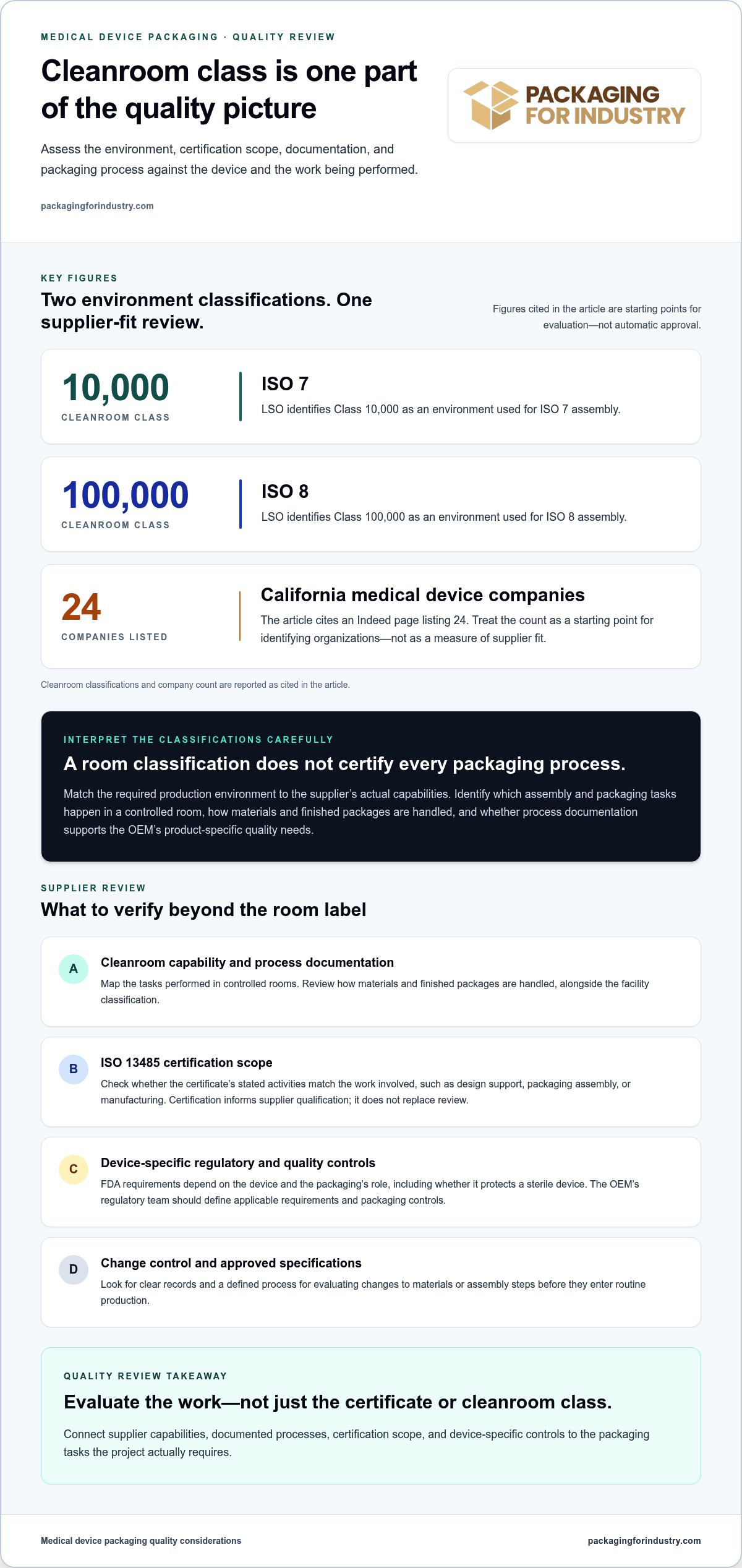
According to LSO, cleanroom environments are classified as Class 10,000 for ISO 7 assembly and Class 100,000 for ISO 8 assembly. These classifications describe environments used for assembly, not automatic approval of every packaging process. Compare the required production environment with the supplier’s actual capabilities and the steps performed there.
For example, map which assembly or packaging tasks take place in a controlled room, then identify how the operation handles materials and finished packages. A cleanroom classification alone does not show whether a process meets an OEM’s product-specific quality needs. Review process documentation alongside the facility classification.
Regulatory and Quality Support
FDA requirements for medical-device packaging depend on the device and the packaging’s role, including whether it protects a sterile device. The OEM’s regulatory team should identify applicable requirements and define packaging controls for the product.
Useful support connects packaging engineering with the OEM’s quality and regulatory functions. For a clinical-use device, teams can document the package configuration, inspection criteria, and changes to materials or assembly steps. This gives reviewers a clear record to assess against the manufacturer’s product requirements.
Supplier risks include inconsistent materials, process changes without clear records, and packaging that does not match approved specifications. These gaps can complicate validation, disrupt production, or affect product protection during distribution. A defined change-control process helps the OEM evaluate revisions before they reach routine production.
Quality Certifications
Medical-device development partners should be assessed for ISO 13485 certification and the scope covered by their certificate. Check whether the listed activities match the work involved, such as design support, packaging assembly, or manufacturing. Certification should inform supplier qualification, not replace a review of the actual process.
Ask how quality records, nonconformance handling, and corrective actions apply to the packaging work. For example, an OEM can compare the supplier’s documented inspection steps with its own acceptance criteria. This clarifies whether quality responsibilities are assigned across the contract.
To qualify a supplier, define the packaging tasks, review relevant certifications and scope, assess facility capabilities, and document responsibilities. Align validation plans, acceptance criteria, and change communication before production release. Without this review, risks include a mismatch between certified scope and actual work, unclear process ownership, and unassessed changes.
For a packaging project, share your packaging requirements so the design and quality needs can be discussed together.
Manufacturing locations and service areas
Southern California’s medical-device supply chain can involve separate sites for engineering, production, packaging, storage, and shipping. For each facility, map its role and where packaging enters the product flow. This helps purchasing and operations teams identify handoffs and plan material supply around actual production needs.
A company’s location can provide regional context, but its packaging role should be verified separately. Separate device manufacturers from packaging partners when researching the local market, then assess each packaging provider’s design, production coordination, and supply capabilities against your project.
Integrated supply-chain planning links packaging needs with production schedules and facility workflows. Map the manufacturing site, packaging area, storage point, and shipping destination. A company shipping from a separate warehouse, for example, should account for transfers between facilities when planning packaging availability and receiving procedures.
Prototype-to-production planning should preserve the package configuration while making it workable for routine operations. Review a sample with production staff, then document material requirements, pack-out steps, and handling instructions. Before scaling, compare those steps with the intended work area and operator workflow. This can surface practical issues before the package becomes part of regular production.
Packaging and labeling responsibilities also need clear ownership across sites. Define who provides approved label content, who applies labels, and where application happens. If different facilities handle assembly and shipping, align their work instructions with the same product configuration. This gives operations teams a consistent reference when responsibilities cross company or site boundaries.
Service-area planning should account for the route between suppliers, production facilities, and distribution points. An OEM operating across Los Angeles County and Orange County, for example, can map delivery points and receiving processes to coordinate packaging supply. San Diego-area operations can use the same approach to connect local production needs with downstream distribution.
Compare potential packaging partners against the stages your operation needs covered:
- Prototype support: Can the team develop and review a sample package?
- Production coordination: Can packaging formats fit the facility’s workflow?
- Labeling process: Are content approval and application responsibilities defined?
- Distribution planning: Does the package suit storage, handling, and destination needs?
These steps help distinguish medical-device manufacturers from external packaging partners. Arthrex California in Walnut is a regional device-company example; assess packaging providers separately for the design, production coordination, and supply-chain activities your operation requires.
Company locations can help frame the regional footprint, but they do not by themselves confirm packaging capability or service coverage. ResMed is located in San Diego, California, and has 5,001-10,000 employees; Dexcom is located in San Diego, California, and has 5,001-10,000 employees. Edwards Lifesciences is located in Irvine, California, and has More than 10,000 employees. These examples can help teams distinguish nearby manufacturers from suppliers whose packaging roles need separate verification.
Other locations broaden the picture beyond Southern California. Intuitive Surgical is located in Sunnyvale, California, and has 5,001-10,000 employees. Arthrex California is located in Walnut, California, and has 1,001-5,000 employees. Life Alert Emergency Response is located in Encino, California, and has 501 to 1,000 employees. Use location and workforce information as context when mapping potential handoffs; confirm service areas, packaging functions, and facility workflows directly rather than inferring them from company size or address.
Sterilization and distribution considerations
A packaging concept for a sterile medical device must account for sterilization, storage, transportation, and delivery. Begin each project by identifying the selected sterilization method, package components, and distribution route. These decisions affect material selection, package configuration, and how the device is protected before use.
Ethylene oxide sterilization depends on gas penetration through packaging materials such as cardboard, shrink wrap, and paper, according to the Agency for Toxic Substances and Disease Registry. Material choice is therefore part of process planning. For an OEM launch, document the packaging materials and configuration alongside the sterilization method, then coordinate evaluations with the teams responsible for the device and sterilization process.
Different sterilization methods bring different packaging considerations, so the design should follow the method selected for the device. Record the product’s clinical use case, sterilization approach, and any material constraints. Then review how each component fits the process. Do not assume that a material chosen for cushioning or outer protection is suitable for every sterilization method.
Form-fill-seal packaging brings package formation, device placement, and sealing into a defined production sequence. For a medical-device project, map where the device enters the process, how it is positioned, and how the seal is created. Review the resulting package configuration with production and quality teams before launch. The sequence should suit the device and planned sterilization process.
A sterile barrier system and its shipping protection serve distinct roles in package design. Identify the layer designated as the sterile barrier, then plan additional protection around it for handling, storage, and distribution. For example, a device may need a fitted internal support and an outer shipping package. Document how the layers work together without treating the shipper as the sterile barrier.
Distribution planning should trace the package from the manufacturing facility to its destination. Consider each handoff, including staging, storage, shipment, and delivery. A package that works on the production line still needs to suit expected handling and storage conditions. For a multi-component kit, check that components stay organized and the outer packaging protects the assembled load.
Use a simple review sequence for each project:
- Define: Record the device, clinical use case, and sterilization method.
- Design: Select package layers and materials for their intended functions.
- Evaluate: Review the package configuration with relevant production and quality teams.
- Trace: Map handling from the facility through storage, distribution, and delivery.
Keeping these decisions together helps OEM teams coordinate packaging design with sterilization and distribution planning. Revisit the documented configuration when materials, device components, or the distribution route change.
Custom packaging materials
Material selection should start with the device’s contact points, handling path, and assembly sequence. A housing with a fragile connector needs different support from a durable accessory shipped beside it. List vulnerable surfaces, moving parts, and required orientation before choosing packaging. This helps engineers compare material options against specific protection and production needs.
Foam can hold a device in position and separate components during transit. A shaped insert, for example, can support a device body while leaving space around a connector or control. Operators also need to place and remove the product without disturbing nearby parts. Review insert geometry against the device and pack-out steps, then revise the design if fit checks reveal pressure points or unnecessary handling.
Corrugated packaging can provide an outer enclosure and organize components with partitions or fitted supports. A diagnostic instrument and its accessories, for example, may need separate compartments to limit movement and simplify packing. Choose box dimensions for the assembled load, not just its largest component. This can reduce empty space while leaving room for protective materials and closure.
Stretch film can stabilize packaged loads as they move through a warehouse or distribution operation. It serves a different function from an insert or inner package, so define where each material belongs. For a palletized shipment, plan the carton arrangement, then apply film to secure the load without relying on it to cushion delicate equipment. Each layer should have a clear purpose.
Device manufacturing teams should also assess how materials affect scale-up. A prototype package may be assembled by hand, while production requires repeatable placement and consistent material use. Compare the sample design with the intended work area, operator sequence, and supply flow. Record approved materials and package dimensions so purchasing and production teams use the same configuration as output increases.
Use a practical material review before releasing a design:
- Map contact: Mark surfaces that need cushioning, separation, or support.
- Check fit: Test the device and accessories in the proposed package.
- Review assembly: Confirm operators can load, close, and remove contents efficiently.
- Plan scaling: Align material choices with repeatable production and replenishment.
- Document changes: Record the approved configuration when device components or packaging technologies change.
The right material combination protects the device and fits the production process. Comparing options by function, fit, and assembly needs helps teams identify practical changes that may reduce shipping damage and avoid excess packaging. For an OEM project, include the device, package dimensions, and production workflow when requesting pricing.
Packaging For Industry (PFI): Foam Packaging
Packaging For Industry (PFI) supports OEM medical equipment teams with foam packaging to protect devices during handling and shipment. A foam insert can be designed around the equipment’s shape and contact points to keep components positioned inside an outer package. Stretch film can stabilize packaged loads for warehouse handling and distribution.
For recurring production needs, Packaging For Industry offers Vendor Managed Inventory (VMI) and Just-In-Time (JIT) inventory programs to coordinate packaging supply with usage. These services can help manufacturers organize replenishment and maintain a dependable flow of packaging materials.
Share your device dimensions, packaging workflow, and supply needs with Packaging For Industry to discuss a practical next step.
Build a Packaging Plan Ready for Your Next Production Stage
Packaging decisions made during development can shape how smoothly a device moves into routine production. For packaging for OEM medical equipment manufacturers in SoCal, turn design requirements into a practical plan: identify the device configuration, production workflow, and packaging supply needs that must remain consistent as operations evolve.
Bring those details together before changing materials or increasing production. A shared specification gives engineering, purchasing, and operations a common reference for evaluating fit, handling, replenishment, and distribution needs. It also keeps discussions focused on the packaging challenges that matter most to your team, rather than treating each order as a separate decision.
Packaging For Industry can help with foam packaging, stretch film, and packaging inventory management. Outline the equipment being packed and the workflow you want packaging to support to start a focused conversation.
A clear plan helps your team align packaging with production. Contact Packaging For Industry to discuss your packaging needs and next steps.
Frequently Asked Questions
What packaging solutions do OEM medical equipment manufacturers in Southern California need?
OEMs need packaging that fits their device configurations, production volumes, and receiving workflows. For products with model variations, use controlled packaging specifications and clear identification so staff can match each configuration to its correct pack-out. Include package dimensions, component counts, and handling instructions in work documents. These details help procurement, production, and warehouse teams coordinate repeat orders and avoid confusion as product versions change.
What packaging materials are suitable for medical equipment shipping and sterilization?
Suitable materials depend on the device, shipping route, and selected sterilization process. Evaluate materials as part of the complete package configuration, including how the package is closed and handled during storage and transport. Document selected materials and review proposed substitutions through the OEM’s quality process. This gives engineering and operations teams a consistent basis for maintaining packaging requirements as production needs evolve.
Which Southern California companies provide medical device packaging design and manufacturing?
Packaging For Industry (PFI) develops medical-device packaging to align with the device’s sterilization method and clinical use. It also designs procedural kit assemblies with multi-component trays, IFU integration, sterile barrier systems, and outer packaging for shipping and storage.