
The nearest supplier isn’t always the best fit for a bulk order. For wholesale edge protectors in Santa Ana, there is no single minimum order quantity across suppliers. The required quantity depends on the protector’s size and material, and whether it uses a standard or custom specification. Compare these details with delivery and ordering terms to understand what an order involves.
Minimums matter: ordering too much can tie up warehouse space and budget, while ordering too little may not cover ongoing shipping needs. This guide explains what affects minimum order quantities, what to compare among suppliers serving Santa Ana, and how to match edge protection to your products and shipping process.
When requesting bulk pricing, have practical details ready, including dimensions, shipment volume, and replenishment needs. This makes it easier to compare supplier options and plan a more reliable packaging supply.
Key Takeaways
- Compare suppliers serving Santa Ana by product fit, order terms, and delivery coverage, not location alone.
- Minimum order quantities can vary with protector dimensions, material, and whether you need a standard or custom order.
- Prepare your size and printing requirements before requesting bulk pricing so suppliers can quote the right specification.
- Choose edge protection around the shipment’s load, handling, and surface-protection needs to help reduce shipping damage.
- For a broader packaging plan, PFI offers foam packaging, stretch film, and packaging inventory management options.
Wholesale edge protector supplier listings
Santa Ana buyers can compare industrial packaging distributors serving Orange County, regional packaging wholesalers, and manufacturers that sell to businesses. Review each supplier’s catalog or sales information for wholesale edge protectors. A general “packaging supplies” listing does not confirm that the supplier carries the profile or quantity your operation needs.
What specifications should you check when choosing edge protectors for shipping and strapping? Compare the material, dimensions, thickness, and profile with the load and strap path. Check protector length and corner fit, especially where straps cross exposed carton edges.
Build a shortlist from business-focused supplier listings, then record the same details for each source:
- Supplier location: Note the listed city and whether the business serves Santa Ana.
- Product category: Confirm the listing identifies edge protectors, corner board, or angle board.
- Order channel: Identify whether the listing supports wholesale or business purchasing.
- Product documentation: Record the dimensions and material shown for each item.
- Delivery information: Capture the stated delivery area and ordering process.
Use a product page, catalog, or written quotation as the basis for comparison. For example, a warehouse buying protectors for strapped cartons should match the listed profile to the carton edges and strap placement. A furniture shipper should look for suitable coverage on exposed finished corners. A general catalog category alone does not establish that a particular size is available.
If a listing lacks detail, send the supplier a defined inquiry through its business sales channel. Include the load type, product dimensions, preferred material, and expected order pattern. This helps clarify whether the supplier can quote your specification or only describes a broad product category.
For Santa Ana, compare Orange County distributors and regional wholesalers on the same basis. A nearby address alone does not show whether a supplier handles wholesale orders or delivers to your facility. Check these points alongside product fit before adding a source to your purchasing list.
Keep a record of the supplier, product description, quote date, and ordering contact. This makes repeat purchases easier when staff change or packaging needs shift. For recurring shipments, compare the approved item description with the next quotation before ordering. A clear record helps prevent substitutions that do not suit the load.
Minimum order quantities
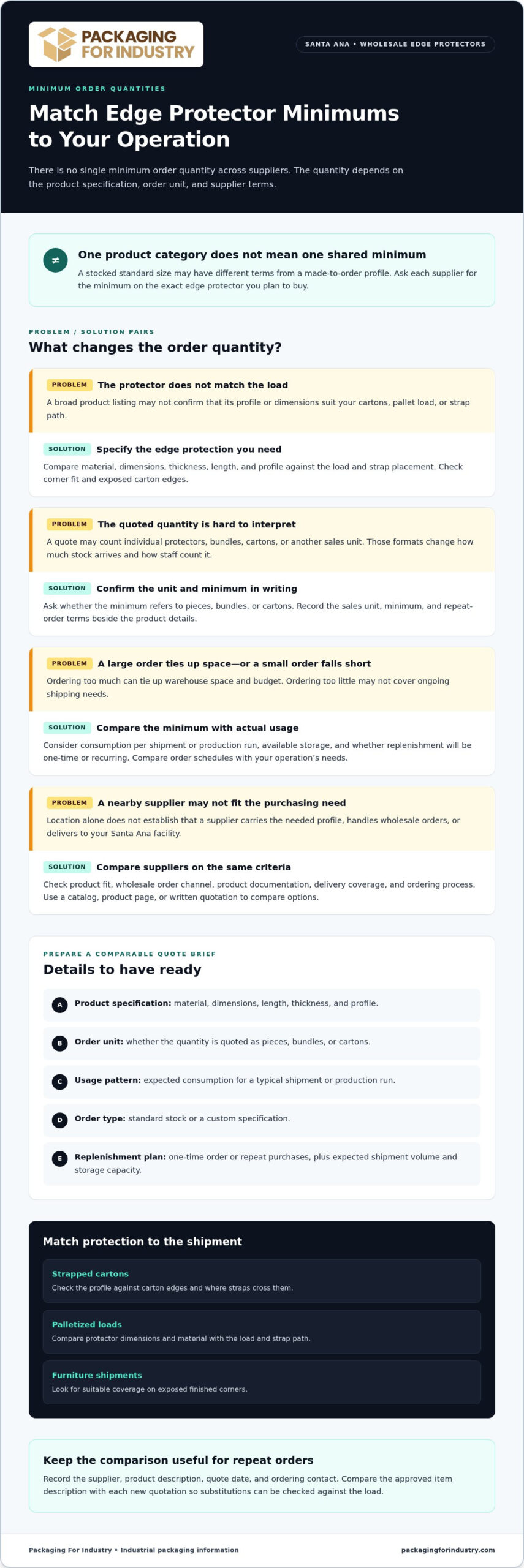
Edge protector minimum order quantities vary by supplier and specification. A stocked standard size may have different terms from a made-to-order profile. Material, dimensions, length, and pack format can all affect the quantity available to buy. There is no universal minimum for every wholesale order serving Santa Ana. Ask for the minimum for the exact product you plan to purchase.
Distinguish the product minimum from shipping or sales-unit requirements. A quote may list individual protectors, bundles, cartons, or another pack format. These units affect how much stock your warehouse receives and how easily staff can count it. If protectors are used only for occasional large shipments, for example, a bundle may suit operations better than frequent small replenishments.
Before requesting bulk pricing, organize the information suppliers need to determine an accurate quantity:
- Product specification: Provide material, dimensions, length, and profile requirements.
- Order unit: Ask whether the quoted quantity means pieces, bundles, or cartons.
- Usage pattern: Estimate consumption for a typical shipment or production run.
- Order type: Distinguish standard stock from a custom specification.
- Replenishment plan: Explain whether you expect a one-time order or repeat purchases.
These details make comparisons more useful. Suppose a distribution center uses one protector size for most pallet loads and a second for occasional oversized cartons. Ask suppliers to quote each specification separately. This shows whether combining demand affects the order terms, without assuming both sizes share a minimum.
Custom orders can require a different purchasing conversation from stock items. A supplier may need to match production to your requested dimensions, material, or profile, which can affect order quantity and planning. If the edge shape is unusual, provide a drawing or sample description and request the minimum for that exact specification.
Compare the minimum with actual usage, not just the quantity per order. A large purchase can reduce ordering frequency but take up more storage space. Smaller replenishments can suit limited warehouse capacity but create more frequent purchasing tasks. For Santa Ana operations, compare expected usage with available storage before choosing an order schedule.
Ask each supplier to state the minimum, sales unit, and repeat-order terms in writing. Keep those details beside the product dimensions and quote date. If you need pricing for a defined packaging requirement, submit a packaging quote request with the specification and expected usage. A consistent brief helps purchasing teams compare offers on equal terms.
Do Santa Ana suppliers offer custom-sized or printed edge protectors?
Custom-sized and printed edge protectors are specifications to discuss with suppliers serving Santa Ana. Availability depends on the supplier and requested design. Stock profiles suit familiar carton and pallet formats, while custom dimensions can address loads standard sizes do not fit. Treat printing as a separate requirement: include it in your quote request rather than assuming it comes with a custom order.
Start with the load’s shape. A narrow edge on a strapped carton needs a different fit from a broad furniture panel or irregular pallet load. Provide package dimensions, identify the edges to protect, and explain how the protector meets the strap. A simple drawing can show whether it should cover one edge or wrap around a corner.
For a custom-size inquiry, prepare these details:
- Protected product: Describe the carton, furniture piece, or pallet load.
- Fit: Give the edge dimensions and the required protector length.
- Application: Explain where straps contact the protector.
- Order pattern: Distinguish a trial order from regular replenishment.
- Marking: State whether printing or another identification method is required.
Printing can help identify products in a warehouse or during distribution. A printed product code, for example, may help staff distinguish similar profiles, while a handling label can communicate an internal packing instruction. These are requested uses, not standard features. Describe the intended message and placement in your inquiry.
Ask suppliers to list custom dimensions and print requirements separately in the written quote. This makes it easier to see which specification affects the order terms. For furniture shipments, compare profile fit first, then consider whether printed identification would help receiving or packing teams.
A sample, drawing, or photograph can clarify an unusual shape. Label measurements clearly and identify the surface that needs protection. For a palletized shipment, show the corner position and strap route. For a furniture panel, mark exposed edges and any finish to protect. Clear references reduce the chance of misunderstandings between purchasing and operations.
Keep standard and custom requirements distinct in purchasing records. A standard protector can serve repeat carton sizes, while a made-to-order profile can address a recurring irregular load. Record approved dimensions and print instructions with the item description. Santa Ana warehouse staff can then use a consistent reference when reordering or receiving supplies.
Which edge protectors are best for protecting palletized shipments and furniture?
The right edge protector depends on the load, contact points, and packing method. A strapped pallet needs protectors between the straps and exposed carton edges. Furniture may need coverage across finished corners and long panels. Match the profile and material to the damage risk instead of choosing by product name alone.
For palletized shipments, map where straps cross the load and where cartons meet the pallet. A corner board can spread strap contact over a wider area and help prevent pressure from cutting into carton edges. Check that each protector reaches the edges exposed during handling. A short piece may leave a vulnerable corner uncovered.
Use these checks to compare options for a pallet load:
- Strap position: Identify each point where banding contacts cartons or product.
- Load shape: Note whether the pallet has square corners, uneven layers, or overhanging cartons.
- Coverage: Confirm protectors cover the exposed edges along the strap route.
- Material: Compare available materials against the load and handling conditions.
- Application: Check that warehouse staff can position protectors consistently before strapping.
Furniture needs a different inspection. A finished table edge, cabinet corner, or upholstered item may need protection from rubbing, compression, or contact during movement. Identify the surfaces that must remain free of marks, then choose a profile that covers them without shifting during packing. For a table, protect exposed corners before securing it for shipment.
Choose material based on the shipment’s surface and handling conditions. Paperboard protectors may suit boxed freight and strapped loads where they sit against packaging. Consider other materials when moisture exposure or repeated handling affects the application. Compare the specific product with its intended use rather than assuming all edge protectors perform alike.
Test the packing sequence with the intended load. Place the protectors, apply the straps, and check whether the edges remain covered and the load stays aligned. For furniture, make sure the protector does not shift or press against an exposed finish. A sample shipment can reveal fit or application issues before the method becomes routine.
Record the selected profile, material, placement, and strap path in the packing instructions. This gives every shift a repeatable method for packing the same pallet or furniture item. Santa Ana businesses can also review damage records to identify edges that need better coverage. Choose protectors for the actual failure points, then assess the results after delivery.
Do local suppliers offer delivery to Santa Ana, and what are the delivery costs and lead times?
Delivery to Santa Ana depends on whether the supplier serves your facility. A local or regional distributor may arrange delivery, while another supplier may ship by carrier. For a warehouse near downtown Santa Ana, delivery access and receiving hours can matter as much as the destination. Confirm the delivery method, service area, and receiving requirements in the quote.
Delivery cost depends on the order and route, not just the city. Factors include shipment size, total weight, distance, unloading needs, and delivery frequency. A bulk order going to one receiving dock may be handled differently from smaller replenishments sent to multiple locations. Ask suppliers to list product prices and delivery charges separately so you can compare the full order cost.
Lead time depends on how the order is supplied. Stock availability, custom specifications, order processing, and transport scheduling all affect timing. A standard item ready to ship follows a different process from a custom profile that must be produced first. Include your required delivery date and specification in the quote request, then ask for expected dispatch and arrival windows.
Use this checklist to clarify logistics for a Santa Ana delivery:
- Delivery address: Provide the full facility address and receiving location.
- Receiving hours: State when the dock or warehouse can accept freight.
- Unloading access: Describe any site restrictions that affect truck access or unloading.
- Order volume: Share the quantity and packaging format being ordered.
- Schedule: Identify the required arrival date and likely reorder pattern.
For example, a distribution center with scheduled receiving windows needs an arrival plan that fits its dock operations. A smaller warehouse may need the shipment divided or scheduled around available storage. These details help suppliers plan delivery and help your team avoid receiving delays.
Compare quotes using the same delivery assumptions. One supplier may include delivery in its estimate, while another lists freight separately. Check whether the quoted schedule refers to processing, dispatch, or arrival: these milestones are not interchangeable. Record each supplier’s terms alongside the edge protector specification and order quantity.
For recurring orders, ask how delivery is scheduled for each replenishment. A predictable purchasing plan can help align stock with production or shipping demand. If order volume changes, update the requested quantity and receiving plan so the quote reflects the current shipment. Clear logistics make delivery costs and lead times easier to assess for Santa Ana operations.
Packaging For Industry (PFI): Foam Packaging
Packaging For Industry (PFI) supports manufacturers and aerospace, electronics, and medical companies with foam packaging for products that need cushioning inside shipping packages. Foam can complement edge protection by limiting product movement inside a carton or crate. Stretch film helps secure palletized loads, while Vendor Managed Inventory (VMI) and Just-In-Time (JIT) inventory management support recurring packaging needs.
PFI can help businesses coordinate product protection and packaging replenishment through one supplier. Share your product type, shipping method, and recurring packaging needs to discuss a suitable approach.
Contact Packaging For Industry to discuss your packaging needs.
Build a More Reliable Packaging Plan
Turn supplier comparisons into a repeatable purchasing plan. Track where freight damage occurs, which loads need more edge coverage, and how packaging use changes across production cycles. This information can help Santa Ana teams refine specifications and manage replenishment with fewer last-minute decisions. A focused review also helps distinguish edge protection from cushioning and load stabilization.
Packaging For Industry (PFI) provides Foam Packaging, Stretch Film, and Vendor Managed Inventory (VMI) for Packaging. These offerings can complement a broader plan to protect products and coordinate packaging supply. If you’re sourcing wholesale edge protectors in Santa Ana, bring your load requirements and purchasing priorities into the same conversation.
A practical packaging plan starts with clear requirements and improves as your team learns from each shipment. Take the next step when you’re ready to make your packaging process more consistent.
Frequently Asked Questions
Where can I buy wholesale edge protectors in Santa Ana, California?
Packaging For Industry (PFI), based in Anaheim, serves industrial packaging needs for businesses in Santa Ana and Orange County, as well as Los Angeles and San Diego. For purchasing, describe the freight application and whether you need a recurring supply or a one-time order. If your operation buys several packaging materials, discuss how those needs fit together. PFI can help align the order with your warehouse or production workflow.
Which Santa Ana packaging suppliers sell edge protectors in bulk?
Industrial packaging suppliers serving Santa Ana are the relevant source for bulk edge protectors. Packaging For Industry (PFI) serves business packaging needs and offers Vendor Managed Inventory (VMI) for Packaging. VMI may suit operations with recurring packaging demand because it supports managed replenishment. Share which teams use the material, how purchasing is handled, and whether demand changes with production so the supply plan reflects your operation.
How do wholesale edge protector prices and products compare among Orange County suppliers?
Compare how each supplier identifies products on quotes and packing documents. Consistent item descriptions help receiving staff match deliveries to purchase orders and prevent similar-looking protectors from being mixed in storage. For example, attach internal item codes or clear product names to each specification. This improves reorder accuracy and gives purchasing teams a reliable record of what arrived from each Orange County supplier.