
The right medical device package is not necessarily the one with the most material. It is the one designed for the device, its handling needs, and whether it is supplied sterile or non-sterile. For manufacturers in Aliso Viejo, medical device packaging solutions in Aliso Viejo may use standard formats or custom designs that better suit the product and shipping process.
Packaging decisions affect more than protection. Fit, materials, presentation, and the flow through packing and distribution all shape daily operations. Compare these factors before choosing an approach.
This guide explains how sterile and non-sterile packaging needs differ, where custom design can help, and what to consider when evaluating contract packaging in Orange County. It also covers how materials and design choices can support practical handling, product protection, and efficient supply.
Key Takeaways
- Match packaging decisions to whether the device is sterile or non-sterile, its handling requirements, and its distribution process.
- Custom packaging can improve product fit and simplify packing by accounting for a device’s shape, components, and protection needs.
- Evaluate contract packaging around the tasks involved, including inspection, labeling, and placing devices and accessories in the correct packaging.
- Compare packaging materials and formats based on product protection, shipping conditions, and how efficiently teams can handle them.
- For protective foam and packaging supply planning, PFI offers foam packaging, stretch film, VMI, and JIT inventory management for packaging.
Sterile and non-sterile medical device packaging
Start by identifying whether each device is supplied sterile or non-sterile. This guides package selection, handling, labeling, and validation planning.
Packaging materials and formats
Choose materials and formats based on the device’s condition, shape, and route through packing and distribution. A sterile device may use a pouch or tray, while a non-sterile component may need a bag, insert, or carton. A device with a cable, for example, may need a separate compartment to prevent tangling. Review the closure, labels, and outer shipping package as one system.
Applicable requirements
For U.S. devices, treat ISO 11607 and FDA requirements as items for the manufacturer’s quality and regulatory review, not as a one-size-fits-all checklist. Applicability depends on the device, its intended use, sterile status, and packaging configuration. Record the rationale for the selected package and controls. Route changes to materials, seals, or labels through the established review process.
Sterile and non-sterile packages serve different purposes. A sterile package must maintain its intended barrier during handling; a non-sterile package should protect the device without implying sterility. In a device kit, separate compartments can organize accessories and limit contact between components. Labels and packing instructions should match the configuration used by the production team.
For projects near Aliso Viejo, evaluations may include package integrity checks, seal assessments, and distribution testing. Select evaluations to suit the design and expected shipping conditions. A sample pouch can be reviewed for seal consistency, while a shipping carton can be assessed as part of the assembled package. The test plan should identify the configuration and record the results.
Connect each potential failure to a practical control. A puncture or damaged seal can compromise package integrity, while movement inside a carton can damage a device or accessory. Consider moisture exposure and inconsistent labeling during design and process reviews. Shelf-life support depends on the package configuration and its supporting evidence, not material choice alone.
- Sterile package: assess seals, closures, and handling damage.
- Non-sterile package: check fit, component separation, and shipment protection.
- Both formats: align labels, inspection steps, and records with the approved configuration.
For an Aliso Viejo OEM, document sterile status, device and accessory dimensions, package materials, and intended distribution conditions. Use this information to select a format and define relevant evaluations. It gives engineering, quality, and purchasing teams a shared basis for reviewing package changes and production handling.
Custom medical device packaging
A custom package starts with the device, not a standard box size. A handpiece, sensor, or multi-part kit each has different needs for fit, access, and component separation. The design should secure the product while supporting how staff pack, store, ship, and unpack it. A better fit can also reduce unused space and unnecessary packaging material.
Document the full product configuration before selecting a format. Record the device’s shape, fragile areas, accessories, and any parts that must remain separate. A reusable instrument with a cable, for example, may need distinct compartments to prevent tangling and contact during transit. Include the outer shipping container and packing sequence in the design review so the inner package works within the complete shipping system.
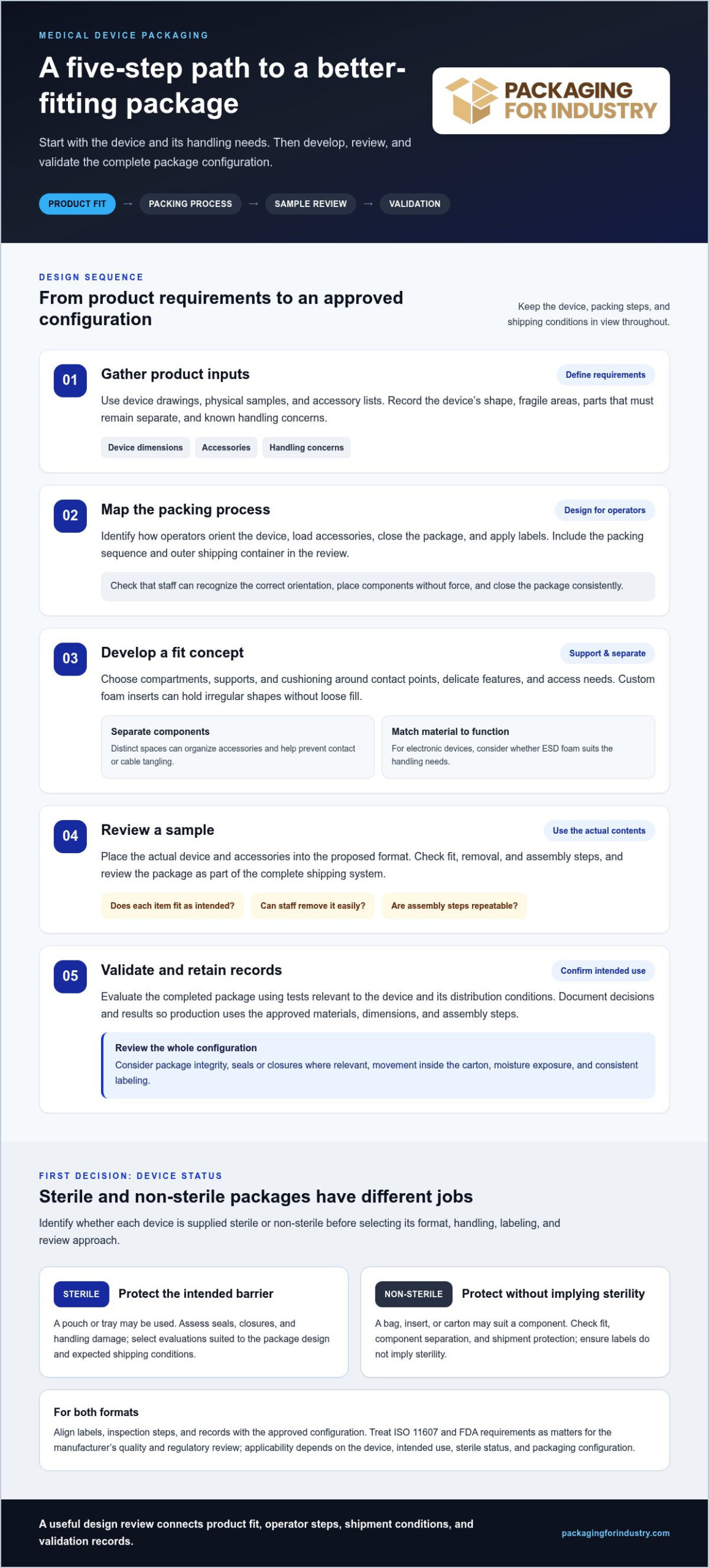
Design and validation follow a clear sequence: define product and handling needs, develop a package concept, assess a sample, then test the finished configuration for its intended use. Document decisions and results so production uses the same approved materials, dimensions, and assembly steps.
- Gather product inputs. Use device drawings, physical samples, accessory lists, and known handling concerns to define the package requirements.
- Map the packing process. Identify how operators orient the device, load accessories, close the package, and apply labels.
- Develop a fit concept. Choose compartments, supports, and cushioning around contact points, delicate features, and access needs.
- Review a sample. Place the actual device and accessories into the proposed format. Check fit, removal, and assembly steps.
- Validate the configuration. Evaluate the completed package using tests relevant to the device and its distribution conditions, then retain the records.
Custom foam inserts can hold irregular shapes without loose fill. A shaped cavity can position a component consistently, while separate spaces keep accessories organized. For electronic devices, consider whether ESD foam suits the handling needs. Select materials according to the device’s characteristics and the package’s function, not appearance alone.
Production practicality matters, too. A design that protects a prototype but slows every packing cycle can create an avoidable bottleneck. Check whether staff can identify the correct orientation, place components without force, and close the package consistently. Packaging kitting and assembly can help organize components into a repeatable pack-out sequence.
For an Aliso Viejo OEM, a useful design review connects product fit, operator steps, shipment conditions, and validation records. If you’re defining a new format or revising an existing one, request a custom packaging quote with device dimensions, accessories, and handling requirements ready.
Medical device contract packaging in Orange County
Contract packaging can move defined packing tasks outside an OEM’s production line. Compare providers by their process scope, quality controls, and fit with your workflow.
Provider capabilities
Start with the work required: inspection, labeling, device placement, accessory packing, sealing, or final shipment preparation. These are distinct capabilities, not interchangeable service labels. A provider that inspects finished devices may not perform sterile barrier packaging or tray sealing. Map each task to the package configuration and production handoff, then compare providers against that list.
For example, an OEM shipping a device with accessories needs consistent component identification and pack-out. Review how the provider manages work instructions, inspection records, label application, and exceptions. Comparing these processes shows whether the service covers one packaging step or a complete contract packaging workflow.
Certifications and lead times
Compare certifications by scope, site, and process. A certificate should apply to the facility and activities handling the device, rather than serve as a general quality claim. Review documented procedures, training records, and production controls alongside certification details.
Lead time depends on design readiness, materials, production scheduling, inspection steps, and approvals. Compare providers using the same project assumptions, including sample review and change handling. This makes timing comparisons meaningful without treating a short estimate as proof of fit.
Local packaging services
Sterile barrier packaging, pouching, tray sealing, and contract packaging describe different operations. A sterile barrier process must align with the device’s package design and applicable validation requirements. Pouching or tray sealing alone does not define the complete service scope. For each provider, distinguish process capability from responsibility for design, inspection, labeling, and records.
A local work example is an Aliso Viejo Packaging Clerk role, which involves inspecting finished devices for defects, labeling products to specifications, and correctly packing devices and accessories. The role also requires following SOPs, work instructions, GMP requirements, and quality procedures, as well as maintaining accurate production documentation.
Aliso Viejo providers
Okami Medical is located at 8 Argonaut in Aliso Viejo, California 92656. That identifies a local medical-device company, but a company location alone does not establish third-party contract packaging, pouching, or tray-sealing services. Keep this distinction clear when comparing local options.
For medical device packaging solutions in Aliso Viejo, define the required tasks before comparing providers. Separate in-house packing from outsourced services, then match each scope to the device, package, and production handoff. Record process coverage, relevant quality controls, certification scope, and timing assumptions in a concise comparison. This helps OEM teams assess Orange County packaging options without mistaking a local medical-device employer for a contract packaging provider.
Orange County is California’s third-most populous county, a regional context that can matter to teams coordinating local production and distribution. That context does not replace a facility-level review. Assess the site’s process scope, quality controls, and handoff responsibilities, then consider how its workflow aligns with the device configuration and required records. Local availability is useful only when documented capabilities match the packaging work and approvals required.
Which companies provide medical device packaging solutions in Aliso Viejo, CA?
Aliso Viejo OEMs may use different companies for packaging materials, design support, and outsourced packing. These roles can belong to separate suppliers, so compare the work each company performs rather than relying on a broad “medical packaging” label. A materials supplier can provide protective packaging, a contract packager performs production tasks for another business, and a design partner focuses on package configuration and fit.
Build a shortlist around your purchasing need. If a device already has an approved package, focus on sourcing materials and maintaining dependable replenishment. If the package needs redesign, prioritize custom engineering and sample review. If production needs external packing capacity, assess contract packaging providers by their stated scope. Keeping these categories distinct helps prevent comparisons between unlike proposals.
For an Aliso Viejo search, map each company’s service area and operating role. A nearby office alone does not mean a company handles medical-device packaging for other manufacturers. Likewise, a packaging distributor’s regional reach does not mean it performs contract packing. Use the company’s stated offerings and project description to identify the right fit.
A concise request for information can help compare candidates. Include:
- Project need: State whether you need packaging materials, package design, or outsourced packing.
- Product profile: Describe the device category, components, and handling concerns.
- Supply pattern: Note whether purchases are recurring, project-based, or tied to production schedules.
- Delivery destination: Identify the facility receiving materials or finished packages.
- Decision criteria: Rank fit, documentation, communication, and supply continuity.
An OEM launching a revised device, for example, may need design input and material sourcing before regular purchasing begins. A manufacturer with an established package may instead need consistent restocking. A production team facing a capacity constraint may need an outside packing operation. Each situation points to a different company type and request for information.
When comparing options across Aliso Viejo and Orange County, keep the evaluation focused on the work being purchased. Ask each company to describe its role, project handoff, and deliverables. Record the details in a simple comparison table. Procurement can then distinguish product supply from design work and outsourced production, and select a partner whose scope matches the operational need.
Compare providers by whether they supply materials, support package design, or perform contract packing. Then review their documented scope, deliverables, records, and supply continuity.
Which packaging materials and formats are used for medical devices?
Medical device packages can combine a primary product container, protective cushioning, and an outer shipping package. The right combination depends on sterile status, shape, sensitivity, accessories, and distribution route. A pouch, tray, box, or fitted insert serves a different purpose. Treat them as parts of one system, not interchangeable materials.
For a sterile device, the primary package must support the intended sterile barrier. Common formats include pouches and formed trays with a compatible lid or seal. Geometry helps determine the format: a flat component may sit securely in a pouch, while a shaped instrument may need a formed tray. Package design and validation must reflect the actual materials and configuration.
Non-sterile devices may use bags, trays, cartons, or protective inserts selected for handling and shipping. A compact sensor with a cable, for example, may need separate spaces to keep parts organized. A heavier assembly may need cushioning to limit movement inside its shipping carton. The format should let operators pack and remove the product without forcing delicate parts against package walls.
Materials serve different functions. Flexible films can form pouches or overwrap, while rigid trays hold a device in position. Foam and other cushioning materials can limit movement within a shipping package. Corrugated boxes provide an outer container for grouped products or transit. These materials are not interchangeable: an outer carton protects the shipment, while a primary package serves the device directly.
- Pouches: suited to devices that fit a flexible package format and require a defined closure.
- Trays: useful for organizing shaped products or multiple components in separated spaces.
- Foam inserts: hold products within a carton and reduce shifting during handling.
- Corrugated cartons: group packaged devices for storage, distribution, or shipment.
Review the complete pack-out before choosing materials. Place the device, accessories, labels, and cushioning in the proposed format, then check orientation, closure, access, and movement. A device kit, for example, may need labeled compartments so staff can identify each component quickly. The outer carton should fit the assembled package without leaving excess space for shifting.
For Aliso Viejo OEMs, compare materials based on product dimensions, handling steps, shipping conditions, and whether the package directly contacts a sterile device. Clearly distinguish the primary package, protective components, and shipping container in design records. This makes changes easier to review and helps purchasing compare materials against actual packaging needs.
Packaging For Industry (PFI): Foam Packaging
Packaging For Industry (PFI) supports medical manufacturers with foam packaging for cushioning devices and components. Foam inserts can help limit movement inside an outer shipping package, while stretch film can secure packed cartons on pallets during handling and distribution. These materials support protection and shipping workflows, but do not replace a sterile barrier package or its validation.
Turn to PFI when your team needs protective packaging materials or more consistent supply planning. Vendor Managed Inventory (VMI) for Packaging and Just-In-Time (JIT) Inventory Management for Packaging can coordinate replenishment with operating needs. Share the packaging’s role, handling requirements, and supply workflow to guide the discussion.
Contact Packaging For Industry to discuss your packaging needs.
Move Your Packaging Plan Forward
For OEMs evaluating medical device packaging solutions in Aliso Viejo, connect package requirements with purchasing and production plans. Document the device’s handling needs, packaging materials, expected usage, and supply constraints. These details focus the discussion on practical ways to protect products and maintain a dependable flow of packaging supplies.
Packaging For Industry (PFI) offers foam packaging and stretch film for protective packaging needs, along with Vendor Managed Inventory (VMI) for Packaging to support inventory planning. These services can suit manufacturers reviewing cushioning, shipment preparation, or packaging supply coordination. Share the operational issue you want to address and the packaging role involved.
A clear starting point helps identify the right materials and inventory approach for your operation.
Take the next step with a packaging plan suited to your device and workflow.
Frequently Asked Questions
What medical device packaging services are available near Aliso Viejo?
Near Aliso Viejo, Packaging For Industry (PFI) supports medical manufacturers with foam packaging, stretch film, and packaging inventory management. Foam can cushion components within shipping packages, while stretch film helps secure palletized loads. Vendor Managed Inventory (VMI) and Just-In-Time (JIT) inventory management can support recurring supply needs. Share your packaging use and replenishment pattern to discuss suitable materials and a practical supply approach.
Are there medical device packaging providers in nearby Irvine, Laguna Hills, or Orange County?
Yes. Packaging For Industry serves Orange County, Los Angeles, and San Diego, including Irvine in Orange County. For medical manufacturing operations, custom sizes are available, and local packaging delivery can support regional supply planning. Buyers can compare packaging and bulk pricing by outlining materials, quantities, and recurring demand. This helps purchasing teams assess options for reducing packaging costs while maintaining supply continuity.