
High-value shipments need to conceal their contents without hiding signs of tampering. Effective packaging solutions to prevent theft of high-value goods combine a discreet exterior with closures that show access and cushioning that helps protect products. For shipments moving through Orange County, Los Angeles, and San Diego, the right design depends on the product, route, and handling requirements.
Stronger seals matter, but security features work best when they suit the entire shipment. This guide explains how to choose tamper-evident packaging, compare options, and balance protection with cost, handling, and the recipient’s experience.
Corrugated boxes, security bags, protective pouches, tamper-evident closures, and stretch film can all contribute to a layered approach. The key is to keep outer packaging discreet, reducing visible clues about the contents while making unauthorized access easier to spot.
Key Takeaways
- Match packaging to the shipment’s main risks, including concealment, unauthorized access, and damage in transit.
- Compare cartons, mailers, security bags, and pouches by how they balance protection, visibility, and ease of handling.
- Assess added material and shipping costs alongside customer experience and sustainability goals.
- Prioritize products and shipping situations with the greatest exposure, then select packaging features to address those risks.
- Use discreet outer packaging to avoid advertising valuable contents while maintaining a clear way to spot tampering.
1. What Is Anti-Theft Packaging?
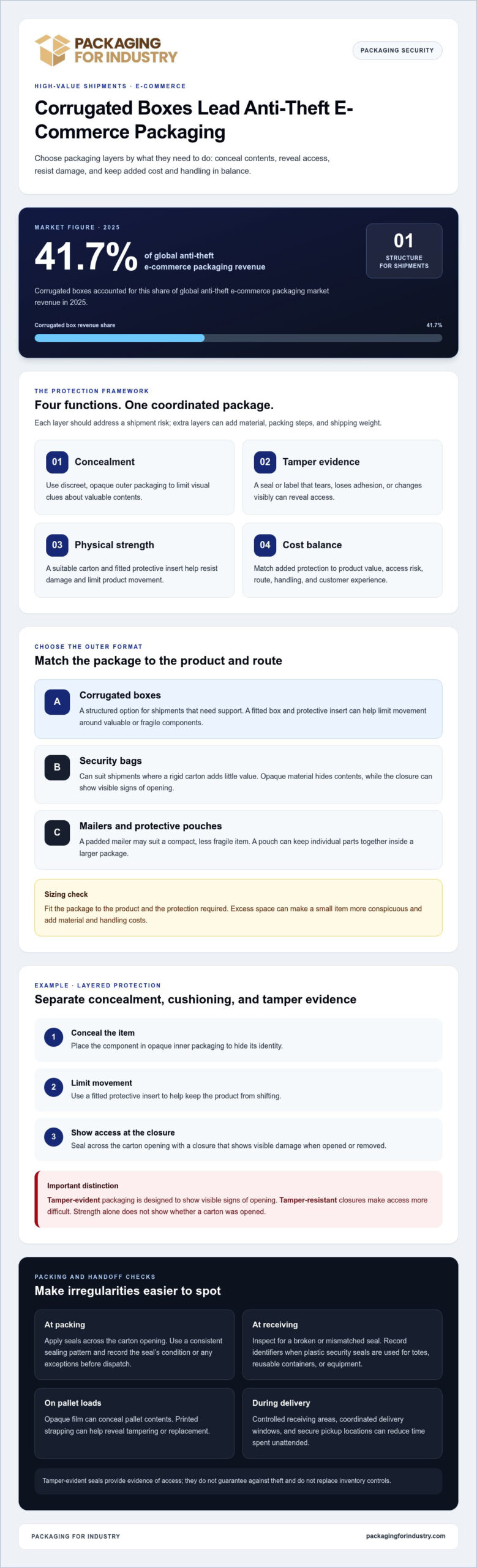
Anti-theft packaging helps deter, detect, or delay unauthorized product removal during storage, display, and transit. A practical design addresses four distinct needs: concealment limits visual clues, tamper evidence reveals access, physical strength resists damage, and cost keeps protection viable. A plain opaque shipper may hide a product, for example, but it cannot show whether someone opened it.
Tamper-evident seals and security labels change visibly when someone opens or removes them. Some leave a message or pattern behind; others tear or lose adhesion, making an unmarked reseal harder. Apply the seal across the carton opening and record its condition during packing or dispatch. It provides evidence of access, not a guarantee against theft.
Tamper-evident and tamper-resistant describe different functions. A tamper-evident carton is designed to show visible damage when opened, while a tamper-resistant closure makes access more difficult. A reinforced closure can slow casual interference, but the carton should still reveal opening. For example, pair a strong outer box with a seal that tears when lifted instead of relying on strength alone.
Labels suit products that need item-level control without changing the entire package. Electronics teams can place a security label across a device carton’s opening; warehouse staff can use numbered labels to match packages with dispatch records. Printed strapping can also help reveal tampering or replacement on pallet loads. Place a label across a closure, not on a flat surface that can be bypassed.
Concealment and strength need to work together. Opaque inner packaging hides product identity, while a fitted protective insert helps prevent a valuable component from shifting. An oversized box can make a small item more conspicuous when left unattended and add material and handling costs. Match package dimensions to the protection required, concealment needs, and transport conditions.
Packaging choices depend on the industry and the risk. Electronics shipments may combine opaque inner wrap, a sealed carton, and cushioning around sensitive components. High-value clinical and aesthetic shipments—such as professional supplies distributed to practitioners by Skin Candy—require processes aligned with strict handling and tamper-evident standards. Aerospace parts may need a rigid enclosure and shaped internal support to limit movement. Food products need protection suited to their handling and packaging requirements.
Compare options by asking what each layer does. A security label provides visible evidence with little added material; a reinforced carton improves physical resistance; opaque film conceals pallet contents; and cushioning helps limit transit damage. Additional layers can increase material use, packing steps, and shipping weight. Use them when the product’s value, access risk, and route justify the added protection.
2. Corrugated boxes, mailers, security bags, and protective pouches
For e-commerce shipments, combine a corrugated carton or security mailer with a tamper-evident closure and protective inner packaging. Corrugated boxes accounted for 41.7% of global anti-theft e-commerce packaging market revenue in 2025. They suit shipments needing structure, while security bags and protective pouches work well for smaller items and flexible fulfillment workflows.
Choose the outer format based on product shape, fragility, and handling. A fitted corrugated box can limit movement around a valuable electronic component, while a padded mailer may suit a compact, less fragile item. Dividers keep multiple products separated. Use a carton sized to accommodate protection without excess space, which can make small goods more conspicuous when left unattended.
Security bags can suit shipments where a rigid carton adds little value. Their closures can show visible signs of opening, while opaque material hides contents from casual view. Protective pouches can keep individual parts together inside a larger package. For example, seal a component in an opaque pouch, then secure it inside a carton to provide concealment and impact protection separately.
Sealing practices matter as much as box choice. Water-activated tape bonds to corrugated fiber, so opening it can disturb the carton surface and leave visible evidence. Use a consistent sealing pattern across packing shifts and record exceptions before dispatch. Custom printed tape can identify a legitimate package and make a changed or missing seal easier to notice at receiving.
Plastic security seals can support retail logistics when reusable containers, totes, or equipment move between locations. Apply each seal through the intended closure point and record its identifier against the shipment or inventory movement. A broken or mismatched seal gives staff a reason to inspect contents before accepting the handoff. Seals support chain-of-custody checks but don’t replace inventory controls.
For third-party logistics operations, align packaging with receiving, storage, picking, and dispatch procedures. Review how access is controlled, exceptions are recorded, and packages are inspected at handoffs. A shipment that is secure at packing can still be exposed during staging, so packaging and handling procedures need to work together.
Delivery arrangements also affect exposure after dispatch. For residential e-commerce orders, secure pickup locations or staffed collection points can reduce time spent unattended at a doorstep. For business shipments, use a controlled receiving area and coordinate delivery windows with site staff. These steps complement packaging by reducing opportunities for unattended access.
Start with the shipment type, then match the carton, mailer, or pouch to its contents and route. Standardize closure methods and receiving checks so staff can spot irregularities without slowing routine operations. If your team needs packaging matched to product dimensions and fulfillment handling, request a packaging quote for a practical comparison.
3. Cost, sustainability, and customer-experience trade-offs
Compare the full cost of a packaging strategy, not just material price. A reinforced carton may need more material and packing time; a weaker package can increase damage, replacement work, and claims administration. For an electronics shipment, assess protection, packing labor, dimensional efficiency, and the effort required to investigate missing or damaged items. The lowest unit cost may not be the lowest cost across operations.
Sustainability and security can pull design in different directions. Oversized cartons or multiple protective layers may use more material and shipping space. A right-sized package with internal supports can reduce unnecessary void fill while keeping the product stable. Review packaging waste, shipment dimensions, and damage outcomes together instead of removing protective components without evaluating transit performance.
Customer experience depends on what recipients see and how they can report a problem. A package with a damaged seal needs a clear opening process and a way to document its condition. Give simple instructions, such as photographing the seal before opening and retaining the carton if contents are missing. This helps customers provide useful evidence without making routine delivery unnecessarily difficult.
Replacement decisions also affect satisfaction. If a customer reports a missing component, connect the order record, package condition, and dispatch information before resolving the claim. A consistent process helps staff distinguish transit issues from picking errors or inventory discrepancies. For valuable electronics, record the product identifier during packing and match it against the order before sealing.
Staff training makes security procedures consistent across shifts. Show packers how to inspect closures, place seals across the actual opening, and record visible damage before dispatch. Train receiving staff to compare seal condition with shipment records before accepting goods. A short checklist at packing and receiving stations helps temporary and experienced staff follow the same process.
Chain-of-custody records should capture each important handoff. Log who packed the shipment, when it left the warehouse, and who accepted it at the next controlled point. If a pallet moves between a warehouse and a carrier, note its seal condition at release and receipt. Comparing those records with inventory movements helps locate where a discrepancy first appeared.
Test changes with a defined product group before a wider rollout. Compare packaging use, damage reports, theft claims, customer feedback, and the time needed to resolve exceptions. For example, an operations team could trial a revised carton and receiving checklist for a high-risk electronics line, then review the results before changing other shipments. This keeps cost, material use, and customer impact visible.
4. How to Choose the Right Tamper-Evident Solution?
Start with the product and the point where loss occurs. Identify which items face repeated shortages, where packages are handled, and whether incidents happen during storage, loading, or transit. A $1 million shipment illustrates why exposure deserves careful planning, but the right measures depend on product value, route, access, and consequences of loss. This risk review gives teams a practical starting point for packaging solutions to prevent theft of high-value goods.
Match materials and closures to the most likely failure. A fragile electronics component needs cushioning and a suitably strong carton; a small, easily concealed part may also need opaque inner packaging. If unauthorized opening is the main concern, apply a tamper-evident seal across the carton opening. For palletized goods, printed stretch film can make replacement more noticeable.
Balance protection against total operating cost. Additional layers can increase material use, packing time, and shipment dimensions. Compare those impacts with damage, missing-item investigations, replacements, and warehouse disruption. A practical starting point is to trial packaging on products with a clear loss history. Track shrinkage, damage, customer feedback, and shipping costs before expanding the design.
RFID tags, GPS trackers, and smart packaging address different parts of theft prevention. RFID helps identify items when compatible equipment reads the tags; GPS trackers provide location information; smart packaging may indicate opening or other monitored conditions. These tools complement physical cartons and seals but don’t replace them.
Packaging should be part of broader loss-prevention measures. Combine it with controlled access, inventory records, shipment tracking, and clear handoff procedures. In a warehouse, separate receiving and shipping workflows where practical, reconcile picked goods against orders, and document seal condition before dispatch. These controls help identify where a discrepancy occurred.
For U.S. shipments, compliance planning starts with the product category and intended use. Food and pharmaceutical products must comply with applicable FDA requirements. Identify relevant requirements before selecting packaging materials, labels, and handling procedures. Keep approved packaging specifications and work instructions together so purchasing, packing, and quality teams use the same version.
Test the complete package, not one material in isolation. Check whether cartons protect products through expected handling, closures remain intact, and staff can inspect them efficiently. Packaging tests can reveal weak points before rollout. For sensitive products, record the test method, package configuration, and design changes so future production uses the evaluated version.
Choose the simplest combination that addresses documented risks. A seal can show access, a stronger carton can resist handling damage, and tracking can support shipment visibility. Review these controls when routes, products, or fulfillment processes change. This keeps packaging solutions to prevent theft of high-value goods aligned with actual operations instead of adding layers without a clear purpose.
5. Discreet outer packaging for high-value goods
Discreet packaging reduces visible clues about valuable contents without removing security. A plain outer carton, opaque wrap, and neutral presentation can make product identification harder for opportunistic thieves. Keep the distinction clear: concealment limits what someone can see, while a tamper-evident closure helps detect unauthorized access.
For palletized shipments, opaque white or black stretch film can hide cartons and their contents. Apply it consistently around the load, including exposed sides, so product labels and branded cartons aren’t visible through gaps. Printed tape or strapping can add a separate security cue, helping staff notice replacement or interference during warehouse handling and delivery.
Discretion shouldn’t obstruct normal shipping operations. Keep carrier labels and internal shipment records readable while avoiding product names or high-value branding on exposed surfaces. For example, a pallet of electronics can travel under opaque film with its transport label facing outward. Staff can identify the destination while passersby see fewer clues about the contents.
Choose outer dimensions that fit the shipment instead of adding conspicuous empty space. An oversized carton can make a small item more visible when left at a doorstep, while excess packaging adds material and handling. Use an appropriately sized shipper, then place the product in opaque inner packaging if the item itself could reveal its value. The aim is concealment without unnecessary bulk.
At packing, cover branded inner cartons and close access points before applying outer film. Check the finished package from several sides, including the pallet base, where cartons may remain exposed. Photographing a sealed high-value shipment creates a record of its condition before storage. The image can support an internal review if the wrapping later appears cut, loosened, or replaced.
For mixed-product pallets, position high-value cartons inside the load rather than along exposed edges. Wrap the completed pallet so carton markings don’t show, then place printed strapping where handlers can inspect it during transfers. This keeps the load stable while reducing visual clues and gives warehouse teams a consistent outer presentation to check at handoff.
Standardize discreet packaging by shipment type instead of applying the same layers everywhere. A single boxed component may need an opaque overpack, while consolidated goods may need opaque pallet film. Review material use, packing steps, and product information visibility for each format. These checks help balance concealment, efficient handling, and the ability to identify interference.
Discreet outer packaging works best when concealment and shipment visibility are planned together. Cover product clues, keep shipping information readable, and inspect the finished load before dispatch. These steps make valuable contents less obvious while helping operations recognize irregular packaging during transit.
Packaging For Industry (PFI): Foam Packaging
Packaging For Industry (PFI) helps businesses protect high-value shipments with foam packaging that cushions products during transit. It’s a practical option when standard packing leaves costly components exposed to movement or impact. For palletized shipments, PFI’s stretch film can help conceal contents and contain the load.
PFI also offers Vendor Managed Inventory (VMI) and Just-In-Time (JIT) inventory programs for packaging. These services suit operations that need materials replenished in step with production and fulfillment. Combining product protection with inventory planning can help reduce damage risk and prevent avoidable supply interruptions.
Contact Packaging For Industry (PFI) to discuss foam packaging for your high-value goods, or visit packagingforindustry.com.
Turn Packaging Priorities into an Action Plan
Make the next step operational: select a high-risk product, trace its route from packing station to recipient, and identify where concealment, protection, or access control matters most. This gives your team a defined scope for testing packaging solutions to prevent theft of high-value goods without changing every shipment at once. Set a review point and compare the trial using practical measures such as packing consistency, visible package condition, damage reports, and claim handling.
A useful packaging plan should fit the product and the way your team works. Packaging For Industry (PFI) can help businesses assess packaging needs as they work to protect valuable goods and maintain reliable operations. Bring product dimensions, handling requirements, and current packaging concerns to the conversation to make the next decision specific and useful.
A clear plan helps your team improve protection while keeping daily work practical. Start with the shipment that needs attention most, then build from there.
Frequently Asked Questions
How to Choose the Right Tamper-Evident Solution?
Choose based on the loss pattern and the team responsible for responding. Review incidents by product, route, and handoff point, then identify who will inspect shipments and what action follows an irregularity. For example, receiving staff need a clear escalation path if a delivery arrives with an unexpected seal condition. A feature without an owner or response procedure adds little operational value.
What Is Anti-Theft Packaging?
Anti-theft packaging is selected to help reduce opportunities for product theft and support investigation when a shipment is compromised. It is one part of a broader control system that includes inventory accuracy, staff procedures, and delivery arrangements. Evaluate not only what a package does, but whether warehouse and receiving teams can consistently apply and inspect it during normal work.
What packaging features help prevent theft of high-value goods?
Useful features depend on the package format and inspection process. For individual products, consider a closure that must be disturbed to access the item; for consolidated loads, consider visible identifiers that receiving staff can compare with shipping records. Check whether product labels, invoices, or packing slips expose sensitive details. Keep those documents inside when external identification isn’t operationally necessary.
How do opaque, plain, or discreet shipping boxes reduce theft?
Discreet packaging can limit exterior clues, but the full shipment presentation matters. Review carton graphics, return-address details, product stickers, and paperwork attached outside the box. A neutral carton can still disclose its contents through a product-specific label. Coordinate packaging artwork and label placement with order fulfillment so necessary carrier information remains visible without exposing avoidable product details.
How much do security packaging materials and services cost?
Cost depends on package design, materials, order quantity, and the effect on packing and fulfillment. Compare the complete cost per shipment, including labor, storage, disposal, and claims handling, rather than seal prices alone. For custom packaging, project complexity, materials, and production volume affect the quote. Request a quote to price the requirements of a specific packaging program.
What U.S. regulations apply to tamper-evident packaging for high-value products?
Applicable requirements depend on the product and its intended use. Food and pharmaceutical products must comply with relevant FDA requirements in the United States, so identify product-specific requirements before approving packaging. Keep applicable specifications and supporting records with the product’s quality documentation. High value alone doesn’t establish a separate packaging rule; the product category and intended use guide the compliance review.
How should businesses choose and implement theft-resistant packaging?
Assign clear ownership before rollout. Purchasing can maintain approved material specifications, packing supervisors can train staff, and receiving teams can record exceptions through the company’s normal reporting process. Define how a shipment discrepancy moves from receiving to inventory control and customer service. This avoids conflicting records and helps teams resolve a concern consistently without interrupting routine warehouse work.
What are the drawbacks of security packaging, including added cost and shipping weight?
Security features can complicate purchasing and warehouse control, especially when each product line needs a different closure or package configuration. More packaging variations can increase storage needs and make replenishment harder to manage. Before adopting a design, check whether staff can identify the correct materials, suppliers can support repeat orders, and recipients can open and dispose of the package through existing processes.