
The Grainger packaging catalog versus custom-designed solutions comes down to more than unit cost: standard packaging is typically faster to source and avoids design or tooling costs, while custom packaging can better match a product’s dimensions and protection needs. Custom options usually require more upfront investment and longer lead times. The lower-cost choice depends on how packaging affects storage, handling, shipping damage, and inventory.
Standard sizes can simplify purchasing and warehouse storage, so they may be a practical choice for speed and affordability. But if a package doesn’t fit the product or workflow, extra material, storage demands, and damage risk can change the total-cost picture.
This comparison explains how catalog and custom packaging differ in cost, scalability, storage, logistics, inventory, upfront investment, and lead times. You’ll see when standard packaging is a practical fit, when design changes may solve operational problems, and what to weigh when comparing packaging costs for ongoing production or distribution.
Key Takeaways
- Compare total packaging cost, not just the purchase price: factor in storage, handling, product protection, and inventory demands.
- Use standard packaging when common sizes and faster sourcing suit your products and warehouse workflow.
- Consider custom packaging when a closer fit or specific protection needs could reduce operational friction or shipping damage.
- Weigh custom design and setup against the potential benefits before committing to added inventory complexity and longer lead times.
- For packaging needs involving protective foam or supply planning, explore foam packaging, VMI, and just-in-time inventory options.
Cost efficiency and scalability
Comparing Grainger’s packaging catalog with custom-designed solutions starts with total operating cost, not just unit price. Standard packaging often costs less because it uses common sizes and avoids custom design, printing, or tooling. For a Southern California distribution center across Los Angeles, Orange County, and San Diego shipping repeat orders in familiar cartons, standard formats can simplify replenishment. That advantage is strongest when available sizes fit the products and their protection needs remain consistent.
Custom packaging may add design and setup costs, but a closer fit can address specific dimensions or handling issues. Consider a manufacturer whose component shifts inside a standard carton. A tailored box or insert may limit movement and help reduce shipping damage. Compare materials, packing labor, protection, and storage alongside purchase price. A lower unit cost may not be the best value if the format creates extra work or product risk.
Scalability depends on demand patterns and product mix. Standard formats can serve repeat orders across multiple product lines when their packaging needs align. Custom formats suit products with distinct shapes or protection requirements. For example, a business might use common cartons for routine items and reserve custom packaging for fragile components. This approach keeps packaging decisions tied to operating needs as demand changes.
Review the packaging portfolio before scaling purchasing:
- Group products by dimensions, shipping method, and protection needs.
- Identify repeat-volume items that may share standard formats.
- Flag products that need custom dimensions, structures, or inserts.
- Compare replenishment and storage demands for each format.
This review can prevent two costly mismatches: custom formats for products that fit standard packaging, and standard formats that cause unnecessary material use or handling. Reassess the mix when product specifications or order patterns change. The choice between Grainger’s catalog and custom-designed solutions should reflect those changes, rather than rely on a one-time purchasing comparison.
Other options include industrial packaging suppliers like Packaging For Industry (PFI) that offer custom design and supply programs. They can develop packaging around product dimensions and replenishment needs, rather than relying only on standard catalog formats. For buyers throughout Los Angeles, Orange County, and San Diego, compare how well each supplier’s packaging approach aligns with the product, order pattern, and fulfillment workflow.
Customization can cover package size, structural features, materials, branded printing, premium finishes, and labeling. For example, a business can specify a different carton size and add branded print. Each choice should serve a defined product or operational need, so the resulting specification remains practical for purchasing and packing.
For sustainability decisions, review the material and recyclability details listed for each catalog item. Recyclability depends on the specific packaging product and material, not simply its catalog category. Include disposal practices at the receiving end when comparing available formats.
Storage, logistics, and inventory complexity
Catalog packaging usually relies on standardized SKUs, making purchasing and warehouse organization more predictable. A Los Angeles distribution center can store repeat-use carton sizes in designated locations and replenish them using familiar item numbers. That structure simplifies picking and avoids maintaining a separate specification for every product. The tradeoff arises when a standard carton leaves excess space or requires extra cushioning for a particular item.
Custom packaging can fit a product’s dimensions more closely, but variable sizes may increase the number of SKUs a warehouse must track. A manufacturer shipping several component shapes, for example, may need a separate packaging specification for each. Purchasing teams then coordinate forecasts, replenishment, and storage locations across those formats. The decision should account for both the space packaging occupies and the work required to keep inventory records accurate.
Catalog and custom packaging differ in product protection and shipping efficiency. A standard format can protect products effectively when its dimensions and cushioning suit the item. A custom design can address movement or fit issues, helping limit unnecessary void space and support more efficient handling during shipment.
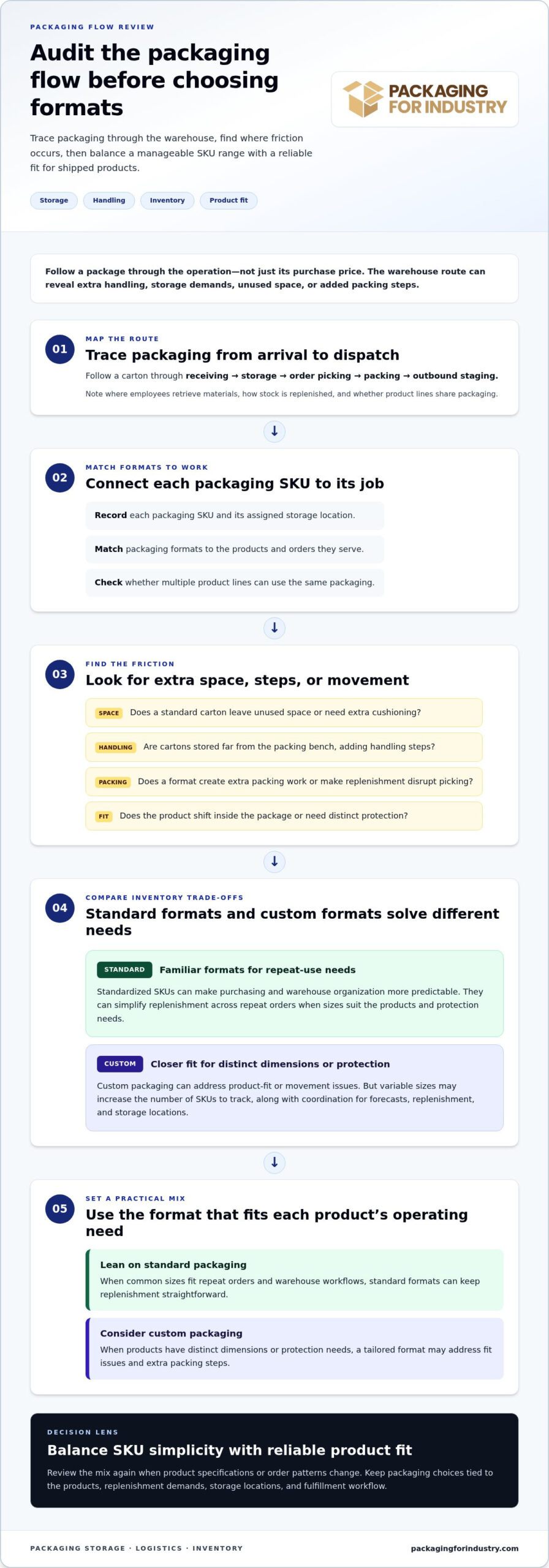
Map the packaging flow before selecting formats. Follow a carton from receiving through storage, order picking, packing, and outbound staging. Note where employees retrieve materials, how stock is replenished, and whether multiple product lines share the same packaging. For example, cartons stored far from a packing bench can add handling steps, while a poorly fitting package may require extra cushioning at the work area.
Use this review to identify where complexity enters the operation:
- Record each packaging SKU and its assigned storage location.
- Match packaging formats to the products and orders they serve.
- Check whether replenishment disrupts picking or packing activity.
- Identify formats that create unused space or added packing steps.
For warehouses and distribution centers, the best inventory setup balances a manageable SKU range with a reliable fit for shipped products. Standard packaging can simplify replenishment across repeat orders. Custom formats may make sense for products that need distinct dimensions or protection. Review the product mix and shipping workflow together, rather than optimizing storage in isolation.
In Los Angeles, a packaging quote can help frame those requirements around actual storage and shipment needs. Request a packaging quote with your product types, packaging formats, and inventory challenges so the comparison reflects the work your operation handles.
Packaging choices should also account for the packaging line and its operating needs. Manufacturers designing a packaging line should assess product shapes, sizes, and materials, available floor space, and the flow between processes such as filling, labeling, sealing, and coding. Poor planning can lead to slowdowns and bottlenecks, manual workarounds that reduce throughput, equipment that cannot scale with demand, and wasted space or underused equipment.
Generic packaging is generally easier to store and uses standardized SKUs, while custom packaging can involve more SKUs, variable dimensions, and additional planning. Considering these factors together helps keep storage choices aligned with product requirements and the flow of work across the packaging line.
Upfront costs and lead times
Catalog packaging usually needs less initial setup because standard formats avoid custom design and tooling. For a Los Angeles warehouse ordering a familiar carton, purchasing can focus on the item specification and replenishment schedule. Custom packaging adds development work before production, especially when dimensions, structural features, printing, or inserts need adjustment. Those steps can increase upfront investment and extend the time before packaging is ready.
Lead time depends on the path from specification to production. Standard packaging uses existing formats, while a custom design may require dimension review, material selection, sample evaluation, and production setup. A manufacturer preparing for a product launch should include those activities in its packaging schedule. If packaging is needed before a planned shipment, starting design work earlier can reduce the risk of a delay affecting dispatch.
Minimum order requirements for custom packaging depend on the design, materials, production setup, and manufacturing run. A straightforward size change and a complex printed structure can involve different production considerations, so order quantities depend on the specific packaging specification.
Compare the full commitment, not just the first order. Custom packaging may require a larger initial purchase to make a production run practical, while standard options can support smaller replenishment decisions where available. Forecast usage against product demand, storage capacity, and the risk of design changes. For example, a seasonal product with uncertain demand may leave excess packaging inventory if ordered far ahead. A stable production item may justify a planned custom run.
- Confirm the packaging specification, including dimensions, material, and printing.
- Map design review and production setup against the required shipment date.
- Estimate usage from current order patterns and planned product changes.
- Assess whether the warehouse can store the expected packaging quantity.
These steps help purchasing compare timing and inventory exposure. A custom format can be a poor fit if product dimensions are still changing or demand is difficult to forecast. A standard format can work well for stable, repeat shipments, but may require packing adjustments if it does not suit the product. The relevant comparison weighs design investment against operational fit and schedule demands.
For a packaging decision in Los Angeles, share the product dimensions, protection needs, expected order pattern, and target shipment timing when requesting pricing. Those details help suppliers evaluate the packaging specification and production steps involved. They also help your team plan purchasing and warehouse space without relying on a unit-cost comparison alone.
Define the product dimensions and expected demand before requesting a custom quote. Custom packaging typically involves higher upfront costs, longer lead times, and greater inventory complexity. Generic packaging is typically faster to produce because it uses standard templates, while custom packaging takes longer because it requires design and setup. These differences make timing and purchasing commitments important parts of the comparison. Before choosing a format, review whether the product specification is settled, how much packaging can be stored, and whether demand is predictable. Align design and setup work with the shipment schedule, and avoid committing to a custom run before the packaging requirements are clear.
What packaging products are available in Grainger’s catalog?
For a Grainger catalog comparison, organize packaging by the job it must perform. A Los Angeles warehouse may need shipping cartons, cushioning, pallet wrap, or packing tape for separate steps. The key question is whether the standard item fits the product, packing process, and shipment. Compare each catalog listing with those operating needs instead of treating all packaging supplies as interchangeable.
Start with the primary container. Corrugated boxes suit many shipping tasks, but products vary in size, shape, and handling needs. A standard carton may fit a component with regular dimensions, while an irregular part may need added cushioning to limit movement. Compare the inside dimensions with the product and protective materials together. This helps determine whether a standard format supports the packing process without excess fill or repeated adjustments.
Next, group supporting materials by function. Cushioning protects products inside a package, while stretch film secures palletized loads for handling and transport. Packing tape closes cartons, and mailing tubes can suit long, narrow items. For example, a distribution team shipping flat parts and cylindrical components may need distinct package formats. Each category solves a different handling problem, so purchasing should match the item to its application.
Use a simple review for each product group:
- Record the product dimensions and how it moves during shipment.
- Identify the container, cushioning, closure, or load-securing material required.
- Compare standard sizes with the packing bench and pallet workflow.
- Note where a mismatch creates extra packing steps or unused material.
This review also separates routine purchases from special requirements. A warehouse shipping repeat orders might use common cartons and tape across multiple product lines. An electronics shipment, by contrast, may need cushioning suited to the item’s shape. Buyers should evaluate materials, size options, and intended use together, rather than selecting by category name alone.
For the catalog-versus-custom decision, identify what each listing specifies: dimensions, material, intended use, and packaging features relevant to the shipment. Then compare those details with the product and warehouse workflow. If a standard format suits the application, it can keep the specification straightforward. If the product needs distinct dimensions or protection, a custom design may offer a better fit. Focus on the complete packaging task, from packing bench to outbound shipment.
Build a purchasing list by packaging function, then connect each item to a product or process. This gives manufacturers and distribution teams in Los Angeles a practical basis for comparing catalog packaging with a tailored specification.
What custom packaging design services does Grainger offer?
Separate catalog products from custom design work when comparing Grainger with packaging suppliers. Custom packaging design can cover dimensions, structural features, materials, branded printing, premium finishes, and labeling. These are distinct design choices, not automatic features of every catalog item. For example, a standard carton listing doesn’t by itself describe a tailored insert or a package engineered around an irregular component.
Dimensions and structure shape a package’s fit and function. A supplier-led design can adjust a box to a product’s length, width, and height, then consider closures, partitions, or inserts. A small electronic assembly, for instance, may need internal separation to limit contact between parts. For bulky equipment, the key design question may be how the package supports handling and protects exposed edges.
Material selection should follow product weight, handling, and shipping conditions. A corrugated structure, cushioning layer, or protective insert can be specified around the item’s needs. Teams should provide product measurements, photos, and packing steps so designers understand how staff load and close the package. That information connects design decisions to actual warehouse work, rather than appearance alone.
Printing and labeling address identification and presentation. Custom printed packaging can carry a visual identity, while labels can identify contents or support internal handling. Premium finishes, such as embossing or foil stamping, may suit presentation-focused products. For industrial shipments, the more useful priorities may be clear identification, correct dimensions, and a package that works with existing packing equipment.
Evaluate a proposed design through a practical sequence:
- Document product dimensions, shape, weight, and handling steps.
- Define protection needs and any inserts or structural features.
- Select materials, printing, finishes, and labels based on the application.
- Review the design against packing workflow, storage, and shipping requirements.
Medical, electronics, and aerospace shipments can have distinct product-protection and labeling needs. Custom packaging may incorporate special inserts or labeling where the application requires them. A design should address the product and operating process; branding alone does not resolve a fit or protection problem. Teams should also account for design setup and production timing in purchasing plans.
For a Grainger comparison, distinguish a standard catalog specification from a design tailored to the product. Compare the proposed dimensions, structure, materials, and labeling with the shipment and packing process. This separates standard sourcing from design capabilities and helps purchasing assess what the packaging must do.
Packaging For Industry (PFI): Foam Packaging
Packaging For Industry (PFI) helps manufacturers address product movement and protection needs with foam packaging. For a component that shifts inside a standard carton, a foam insert can provide cushioning shaped around the item and its packing process. Share product dimensions, handling requirements, and shipment needs to guide the packaging design.
Foam packaging can be paired with stretch film when products also need stable pallet loads. For recurring packaging demand, Packaging For Industry (PFI)’s Vendor Managed Inventory (VMI) and Just-In-Time (JIT) inventory management can support supply planning. These services can help when storage capacity, replenishment coordination, or packaging availability affects operations.
If your packaging needs call for a closer fit or more coordinated supply, contact Packaging For Industry (PFI) to discuss the application.
Make the Next Packaging Decision With Confidence
Use your comparison of the Grainger packaging catalog and custom-designed solutions to define what your operation needs next. Start with the product, packing workflow, and supply requirements, then prioritize the issue that matters most: protection, replenishment, or material handling. A clear specification gives purchasing and operations teams a practical basis for evaluating options.
Packaging For Industry (PFI) offers foam packaging for product protection, stretch film for palletized loads, and Vendor Managed Inventory (VMI) for packaging supply planning. These options can suit teams addressing product movement, load stability, or recurring inventory coordination. Share the packaging challenge and operating context to begin a focused discussion.
A well-defined next step can help your team move from comparison to a packaging plan that supports daily operations.
Frequently Asked Questions
What is custom packaging?
Custom packaging is designed or adapted for a specific product, handling process, or shipping requirement. It can involve tailored dimensions, structural features, material choices, inserts, printing, or labels. For example, a manufacturer shipping a component with protruding fittings may need a package shaped to keep those parts clear of the carton walls. The design should solve a practical packing or protection need, not add complexity without purpose.
How do catalog packaging and custom-designed packaging compare in cost?
Catalog packaging generally avoids custom design and tooling, while custom packaging can include additional design and setup costs. To compare options, evaluate more than unit cost: include material use, packing labor, product damage, and storage needs. For a Los Angeles operation shipping several product types, compare the packaging used for each product group. A standard option may suit routine shipments, while a tailored format may address a specific fit or handling issue.
What order quantities and lead times apply to custom packaging solutions?
Minimum quantities and lead times depend on the packaging design, selected materials, production setup, and manufacturing run. A custom box with a changed dimension may involve different planning than a printed design with inserts. For purchasing, align the specification and expected order volume with when packaging is needed. Include design review and setup in the schedule, especially when a product launch or production change affects packaging requirements.