
A standard pallet isn’t automatically the right pallet. When evaluating wood pallets for sale in Orange County, consider the load, handling method, storage needs, and whether a conventional pallet or a wood skid with runners suits your operation. Start with those requirements, then match the pallet’s size and construction to the job.
Choosing a pallet involves more than selecting a familiar footprint. You need a design that supports the load through handling and shipping without adding unnecessary material or disrupting warehouse flow. That’s why a skid or runner-style build may be worth considering alongside standard pallet designs.
This guide explains how pallet condition, size, and load requirements affect selection, and when a custom build or skid may make sense. You’ll also learn what influences minimum order quantities and lead times, so you can plan procurement around your specifications and schedule. Use it as a practical starting point for comparing options and identifying the details to settle before ordering.
Key Takeaways
- Match pallet grade to its intended use and inspect reconditioned pallets for consistent, usable construction.
- Compare standard sizes with custom builds based on your product dimensions, handling equipment, and storage setup.
- Assess load capacity in the context of how the pallet will be loaded, moved, and stored.
- Consider wood skids with runners when their design better suits your product or material-handling process.
- Plan orders around your required specifications, quantity, and schedule to support reliable pallet supply.
Ordering lead times and minimum quantities
Order timing starts with a clear specification, not just a requested delivery date. Availability, pallet condition, dimensions, construction, order volume, and delivery location all affect fulfillment. A standard pallet in stock follows a different process from a custom build requiring specific measurements or materials. For an Orange County warehouse, start by separating immediate replenishment from pallets that need a tailored design.
Set the request up in steps:
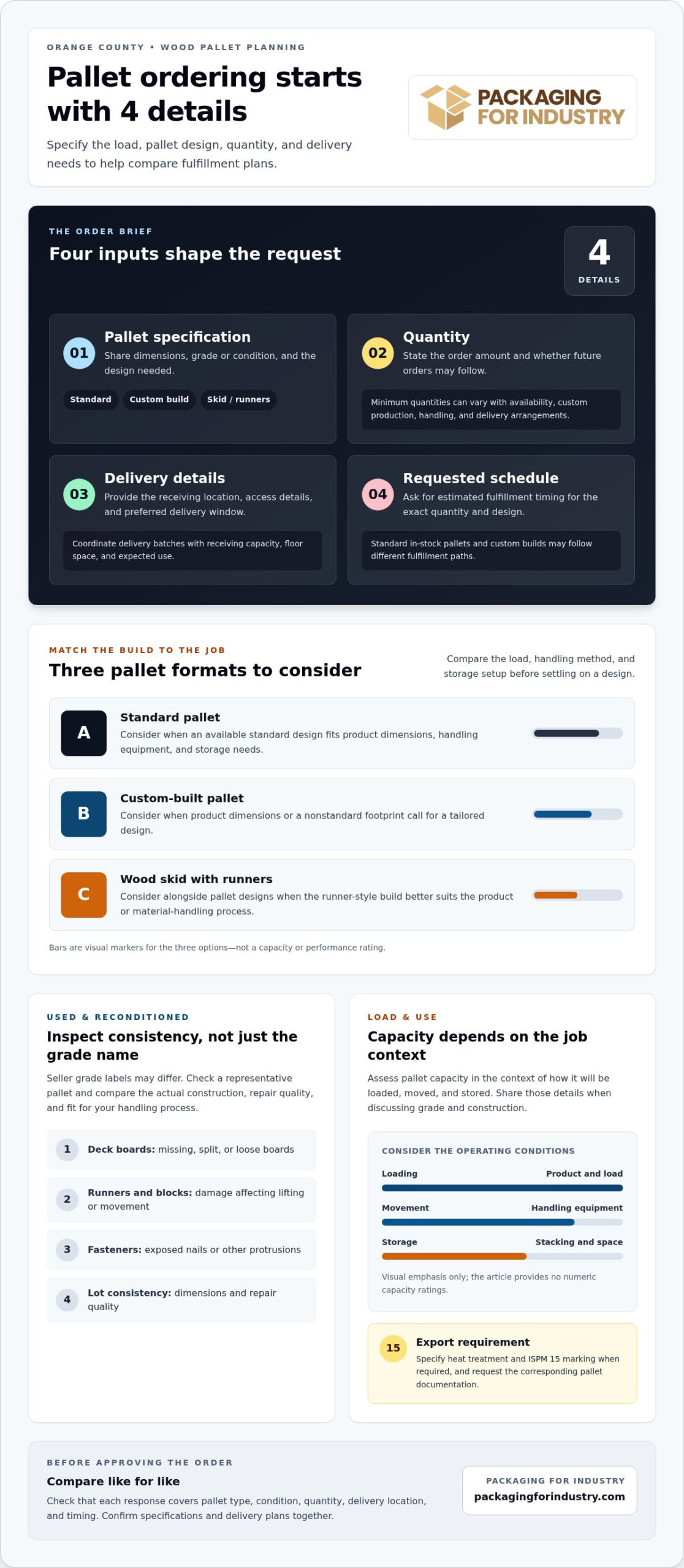
- Describe the pallet. Provide dimensions, grade or condition, and whether you need a standard design, a custom build, or skids.
- State the quantity. Include the order amount and whether future orders may follow. This helps suppliers assess the right production or inventory path.
- Explain delivery needs. Give the Orange County receiving location, access details, and preferred delivery window.
- Request the schedule. Ask for the estimated fulfillment timing for the specified quantity and design before placing the order.
Minimum quantities vary. Sellers may set them based on availability, custom production, handling, or delivery arrangements. A request for a standard design may differ from one for a manufacturer’s nonstandard footprint. Ask whether a smaller initial order and later replenishment can use the same specifications. This helps purchasing compare the overall supply need, not just a single shipment.
For online ordering, prepare the same details before submitting a form or email request. Use the pallet requirements as a starting point, then specify the dimensions, grade, quantity, and delivery location in your inquiry. If a measurement is unavailable, identify the product or load and describe how it moves through your facility. Clear information reduces avoidable clarification steps.
Bulk orders can support planned replenishment, but volume alone doesn’t determine the schedule. A large quantity of a standard pallet may be handled differently from the same quantity of custom pallets. Coordinate delivery batches with receiving capacity, floor space, and expected use. For example, a distribution center with limited staging room may prefer scheduled releases over one large delivery. Confirm the specifications and delivery plan together.
Before approving an order, compare responses based on the same request details. Check that each covers pallet type, condition, quantity, delivery location, and timing. If requirements change after submission, such as a revised footprint or increased order volume, communicate the change promptly because it can affect fulfillment planning. A complete request gives Orange County buyers a sound basis for comparing lead times and minimum quantities.
Pallet grades and reconditioned pallets
Yes, Orange County buyers can source heat-treated pallets marked for ISPM 15 use. Specify the requirement when ordering and request the corresponding pallet documentation.
Grade describes a pallet’s condition and intended use, but sellers may use labels differently. Compare the actual construction, repair quality, and fit for your handling process instead of relying on a grade name alone.
Used Pallet Grades and Pricing
Used-pallet grades help describe condition, appearance, and expected service needs. A higher-grade used pallet generally has fewer visible repairs, while a lower-grade option may show more wear. Ask what each seller’s grade includes, since labels can represent different standards. Inspect a representative pallet before committing to a larger order.
Pricing depends on condition, dimensions, construction, availability, and order volume. Compare quotes for matching specifications, including whether delivery is included. A lower-priced pallet may need more frequent replacement if it doesn’t suit the load or handling equipment. For a fair comparison, match condition and intended use before weighing the quoted price.
Reconditioned Pallet Options
Reconditioned pallets are used pallets repaired for continued service. Repairs may address damaged boards or runners, but the result depends on the pallet’s original condition and the repair work. Ask how the seller defines reconditioned and whether the delivered lot will meet a consistent specification. Warehouses using automated equipment should pay close attention to dimensions and structural consistency.
Before ordering, inspect sample pallets for loose boards, protruding fasteners, split components, and uneven contact points. Check that repaired areas support the load and suit your handling method. A pallet that looks serviceable may still cause problems if it shifts during stacking or doesn’t fit the equipment.
Use these checks to compare a used or reconditioned lot:
- Deck boards: Look for missing, split, or loose boards that could affect product support.
- Runners and blocks: Check for damage that could interfere with lifting or movement.
- Fasteners: Watch for exposed nails or other protrusions that could snag goods or equipment.
- Consistency: Compare pallets across the lot for matching dimensions and repair quality.
Match the grade to the job. A pallet for a stable, light product may not suit a dense load, repeated handling, or warehouse stacking. Share how pallets will be loaded, moved, and stored so sellers can quote a relevant grade. For export shipments, state the heat-treatment and ISPM 15 marking requirement before order approval; don’t assume a general grade includes it.
For recurring purchases, document the accepted condition with photos or a written specification. This gives purchasing and receiving teams a shared reference when later lots arrive. If you’re comparing options for an Orange County operation, request a pallet quote using the same grade, dimensions, quantity, and delivery details for each comparison.
Pallet sizes and custom-built pallets
Yes. Orange County pallet suppliers can quote custom sizes and repair existing pallets. Specify whether you need a new design or repairs when requesting a quote.
A custom pallet should suit the product, facility equipment, and shipping plan as a system. Start by measuring the product footprint and noting how it sits on the pallet. Then record forklift or pallet-jack entry direction, storage method, and access limits. A pallet designed around one dimension alone can still create handling problems.
For example, a manufacturer shipping a long component should provide its length, support points, and loading direction. A warehouse moving palletized goods through racking should explain how the pallet enters and sits in the system. These details help determine deck-board placement, runner orientation, and usable clearance. They can also prevent a custom footprint from interfering with receiving or storage.
Include these details in a custom-size request:
- Product footprint: Provide the length and width, plus any overhang that the pallet must accommodate.
- Load placement: Explain whether the product sits centrally, spans the deck, or rests on defined support points.
- Handling: Identify the equipment and entry direction used to lift the pallet.
- Use conditions: Describe stacking, storage, and shipping needs that influence the build.
Design details matter as much as outside dimensions. Deck boards determine where the product receives support, while runners or stringers affect how lifting equipment enters. A skid-style build may suit a load that needs a particular runner arrangement. Share drawings or photographs when they clarify a shape that measurements alone can’t convey. Mark required dimensions on drawings to reduce interpretation errors.
Repairs require a different assessment. Identify the damaged area, such as a cracked deck board, loose fastener, or compromised runner. Describe the pallet’s current use and whether it must return to the same equipment or storage process. Distinguish reusable pallets from units with damage that prevents safe, stable handling. Keep repaired pallets separate from uninspected stock until receiving staff review them.
Before approving a custom order, compare the drawing or written specification with the physical product and handling route. Confirm dimensions, board placement, runner direction, and repair scope in the same review. If the pallet supports a recurring shipment, retain the approved drawing for repeat orders. This gives purchasing and operations teams a consistent reference when specifications or suppliers change.
For a tailored design, request a pallet quote with measurements, handling details, and any repair requirements. A complete description helps suppliers evaluate the build against the actual job, rather than treating every load as a standard pallet.
Pallet sizes and load capacity
A pallet’s dimensions and load capacity work together. A load may fit on the deck yet need more support than its construction provides. Match pallet specifications to the product, handling equipment, and storage conditions. For example, a compact machine part may need a different support pattern from a broad load with uneven weight distribution.
“Capacity” depends on how the pallet carries weight. A stationary pallet on a level floor faces different conditions from one moving on a forklift or resting in warehouse racking. These ratings aren’t interchangeable. Ask sellers to identify the applicable capacity for your operation instead of relying on one general load figure.
- Static use: Consider the loaded pallet while it remains stationary on a supporting surface.
- Moving use: Account for the load during forklift or pallet-jack handling.
- Racked storage: Describe how the pallet is supported in the rack and where the load rests.
Load distribution matters as much as total weight. A dense component placed near the center creates different demands from several items spread evenly across the deck. Overhang can also affect support. Describe the product’s footprint, weight distribution, and placement pattern so the pallet design can be assessed against actual use.
Dimensions should account for the full handling path. Measure the product base, then compare it with conveyor widths, rack openings, forklift entry, and staging space. A pallet that fits the product but obstructs a conveyor can slow warehouse flow. Likewise, a design that enters a rack incorrectly can leave its intended support points misaligned. For teams examining how pallet sizes integrate with warehouse infrastructure, resources from industrial storage providers like colbydandenong.com.au offer useful perspectives on planning rack and shelving layouts.
Before ordering, gather these details for the supplier:
- Product information: Record the footprint and explain whether the load is centered or uneven.
- Handling method: Identify the equipment and approach direction used at receiving and shipping.
- Storage conditions: State whether pallets sit on floors, stack, or rest in warehouse racks.
- Load changes: Explain whether the same pallet carries different products or configurations.
Use the same operating details when comparing pallet proposals. If one quote describes a pallet for floor storage and another assumes rack support, their capacity figures aren’t directly comparable. Ask about the load conditions behind each rating, and keep those specifications with the purchase record. This helps warehouse and purchasing teams order pallets for the actual job, not just the product’s outside dimensions.
What pallet sizes and grades are available from Orange County sellers?
Orange County sellers may offer standard footprints, custom dimensions, and pallets in different conditions. Availability and grade labels vary, so compare exact specifications rather than relying on a label alone. When comparing wood pallets for sale in Orange County, include dimensions, condition, intended use, and quantity in each inquiry.
Standard sizes suit common warehouse and shipping workflows, while custom footprints can accommodate products or equipment that don’t fit those formats. Sellers may offer new, used, or reconditioned options. The right match depends on the product base, how forklifts or pallet jacks approach it, and whether the pallets enter racks or conveyors.
Before comparing seller listings, record these details:
- Footprint: Measure the length and width needed for the product and handling route.
- Construction: Identify whether the load requires a conventional pallet or a skid-style design.
- Condition: Separate new pallets from used or reconditioned stock in your request.
- Use: Describe floor storage, racking, shipping, or repeated warehouse handling.
Grade names need closer examination. One seller’s “A grade” may not describe the same condition as another seller’s label. Ask for the grade criteria and inspect a sample or representative photographs. Look for missing or split boards, loose components, protruding fasteners, and repairs that affect stable support. For example, a pallet used for routine warehouse transfers may tolerate cosmetic wear, while a customer-facing shipment may call for a cleaner appearance.
Used and reconditioned pallets can differ in repair history and consistency. Ask whether the lot meets a single size and condition specification. Mixed dimensions can disrupt stacking, racking, or automated handling, even when each pallet appears usable on its own. The receiving team can compare a delivered sample with the agreed specification before the full lot enters inventory.
Custom sizes are useful when a product overhangs a standard deck or needs specific support points. Share a drawing, product measurements, and equipment-entry direction with the seller. For example, a long component may need support along its length, while a compact part may need a smaller footprint. Custom design should account for the load and handling process, not just product dimensions.
Compare quotes using identical dimensions, condition, construction, and delivery requirements. When sourcing wood pallets for sale in Orange County, clarify whether each quote covers used stock, reconditioned pallets, or a custom build. Record the approved specification for repeat orders so purchasing and receiving teams can assess future deliveries consistently. To discuss pallet requirements, request a pallet quote.
Packaging For Industry (PFI): Foam Packaging
Packaging For Industry (PFI) helps Orange County businesses protect products shipped on wood pallets with foam packaging and stretch film. Foam can cushion vulnerable items inside their packaging, while stretch film helps secure unit loads for handling and shipment. These materials complement a pallet selected for the load and warehouse process.
For recurring packaging needs, PFI also offers Vendor Managed Inventory (VMI) and Just-In-Time (JIT) inventory management. These services can help businesses coordinate packaging supply with ongoing operations. Share your product-protection needs and purchasing requirements to discuss a practical packaging approach.
Contact Packaging For Industry
Make Your Next Pallet Order Easier to Repeat
For teams sourcing wood pallets for sale in Orange County, the next step is to make a one-time purchase part of a repeatable procurement process. Assign someone to maintain approved specifications and record feedback from receiving, shipping, and warehouse teams. That record helps purchasing respond to operational needs without rebuilding requirements for every order.
Use the next replenishment cycle to identify what should stay consistent and what needs adjustment. Changes in product mix, handling routes, or storage practices can affect pallet requirements over time. Sharing those changes with your packaging partner can help keep the supply plan aligned with current operations.
Packaging For Industry can discuss packaging needs for your palletized shipments. Start with your operational priorities and the packaging challenges you want to address.
A clear purchasing process gives your team a practical foundation for dependable supply. Move forward with a specification your operation can use and maintain.
Frequently Asked Questions
What are typical prices for new and used wood pallets in Orange County?
There isn’t one typical price for new and used pallets in Orange County. Pricing depends on dimensions, construction, condition, order quantity, and delivery requirements. Used pallets can differ substantially by grade and repair history, so compare quotes with matching specifications. The price depends on the specific order and is provided after a quote request. Include your pallet requirements and delivery location to get a useful comparison.
Do local pallet companies offer bulk discounts or pallet delivery?
Ask sellers to quote bulk pricing and delivery terms for your order. Provide the quantity, pallet specifications, and Orange County delivery location so the quote reflects the actual shipment. Request separate details for pallet charges, delivery, and any minimum order requirement. For recurring purchases, describe your expected order pattern to give the seller context for quoting planned replenishment rather than a one-time load.
What should I check when buying used wood pallets for safety and quality?
Before loading, check that each pallet sits level and remains stable under gentle handling. Look for loose boards, exposed fasteners, cracked components, and repairs that leave uneven support. Separate damaged pallets from usable stock so they don’t enter shipping or production by mistake. During receiving, compare the delivered lot with the agreed condition and dimensions, and document any mismatches with clear photos for purchasing records.