
More corrugated boxes on hand do not always mean a more reliable operation. Just-in-time corrugated box delivery in San Diego coordinates deliveries with manufacturing or distribution schedules, helping businesses reduce excess inventory and the space it occupies. The goal is to match box supply more closely to operational demand, not simply to keep fewer boxes in storage.
Packaging should be available when orders are moving, without taking up warehouse space before it is needed. This article explains how just-in-time delivery works, how inventory management coordinates supply with demand, and what to consider when matching corrugated boxes to your operation. Scheduled deliveries can support production and fulfillment while limiting unnecessary storage and handling.
Key Takeaways
- Coordinate box deliveries with production and shipping schedules to keep packaging available without crowding warehouse space.
- Use inventory tracking and demand patterns to set replenishment points that reflect actual packaging consumption.
- Account for box dimensions, construction, and product protection needs when planning corrugated supply.
- Clarify how order quantities and lead times fit your forecast before setting a local replenishment schedule.
- Consider just-in-time inventory management or vendor managed inventory when you need a more coordinated packaging supply plan.
Corrugated products and just-in-time delivery
Just-in-time delivery aligns corrugated box arrivals with manufacturing or distribution needs. For San Diego businesses, coordinating supply with operations can reduce excess packaging inventory and the space it occupies. Both box specifications and delivery timing matter: the schedule must support the work that uses each box.
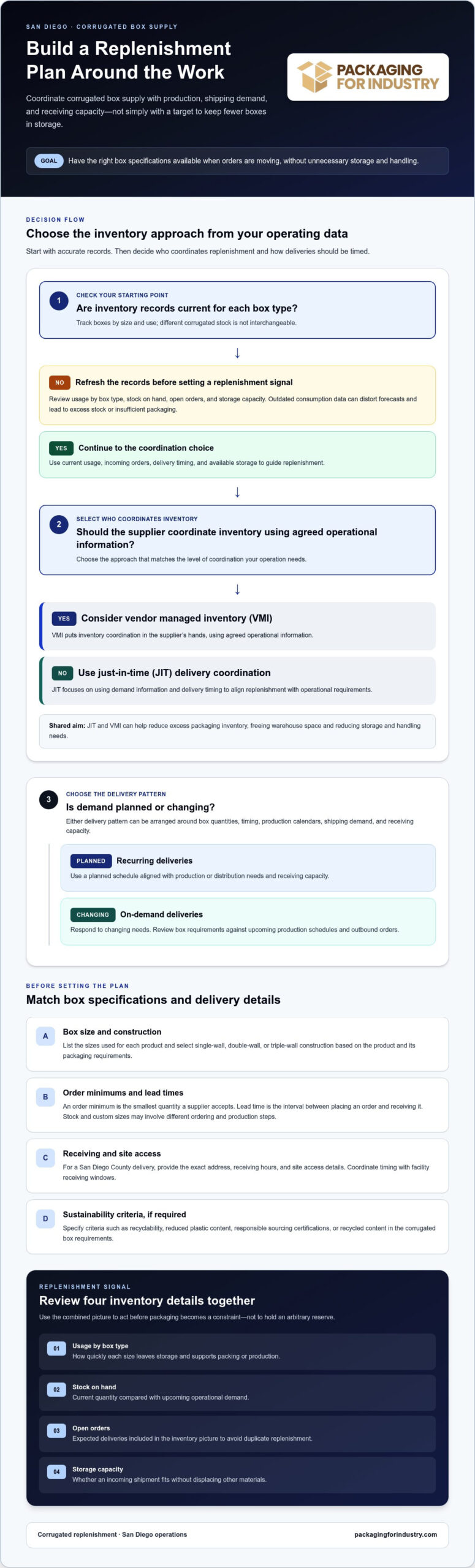
Corrugated boxes come in single-wall, double-wall, and triple-wall constructions. Choose a construction based on the product and its packaging requirements. A business shipping different products, for example, may need several box sizes or constructions. Track requirements by box type to keep packaging plans tied to actual use.
Order Minimums and Delivery Lead Times
An order minimum is the smallest quantity a supplier accepts, while lead time is the interval between placing an order and receiving it. Both affect how much stock a San Diego facility needs to keep on hand. Stock and custom sizes may involve different ordering and production steps. Plan replenishment around box specifications, expected usage, and available storage.
Delivery Areas and Service Limits
Delivery areas define the locations a supplier serves, while service limits describe conditions that affect delivery to a facility. When arranging a shipment in San Diego County, provide the exact address, receiving hours, and site access details. For example, a distribution center with set receiving windows needs delivery timing coordinated with those hours.
Recurring and On-Demand Deliveries
Recurring deliveries follow a planned schedule; on-demand deliveries respond to changing needs. Businesses can arrange either by matching box quantities and timing to production calendars, shipping demand, and receiving capacity. To set up just-in-time box deliveries, share these operational requirements and establish a replenishment plan based on actual usage.
Demand can shift when production schedules or outbound orders change. Review box requirements against upcoming work to adjust deliveries and keep packaging aligned with operations. A distributor facing a different order mix, for example, can reassess which box sizes its shipments will require.
For sustainability planning, include relevant criteria in the corrugated box request. San Diego buyers can consider recyclability, reduced plastic content, and responsible sourcing certifications when defining packaging requirements. Specify recycled content or other sustainability attributes in the quote request rather than assuming every supplier offers the same options.
A manufacturer can list the box sizes used for each product, the required construction, and expected production needs. This gives purchasing a clearer basis for coordinating corrugated supply with operations. A distribution center can similarly map box requirements to planned outbound orders and its receiving process.
Inventory management
Packaging inventory management balances box availability against the space and handling needed to store it. For a San Diego operation, excess corrugated stock can occupy warehouse capacity, while low stock can disrupt packing or production. A useful plan connects inventory records to actual usage, replenishment timing, and receiving capacity.
Track box inventory by size and use instead of treating all corrugated stock as interchangeable. A distribution center shipping several product formats, for example, needs to track each box type separately. Usage records reveal which sizes move steadily and which sit on shelves. This helps purchasing teams limit excess stock without overlooking boxes needed for specific orders.
Set useful replenishment signals
A replenishment signal shows when inventory needs attention. Teams can base it on observed consumption, incoming orders, supplier delivery timing, and available storage. If a production schedule changes, compare projected box use with stock on hand and adjust the next order. The aim is to act before packaging becomes a constraint, not to hold an arbitrary reserve.
Review these inventory details together:
- Usage by box type: Track how quickly each size leaves storage and supports packing or production.
- Stock on hand: Compare the current quantity with upcoming operational demand.
- Open orders: Include expected deliveries in the inventory picture to avoid duplicate replenishment.
- Storage capacity: Consider whether an incoming shipment fits without displacing other materials.
Electronic data interchange, or EDI, can help businesses share inventory and delivery information with packaging suppliers. When records and demand updates move between operations and suppliers, teams can coordinate replenishment with less manual back-and-forth. An updated order forecast, for example, can inform packaging needs before a scheduled production run increases box consumption.
Just-in-time inventory management uses demand information and delivery coordination to align replenishment with need. Real-time data analytics can support demand forecasting and shipping schedules, while EDI can transmit relevant information. These tools are most useful when inventory records reflect current activity. Outdated consumption data can distort forecasts, leading to excess stock or insufficient packaging.
Vendor managed inventory (VMI) puts inventory coordination in the supplier’s hands, using agreed operational information. JIT management focuses on timing deliveries to match requirements. Both approaches can reduce excess packaging inventory, freeing warehouse space and reducing storage and handling needs. Less excess stock also means less risk of packaging damage or expiration in storage.
To assess which approach fits, map box consumption, replenishment records, and storage constraints. A packaging quote request can start a discussion about inventory coordination and delivery needs.
What are minimum order quantities and lead times for local box deliveries?
A minimum order quantity is the smallest amount a supplier accepts for a particular box order. Lead time is the interval from order placement to delivery. For a San Diego buyer, both affect how much corrugated inventory to hold and when to reorder. The exact quantity and timing depend on the box specification and order conditions.
What shapes the minimum order quantity?
Stock boxes and custom corrugated boxes may have different order requirements. A stock size may already be held in inventory, while a custom box may require a production run based on its dimensions and construction. If your business needs a less common size, plan around the production requirements rather than assuming it can be ordered like a standard box.
Order quantity affects both storage and replenishment. A large order can reduce how often purchasing needs to reorder, but it may take up valuable warehouse space. A smaller order limits stored inventory, but frequent replenishment can add pressure to purchasing schedules. Compare usage for each box type with available storage before choosing a quantity.
What affects lead time?
Delivery timing depends on whether the required box is in stock or needs to be produced. Custom dimensions, board construction, printing, and order volume can add planning or production steps. Local transit is only one part of the timeline: order processing, production scheduling, dispatch, and receiving requirements also affect when boxes arrive.
A San Diego warehouse ordering an existing box size, for instance, has different needs from a manufacturer requesting a new design. The manufacturer may need to finalize dimensions and packaging requirements before production starts. Clear specifications help prevent revisions from disrupting the order schedule.
Plan replenishment around actual use
Use a simple sequence to make order timing more predictable:
- Record box sizes, specifications, and usage by product or operation.
- Compare remaining stock with upcoming production or shipping demand.
- Include supplier processing and delivery timing in the reorder decision.
- Review the schedule when order volume, box design, or receiving conditions change.
A distributor preparing shipments for several product formats should track each box size separately. One size may be consumed quickly, while another moves slowly. Grouping them under a single estimate can leave excess stock of one type and cause shortages of another.
For just-in-time planning, match order quantity to consumption, storage limits, and replenishment timing. Request a corrugated box quote that includes dimensions, construction, quantity, and delivery location. These details help shape an order plan around your operation’s actual packaging needs.
Do San Diego suppliers offer same-day or next-day corrugated box delivery?
Same-day and next-day corrugated delivery depends on supplier inventory, order details, and delivery scheduling. A standard box already in stock differs from a custom size that needs production. San Diego businesses should match the requested delivery window to the box specification and the urgency of the operation.
Same-day delivery takes more than a nearby warehouse. The supplier needs the correct box quantity ready for dispatch, and the order must fit the available delivery schedule. A business needing a standard box for an unexpected shipment has a different request from one ordering a new design, construction, or printed box.
Next-day delivery can be a practical replenishment option when the box is available and the delivery route serves the destination. A San Diego warehouse with a predictable shipping schedule can plan around expected arrivals. If a facility faces an urgent shortage, provide the exact size, quantity, and receiving address promptly so the delivery request can be assessed.
What affects urgent box delivery?
Four details shape whether an expedited delivery can meet the operation’s needs:
- Box availability: Stock dimensions can be ready sooner than boxes requiring custom production.
- Order completeness: Exact dimensions, construction, quantity, and any printing requirements help prevent delays caused by revisions.
- Destination: The delivery address, access conditions, and receiving hours affect routing and unloading.
- Order timing: A request made before dispatch planning differs from one made after vehicles are already scheduled.
A San Diego fulfillment center facing a surge in outbound orders, for example, may need stock boxes replenished quickly. Identify which sizes are running low and whether substitute dimensions will fit the products. A manufacturer needing a specific custom box should account for production time, not treat transit as the only part of the lead time.
Urgent delivery works best as a recovery option, not as the foundation of inventory planning. A replenishment schedule tied to usage helps prevent one late order from interrupting packing. Keep box specifications, recent consumption, current stock, and upcoming demand on record. These details help distinguish a genuine emergency from a planned restock.
For a San Diego order, provide the required arrival date, box specifications, quantity, and site receiving constraints together. If the preferred size is unavailable, ask which available options will fit the shipment. This keeps decisions focused on product protection and operational needs, not speed alone. Base routine replenishment on forecast demand and reserve urgent delivery for genuine schedule changes.
Consider whether an alternative can meet the need without changing product fit or protection, and confirm that dispatch and receiving can align with the requested arrival window. If no suitable stock box is ready, clarify whether a later delivery or a substitute specification will work before relying on expedited service.
Just-in-time shipping coordinates supplier deliveries so goods arrive at a manufacturing or distribution center when needed, reducing the need for large inventories and storage. For corrugated replenishment, this can align orders with expected use and receiving capacity. Keep specifications and stock information ready so suppliers can assess whether a delivery fits the operation’s schedule.
What delivery areas and service limits apply around San Diego County?
Delivery coverage around San Diego County depends on the supplier’s route, shipment requirements, and delivery address. When planning corrugated box replenishment for a facility in San Diego, Chula Vista, or Oceanside, provide its exact location. Being in the county does not by itself establish a delivery schedule or service boundary.
Route planning affects how deliveries fit a just-in-time schedule. Suppliers may group stops by location, shipment size, and receiving availability. A warehouse in Escondido with a narrow receiving window, for example, has different coordination needs from a facility near central San Diego with flexible unloading access. Accurate address and receiving details help shape a practical delivery plan.
Site conditions that shape delivery
At a San Diego County facility, site access can affect how a box shipment reaches its destination. Share whether the site has a loading dock, restricted vehicle access, limited unloading space, or designated receiving hours. These details help coordinate delivery and avoid preventable delays on arrival.
Shipment size matters, too. A planned distribution center replenishment may require a different load and unloading process from a smaller restock for a production area. Describe the box quantity, packaging format, and receiving location. That information helps align transport and handling with the site.
Plan across multiple locations
Businesses with facilities in different parts of the county should map each delivery address separately. A company with sites in Carlsbad and Chula Vista, for example, can compare receiving hours, storage capacity, and packaging use at each location. One schedule may work for both, or separate replenishment plans may better match each facility’s demand.
For multi-site operations, keep a shared record of box specifications and usage by location. This makes it easier to distinguish routine replenishment from an urgent need at one warehouse. If a site changes its receiving schedule, update the delivery plan rather than assuming the previous arrangement still fits.
Service limits can also relate to order readiness, product availability, and delivery timing. Stock boxes and custom orders may follow different fulfillment paths, so plan for them separately. A custom box may need to be produced before dispatch, while a stocked item can follow the supplier’s established delivery process. Treating both alike can disrupt receiving plans.
To prepare a San Diego County delivery request, provide the full address, box specifications, quantity, preferred receiving window, and site access details. For multiple locations, list each destination and its requirements. This gives the supplier practical information to assess routing and coordinate corrugated delivery with facility operations.
Custom packaging boxes are designed around a product’s size, weight, fragility, and shipping environment. Provide those product and transit details when discussing a custom package, then confirm how the resulting specifications fit the delivery address and receiving process. This connects box design to handling needs, while route, shipment requirements, and site access remain part of delivery planning.
Packaging For Industry (PFI): Foam Packaging
Packaging For Industry (PFI) helps manufacturers and warehouses coordinate recurring packaging needs through Just-In-Time (JIT) Inventory Management and Vendor Managed Inventory (VMI) for Packaging. These programs can help align supply with operational use, supporting space planning and efforts to lower packaging costs.
Foam Packaging can protect medical devices, electronics, and industrial components, while Stretch Film helps secure shipments. Matching materials to product and handling requirements helps purchasing teams weigh packaging costs against operational needs. For repeat orders, discuss bulk pricing and local delivery as part of a broader supply plan.
PFI supports industrial teams coordinating packaging supply and product protection. Contact Packaging For Industry to discuss a JIT delivery and inventory plan for your corrugated boxes in San Diego.
Build a Packaging Plan Around Your Next Production Cycle
Use your next planning cycle to connect packaging needs with purchasing priorities. Identify upcoming product or order changes, then review whether current box specifications still fit. This gives your team a practical basis for refining just-in-time corrugated box delivery in San Diego without relying on assumptions about future demand.
Prepare the information that will shape the discussion: packaging specifications, expected usage, delivery locations, and operational priorities. A clear request helps focus the conversation on a supply approach that fits your workflow.
A clear plan helps your team make its next packaging decision with confidence.
Frequently Asked Questions
What are the Benefits of JIT Shipping?
JIT shipping can align incoming packaging with production and fulfillment needs, helping operations respond without holding excess boxes. A San Diego distributor preparing for a customer order surge, for example, can coordinate box arrivals with the planned shipping workload. This can reduce time spent moving packaging between storage and work areas while helping orders keep moving. The approach works best when delivery timing reflects actual demand.
What inventory forecasting and storage practices help prevent box stockouts?
Forecast box needs using planned orders, production schedules, and packaging consumed per finished product. Review those inputs when the product mix changes or a new order arrives. In storage, label box locations clearly and separate sizes to improve stock checks. Record damaged or unusable cartons separately from available inventory. Regular counts can reveal gaps between system records and physical stock before they affect packing or shipping.