
For San Diego, count only metro listings that explicitly identify industrial crate building as a company capability. General packaging and freight listings are not equivalent to crate-builder records. This article compares listings across U.S. metros and explains how to assess local results without treating every packaging-related company as a builder.
A directory count is a starting point for supplier research, not a substitute for confirming a company’s stated capabilities. Use listings to identify potential builders, then compare their described services with your shipment requirements. The sections below cover custom-sized and heavy-duty crate needs, on-site crating considerations, and how to assess materials, services, and customer reviews. This helps purchasing and operations teams turn a San Diego search into a focused shortlist.
Key Takeaways
- Use metro listings as a starting point, then narrow your search by the crate requirements and services your operation needs.
- Compare builders by how they handle custom dimensions, load requirements, materials, and protection needs.
- Assess whether on-site crating and packaging fit your shipment’s size, handling process, and facility workflow.
- Look beyond reviews by comparing service scope and material options against your shipping and purchasing priorities.
- For shipments that need added product cushioning, consider how foam packaging can support protection within your packaging plan.
Which companies build industrial crates in San Diego, California?
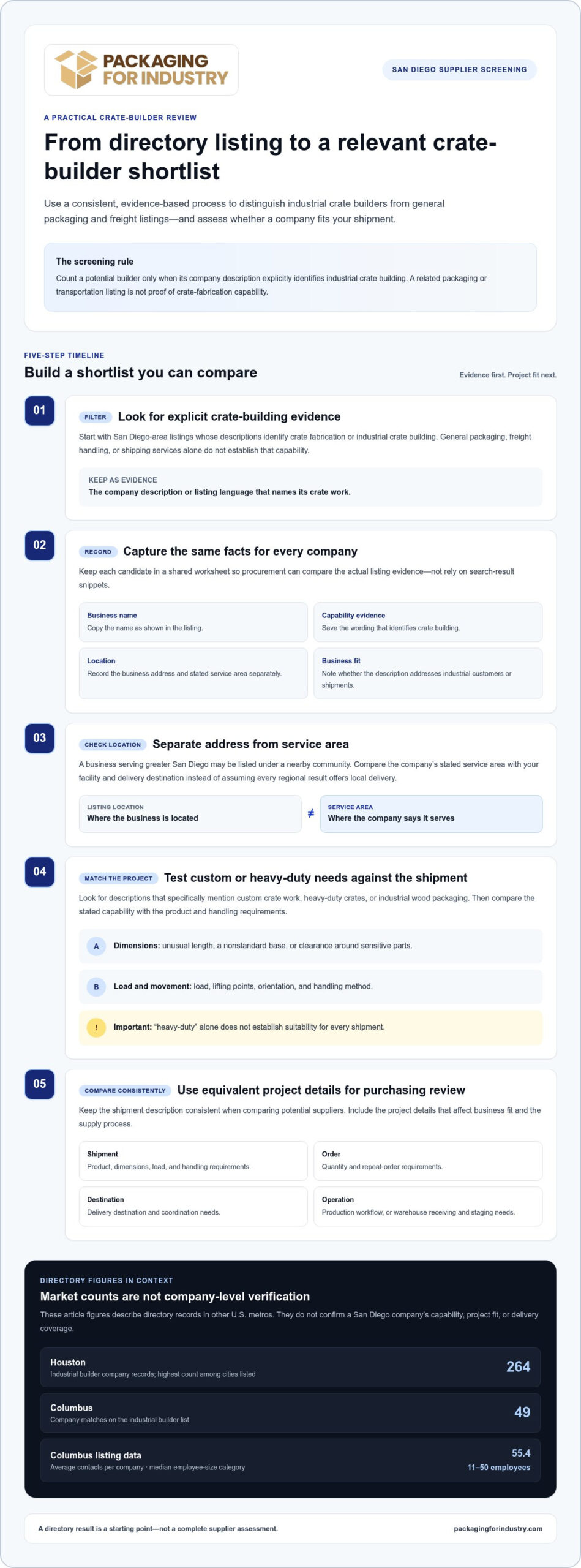
For an industrial crate search in San Diego, focus on businesses whose descriptions explicitly identify crate fabrication. A packaging distributor, freight handler, or shipping company may appear in related searches, but those categories alone do not establish crate-building capability. Start a shortlist with named businesses and save the listing or company description that identifies their crate work. This separates potential builders from companies focused on adjacent packaging or transportation tasks.
Check the location attached to each listing. A business serving the greater San Diego area may appear under a nearby community rather than the city itself. Record the stated service area separately from the business address, then compare both with your facility and delivery destination. This helps San Diego manufacturers, warehouses, and distribution centers judge whether a listing is operationally relevant, rather than assuming every regional result offers local delivery.
Use a consistent record for each company so procurement can compare listings without relying on search-result snippets. Capture the business name, stated crate-building service, location, and source description. Note whether the listing mentions industrial customers or shipments. A profile describing crate fabrication for machinery, for example, is more relevant to a machinery shipment than a general page about packaging supplies.
Distinguish a metro search result from a verified company match. A “match” should mean your team reviewed a business record and found explicit crate-building language, not simply that a broad search returned it. Apply the same definition when comparing San Diego with other U.S. metros. Consistent criteria make the count useful for supplier research and keep unrelated packaging or logistics businesses from inflating your shortlist.
For a practical purchasing review, organize the information in a simple table or shared worksheet:
- Business name: copy the name as shown in the listing.
- Capability evidence: note the wording that identifies industrial crate building.
- Location: distinguish the company address from its stated service area.
- Business fit: record whether the description addresses manufacturers, warehouses, or distribution centers.
- Purchasing follow-up: prepare questions about quantities, delivery coordination, and repeat-order requirements.
That record helps buyers compare packaging quotes using equivalent project details rather than incomplete directory summaries. Describe the shipment, quantity, and delivery destination consistently when requesting a quote. For packaging used by manufacturers, note how the crate fits production and shipping workflows. For warehouses and distribution centers, include receiving and staging requirements. This lets purchasing teams assess both business fit and the supply process.
Use your San Diego shortlist to guide the next purchasing step. Local delivery needs, a bulk order, or recurring shipments may affect which listing deserves priority. Keep the evidence and project details together, then compare potential suppliers against the same operational requirements. A directory result is a starting point, not a complete supplier assessment.
Use the worksheet to compare suppliers on evidence and purchasing fit, then keep market-size figures separate from company-level verification. The Columbus industrial builder list has 49 company matches. It averages 55.4 contacts per company, and the median employee-size category for companies on the Columbus industrial builder list is 11-50 employees. These figures are reference points for understanding directory data, but do not establish that a San Diego result builds crates or serves your facility.
Houston has 264 industrial builder company records, the highest count among the U.S. cities listed. Keep this count distinct from a verified local supplier shortlist: city-level records do not show whether individual businesses offer the required fabrication, match a shipment’s specifications, or coordinate delivery to your site. For each San Diego candidate, use the company’s own description and confirm the capability and location with the business before treating it as a purchasing option. This keeps directory scale in perspective while preserving the evidence-based screening process already recorded in your worksheet.
Which San Diego crate builders make custom-sized or heavy-duty crates?
For a custom-sized or heavy-duty crate, distinguish documented fabrication capability from general packaging services. A San Diego company description should specify custom crate work, heavy-duty crates, or industrial wood packaging. A broad claim about packaging does not show whether a business can build around a product’s dimensions or load. Use the stated capability as your first filter, then compare it with your project.
Custom sizing matters when a product will not fit a standard crate layout. A long assembly, irregular machine component, or piece of equipment with projecting controls may need a crate designed around its shape. For each San Diego listing, look for language describing made-to-order crates or product-specific design. Compare that description with your requirements, such as unusual length, a nonstandard base, or clearance around sensitive parts.
“Heavy-duty” also needs to be considered in the context of the project. A crate for a dense machine part has different requirements from one protecting a large, lightweight assembly. Describe the load, lifting points, orientation, and handling method before deciding whether a builder’s stated work is relevant. The term “heavy-duty” alone does not establish suitability for every shipment. Match the stated capability to the load and movement conditions.
Evaluate each candidate using the same evidence and project details:
- Capability wording: identify an explicit reference to custom crate design, fabrication, or heavy-duty industrial crates.
- Product fit: compare stated examples with your equipment, such as a machine assembly or a long component.
- Design requirements: record unusual dimensions, sensitive surfaces, protrusions, and required access.
- Handling demands: describe how the crate will be lifted, staged, and loaded for shipment.
- Scope clarity: distinguish crate construction from internal supports or cushioning requirements.
For example, a San Diego manufacturer shipping a control cabinet can note its footprint, projecting connectors, and required loading orientation. Those details make the design brief more useful than simply requesting a “large crate.” A warehouse shipping a dense equipment base can document its support points and forklift approach. In both cases, the product brief helps determine whether a builder’s custom or heavy-duty capability addresses the actual packaging challenge.
Keep evidence separate from assumptions. Save the company description that states its crate capability, then record how your project aligns with it. If a listing mentions custom fabrication but not your particular load type, compare the design requirements rather than treating the label as a guarantee. This gives procurement a clear basis for discussing the project and helps operations explain why a standard crate may not suit the shipment.
Once you have a documented candidate and a concise specification, include both in your quote request. Provide dimensions, weight, handling points, destination, and unusual product features. A clear brief keeps the discussion focused on crate design and load protection instead of filling gaps in basic shipment information.
Do San Diego crate builders provide on-site crating and packaging
On-site crating is different from building a crate at a workshop and delivering it. A San Diego listing may establish that a company builds crates, but that alone does not show whether its team packs equipment at your facility. For a large machine that is difficult to move, the distinction affects loading, scheduling, and coordination with your warehouse team.
Check each company profile for explicit references to on-site crating, field packing, or on-location packaging. Treat “crate manufacturing” and “on-site service” as separate capabilities. A builder might design a crate at its shop while your staff loads the item at your dock; another business might describe packing equipment at a customer’s plant. The specific service description helps you compare relevant options.
Before reviewing providers, map the shipment process at your facility. Identify where the product sits, how it can be moved, and whether the work area has room for packing. A production line with restricted access presents a different job from a warehouse staging area with forklift access. Include the pickup point, loading sequence, and destination in your notes so each company receives the same practical description.
Use this checklist to distinguish on-site requirements from standard crate fabrication:
- Location: state whether the item must be packed at a production floor, warehouse, or loading dock.
- Movement: describe whether a forklift, pallet jack, or other equipment can reach the product.
- Item condition: note if the product is assembled, delicate, unusually shaped, or difficult to reposition.
- Work access: identify space limits, operating equipment, or shipping deadlines that affect the packing sequence.
- Scope: distinguish crate construction from packing, blocking, bracing, and securing the product.
These details help clarify why on-site work matters. Consider an industrial pump already installed on a skid. Moving it across a facility before crating adds handling steps, while packing it in place may better fit the workflow. By contrast, a small component that can be moved safely may be easier to protect after transport to a dedicated packing area. The product and facility layout shape the decision.
For San Diego companies, compare published service descriptions with your actual site conditions rather than assuming every crate builder offers field work. A profile that mentions crate design may not describe packing at a customer’s location. Record what each listing says and match it with your requirements. This keeps comparisons specific and prevents a general packaging description from being mistaken for an on-site commitment.
Prepare a concise project brief before making a shortlist. Include product dimensions, weight, location inside the facility, handling equipment, and intended shipping method. Add a simple sequence, such as “pack beside the assembly line, move to the dock, then load for freight.” This gives a company a clear picture of the work and distinguishes an on-site packaging request from a request for a crate alone.
How do San Diego industrial crate builders compare on materials, services, and reviews?
Compare San Diego listings across three separate factors: crate materials, service scope, and customer feedback. A company description mentioning wood crates does not explain its design options or packing services. Likewise, a positive review does not establish that the business handles your product type. Keep each factor distinct in a comparison sheet and relate it to the shipment you need to protect.
For materials, record what each builder says it uses and how those materials suit the load. Lumber, plywood, and internal blocking serve different design roles, while cushioning can protect a product from contact with crate walls. A machine base, for example, may need stable support, while a finished surface may need separation from hard crate components. Compare stated materials with the product’s weight, shape, and contact points, not just a general claim of durability.
Read service descriptions just as carefully. Separate crate design and fabrication from packing, on-site work, assembly, and shipment preparation. A listing may discuss custom crate construction without describing the handling steps around it. If a shipment must be packed at a warehouse dock, that distinction affects coordination. Record each service mentioned and how it relates to your shipping workflow.
- Materials: note named materials, internal supports, and cushioning described for the crate.
- Design scope: distinguish standard crate work from custom dimensions or product-specific layouts.
- Packaging work: record whether the description covers packing or only crate fabrication.
- Location: separate facility-based work from services described at a customer site.
- Reviews: look for comments about projects resembling your shipment and the service being compared.
Treat reviews as project evidence, not as a substitute for capability details. A comment about careful handling may be relevant to a delicate assembly; feedback about communication may matter when production and shipping schedules must align. Check whether the reviewer describes a specific service or product. General praise provides context, but it does not show whether the company built a custom industrial crate or handled on-site packaging.
Apply the same review method to every San Diego listing. First, capture the company’s stated material and service details. Next, compare them with the product brief, including dimensions, weight, vulnerable surfaces, and loading method. Then look for reviews describing relevant projects. If a review concerns a different packaging service, keep it separate from your crate assessment. This prevents unrelated feedback from being treated as proof of crate-building experience.
For the final comparison, assess each candidate against the same requirements instead of relying on a single overall impression. A builder whose description matches your material and service needs may be a closer fit than one with broader but less relevant feedback. Keep notes specific: “plywood crate, internal blocking, dock-side packing” is more useful than “good packaging company.” Clear records support a focused purchasing discussion and a well-defined project scope.
Packaging For Industry (PFI): Foam Packaging
Packaging For Industry (PFI) offers foam packaging that can be considered alongside a crate to help cushion a product during shipment. Foam can separate delicate surfaces from crate walls or support components inside the package. The right approach depends on the product’s shape, contact points, and handling needs.
For shipments with multiple parts, custom packaging design can account for how components fit and stay organized. PFI also offers stretch film, Vendor Managed Inventory (VMI) for Packaging, and Just-In-Time (JIT) Inventory Management for Packaging to support related supply needs.
Share your product and packaging requirements with Packaging For Industry (PFI) to discuss a practical next step.
Move from supplier research to a packaging plan
For teams comparing industrial crate builders in San Diego, turn the shipment requirements into a coordinated packaging plan. Consider how the product will be cushioned inside its crate and stabilized during handling. Packaging For Industry (PFI) offers foam packaging and stretch film to support these related protection needs.
If packaging supply is a recurring purchasing challenge, Vendor Managed Inventory (VMI) for Packaging can also be part of the discussion. Share the product type, shipment workflow, and supply concerns when requesting a quote. This keeps the conversation practical, whether you are addressing one shipment or improving packaging supply across regular operations.
Bring your requirements together and take the next step toward a packaging approach that fits your operation.
A clear project brief helps make the conversation productive. You are ready to move forward.
Frequently Asked Questions
What information is needed to request a quote for an industrial crate in San Diego?
Provide the product’s dimensions, weight, and shape, and note any fragile or protruding parts. Include how it will be lifted, loaded, and shipped, the destination, and whether packing must take place at your facility. Photos or a simple drawing can clarify unusual features, such as exposed connectors or offset mounting points. Also state the quantity and whether the crate is for a one-time shipment or recurring orders.
What types of industrial crates do San Diego builders offer?
San Diego builders may offer custom-sized and heavy-duty industrial crates, including industrial wood packaging. Compare their stated capabilities with your product’s dimensions, load, and handling needs.